The IDF’s Manpower Directorate and Medical Corps have established initial absorption points where immediate medical care and personal support will be provided.
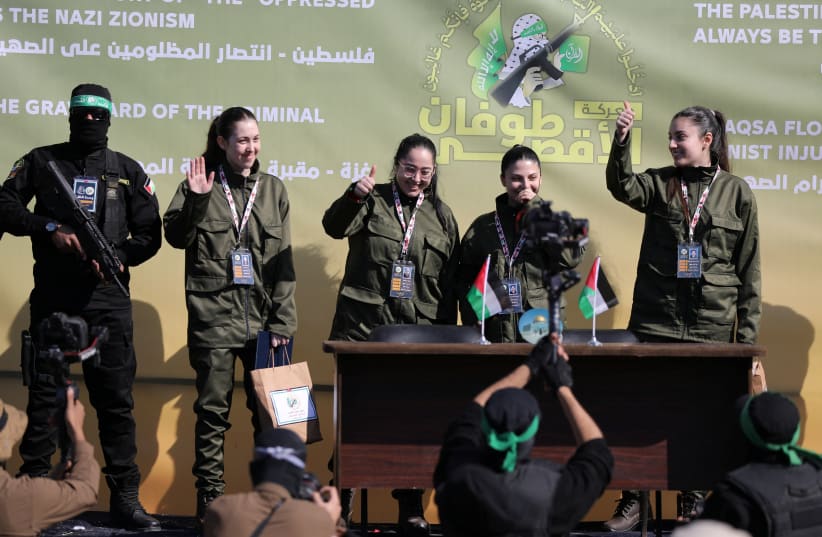
The four female IDF soldiers taken hostage by Hamas were transferred, in military uniform, to the Red Cross in Gaza City on Saturday.
The hostages were seen holding bags similar to the ones given to the three hostages released last week. Last week, the bag included Arabic language completion certificates and photos of the hostages’ time in captivity.
The Red Cross subsequently communicated to the IDF that the four hostages were transferred to them and were on their way toward IDF and Shin Bet (Israel Security Agency) forces in the Gaza Strip.
Ahead of the hostage transfer, Hamas and Palestinian Islamic Jihad terrorists, along with Gazan civilians, congregated in Palestine Square of Gaza City ahead of the planned release of Israeli hostages in the second week of the ceasefire.


The deal was threatened after Hamas violated the terms of the deal, according to Qatari-state-run media giant Al Jazeera, by failing to release a female civilian in this week’s release. In response, the IDF temporarily removed the names of some PIJ prisoners set to be released, although they later returned the names – going ahead with the deal.
Hamas reportedly confirmed that German-Israeli civilian hostage Arbel Yehoud is alive. Al Jazeera also reported that Agam Berger, another IDF soldier taken from the Nahal Oz base, is alive – although she was not released alongside her fellow soldiers on Saturday.
A banner reading “Zionism won’t win” in Hebrew featuring the logos of Mossad and Amman appeared on a live Al Jazeera stream among the Hamas and Palestinian flags being flown at the site.
The handover is imminent, with hundreds of terrorists occupying the square, according to Al Jazeera. The four hostages have reportedly yet to arrive. The Qatari state media source also said that there are more Hamas terrorists physically at the location of the hostage swap than the one on Sunday.
Noted by the Qatari media giant was the number of guns and vehicles, in addition to terrorists, at the dispense of the terror group – despite 15 months of war.
Israel estimates that preparations will begin in Gaza in the coming hours to return the hostages Daniella Gilboa, Karina Ariev, Liri Albag, and Naama Levy, Israeli public broadcaster KAN reported on Saturday morning, citing a security source.
After the hostages are released, Israel is expected to release some 200 security prisoners and withdraw from the Netzarim Corridor – an area which separates northern and southern Gaza.
Hamas said that 70 of the 200 Palestinian prisoners to be freed by Israel on Saturday would be deported outside of Gaza and the West Bank – being sent to countries like Turkey, Egypt, Qatar and Algeria.
A team from the International Committee of the Red Cross in Gaza were on the way on Saturday to collect Israeli hostages from Hamas, an official involved in the operation told Reuters.
According to reports, Red Cross vehicles have entered southern Gaza to retrieve the hostages. The hostages’ parents are waiting for them at the IDF base in Kibbutz Re’im, Israeli media reported.
Separately on Saturday morning, the IDF stated that it had completed preparations to return the hostages from the Gaza Strip to Israel. The Israeli military is preparing for the possibility that Hamas will try to create psychological terror during the release, Walla reported.
The IDF’s Manpower Directorate and Medical Corps have established initial absorption points where immediate medical care and personal support will be provided to the released hostages, the military noted.
After that, the former hostages will proceed to hospitals and reunite with their families.
Process in preparing to retrieve the hostages
IDF Col. (res.) Sharon Nakash, who is also the commanding officer in the Operation “Wings of Freedom,” the name of the initiative to return Israeli hostages from Hamas captivity, said, “Amid all of this, I can say that we are all excited.
“Reservists and regular soldiers feel they are doing the most important work. It is both a privilege and our moral duty to do this. I believe the preparations we have made so far will reflect our ability to carry out the mission properly and bring our songs and daughters back home in a proper and respectful way.”
This is a developing story.