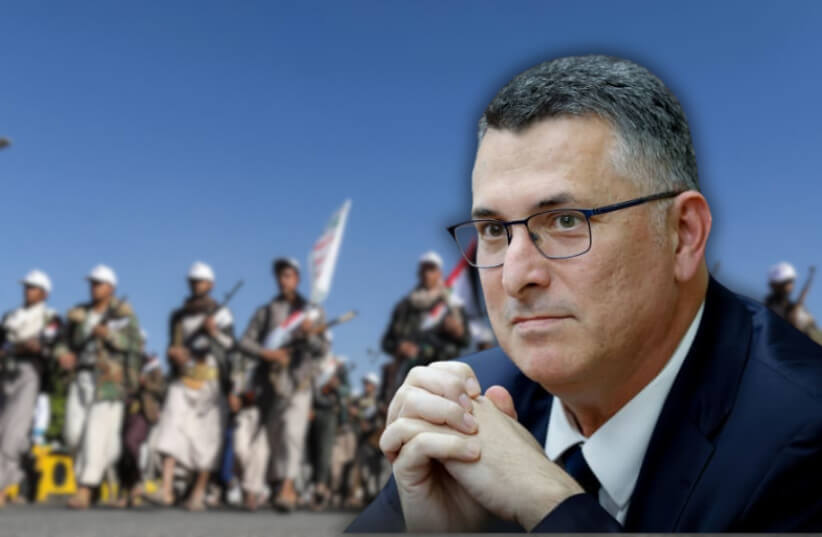
In an exclusive interview, Foreign Minister Gideon Sa’ar shared his vision, laying bare the challenges and opportunities ahead for Israel on the international stage.

He opened the drawers in the Jerusalem office of the foreign minister, which he had yet to get used to. Since he had only slept two hours the previous night, he asked his staff if they had chocolate or energy bars. In this exclusive interview, he assured the Magazine that since he has decades of experience as a politician, the fatigue won’t affect his ability to speak about all the threats and opportunities for Israel in the near future.
He is not one to shy away from the complex realities of diplomacy. He has tackled pressing issues with a pragmatic approach, ranging from Iran’s nuclear ambitions to regional instability in Syria, relations with the US, and delicate diplomatic ties with Europe. In a candid interview, Sa’ar shared his vision, laying bare the challenges and opportunities ahead for Israel on the international stage.
Trump’s second term, ‘an opportunity’
Sa’ar began by expressing optimism about Donald Trump’s upcoming presidency, highlighting the alignment between the two nations on key strategic issues. “First and foremost, there is a shared perspective on the Iranian issue, which has the potential to lead to strategic understandings at the highest level,” Sa’ar remarked.
He reflected on Trump’s first presidency as a period of significant breakthroughs for Israel, citing the Pompeo Doctrine on settlements, the recognition of Israeli sovereignty over the Golan Heights, and the relocation of the US Embassy to Jerusalem. “These were groundbreaking steps that were not standard policies, even by American terms,” he said.


Acknowledging that disagreements with Washington are inevitable, Sa’ar nonetheless emphasized the strategic importance of shared views. “When there’s no clear gap between us and America, Israel becomes diplomatically stronger,” he explained. This alignment, he added, serves as a deterrent to Israel’s adversaries, who often look for fissures between the two nations. “Our adversaries are always searching for rifts in the US-Israel relationship,” he stated.
While flexibility will be required to navigate differences, Sa’ar is confident that the foundation for collaboration is strong. “You can’t expect to always get exactly what you want, but flexibility is essential in diplomacy,” he said.
Israeli presence in Gaza
When asked if he assumes there will always be an Israeli military presence in Gaza, Sa’ar was unequivocal: “My working assumption is that in the foreseeable future, only we can ensure our security.” However, he clarified that this does not mean reestablishing Jewish settlement in Gaza. “Although I opposed the disengagement [from Gush Katif, the Israeli settlements in the Gaza Strip in 2005], the goals set by the cabinet do not include such plans,” he said.
Sa’ar expressed skepticism about the existence of an external force capable of effectively guaranteeing security in Gaza. “I doubt there will be an effective entity that can provide security in Gaza, which is why I believe Israel will need to remain the controlling force from the Mediterranean to the Jordan River, west of the river,” he stated.
He described Hamas’s rule in stark terms: “What has happened in Gaza is the creation of a foreign military force. This isn’t just a terror organization – it’s a terror state with a terror army. They control everything.”
He elaborated on the consequences of Hamas’s military buildup. “They’ve created an insane system of weaponry and underground tunnels, and in a short time you saw the consequences of having a foreign military force near civilian communities: 1,200 people killed in one day,” he said. Sa’ar made it clear that Israel would not allow the establishment of another foreign military force in Gaza, “Israel cannot allow the construction of another foreign military force west of the Jordan River,” he declared.
However, he expressed openness to exploring autonomous governance for civilian matters in Gaza. “We must create an autonomous entity to manage civilian affairs,” he said, paralleling past events. “Look at history: In 1994-95, we withdrew from cities under the Oslo Accords, and by 2000 the Second Intifada erupted. It took them just five years to manufacture explosives.”
Sa’ar emphasized the necessity for clear communication with international partners. “We need to approach the new administration [in the US] and present these realities in simple terms,” he explained. “It’s not that we refuse to consider models, but we cannot take unnecessary risks. On Oct. 7, we were fortunate that the attack didn’t occur on multiple fronts simultaneously.”
Hamas’s exploitation
Sa’ar was frank about the challenges surrounding humanitarian aid in Gaza, particularly Hamas’s exploitation of these resources. “This is a complicated issue. It’s being used as a weapon to attack Israel,” he said. “The bigger problem isn’t the humanitarian aid itself but the fact that Hamas takes over and loots the aid.”
He called for a reassessment of how aid is managed, though he remained realistic about the limitations. “Do I believe that aid will stop being appropriated by Hamas the day Trump takes office? No, I don’t think so,” he admitted.
Sa’ar also highlighted potential shifts in US policy under Trump, particularly concerning international legal bodies like the International Criminal Court (ICC), which has blamed Israel for a “genocide”: “We may see US legislation against the ICC. There could be a shift. The Americans say, ‘We’re next.’
“If international law becomes a tool, then they too are at risk,” he said, noting that both Israel and the US are not members of the court. He speculated that this shared vulnerability could prompt action. “I believe we’ll see action – maybe even sanctions against the court,” he added.
Regarding Iran, Sa’ar’s tone was unyielding. Still, he was also very conservative in his response, not getting into details of a reported possible third Israeli strike on Iran. “Iran must never possess nuclear weapons; this is a red line we cannot play with,” he declared, focusing on the existential threat a nuclear-armed Iran would pose to Israel and the region.
He stressed the importance of collaboration with the US in preventing Tehran from achieving its nuclear ambitions. However, he criticized the public discourse surrounding potential military action. “The entire public discussion about attacking Iran does not serve our interests. This is not something that should be handled in this manner,” he said.
According to Sa’ar, international awareness of Iran’s destabilizing activities has grown significantly in the past year. He attributed this shift to two factors: Iran’s collaboration with Russia in Ukraine, and its increasingly aggressive use of proxies in the Middle East.
“Iran’s partnership with Russia in Ukraine has significantly influenced global perceptions,” Sa’ar explained. “And their proxies have acted with unprecedented aggression, launching hundreds of missiles at Israel.”
Even in Europe, where skepticism about Iran’s threat had previously prevailed, there is now greater recognition of the danger. “Today, even the Europeans understand the issue,” he said.
When asked about Qatar as a mediator in the hostage deal, Sa’ar said that in his opinion, they are “a highly problematic player, deeply hostile toward Israel.”
“There could have been a debate about whether it was right to involve them in a mediating role, but we took the approach that anyone who can influence Hamas should be used for this purpose,” Sa’ar added. “However, it is important to understand that the distance between Hamas and Qatar is very small – they are not on opposite ends of the spectrum. This must be acknowledged, especially given Qatar’s alignment with Turkey and their shared ideology of the Muslim Brotherhood.
“This is something we need to monitor closely, as it has the potential to impact regional dynamics,” the minister explained.
Not falling for Syria’s facade
Few issues illustrate the complexity of Sa’ar’s foreign policy agenda as vividly as the situation in Syria, and it is probably the most important to him. Following the fall of Syrian president Bashar al-Assad and the Syrian Armed Forces, the country, Sa’ar said, is a fractured state plagued by competing factions and extremist ideologies.
“The reality in Syria hasn’t stabilized,” Sa’ar stated. “The regime in Damascus is essentially a gang – not a legitimate government. Other areas, like Idlib, are controlled by Islamist groups with extreme ideologies.”
Assad was a member of the Alawites, an Arab ethno-religious group primarily residing in the Levant. They adhere to Alawism, a religious sect that splintered from early Shi’ite Islam in the 9th century.
Among the most concerning figures in Syria, according to Sa’ar, is Abu Mohammed al-Julani, the leader of the al-Nusra Front, a group with historic ties to al-Qaeda, whom the West has recognized as the new leader of Syria.
“The international community may understand the reasoning behind entering buffer zones, but understanding does not equate to approval. After Oct. 7, taking proactive measures is essential,” Sa’ar said. “The cabinet was presented with three options: to do nothing, to seize strategic areas that provide control over the region, or to pursue the third option – conquering up to the Syrian missile line, 12-15 km. in.
“This measure is limited and temporary. When asked how long ‘temporary’ means, I respond: ‘until we see the situation stabilize and can return to the previous line.’ However, the situation in Syria has not indeed stabilized,” the minister said. “While one gang may have taken control of Damascus [Julani], and another rules Idlib, this does not equate to stability.”
He added that the emerging regime is centered in Damascus, not all of Syria. “This so-called leadership is the Idlib gang, not an inclusive authority. They are Islamists with a highly extreme worldview,” he explained.
“For example, Syria’s new justice minister demanded the removal of female judges, with cases transferred exclusively to male judges. These players are deceiving the West, yet the world rushes to Damascus,” he cynically pointed out. “There are even those who would like us to do the same. But why is the world so eager to engage with Damascus? After all, this is an Islamist regime, not a moderate one,” he concluded.
Sa’ar analyzed this situation, adding an explanation: There’s the issue of Syrian refugees, which affects not only countries like Turkey and Jordan but also Europe, he said. “In Europe, this issue carries enormous political ramifications. Their goal is clear: to claim the situation is stable, thereby enabling the return of refugees to Syria. This longing drives much of the current process,” he observed.
According to the minister, another significant motivator for the recognition of this regime is an anti-Russian sentiment. “The defeat of Russian interests has brought considerable satisfaction, particularly within the European Union. They claim they will evaluate actions on the ground. Still, the rapid rehabilitation of Julani and his associates raises questions – and there is no guarantee it won’t lead to disappointment,” Sa’ar said.
Sa’ar also addressed the broader dangers posed by Islamist groups in the region. “Groups like ISIS have risen and fallen in this region, and the lesson is clear: We cannot allow Islamist extremism to gain a foothold near our borders,” he warned.
Israel has taken proactive measures to protect its security amid Syria’s ongoing chaos. “We struck Assad’s forces because we feared their weapons could fall into Islamist hands or be sold on the black market,” Sa’ar explained. Establishing buffer zones was another critical step prompted by violations of separation agreements.
“The cabinet decided on this after armed groups entered the area and even attacked UN positions. We had to act quickly to prevent a situation where hostile forces like Hamas or Hezbollah would operate right on our border,” he said.
While the international community has understood these measures, criticism persists. “The world may understand why we’ve entered buffer zones, but understanding doesn’t mean they won’t criticize us,” Sa’ar acknowledged. Despite this, he emphasized the necessity of these actions, particularly in light of the Oct. 7 attacks. “Proactive measures became a necessity. We cannot afford to wait for threats to materialize,” he asserted.
A minority in the Middle East
Sa’ar emphasized Israel’s diplomatic involvement in supporting the Kurds, calling on the international community to uphold its responsibilities. “In conversations I’ve had with foreign ministers worldwide – from [US Secretary of State] Antony Blinken to others – I’ve stressed the international community’s responsibility to the Kurds,” he said. Sa’ar highlighted the sacrifices made by the Kurds in their fight against ISIS and warned of the dangers of dismantling Kurdish autonomy.
While Israel has not taken military action to defend the Kurds, Sa’ar underscored the moral and diplomatic imperative of supporting them. “The Kurds are a pro-Western and friendly group, and we must stand by them,” he stated.
He also drew attention to the disparity in global attention given to the Kurdish cause compared to other issues. “They’re not Palestinians, but give them even one percent of the attention you give the Palestinian issue,” Sa’ar said, recounting his conversations with foreign ministers. He likened Israel’s ties to the Kurds to its relationship with the Druze community, describing the bond as one rooted in shared principles. “It’s a matter of principle – both morally and diplomatically – to stand by them,” he stressed.
When asked about the role of the European Union in Israel’s foreign policy, Sa’ar described the EU as a critical partner. “The European Union is Israel’s largest trading partner, and maintaining strong ties is crucial,” he said.
While acknowledging past challenges, particularly under the leadership of Josep Borrell, the former European Union foreign policy chief, Sa’ar expressed optimism about resetting relations with the EU’s new foreign minister. “The new foreign minister [High Representative of the Union for Foreign Affairs and Security Policy Kaja Kallas] in Europe presents an opportunity to reset relations. We aim to strengthen not only diplomatic but also scientific and economic ties,” he predicted.
Sa’ar highlighted an upcoming meeting in Brussels as a chance to build momentum. “In a few months, we’ll have another meeting in Brussels, which I see as a fresh start,” he noted. However, he tempered his optimism with realism, pointing out that fundamental shifts in Europe’s stance are unlikely. “The key question is whether they’re open to hearing a different perspective and engaging in a genuine dialogue. If they are, we can work toward constructive solutions,” Sa’ar said.
Ireland and antisemitism
One of Sa’ar’s boldest and most controversial decisions was closing Israel’s embassy in Ireland. While the move sparked debate, Sa’ar defended it as a necessary response to Ireland’s persistent hostility toward Israel.
“Ireland’s actions repeatedly demonstrated hostility toward Israel,” he said, noting Ireland’s alignment with South Africa at the International Criminal Court and its push to expand the definition of genocide. “That was the final straw, but this decision had been under consideration for some time.”
Sa’ar detailed a litany of grievances against Ireland, including its failure to combat antisemitism and its dismissive attitude toward Israeli diplomacy. “Even basic meetings we [the Israeli ambassador to Ireland] requested with Irish ministers didn’t happen,” he revealed. Maintaining the embassy, he argued, only gave Ireland “a false sense of legitimacy to act against us without consequences.”
The decision was supported by Foreign Ministry professional assessments, according to Sa’ar, which concluded that the embassy offered negligible benefits. “This is taxpayer money, and we must ensure it is spent responsibly,” he said. By closing the embassy, Israel sent a message not only to Ireland but to other nations. “We cannot allow a country to target us while we do nothing in response repeatedly,” he explained.
Sa’ar was particularly critical of Ireland’s approach to antisemitism. “You cannot allow antisemitism to go unchecked, especially from a country that should know better,” he stated. For him, the decision was as much about principle as policy. “Ireland displayed consistent anti-Israel and antisemitic behavior. Closing the embassy was entirely justified,” he said.
Sa’ar said that he announced the opening of an Israeli embassy in Moldova for the first time as an answer to closing the one in Ireland. “With over 100 diplomatic missions worldwide and many countries requesting Israel to open embassies, we must prioritize,” he said. “For example, Moldova, which has consistently supported Israel, is now home to a new Israeli embassy.
Moldova, Sa’ar made a point to mention, “ranked 22nd in voting support for Israel, repeatedly asked why we hadn’t opened an embassy there.”
“When deciding to open or close embassies, we must evaluate a country’s relationship with Israel across several parameters. If there’s potential for a significant change in the near term, the decision might differ,” he concluded.
Blame Canada
Turning to the alarming rise of antisemitism in Canada, Sa’ar did not hold back. “The situation in Canada is intolerable,” he said, citing a 670% increase in antisemitic incidents.
He expressed frustration that such hostility is occurring in a country traditionally friendly to both Israel and Jews. “We’ve called on the government to use every available tool to combat this. President Isaac Herzog discussed this issue extensively with Prime Minister Justin Trudeau,” he revealed.
Sa’ar noted that the rise in antisemitism is not unique to Canada but is part of a broader trend in other friendly nations like Australia.
A major part of Sa’ar’s agreement to join the coalition was the promise by Netanyahu to receive about a half-billion shekels to invest in Israeli public diplomacy worldwide. In November, The Jerusalem Post’s Eliav Breuer reported that the Foreign Ministry will receive a NIS 545 million budget increase for hasbara (public diplomacy). According to a statement by Sa’ar in November, the budget will go toward “media campaigns abroad, in the foreign press, on social media, and more.”
These will include “concentrated activity on US campuses to change their attitude toward Israel and its policies while cooperating with the Jewish community in the US and without harming the activity of the Diaspora Affairs Ministry.”
“There’s a growing battle for public opinion, which ties into a broader diplomatic struggle,” Sa’ar told the Post this week. “We’re currently working on plans and objectives, meeting with many groups involved in this field,” he said.
The goal is to enact both immediate and long-term changes. “We’re trying to implement small immediate changes and set the stage for larger changes in the medium term,” Sa’ar said. He and Deputy Minister Sharren Haskel hold weekly briefings with foreign journalists to ensure accurate coverage. “Even small quotes in articles can make a difference,” he noted.
Sa’ar expressed gratitude for the many ideas and initiatives within the Jewish community. “Many Jews want to contribute and create partnerships, but the problem has been a lack of funding, and understanding that this requires a systematic approach,” he said.
He also stressed the importance of public diplomacy in shaping global perceptions. “I hope to lay the foundation for a Foreign Ministry that excels not just in diplomacy but also in public advocacy,” he stated.
Sa’ar concluded by emphasizing the importance of equipping embassies in strategic locations like India with the resources to engage effectively.
“It’s unacceptable that embassies in places like India lack the funding to organize essential activities,” he said.