People celebrate in streets; Syrian president said to flee, whereabouts unknown; prime minister offers to cooperate; IDF deploys to buffer zone with Syria, bolsters border forces

The Syrian government fell early Sunday in a stunning end to the 50-year rule of the Assad family, after a sudden rebel offensive sprinted across government-held territory and entered the capital in 10 days.
Syrian state television aired a video statement by a group of men saying that President Bashar al-Assad had been overthrown and all detainees in jails had been set free.
The man who read the statement said the Operations Room to Conquer Damascus, an opposition group, called on all opposition fighters and citizens to preserve state institutions of “the free Syrian state.”
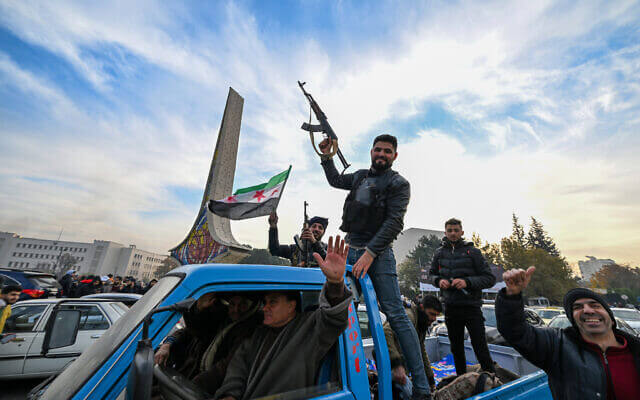
Residents were seen cheering in the streets of the capital, as the rebel factions heralded the departure of “tyrant” Assad and “declare the city of Damascus free.”
“After 50 years of oppression under Baath rule, and 13 years of crimes and tyranny and (forced) displacement… we announce today the end of this dark period and the start of a new era for Syria,” the rebel factions said on Telegram.
Syria’s army command notified officers on Sunday that Assad’s 24-year authoritarian rule had ended, a Syrian officer who was informed of the move told Reuters, following the rapid rebel offensive that took the world by surprise.
Residents of the capital reported hearing gunfire and explosions. Footage broadcast on opposition-linked media showed a tank in one of the city’s central squares while a small group of people gathered in celebration. Calls of “God is great” rang out from mosques.
Assad, who had crushed all forms of dissent, flew out of Damascus for an unknown destination earlier on Sunday, two senior army officers told Reuters, as rebels said they had entered the capital with no sign of army deployments.
Prime Minister Mohammed al-Jalali said he was ready to cooperate with “any leadership chosen by the Syrian people.”
Thousands in cars and on foot congregated at a main square in Damascus waving and chanting “Freedom” from a half-century of Assad family rule, witnesses said.
The dramatic collapse marks a seismic moment for the Middle East, ending the family’s iron-fisted rule over Syria and dealing a massive blow to Russia and Iran, which have lost a key ally at the heart of the region.
In one suburb, a statue of Assad’s father, the late President Hafez al-Assad, was toppled and torn apart.
Outside the city, rebels swept across the entire southwest over 24 hours and established control.
“We celebrate with the Syrian people the news of freeing our prisoners and releasing their chains and announcing the end of the era of injustice in Sednaya prison,” the rebels said, referring to a large military prison on the outskirts of Damascus where the Syrian government detained thousands.
Syrian rebel leader Ahmed al-Sharaa said that it was prohibited to go near public institutions that he said would remain under the supervision of the “former prime minister” until they were officially handed over.
Footage shared online showed people storming Assad’s abandoned palace in the capital.
The rapid developments in Damascus come only hours after the Islamist militant group Hayat Tahrir al-Sham said they had captured the strategic city of Homs, on the way to the capital.
The Israel Defense Forces on Sunday morning confirmed Syrian reports that it had taken up new positions in the buffer zone between the two countries in the Golan Heights, following the fall of the Assad regime.
“The IDF has deployed troops in the buffer zone and in a number of areas that are necessary to defend, in order to ensure the security of the communities in the Golan Heights and the citizens of Israel,” the military said in a statement.
The move came following a fresh assessment and “the possibility of gunmen entering the buffer zone,” the IDF said. “We emphasize that the IDF does not intervene in the events taking place in Syria,” the military added.
The Syrian reports said that Israeli forces had pushed into the buffer zone in the Quneitra area, and launched artillery shells.
In addition, The IDF’s 98th Division with the Paratroopers and Commando brigades was dispatched to the Golan Heights as Israel bolstered its defenses on the border.
Over the weekend, amid the rebel offensive against the Syrian regime, the IDF said it sent more forces to the Golan Heights.
However, there will be no changes to guidelines for residents of the Golan Heights, local authorities said, following a fresh assessment held by the military.

Earlier, Army Radio reported that the IDF was considering imposing restrictions on gatherings and schools following the fall of the Assad regime.
The Golan Regional Council said in a statement that sounds of explosions may be heard as Israeli forces carry out operations in the buffer zone.
Assad’s whereabouts unknown
The head of the Syrian Observatory for Human Rights, Rami Abdel Rahman, told AFP that “Assad left Syria via Damascus International Airport before the army security forces left” the facility. The London-based Observatory is of unclear and unreliable resources.
AFP was unable to immediately confirm the report.
The New York Times reported that screen captures shared on social media purport to show only a single flight leaving Damascus as the rebels moved in. That flight went to Moscow.
According to data from the Flightradar website, a Syrian airplane took off from Damascus airport around the time the capital was reported to have been taken by rebels.
Other footage appears to show chaos at the airport as staff and security left their posts.
Reports of the president having fled were followed by the premier saying he was ready to “cooperate” with a new leadership and any handover process.
“This country can be a normal country that builds good relations with its neighbors and the world… but this issue is up to any leadership chosen by the Syrian people,” Jalali said in a speech broadcast on his Facebook account.
He said he would go to his office to continue work in the morning and called on Syrian citizens not to deface public property.
He did not address reports that Assad had left the country.
US President Joe Biden and his team were monitoring the “extraordinary events in Syria” and were in touch with regional partners, the White House said.
US President-elect Donald Trump has said the US should not be involved in the conflict and should “let it play out.”
Separately, Biden’s national security adviser Jake Sullivan said the Biden administration had no intention of intervening.
Assad has for years been backed by Lebanese Hezbollah, whose forces “vacated their positions around Damascus,” according to a source close to the group.
Hezbollah “has instructed its fighters in recent hours to withdraw from the Homs area, with some heading to Latakia (in Syria) and others to the Hermel area in Lebanon,” the source also told AFP.
Damascus celebrations
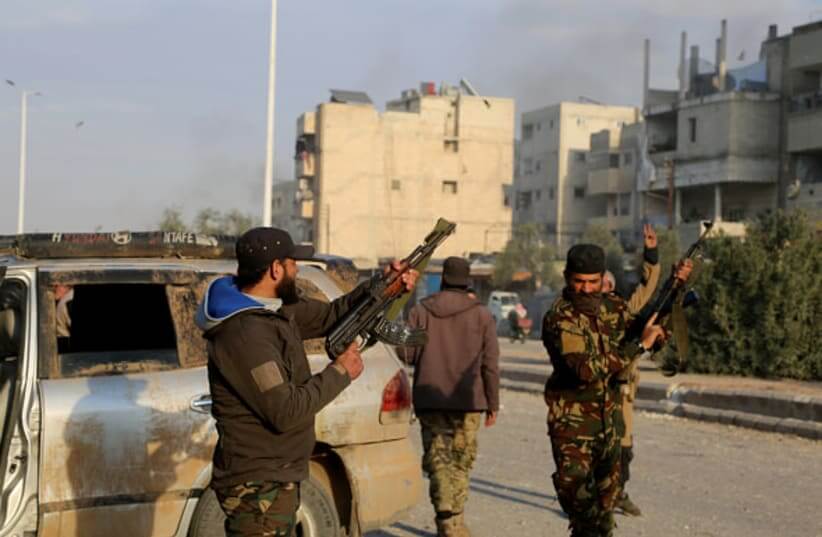
Crowds of Syrians gathered to celebrate in the central squares of Damascus, chanting anti-Assad slogans and honking car horns. In some areas, celebratory gunshots rang out.
“My feelings are indescribable,” said Omar Daher, a 29-year-old lawyer. “After the fear that he (Assad) and his father made us live in for many years and the panic and state of terror that I was living in, I can’t believe it.”
Daher said his father was killed by security forces and his brother was in detention, his fate unknown. Assad “is a criminal, a tyrant and a dog,” he said.”
“Damn his soul and the soul of the entire Assad family,” said Ghazal al-Sharif, another reveler in central Damascus. “It is the prayer of every oppressed person and God answered it today. We thought we would never see it, but thank God, we saw it.”

An Associated Press journalist in Damascus reported seeing groups of armed residents along the road on the outskirts of the capital and hearing the sounds of gunshots. The city’s main police headquarters appeared to be abandoned, its door left ajar with no officers outside.
Another AP journalist shot footage of an abandoned army checkpoint where uniforms were discarded on the ground under a poster of Assad’s face.
In Damascus, people rushed to stock up on supplies. Thousands went to Syria’s border with Lebanon, trying to leave the country. Lebanese border officials closed the main Masnaa border crossing late Saturday, leaving many stuck waiting.
Many shops in the capital were shuttered, a resident told The Associated Press, and those still open ran out of staples such as sugar. Some were selling items at three times the normal price.
The UN said it was moving noncritical staff outside the country as a precaution.
Rapid developments
The pace of events has stunned Arab capitals and raised fears of a new wave of regional instability.
Qatar, Saudi Arabia, Jordan, Egypt, Iraq, Iran, Turkey and Russia issued a joint statement saying the crisis was a dangerous development and calling for a political solution.
Syria’s civil war, which erupted in 2011 as an uprising against Assad’s rule, dragged in big outside powers, created space for jihadist militants to plot attacks around the world, and sent millions of refugees into neighboring states.
Hayat Tahrir al-Sham, the strongest rebel group, is the former al Qaeda affiliate in Syria regarded by the US and others as a terrorist organization, and many Syrians remain fearful it will impose draconian Islamist rule.
HTS leader Abu Mohammed al-Golani has tried to reassure minorities that he will not interfere with them and the international community that he opposes Islamist attacks abroad. In Aleppo, which the rebels captured a week ago, there have not been reports of reprisals.
When asked on Saturday whether he believed Golani, Russian Foreign Minister Sergei Lavrov replied, “The proof of the pudding is in the eating.”
Assad’s long rule relied on allies to subdue the rebels. Russian warplanes conducted bombing while Iran sent allied forces including Hezbollah and Iraqi militia to reinforce the Syrian military and storm insurgent strongholds.
But Russia has been focused on the war in Ukraine since 2022 and Hezbollah has suffered big losses in its own grueling war with Israel, significantly limiting its ability or that of Iran to bolster Assad.