
Mohammed bin Salman warns Israel against hitting Islamic Republic, marking turn toward Tehran and away from US-supported normalization with Jerusalem


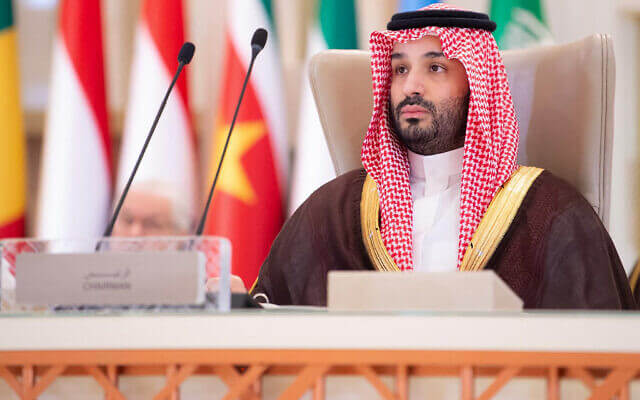
A handout picture provided by the Saudi Press Agency SPA on November 11, 2024, shows Saudi Crown Prince Mohammed bin Salman addressing the joint extraordinary leaders summit of the Organization of Islamic Cooperation (OIC) and the Arab League in Riyadh. (Photo by Ahmed NURELDINE / SPA / AFP)

A handout picture provided by the Saudi Press Agency SPA on November 11, 2024, shows Saudi Crown Prince Mohammed bin Salman addressing the joint extraordinary leaders summit of the Organization of Islamic Cooperation (OIC) and the Arab League in Riyadh. (Photo by Ahmed NURELDINE / SPA / AFP)

Saudi Arabia’s de facto ruler on Monday called on Israel to respect Iran’s sovereignty and refrain from attacking Iranian soil, while appearing to step up criticism of Jerusalem, accusing it of genocide.

Crown Prince Mohammed bin Salman made the comments at a summit of Arab and Muslim leaders organized to press for the establishment of a Palestinian state, a year after the Arab League and the Organization of Islamic Cooperation held a first conference on the subject.

Mohammed told the summit that the international community should oblige Israel “to respect the sovereignty of the sisterly Islamic Republic of Iran and not to violate its lands.”

Speaking days after Americans voted to send former president Donald Trump back to the White House, Mohammed also appeared to harden the kingdom’s rhetoric against Israel, signaling that Riyadh may be moving further away from US efforts to broker a normalization deal with Jerusalem.

Mohammed told leaders gathered in Riyadh that the kingdom renewed “its condemnation and categorical rejection of the genocide committed by Israel against the brotherly Palestinian people, which has claimed the lives of 150,000 martyrs, wounded and missing, most of whom are women and children.”

A handout picture provided by the Saudi Press Agency SPA shows Saudi Crown Prince Mohammed bin Salman, center, posing for a group picture with leaders from member states of the Organization of Islamic Cooperation (OIC) and the Arab League during their joint extraordinary summit in Riyadh on November 11, 2024. (SPA / AFP)

Some 43,000 people have been killed during Israel’s offensive in Gaza, according to figures provided by the Hamas terror group that cannot be verified, and do not differentiate between combatants and civilians. Israel denies the charges of genocide and says it implements measures to minimize harm to noncombatants.

The war began with Hamas’s brutal October 7, 2023, onslaught in southern Israel, killing 1,200 people and abducting 251 as hostages to Gaza. Israel responded by vowing to destroy the terror group ruling the Strip, and free the hostages.

That would have built on the Abraham Accords brokered during Trump’s first term as president, which saw the United Arab Emirates, Bahrain, Sudan and Morocco agree to normalize relations with Israel.

However, Riyadh has also moved to patch up ties with Iran after a March 2023 rapprochement deal brokered by China.

The restored ties between Riyadh and Tehran have reshaped the diplomatic landscape, which Trump will have to reckon with when he takes office again next year, said H.A. Hellyer, Middle East expert at the Royal United Services Institute.

“Clearly Riyadh and Tehran are warming their relationship, and this is a very different regional environment as compared to when Trump was last in office,” Hellyer said.

“Trump may want to expand the Abraham Accords when he takes office next year, but unless Israel changes tack drastically in the region, that’s going to [be] fraught with many more challenges than last time,” he said.

Iran and Saudi Arabia severed ties in 2016 following attacks on Saudi diplomatic missions in the Islamic Republic during protests over Riyadh’s execution of Shiite cleric Nimr al-Nimr. Relations had already been frayed by Saudi Arabia’s mobilization of a military coalition to counter Iran-backed Houthi rebels in Yemen.

An anti-Israel sign is displayed in Tehran’s Palestine Square on October 1, 2024. (Atta Kenare/AFP)

Though issues remain in the complex relationship, the rapprochement amounts to a signature diplomatic achievement for Mohammed, who has taken a more conciliatory approach to regional diplomacy in recent years.

Saudi Arabia and Iran have maintained high-level contacts as part of what they say are efforts to contain the war in Gaza.

At the same time, Iranian proxy groups and Iran itself have attempted to expand the war by launching attacks on Israel from around the Middle East, including a ballistic missile fired at central Israel from Yemen earlier Monday.

Israel has said it will respond if Iran goes through with threats to attack the country in retaliation for Israeli strikes on military sites on October 26. The Israeli sorties came after Iran fired some 200 ballistic missiles at cities across Israel on October 1.

The warning against hitting Iran appeared to mark a shift since April, when Saudi Arabia reportedly allowed its airspace to be used to counter a volley of hundreds of drones and missiles fired by Iran at Israel.

Both Hamas and Hezbollah, a Lebanese terror group that Israel is fighting to halt over a year of incessant rocket fire, are backed by Iran, and had previously been blacklisted by Saudi Arabia as terror groups.

In an earlier sign of Saudi Arabia’s shifting positions, Riyadh said in October it was revoking the license of Saudi-owned news broadcaster MBC after it called slain Hamas leader Yahya Sinwar a terrorist.

A handout picture provided by the Saudi Press Agency SPA on November 11, 2024, shows Saudi Deputy Governor of the Riyadh region Prince Mohammed bin Abdulrahman bin Abdulaziz (R) welcoming Iran’s Vice President Mohammed Reza Aref upon his arrival in Riyadh ahead of the Organization of Islamic Cooperation and the Arab League joint extraordinary leaders summit. (SPA / AFP)

He also said the international community was expecting Trump to end Israel’s wars against Hamas and Hezbollah.

“The American government is the main supporter of the actions of the Zionist regime, and the world is waiting for the promise of the new government of this country to immediately stop the war against the innocent people of Gaza and Lebanon,” Aref told the joint Arab League and Organization of Islamic Cooperation summit.

On Sunday, Saudi Arabia’s top military official, Fayyad al-Ruwaili, arrived in Tehran for talks with Iranian officials, weeks after Saudi Arabia announced it had held war games with Iran and other countries in the Sea of Oman.

Mohammed and Iranian President Masoud Pezeshkian spoke by phone on Sunday ahead of the summit.

Pezeshkian is not attending because of pressing “executive matters,” an Iranian government statement said.
Security advisors have recommended that Netanyahu avoid staying in specific locations for an extended period of time due to the threat of additional attacks.

JERUSALEM POST STAFF

NOVEMBER 11, 2024 08:46
Updated: NOVEMBER 11, 2024 09:11
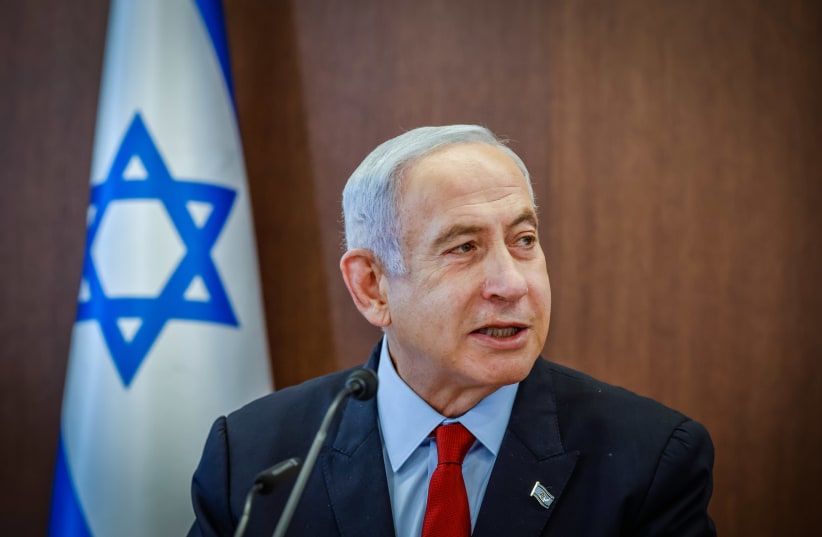
 Israeli prime minister Benjamin Netanyahu leads the weekly government conference at the PM's office in Jerusalem on January 22, 2023. (photo credit: OLIVIER FITOUSSI/FLASH90)

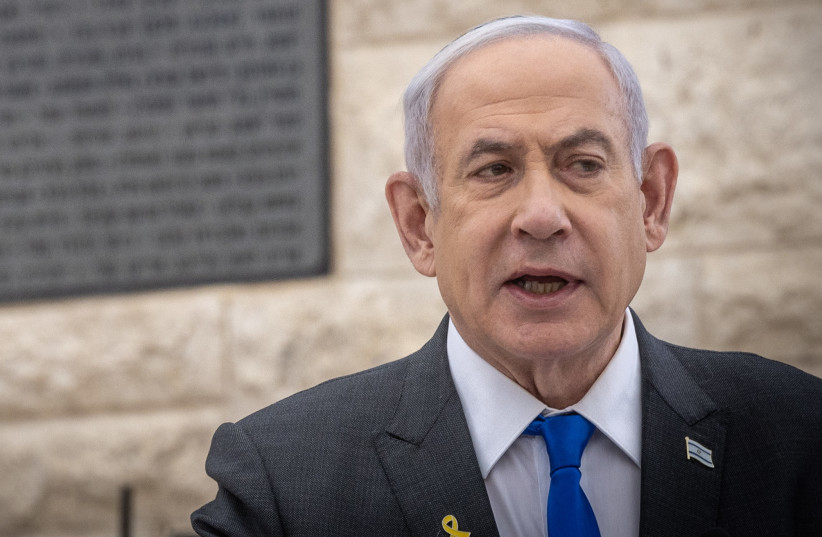
Prime Minister Benjamin Netanyahu has been holding security meetings in an underground saferoom, N12 reported on Sunday.

In October, a drone that infiltrated from Lebanon struck his home in Caesarea, though Netanyahu and family weren’t present at the time of the attack.

Since then, N12 reported that Netanyahu has been operating within a secure room in the basement of the Prime Minister’s office in Jerusalem, with heightened protective measures.

Security advisors have also recommended that Netanyahu avoid staying in specific locations for an extended period of time due to the threat of additional attacks.

According to claims, Prime Minister Benjamin Netanyahu has also been looking to postpone the wedding of his son, Avner, due to security considerations for those in attendance.

Drone strikes Netanyahu’s home

The drone was tracked by a combat helicopter, which identified its infiltration from Lebanon until the moment of impact. As a result, alarms were triggered in Glilot and northern Tel Aviv, though the Home Front Command app did not issue any warnings.

In response to Hezbollah’s drone attack on his home, Netanyahu said, “Iran’s proxies, who today attempted to assassinate me and my wife, made a grave mistake. This will not deter me or the State of Israel from continuing the war of resurgence against our enemies to secure our safety for generations to come.”

He added: “I say to the Iranians and their partners in the axis of evil—anyone who harms Israeli citizens will pay a heavy price. We will continue to eliminate your terrorists, retrieve our hostages from Gaza, and restore security to our northern residents.”


Intelligence services have begun intensifying intelligence sharing and situational assessments with the US military to prevent overlooking critical developments.

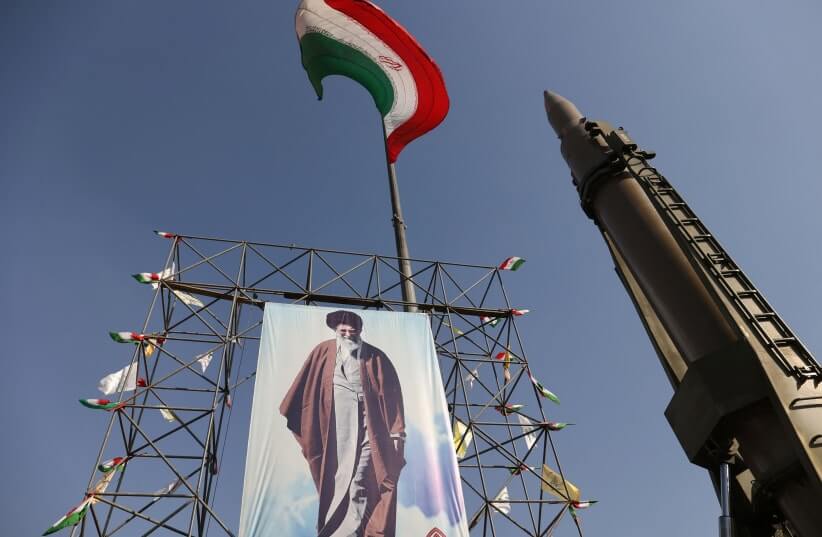
 An Iranian missile system is displayed next to a banner with a picture of Iran's Supreme Leader Ayatollah Ali Khamenei, during Iranian defence week, in a street in Tehran, Iran, September 24, 2024. (photo credit: MAJID ASGARIPOUR/WANA (WEST ASIA NEWS AGENCY) VIA REUTERS)
An Iranian missile system is displayed next to a banner with a picture of Iran’s Supreme Leader Ayatollah Ali Khamenei, during Iranian defence week, in a street in Tehran, Iran, September 24, 2024.
(photo credit: MAJID ASGARIPOUR/WANA (WEST ASIA NEWS AGENCY) VIA REUTERS)
Concerns have been raised within Israel’s defense establishment that Iran might try to exploit the period before former US President Donald Trump’s return to office to act against Israel.

Intelligence services have begun intensifying intelligence sharing and situational assessments with the US military to prevent overlooking critical developments.

Officials emphasize that Israel’s political leadership must understand Trump’s proposed Iran policy to shape its own military and diplomatic strategy. Many within the defense community believe that the diplomatic efforts to curb Iran’s nuclear ambitions “have run their course.”

Some defense officials recall Trump’s statement at a recent convention: “Iran will not have nuclear weapons,” though he added that, if elected, he would aim to end wars rather than start new ones. Questions remain regarding his intended methods.

In private discussions, sources said that Trump confided to associates that if he had a few more months in his first term, he would have imposed additional sanctions to destabilize Iran’s economy. Now, the question for Israel is whether Prime Minister Netanyahu’s government will align with Trump on a new round of sanctions against Iran or press for a broader military initiative targeting Iran’s nuclear facilities. To date, Trump has not provided a detailed policy on Iran’s nuclear program.

 Republican presidential nominee and former U.S. President Donald Trump takes the stage to address supporters at his rally, at the Palm Beach County Convention Center in West Palm Beach, Florida, U.S., November 6, 2024. (credit: REUTERS/BRIAN SNYDER/FILE PHOTO)Enlrage image
Republican presidential nominee and former U.S. President Donald Trump takes the stage to address supporters at his rally, at the Palm Beach County Convention Center in West Palm Beach, Florida, U.S., November 6, 2024. (credit: REUTERS/BRIAN SNYDER/FILE PHOTO)

Senior IDF officials have emphasized the close coordination between Israel and top US government officials, including the US Central Command (CENTCOM) and British allies, in preparation for the recent Israel Air Force strike in Iran. According to senior IDF sources, this collaboration enhanced both the precision and effectiveness of the operation.

Leaving Iran exposed to future attacks

IDF data indicate that the strike successfully targeted key Iranian defensive and offensive sites. Among the targets were 14 radar systems connected to surface-to-air missile batteries designed to protect critical Iranian locations, four S-300 missile batteries, and facilities involved in the production of ballistic missile fuel.

Israeli assessments suggest the strike significantly weakened Iran’s production capabilities, leaving its strategic sites “more exposed than ever” to air attack.

Following the strike, Israeli sources anticipate that Iran may seek to offset the impact by strengthening its foothold in Iraq, Yemen, Syria, and Lebanon. This reinforcement could include the transfer of advanced weaponry and efforts to establish what one defense official described as a “terror army.” Defense officials further noted that while Iran is unlikely to abandon plans for a ground raid, it may consider alternative routes through Syria or Jordan for the Radwan Force’s planned incursion from Lebanon.

Israeli intelligence assessments show that although Iran has enriched more uranium at the 60% level over the past year, it has not yet reached the 90% enrichment level required for a nuclear weapon. This development, however, has expanded Iran’s capacity to reach 90% enrichment quickly, effectively designating it as a nuclear threshold state.

Further assessments from Israeli defense officials indicate that, given Israel’s air force operations in Yemen and Iran and the structure of Iran’s nuclear program, the Israeli Air Force would likely face challenges in achieving high levels of destruction without US support.