David Israel7 Heshvan 5785 – November 8, 2024

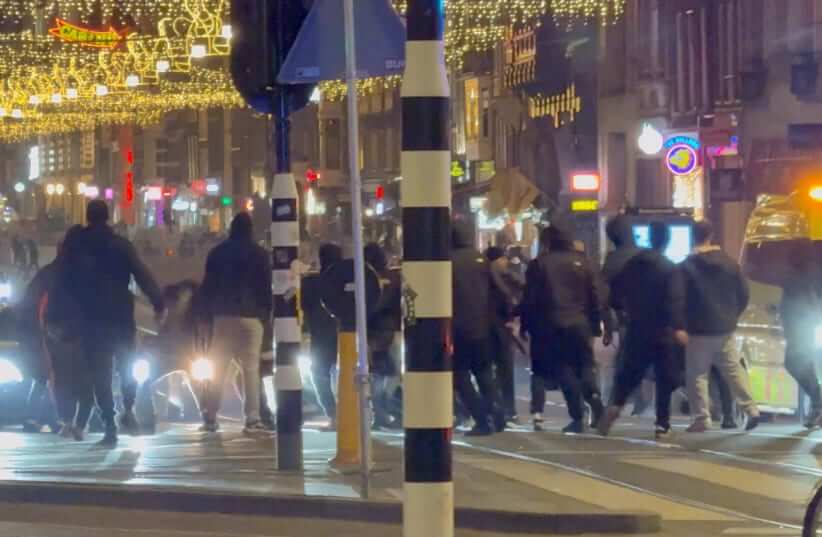
Gangs of Muslim rioters attacked Israeli Maccabi Tel Aviv fans who had come to watch their team play against Ajax in Amsterdam, the capital of the Netherlands, Thursday night. The attack was preplanned, and local authorities ignored the warnings they received from Israeli security authorities.
Footage from the city shows fans being violently attacked, kicked, and even run over by cars. There were clashes resulting in injuries to Maccabi fans before the game as well. In one case, an Israeli fan was thrown into a canal and forced to say “Free Palestine” until he was released.
Advertisement
<!– Publisher #16: JewishPress.com Zone #123: Comment Banner / (I1) / Local NY Size #15: Banner 468×60 (Comments and Mobile) [468×60] Adhesion: non-closeable with bottom_left placement. Secure (HTTPS): enabled
–>
NOTE: These Twitter videos include expletives. If you are offended, please do not click.
Horrifying scenes in Amsterdam of attempted lynching of Jews by terror supporters. Amsterdam, where are your police?! Jews were beaten by mobs of Arabs and some even jumped into the canals to get away from violent mobs.
Shameful, unacceptable. pic.twitter.com/lr7m4rf8bm
— Emily Schrader – אמילי שריידר امیلی شریدر (@emilykschrader) November 8, 2024
Authorities in the Netherlands reported 12 injured people in hospitals and the Foreign Ministry reported seven Israelis who are out of contact, five more Israelis have been hospitalized. The actual number of injured and out-of-contact may be higher.
Testimonies from Amsterdam revealed that Muslims had organized their locations in advance and were hunting down Jews near hotels, casinos, and central locations in the city. There are reports of missing persons, and photos of stolen Israeli passports were circulated online. A total of about 3,000 Israelis flew to the game. Now they are besieged in hotels, fearing being attacked if they go out into the streets.
The Muslims filmed their attacks and published them.
Rep. Steny Hoyer (D-Md.) posted: “Two days before the anniversary of Kristallnacht, Jews are once again experiencing antisemitism and vicious attacks in Europe.”
ANTISEMITIC POLICE OFFICERS
“The police were not there at the end of the game, and Muslims were waiting near train stations to follow Israeli fans,” one fan told Kan11 News. “The police only started to intervene at least half an hour to 45 minutes into the attacks, after attackers threw firecrackers at people and into buildings.”
Local police said they protected Israelis and took them to their hotels. Dutch media reported that police had arrested 57 rioters.
In early October, Dutch media revealed that local police chiefs admit to altering duty schedules to accommodate officers with “moral objections” to providing security at Jewish sites, including the National Holocaust Museum. Mireille Beentjes, spokesperson for the national police force leadership, confirmed that the force considers individual objections when arranging assignments.
For everyone asking where the Dutch police are, this should answer your questions.#Amsterdam #Pogrom pic.twitter.com/4roAwJEfBV
— Naturalized Deer ?? (@PingouinHeureux) November 8, 2024
“There is no strict policy,” she said. “The principle is that police staff are permitted to hold moral objections.”
NOTE: These Twitter videos include expletives. If you are offended, please do not click.
This is what happens when terrorists are allowed into Europe. Tonight, in central Amsterdam, young Jews were attacked by Palestinians, facing attempted lynching. The police were absent or arrived too late. This is happening in the heart of Europe, and it’s only the beginning. In… pic.twitter.com/sAFWjMCUD9
— Eli Beer (@EliBeerUH) November 8, 2024
POGROM IN THE NETHERLANDS
“They waited in groups on every corner, and as soon as they spotted Jews, they chased them,” an Israeli who was there told Kan11. “Others waited near hotels and the casino in larger groups, and they attacked fans there as well. Then others passed by in cars and didn’t stop honking their horns near hotels where there were Israelis.”
“We survived an attempted lynching in Amsterdam by dozens of Arabs who ambushed us outside the train station,” another Israeli said. “It’s scary and crazy”
One Maccabi Tel Aviv fan in Amsterdam told Kan11: “They threw firecrackers outside our hotel and chased fans. We are now inside the hotel, sitting quietly in the dark. For the last half hour, it has been quiet outside, but they keep coming and going. They also threw firecrackers outside our hotel and chased fans. I’m just trying to figure out how to get to the airport tomorrow.”
The attackers are sharing on social media images of passports they stole from their Israeli victims.
Rep. Ritchie Torres (D-N.Y.) posted: “The hysterical and hyperbolic demonization of Israel has led to a global outbreak of antisemitic vitriol, vandalism and violence. The single most monstrous manifestation of antisemitism is a pogrom that is presently unfolding against hundreds of Jews who were cheering on the Tel Aviv football club in Amsterdam.
“Those inciting antisemitism now have the blood of a 21st-century pogrom on their hands. The situation is so dire that the Israeli government is dispatching rescue teams for Jews in danger. I am sick to my stomach that a pogrom is happening in the 21st century.”
The hysterical and hyperbolic demonization of Israel has led to a global outbreak of antisemitic vitriol, vandalism, and violence. The single most monstrous manifestation of antisemitism is a pogrom that is presently unfolding against hundreds of Jews who were cheering on the… pic.twitter.com/xpwcMGZgf8
— Ritchie Torres (@RitchieTorres) November 8, 2024
ISRAELI RESPONSE
Israeli Foreign Minister Gideon Sa’ar, who took office only this week, reported that ten Israeli citizens were injured in the violence, advising Israeli nationals in Amsterdam to remain in their hotels as a precaution.
“The impression from the reports is that the situation has been calming down over the past hour,” Sa’ar noted.
Sa’ar also appealed to his Dutch counterpart, Kasper Veldkamp, for assistance in facilitating safe transportation for Israelis from their hotels to the airport, according to a statement from Israel’s Foreign Ministry.
Prime Minister Benjamin Netanyahu held an assessment with his Military Secretary and the Foreign Minister and is receiving regular updates. The Prime Minister has directed that two rescue planes be sent immediately to assist our citizens.
“The harsh pictures of the assault on our citizens in Amsterdam will not be overlooked,” the PM said, adding that he views the horrifying incident with the utmost gravity and demands that the Dutch government and security forces take vigorous and swift action against the rioters, and ensure the safety of Israeli citizens.
A Pair of El Al Flights “ELY337” and “ELY5525” have taken from Tel Aviv for Amsterdam, where they will assist in the Evacuation of Israeli Nationals from the Country. pic.twitter.com/plFamf37oS
— OSINTdefender (@sentdefender) November 8, 2024
Israeli UN envoy Danny Danon posted: “We are receiving very disturbing reports of extreme violence against Israelis and Jews on the streets of Holland. There is a pogrom currently taking place in Europe in 2024.
“These are the true faces of the supporters of the radical terrorism we are fighting. The Western world needs to wake up now. This is the time when the United Nations should immediately and clearly condemn the violence of the Palestinians and their supporters. The Dutch authorities must take decisive action against terrorism now.”
We are receiving very disturbing reports of extreme violence against Israelis and Jews on the streets of Holland. There is a pogrom currently taking place in Europe in 2024.
These are the true faces of the supporters of the radical terrorism we are fighting. The western world… pic.twitter.com/LwMC6q1Grf— Danny Danon ?? דני דנון (@dannydanon) November 8, 2024
GLOBAL RESPONSE
Geert Wilders, who head of the largest political party in the Netherlands, demanded that the “multicultural scum” that attacked the Jews be deported.
Looks like a Jew hunt in the streets of Amsterdam. Arrest and deport the multicultural scum that attacked Maccabi Tel Aviv supporters in our streets. Ashamed that this can happen in The Netherlands. Totally unacceptable. https://t.co/Ju54TO27Ks
— Geert Wilders (@geertwilderspvv) November 8, 2024
Deborah Lipstadt, the U.S. Special Envoy to Monitor and Combat Antisemitism, tweeted, that she was “horrified by the attacks tonight in Amsterdam, which are terribly reminiscent of a classic pogrom.”
Horrified by the attacks tonight in Amsterdam, which are terribly reminiscent of a classic pogrom. I am also deeply disturbed by how long the reported attacks lasted and call on the government to conduct a thorough investigation into security force intervention and on how these…
— Ambassador Deborah Lipstadt (@StateSEAS) November 8, 2024
Jonathan Greenblatt, director of the Anti-Defamation League (ADL), tweeted that “this is exactly what ‘globalize the intifada’ looks like.
This is exactly what “globalize the intifada” looks like.
Mobs of hate-filled people chasing down and attacking innocent Israeli soccer fans who they have dehumanized as “Zionists,” hunting down and brutalizing ordinary people who came to Amsterdam simply to enjoy a soccer…
— Jonathan Greenblatt (@JGreenblattADL) November 8, 2024
RESCUE MISSION
The first El Al plane is expected to land around 2 PM (local Holland time). The next will be at 9 PM, and then again on Shabbat at 2 PM. The rescue flights will be free of charge.
A special telephone number for coordinating a seat on the planes has been set up: 03-940-4040. For extraction assistance from hotels or buildings call: 0753452355 (local-Holland number).
Israel’s Chief Rabbis have given El Al permission to fly on Shabbat for the rescue operation.
Emergency telephone lines have been set up to help Israelis escape.
Israel Foreign Ministry:
02-5304358
02-5303287
02-5303644
02-5303401
050-5074986
02-5303155
Israeli Embassy in Holland:
+31703760570
+31642648282
+31648493297
United Hatzalah’s Psychotrauma and Crisis Response Unit Has Opened an Emergency Hotline for Israelis in Amsterdam: +972-50-499-1221.