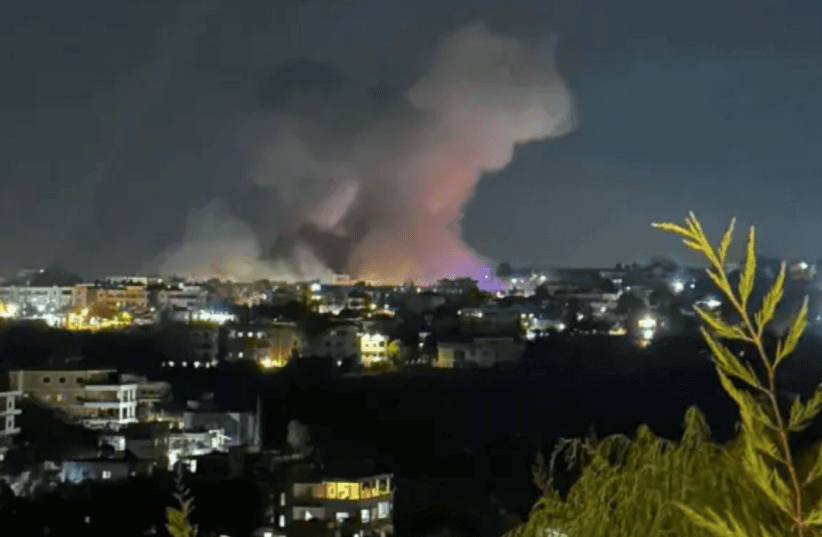
WASHINGTON — Israel said it hit military targets in Iran in retaliation for that country’s missile barrage on Oct. 1, apparently heeding Biden administration pleas to avoid oil fields or Iran’s nuclear program because of fears of escalation into an all-out war.
“In response to months of continuous attacks from the regime in Iran against the State of Israel – right now the Israel Defense Forces is conducting precise strikes on military targets in Iran,” Daniel Hagari, the Israeli army spokesman, said in a video statement released to reporters Saturday before dawn as the strikes took place.
Iranian media reported explosions at military bases, including near Tehran. Iranians flocked to social media to say they had been awakened by explosions.
President Joe Biden and his officials had said they understood and support Israel’s stated plans to hit back for the Oct. 1 attack. But he asked Israel to avoid oil fields and Iran’s nuclear weapons program to prevent an escalation in an already volatile conflict.
“If I were in their shoes, I’d be thinking about other alternatives than striking oil fields,” Biden said at a White House press conference on Oct. 4 after he had consulted with Israeli Prime Minister Benjamin Netanyahu.
An Israeli source familiar with the attack told the Jewish Telegraphic Agency that Israel had informed U.S. officials ahead of time of the attack.
“We understand that Israel is conducting targeted strikes against military targets in Iran as an exercise of self-defense and in response to Iran’s ballistic missile attack against Israel on Oct. 1,” National Security Council spokesman Sean Savett said in an email.
Israel announced the attacks had ended three and a half hours after they started and said the principal targets had been sites where missiles targeting Israel were manufactured, as well as missile launch sites.
“These missiles posed a direct and immediate threat to the citizens of the State of Israel,” said an army statement. “Simultaneously, the IDF struck surface-to-air missile arrays and additional Iranian aerial capabilities, that were intended to restrict Israel’s aerial freedom of operation in Iran.”
A senior administration official said after the attack that the White House was pleased with how the retaliation went, and suggested that the United States was involved in the planning if not the implementation.
“The United States was not a participant in this military operation,” the official said. “The president and his national security team, of course, worked with the Israelis over recent weeks to encourage Israel to conduct a response that was targeted and proportional with low risk of civilian harm, and that appears to have been precisely what transpired this evening.”
The official warned Iran not to retaliate. “If Iran chooses to respond once again, we will be ready and there will be consequences for Iran once again,” the official said.
Americans appeared ready for any possible lineup. On Friday, U.S. Central Command, which covers the Middle East, posted its social media photos of F-16 combat aircraft landing at Spangdahlem Air Base in Germany.
“US Air Force F-16s from the 480th Fighter Squadron based at Spangdahlem Air Base, Germany arrive in the US Central Command area of responsibility,” said the caption.
John Kirby, the lead National Security Council spokesman, would not directly confirm earlier on Friday that the F-16s were relayed to CENTCOM’s region to assist Israel but suggested that was the case.
“Our commitment to Israel’s security remains ironclad, and that means, as appropriate, making force changes posture that we think need to be made to help Israel defend itself, and I don’t think I can really go beyond that,” he said, responding to a question about the positioning of the F-16s.
Hagari said Israel was ready for any further actions.
“Our defensive and offensive capabilities are fully mobilized,” he said. “We will do whatever necessary to defend the State of Israel and the people of Israel.”
The United States earlier this month deployed troops to Israel to operate an advanced missile defense system, Terminal High Altitude Area Defense, or THAAD.
How Iran responds to the strikes is an open question. The Iranian military had been on high alert in advance of the anticipated attack, and Iranian officials said they would retaliate against any aggression. But the apparently limited scope of the Israeli onslaught is seen as a deterrent, and Iranian media was reportedly downplaying the scale of Saturday morning’s attack, suggesting a state interest in treating it as a minor incident.
Israel previously struck military sites within Iran in April, days after Iran launched a drone attack against Israel. Iran did not directly retaliate in that exchange.
Iran and Israel have been sparring since Oct. 7, 2023, when Hamas, an Iran-backed terrorist group, invaded Israel, killing 1,200 and taking 251 hostage. The next day, Hezbollah, a Lebanon-based terrorist group also backed by Iran, began firing rockets into Israel’s north. Iranian proxies elsewhere, including in Yemen, have similarly attacked Israeli and U.S. interests in what Israeli officials have come to call a seven-front war.
Tensions between Iran and Israel ratcheted up again in recent months after the assassination of Hamas’ leader, Ismail Haniyeh, in Tehran, in an attack attributed to Israel and widely seen as humiliating for the Iranians. The Oct. 1 missile barrage from Iran was retaliation for Israel’s killing of Hassan Nasrallah, Hezbollah’s leader, in Beirut. One person was killed in that attack, a West Bank Palestinian.
“The regime in Iran and its proxies in the region have been relentlessly attacking Israel since Oct. 7 – on seven fronts – including direct attacks from Iranian soil,” Hagari said. “Like every other sovereign country in the world, the State of Israel has the right and the duty to respond.”
Reports said Israel hit Iran-affiliated targets in Syria as well as Iran.
Israel’s retaliation comes a week and a half before the U.S. election. A conflagration in the region could upend what is a neck-and-neck race between Vice President Kamala Harris and former President Donald Trump. Harris has said that all options are on the table to keep Iran from going nuclear, intimating that U.S. involvement may become necessary.
In addition to his discussions with Biden, Netanyahu has communicated with Trump, who has attacked Biden for warning Israel away from nuclear targets.
“Do what you have to do,” Trump told Netanyahu in one of the phone calls, The Washington Post quoted anonymous sources as saying.
The White House said that Biden and Harris, who was in Houston headlining a rally with Beyonce, were briefed throughout the retaliatory attack.