Iran’s response to an Israeli strike would be contingent on the extent of Israel’s attack, the officials claimed.
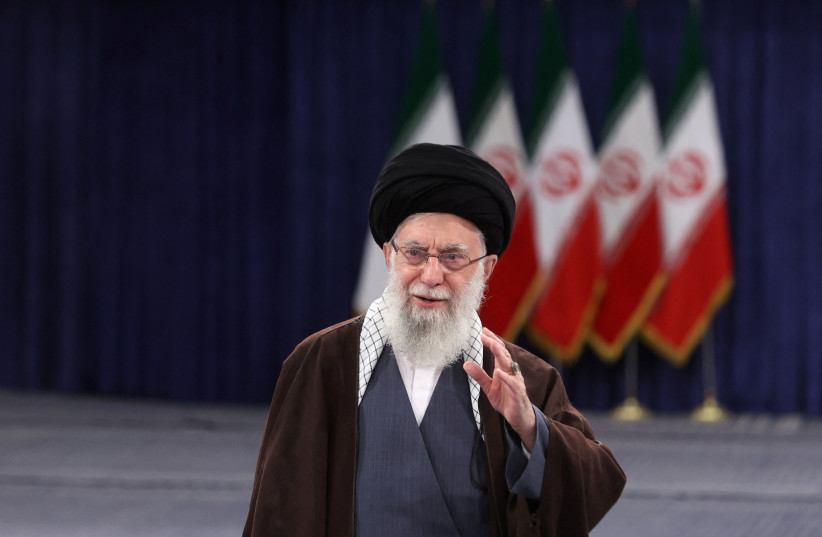
By JERUSALEM POST STAFFUpdated: OCTOBER 25, 2024 09:10Ayatollah Ali Khamenei reportedly told Iran’s military to prepare response scenarios for a potential Israeli attack, according to a New York Times report.(photo credit: IRANIAN ARMY/WANA/REUTERS/AFP PHOTO)
Ayatollah Ali Khamenei has asked the Iranian military to prepare response scenarios to a potential Israeli attack, according to a Thursday New York Times report, citing four Iranian officials.
Iran’s response to an Israeli strike would be contingent on the extent of Israel’s attack, the officials, two of whom were from the Islamic Revolutionary Guard Corps (IRGC), claimed.
According to them, the Islamic Republic may choose not to respond if Israel reduces the scope of its strike to solely military warehouses and bases.
However, were the strike to cause major casualties and destruction, or were Israel to attack nuclear, oil, or energy infrastructure or carry out targeted eliminations, Iran would hit back, the officials noted.
Iran’s response scenarios
In such a case, Iran’s response scenario could include a potential barrage of up to 1,000 ballistic missiles, further attacks by Iranian proxies, and interference in energy supplies and shipping in the Persian Gulf.
Iran’s Supreme Leader Ayatollah Ali Khamenei gestures before he votes during parliamentary elections in Tehran, Iran, March 1, 2024. (credit: Majid Asgaripour/WANA/via Reuters)
Israel has vowed to respond to Iran’s October 1 attack, which saw the Islamic Republic fire some 180 ballistic missiles at Israel in what the IRGC said was a response to the killing of Hezbollah‘s leader Hassan Nasrallah.
Prior to October 1, Iran last attacked Israel on April 14, launching some 300 aerial threats at the Jewish State.
While those interviewed did acknowledge the dangers of the broadening war in the region, they said they weren’t interested in going back to Russia.
By JERUSALEM POST STAFFUpdated: OCTOBER 24, 2024 05:38RUSSIAN IMMIGRANTS attend an event in 2015 in Jerusalem marking the 25th anniversary of the great Russian aliyah from the former Soviet Union to Israel.(photo credit: HADAS PARUSH/FLASH90)
Many Russian olim say that they would rather stay in Israel than return to Russia despite regional tensions escalating in the Middle East, according to reporting from The Moscow Times earlier in October.
Approximately 83,198 emigres from Russia have come to Israel since the start of the Ukraine-Russia war in early 2022, according to figures from the Aliyah and Integration Ministry. In 2023, nearly 70% of emigrants who came to Israel were from Russia, according to an Interfax report.
According to a report from The Moscow Times, these recent olim feel that political tensions in Russia are personally more dangerous for them than the multifront war Israel is currently fighting.
“It’s hard to explain to people who don’t live here, but the rocket attacks don’t feel the same as they might in other countries. Most people here really don’t stress about it,” said 27-year-old Denis, who emigrated to Israel for political reasons.
All names of sources interviewed by The Moscow Times were changed in the report because Moscow declared the media outlet “undesirable”. This is a rating the Russian government commonly uses to further suppress media that is critical of the Kremlin.
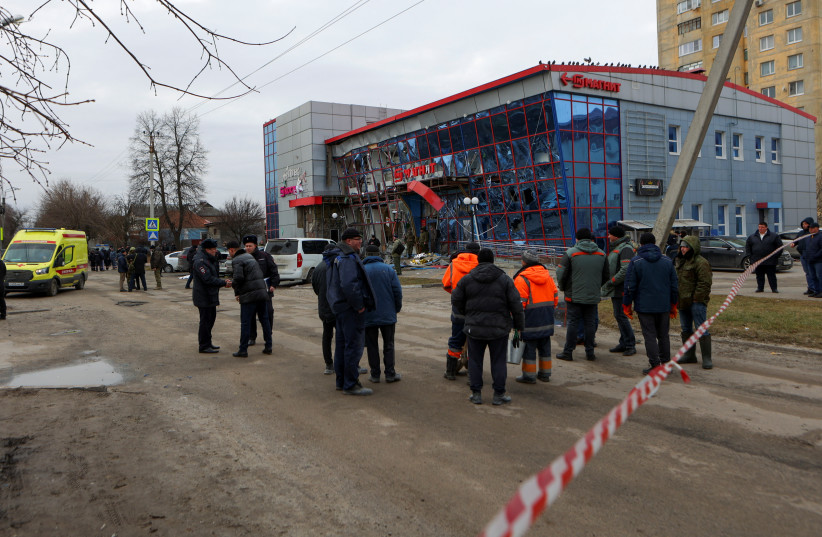
People gather near a shopping centre hit by a missile strike, what local authorities called a Ukrainian military attack, in the course of Russia-Ukraine conflict in Belgorod, Russia, February 15, 2024. (credit: REUTERS/Stringer)
‘I want to help the country in any way I can’
Some of those interviewed by The Moscow Times said that the war has given them a sense of solidarity with citizens in Israel.
“The feeling inside Israel doesn’t make you panic or want to run away,” Valentina, 42, told The Moscow Times. “On the contrary, there’s a sense of ‘I want to stay here, I want to live here, and I want to help the country in any way I can.”
Valentina further told The Moscow Times that she felt like the whole country was attuned to the war in Gaza and Lebanon, while that isn’t really the case in Russia.
“It feels as if the [Russian] government has abandoned its citizens. One thing that truly astonishes me is how many people in Moscow are not aware of what’s happening in Kursk, Belgorod, or elsewhere,” said Valentina, referencing regions in Russia that have faced attacks since the war in Ukraine’s onset. “In Israel, that’s simply not possible — no one can ignore what’s happening in the regions of the country that were attacked.”
These interviews are especially interesting in comparison to data that shows that Israelis are leaving the country at record rates. 40,600 people left to go abroad in the first seven months of the year, averaging 2,200 more each month than in 2023.
Those interviewed acknowledged the dangers of the current conflict. Some said that they were more worried about terror attacks than missiles or rockets.
“There’s no way to protect yourself from that kind of violence,” said Anna, who came to Israel in the fall of 2022. “You just hope you’re not in the wrong place at the wrong time.”
While some sources said that they disagree with the government’s handling of the war, they feel as if they can’t return to Russia.
“There are risks everywhere, but in Russia, it’s particularly dangerous given our political stance,” Anna said. “We loved Moscow. We had a great life before 2022, and leaving was heartbreaking. But for us, it’s just not safe to return.”
Lebanon’s state-run National News Agency reported Sunday night that the IDF carried out a series of raids targeting buildings belonging to the Hezbollah-affiliated Al-Qard Al-Hassan Association after asking residents to stay away. IDF spokesman in Arabic Avichay Adraee issued a series of warnings accompanied by maps of buildings in the southern suburbs of Beirut, the eastern Beqaa, and south Lebanon, warning that these are facilities and interests affiliated with Hezbollah, and calling for people to keep their distance.
The first IDF raids targeted areas in the southern suburbs of Beirut, and the headquarters of Al-Qard al-Hasan in Baalbek, Hermel, and Rayak in the Beqaa Valley.
The Qard al-Hasan is similar in principle to the Jewish Gmach – offering interest-free loans to people in the community who need them. But according to Israeli sources, the bank was used to pay the salaries of Hezbollah terrorists. It also functions as a conduit for money laundering for Hezbollah’s drug trade.
The bank has been under sanctions imposed in 2007 by the US Office of Foreign Assets Control. In 2021, the U.S. Treasury Department said the bank “illicitly moves funds through shell accounts and facilitators, exposing Lebanese financial institutions to possible sanctions.”
Adraee told the people of Lebanon that Hezbollah is financed by the Iranian state budget, which is used for arming, building ammunition storage facilities, erecting launchers, financing rent for Hezbollah members, and carrying out various terrorist activities. According to Adraee, most of the funds transferred from Iran, as well as funds that Hezbollah brought in themselves, are managed by Al-Qard al-Hasan which serves as a shelter for Hezbollah’s economic assets.
While the number of raids on the southern suburbs reached 11 according to the official National News Agency, the Al-Arabiya TV correspondent reported that one of them targeted the vicinity of Beirut Airport. Al-Qard Al-Hassan has 31 branches across Lebanon, many in Beirut’s Hezbollah stronghold southern suburbs, which have been hit repeatedly by the IDF bombing campaign and are largely evacuated. Another branch is located in downtown Beirut, outside the Lebanese parliament.
The Hezbollah bank issued a statement calling the decision to target it a sign of Israel’s “bankruptcy” and assured customers it had taken “measures” to ensure their funds were safe, and threatened “An eye for an eye, a tooth for a tooth.” The Saudi newspaper Asharq Al Awsat reported that a stream of people left the areas surrounding its branches in Beirut.
Israel launched its attack one day following Defense Secretary Lloyd Austin’s remarks regarding the civilian casualties in Lebanon, which he described as “far too high,” urging Israel to reduce certain military strikes, particularly in and around Beirut (Austin Wants Israel to Curb Its Response to the Attempt on Netanyahu’s Life).