
Top aide says US committed to holding Tehran accountable; Gallant: Our strike on Iran will be ‘lethal, precise and surprising’; administration wants IDF Lebanon op to stay limited

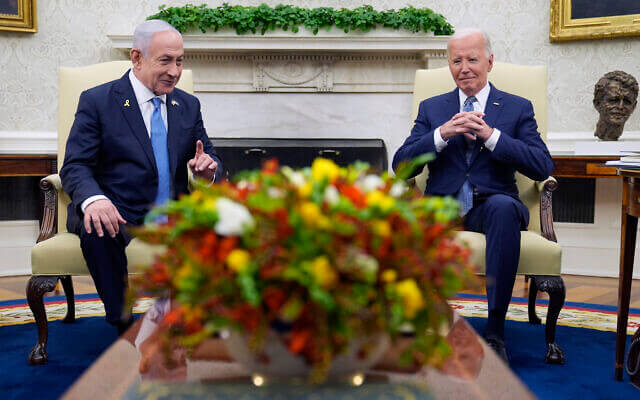
Prime Minister Benjamin Netanyahu held a phone call with US President Joe Biden on Wednesday for the first time in nearly 50 days, as Jerusalem aims to coordinate with Washington regarding its response to Iran’s ballistic missile attack last week.
Israel has pledged a devastating retaliation, but Biden — who directed US forces to help thwart the attack — has expressed opposition to targeting Iran’s nuclear or oil production sites. Netanyahu blocked his defense minister, Yoav Gallant, from flying to the US for meetings with top administration officials until he spoke with Biden.
The US president has long been frustrated with Netanyahu’s handling of the war in Gaza as well as Israel’s fighting in Lebanon, lamenting his lack of strategy for how to draw the conflict to a close.
But the White House characterized Wednesday’s call as “direct and productive” and the Prime Minister’s Office said it was conducted in a “positive spirit.” Vice President and Democratic presidential nominee Kamala Harris listened in on the call.
The White House readout didn’t offer any new information regarding the US stance on a potential Israeli retaliatory attack against Iran, saying that Biden “affirmed his ironclad commitment to Israel’s security [and] condemned unequivocally” Tehran’s October 1 missile strike.

White House Mideast czar Brett McGurk told the roughly 5,000 participants on the call that the US is “committed to holding Iran fully accountable for that attack, and we will continue to do so.”
Highlighting the US military presence in the region, McGurk said, “Things come in and out, but we make sure that we have a very strong deterrent posture because we know that Iran is behind this network of terror that is very focused, not only on US personnel, but particularly on Israel.”
He said Iran’s strike last week, by contrast, was “aggressive, but they failed because they were inaccurate.” He also said that the entire Israeli security system, from the soldier on the ground up to the prime minister, was in sync around the strike on Iran: “The entire chain of command is in line and focused around this issue.”

During the president’s call with Netanyahu, the US readout said Biden also “affirmed Israel’s right to protect its citizens from Hezbollah terror group, while emphasizing the need for a diplomatic agreement between Israel and Hezbollah that would allow civilians on both sides of the Blue Line to return to their homes.”
In recent days, the Biden administration has gradually walked away from its initiative for a 21-day ceasefire along the Blue Line, while intensifying its support for the limited Israeli raids aimed at dismantling Hezbollah posts along the border, which were launched hours after the White House rolled out the ceasefire proposal on September 25.
According to the White House readout, Biden stressed “the need to minimize harm to civilians, in particular in the densely populated areas of Beirut,” where Israel has been conducting airstrikes largely targeting Hezbollah’s Dahiyeh stronghold.
In a press briefing later Wednesday, State Department spokesperson Matthew Miller said that while the US supports the limited ground incursions that the IDF is currently conducting inside Lebanon, it does not want them to extend deeper into Lebanon or for Israel’s presence to become long-term like after the war in 1982.

“We are cognizant of the long history of Israel, starting with limited ground operations in Lebanon, turning those into more full-scale ground operations, turning those into occupation, something that we are very clear we are opposed to,” Miller said.
While US officials have gone on record talking about their concern of Israeli “mission creep,” this appeared to be one of the first times that one of them publicly detailed what that means.
“We want to see them limit their operations to what we have seen to date… This refers to the amount of land that they are going into in Lebanon, not the number of troops that they’re deploying,” Miller explained.
Still, he stressed that the US opposes mass airstrikes in Lebanon akin to the ones Israel has carried out in Gaza. “We cannot and must not see the situation in Lebanon turn into anything like the situation in Gaza.”
Biden and Netanyahu also discussed the situation in Gaza during their phone call, agreeing on the “urgent need to renew diplomacy to release the hostages held by Hamas.”

Talks have been at an impasse for over a month, with Washington placing primary blame on Hamas leader Yahya Sinwar, saying that he has refused to engage in the effort at all.
But Biden also raised to Netanyahu “the humanitarian situation in Gaza and the imperative to restore access to the north, including by reinvigorating the corridor from Jordan immediately.”
Recent days have seen an uptick in reports from humanitarian agencies that they have been unable to access and provide aid to northern Gaza, where Israel has re-intensified military operations.
Biden and Netanyahu “agreed to remain in close contact over the coming days both directly and through their national security teams,” the US readout added, indicating that another call would take place soon after the two hadn’t spoken last since August 21. The two leaders have spoken over a dozen times since Hamas’s October 7 attack last year, White House press secretary Karine Jean-Pierre noted.
Biden later said Wednesday’s call with Netanyahu lasted for about an hour, though, Jean-Pierre said it lasted 30 minutes, and Netanyahu’s office said it lasted for 50 minutes.
Netanyahu’s office hasn’t regularly issued readouts on such calls and has yet to do so this time either.

During the High Holidays call with American rabbis, Biden appeared to lament the hardline nature of Israel’s current government.
Biden reiterated his identification as a Zionist and his belief that Jews around the world would be less safe without a State of Israel.
“That doesn’t mean that Jewish leadership doesn’t have to be more progressive than it is, but it does mean it has to exist, and that’s what worries me most about what’s going on now,” Biden said.
During Wednesday’s press briefing, Jean-Pierre avoided denying that Biden called Netanyahu a “fucking liar” and a “bad fucking guy,” earlier this year, as was revealed yesterday in journalist Bob Woodward’s new book.
“That is not something that I can confirm,” she said when asked about the reported remarks. “There are going to be many books that are written about this administration and many administrations… I’m not going to weigh in on particulars in each one of those books.”
When Politico first reported that Biden had called Netanyahu a “bad fucking guy” in February, the White House issued a firm denial.

Biden spoke at length during his call with American rabbis about the “absolutely despicable” surge in antisemitism at home and abroad since the October 7 attack, detailing the steps his administration has taken to combat the phenomenon.
The president urged those on the call to report incidents of antisemitism to his administration, where the Education and Homeland Security Departments are taking actions to prosecute such actions.
Biden also called out the “vile” antisemitic harassment that some of his Jewish aides involved in the hurricane response effort have been enduring. “It must end now,” he said, adding that his administration “is calling on social media companies to adopt a zero-tolerance policy toward antisemitism and other hateful content.”
The US president went on to reflect that the High Holidays present “a delicate yet profound balance between joy and pain,” which embodies the spirit of the Jewish people more broadly.
Biden has said his father’s sympathy for the Jews during the Holocaust, and for Israel, shaped his political outlook. He told the listeners, as he has in the past, that he sends his children and grandchildren to see Dachau, the Nazi concentration camp, to absorb its horrors. What he saw when he visited Israel in the immediate wake of the Hamas attack in which Palestinian terrorists killed 1,200 people and abducted 251, Biden said, was a “second, smaller Holocaust.”
“I wanted to let the world know where I stood and where America stood,” he said.

Rabbis on the call asked questions about the US-Israel relationship, about antisemitism and about reproductive rights. A focus was on the proliferation of student protests against US backing for Israel, which have at times devolved into hostility toward Jewish students. Neera Tanden, Biden’s top domestic policy adviser, said the administration was committed to inhibiting the attacks.
“The Department of Homeland Security has approved and provided resources to train campus law enforcement administrators on how to ensure Jewish students are safe on campus, and we’re going to keep working to ensure that Jewish students can get their education freed of intimidation and harassment,” said Tanden, who encouraged those on the call to report any harassment.
JTA contributed to this report.