“Just as we entered Karabakh and Libya, we will do the same to Israel,” Erdogan said during a party meeting, referring to the Nagorno-Karabagh dispute and Libya, which have had Turkish troops.

“Just as we entered Karabakh and Libya, we will do the same to Israel,” Erdogan said during a party meeting, referring to the Nagorno-Karabagh dispute and Libya, which have had Turkish troops.
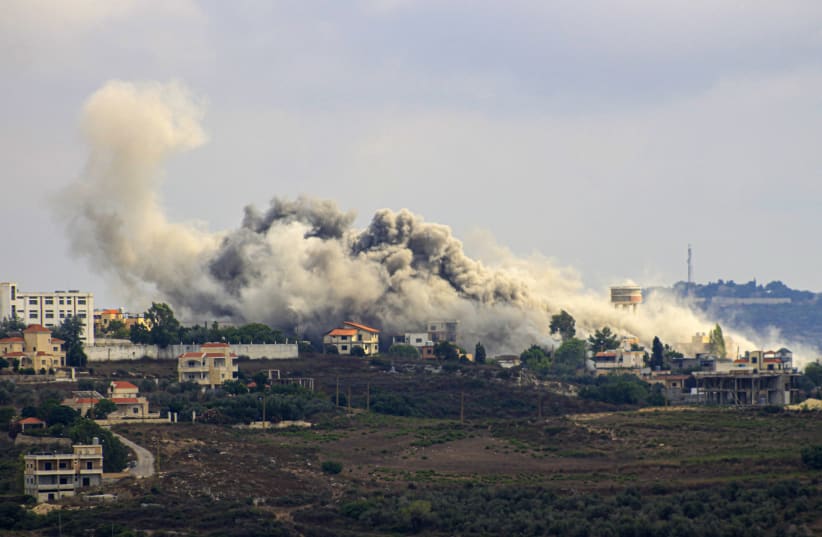
Rotem Mey-Tal, CEO of Asgard Systems, a company developing military technology for the defense industry discusses Hezbollah’s new tactic and supply of electromagnetic ordnance.

“Describing electromagnetic ordnance is like talking about something no one has ever seen, but everyone understands exists and is present in reality—in our case, on the geopolitical and military chessboard of the Middle East. In essence, imagine lightning striking the building you live in, not hitting a lightning rod or antenna, but the entire building, causing all the electrical panels, water heaters, water and electrical systems, household appliances, computers, television systems, and even life-saving medical systems to stop working. It’s like a power outage, but in this case, the systems can also burn out from the inside like in an electrical short.”
“I suspect the threat is more focused on bases, strategic facilities, desalination systems, and the Israeli power grid. However, it’s impossible to say precisely, as such a weapon has never been used in history, so there are no sources or references to learn from.”


“The physics are the same in any way they choose to use such capability, but I suspect the model will likely be in the form of a low-flying UAV. Much like the Iranian-Houthi attack of the upgraded Samad 3 UAV, which struck near the US Embassy in Tel Aviv last weekend, only instead of a kinetic warhead with gunpowder, the front of the UAV can be armed with an electromagnetic pulse (EMP) activation mechanism, which is triggered during the UAV’s flight and emits an EMP upon contact with the target. But again, it’s mostly speculation, as there is no documentation to date of the use of such a weapon or technology.”
“In my personal opinion, not only is this an escalation on the map of potential threats, but it should also be regarded as close to a non-conventional weapon threat. Just as no sovereign country would tolerate a non-conventional weapon threat, the same applies here. This is because, in 2024, electronic processors manage and operate all the vital systems in the State of Israel—infrastructure, medical systems, security, and military applications.
“Think of the analogy from the 1960s, which describes that in a nuclear explosion, only the cockroaches would survive. In the same vein, in an electromagnetic attack, the ‘cockroaches’ (a nickname for electronic components in electrical circuits) will not survive this time. It will affect all of us in our daily lives and emergency preparedness. Like in a poker game, when someone raises a bet on the table, everyone stops everything and looks him in the eye to understand his next move or whether he is bluffing. I think we need to look them in the eye.”
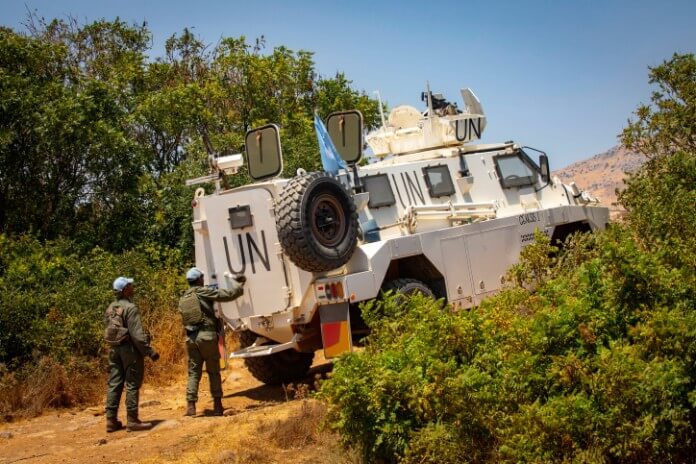
The European Union and United Nations condemned a horrific Hezbollah rocket attack Saturday on northern Israel that killed 12 children and wounded 30 others while they were playing soccer in the Israeli Druze village of Majdal Shams.
The rocket used in the attack was an Iranian-made Falaq-1 that carried a warhead with 53-kilograms explosives, the Israel Defense Forces found in its initial investigation.
But despite their condemnations, top officials in both international bodies urged “restraint,” while offering no proposals that would end the threat to northern Israel posed by Iran’s proxy in Lebanon.
“Shocking images,” said Joseph Borrell Fontelles, High Representative of the EU for Foreign Affairs and Security Policy, and Vice President of the EU Commission.
“I strongly condemn this bloodbath. We need an independent international investigation into this unacceptable incident. We urge all parties to exercise utmost restraint and avoid further escalation,” Borrell wrote in a post on the X social media platform.
The United Nations Interim Force in Lebanon (UNIFIL) also condemned the attack in a joint statement by UN Special Coordinator for Lebanon Jeanine Hennis-Plasschaert and UNIFIL Head of Mission and Force Commander Lt. Gen. Aroldo Lazaro.
“We deplore the death of civilians – young children and teenagers – in Majdal Shams. Civilians must be protected at all times,” the statement read.
The UNIFIL mandate began in 1978, but has since been adjusted several times; most recently the mandate was adjusted following the 2006 Second Lebanon War to include assistance to the Lebanese Armed Forces “in taking steps towards the establishment between the Blue Line and the Litani River of an area free of any armed personnel, assets and weapons other than those of the Government of Lebanon and of UNIFIL deployed in this area” in accordance with the United Nations Security Council Resolution 1701, the ceasefire agreement that ended the war between Hezbollah and Israel.
Needless to say, UNIFIL has declined to tangle with Hezbollah, backed by Iran, thus allowing the terrorist army to create an Iranian proxy state within a state along Israel’s northern border.
Like the EU, UNFIL insisted on moral equivalence in its statement, fearing a wider regional conflict.
“We urge the parties to exercise maximum restraint and to put a stop to the ongoing intensified exchanges of fire. It could ignite a wider conflagration that would engulf the entire region in a catastrophe beyond belief,” the statement continued. “UNIFIL and UNSCOL are in contact with both Lebanon and Israel.”
Lebanon, however, has no power of Hezbollah, which has created its own state within a state and years ago managed to infiltrate the Lebanese government.
Hezbollah today maintains a significant faction in both the Lebanese parliament and its government cabinet, successfully sabotaging every attempt to install a new president for the country for more than a year, following the end of former President Michel Aoun’s six-year term in October 2022.
The attack was likewise condemned by Tor Wennesland, United Nations Special Coordinator for the Middle East Peace Process, who called the slaughter an “abhorrent rocket attack.”
Wennesland, like UNIFIL and the EU, also missed the point, sanctimoniously writing that “children continue to bear the burden of the horrific violence plaguing the region” but opting for moral equivalence over truth.
“I urge all to exercise maximum restraint,” Wennesland wrote on X. “The launching of rockets across the Blue Line must cease immediately. The Middle East is on the brink; the world and the region cannot afford another open conflict.”
One has to wonder: If the targeting of children in a soccer field with 53 kilograms of explosives, and daily attacks from Lebanon leading to the complete evacuation of Israeli residents from their homes along the border due to the danger isn’t already an “open conflict,” then how would one define it?
Share this article on WhatsApp:
Scofield Biblical Institute and Theological Seminary Copyright 2010 – 2020