An Israeli negotiating team will fly out this week for ongoing talks with mediators on securing a hostage release deal with Hamas, despite uncertainty after the IDF’s attempted assassination Saturday of a top commander in the terror group, Muhammad Deif, an Israeli official told The Times of Israel on Monday.
The official declined to say who would be flying, and whether the talks would be held in Doha or in Cairo.
Over the weekend, Israel carried out a strike intended to kill Hamas military commander Deif. The strike killed another target — Rafa’a Salameh, the commander of Hamas’s Khan Younis Brigade — though Israel has not yet been able to confirm whether Deif died in the bombing.
The official maintained that the fact that Hamas has not walked away from talks “further supports the prime minister’s position that continued military pressure and a firm stance brings Israel closer to its goals — the defeat of Hamas and the return of the hostages.
“Now is the time to ramp up military pressure,” said the official, adding that regardless of whether Deif is dead, “Hamas has suffered a major blow.”
US, Egyptian, and Qatari mediators have been working to reach a deal between Israel and Hamas that would see the release of the hostages held in Gaza in exchange for Palestinian security prisoners and a ceasefire in the ongoing war, which began on October 7 when Hamas led a devastating attack that killed 1,200 people and saw 251 abducted to Gaza.

Prime Minister Benjamin Netanyahu holds a press conference at the Ministry of Defense in Tel Aviv. July 13, 2024.(Dudu Bachar/POOL)
Hebrew media outlets have widely reported that US and Qatari mediators also believe the strike on Deif will not push Hamas to stop negotiating for a deal.
Nonetheless, Mossad chief David Barnea, who leads Israel’s negotiating team, is currently not slated to make the trip, as initially planned. The team is expected to comprise professionals who will work on the details of a deal proposal, rather than senior figures who can haggle over the broader terms.
Netanyahu has recently toughened his stance on the current proposal, reportedly amid intelligence reports that the IDF offensive in Gaza has weakened Hamas to the point that it is eager for a ceasefire.
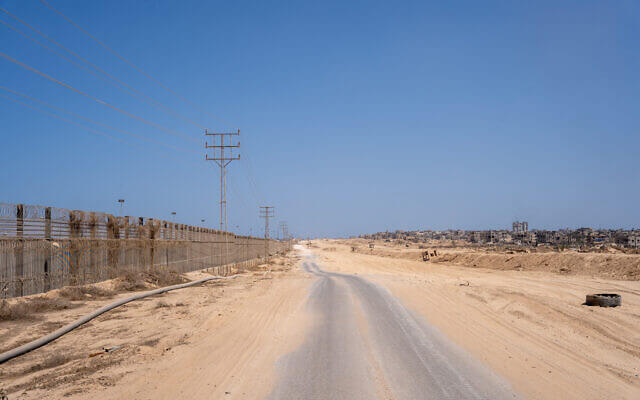
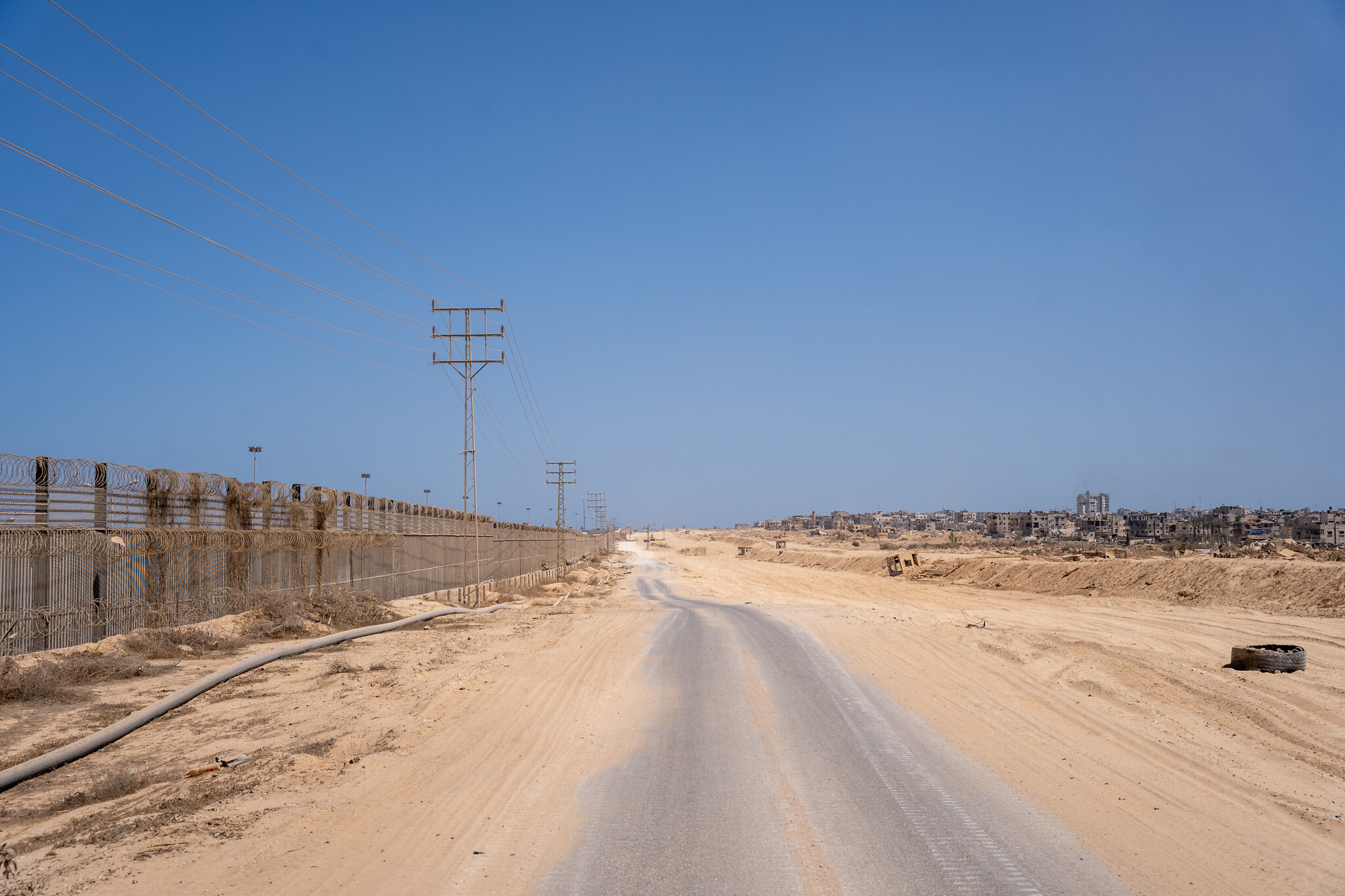
In recent remarks, the prime minister laid down what he said were nonnegotiable terms, one of which concerns maintaining Israeli control along the Egypt-Gaza border, known as the Philadelphi Corridor.
The question of whether IDF forces remain on the border is one of the issues blocking a potential hostage-and-ceasefire deal, because both the Gaza-based Hamas and Egypt, a mediator in the talks, are opposed to Israel keeping its forces there.
The IDF currently controls the border on the Gaza side, having captured it as part of a military offensive to destroy Hamas.
Israel is worried that if its troops leave the border zone, Hamas’s armed wing could return to its practice of smuggling weapons and supplies from Egypt into Gaza via tunnels that would allow it to rearm.

Rocket launchers found by IDF troops on the Gaza-Egypt border, May 22, 2024. (Israel Defense Forces)
Channel 12 reported that recent talks in Cairo with the participation of Shin Bet chief Ronen Bar, Israeli security officials, the head of Egyptian intelligence and US officials hammered out a plan under which Israeli forces would withdraw from the border area, and electronic surveillance systems would be installed to prevent smuggling under or above ground. Work would also be carried out to ensure that there are no more tunnels passing under the border. Israel would have control over the surveillance systems, the report said.
The outline plan is to be presented Tuesday to Netanyahu, the report said.
The framework largely matches similar reports last week that said Israel was discussing withdrawing its forces on the ground from the border area. On Friday, the Prime Minister’s Office emphatically denied that any such pullout was being discussed, calling a Reuters report on the matter “complete fake news.”
Addressing another stumbling block on the road to a hostage deal, the framework calls for the Rafah Border Crossing between Egypt and Gaza to be operated by international entities with the support of local Palestinians who are not linked to Hamas, through a list compiled by Egypt and vetted by Israel’s Shin Bet, Channel 12 reported.
The intention is to add the framework to an appendix of the current hostage deal proposal that will also address other outstanding issues, such as preventing Hamas fighters from moving to the northern Gaza Strip when permission is given for civilians to make the move, the network said.
Also, Israel is demanding that terrorists convicted of murder who are released as part of a hostage deal be exiled to Gaza or another country rather than to the West Bank, Channel 12 reported, citing senior Israeli officials familiar with the details.
That demand has been made to avoid opposition to the deal by far-right National Security Minister Itamar Ben Gvir and Finance Minister Bezalel Smotrich, who have said they would withdraw from the government if such prisoners are released in exchange for hostages.
Israel could request that at least 50 terrorists convicted of murder and released in exchange for hostages be exiled to Gaza or sent to another country, the report said.

This image from video released by the IDF on June 5, 2024, shows a Hamas smuggling tunnel in southern Gaza’s Rafah. (Israel Defense Forces)
Kan news reported Tuesday that Netanyahu is still emphatic about Israel retaining control of the Philadelphi Corridor.
According to the outlet, during a Sunday meeting attended by the prime minister, senior security officials and negotiators, a major gap became apparent between Netanyahu’s position and that of Defense Minister Yoav Gallant and security officials regarding Philadelphi.
Netanyahu insisted on leaving IDF units along the border, rather than just relying on surveillance, in contrast to Gallant and security officials who were in favor of the arrangement. The prime minister also demanded that a method be found to prevent armed Gazans from moving to the north of the Strip. Negotiators warned Netanyahu that without a withdrawal of Israeli forces from the Egyptian border and a plan to enable the return of displaced Palestinians to northern Gaza, Hamas would not agree to a deal, the report said.
Meanwhile, Gallant told relatives of IDF observation soldiers held hostage by Hamas at a meeting Monday that a hostage-truce deal is closer than it has ever been and that the security establishment sees no insurmountable security obstacles to it, Channel 12 reported. The female soldiers were captured from their base on the border on October 7.
Gallant reportedly advised the families to schedule a meeting in the next few days with Netanyahu to ensure the opportunity was not missed.

Defense Minister Yoav Gallant meets with IDF fighter pilots at the Nevatim IDF air base on July 14, 2024. (Ariel Hermoni/Defense Ministry)
“When a deal was not possible, I told you,” Gallant said, according to Channel 12. “Now it is [possible], so I’m telling you: It’s closer than it has ever been. There is complete unanimity in the defense establishment — the IDF, the Shin Bet, and the Mossad — that there is no insurmountable security obstacle to the deal from their point of view.”
Gallant reportedly went on: “The matter is not parked with us [in the defense establishment]. It is critical to move ahead with decisions in the near future. It’s important to finalize the processes in the coming days before the prime minister’s trip to Washington, or during the course of his visit. After that, it will be much more difficult and complicated.”
Netanyahu heads to the US next week to address a joint session of Congress and for talks at the White House with President Joe Biden.
The hostage families reportedly asked Gallant how exactly they should proceed, and whether Netanyahu was sabotaging the deal.
The defense minister, in response, reportedly said: “You should arrange a meeting with the prime minister before he flies to the US. He’s the one who decides.”

Families of hostages and supporters march toward Jerusalem to demand their release, on the third day of a four-day trek from Tel Aviv, at Shoresh, July 12, 2024 (Sha_b_p@ / Pro-Democracty Protest Movement)
Responding to the report, Gallant’s office said he holds frequent meetings to update families of hostages, but would not comment on the reported content of such meetings and was unhappy when material was leaked from them.
A source in the Prime Minister’s Office said that to secure the release of the hostages, pressure must be increased on Hamas’s Gaza leader Yahya Sinwar — and not on Netanyahu.