
U.S. officials say the framework of a three-stage deal is down to implementation details.
July 10, 2024 at 7:43 p.m. EDT

Officials caution that although the framework is in place, a final pact probably isn’t imminent, and the details are complex and will take time to work through.
If final agreement could be reached, it would be a ringing validation of President Biden’s patient diplomacy, which has tried to balance America’s role as peacemaker in the Middle East with strong military support for Israel. It would also create a potential valedictory moment for the president, affording him a chance to step back honorably from his quest for a second term or, conversely, to double down.
Like most peace agreements, this one would reflect in part the exhaustion of both sides. After nine months of war, Israel wants to rest its troops and prepare for possible conflicts with Iran and its proxies. Hamas, in “rough shape” in its underground lair, according to one U.S. official, is said to be low on ammunition and supplies. It’s also facing growing pressure from battered Palestinian civilians, who are increasingly vocal in demanding a truce.
The agreement, described Wednesday by U.S. officials, envisions a three-stage resolution of the conflict. First would be a six-week cease-fire, during which Hamas would release 33 Israeli hostages, including all female prisoners, all men over 50 and all who are wounded. Israel would release hundreds of Palestinians from its prisons and withdraw its troops from densely populated areas toward the eastern border of Gaza. Humanitarian aid would flow in, hospitals would be repaired, and crews would begin clearing the rubble.
The stumbling block has been the transition to, in which Hamas would release the male soldiers who remain as hostages and both sides would agree to a “permanent end to hostilities” with “a full withdrawal of Israeli forces from Gaza.” Each side feared the other would use the initial pause to rearm and return to battle. And Israel wanted to make sure it achieved its primary goal of blocking Hamas from ruling Gaza again.
The breakthrough came recently, when Hamas relented on its demand for a written guarantee on a permanent end to the fighting. Instead, it accepted the reassuring language of a U.N. Security Council resolution, passed last month, affirming the U.S.-negotiated deal. Here’s the key passage: “If the negotiations take longer than six weeks for phase one, the ceasefire will still continue as long as negotiations continue,” the U.N. resolution says. American, Qatari and Egyptian mediators would “work to ensure negotiations keep going until all the agreements are reached and phase two is able to begin.”
Israel and Hamas have both signaled their acceptance of an “interim governance” plan that would begin with Phase 2, in which neither Hamas nor Israel would rule Gaza. Security would be provided by a force trained by the United States and backed by moderate Arab allies, drawn from a core group of about 2,500 supporters of the Palestinian Authority in Gaza who have already been vetted by Israel. Hamas has told mediators that it is “prepared to relinquish authority to the interim governance arrangement,” a U.S. official said.
As security expands in postwar Gaza, the peace plan envisions a third phase, with what the U.N. resolution describes as a “multi-year reconstruction plan.”
As U.S. mediators moved closer to finalizing this deal, they got crucial help from their diplomatic partners, Qatar and Egypt. To pressure Hamas, Qatar told the group’s representatives they could not remain in Doha if they rejected the pact. Egypt provided last-minute help by accepting an innovative U.S. proposal to block any new tunnels across the border between Egypt and Gaza after Israel withdraws its troops.
Israeli Defense Minister Yoav Gallant, who has emerged as a key contact in the negotiations, issued a statement Wednesday noting “progress … with Egypt” toward a plan “that will stop smuggling attempts and will cut off potential supplies for Hamas.”
If the cease-fire deal is clinched, it will open the way for two other major changes in the Middle East landscape — involving Lebanon and Saudi Arabia — that could reduce the danger of a broader war.
Lebanon has signaled that following a Gaza truce, it would endorse a package that includes withdrawal of Hezbollah forces north from the border to near the Litani River. The agreement would also include Israeli acceptance of border changes that Hezbollah has long demanded and other confidence-building measures to end the deadly exchange of rocket fire between the two sides.
With Congress in session for only 4 more weeks before US presidential vote, there’s not enough time left for Senate to ratify agreement, which first requires still-elusive Gaza truce

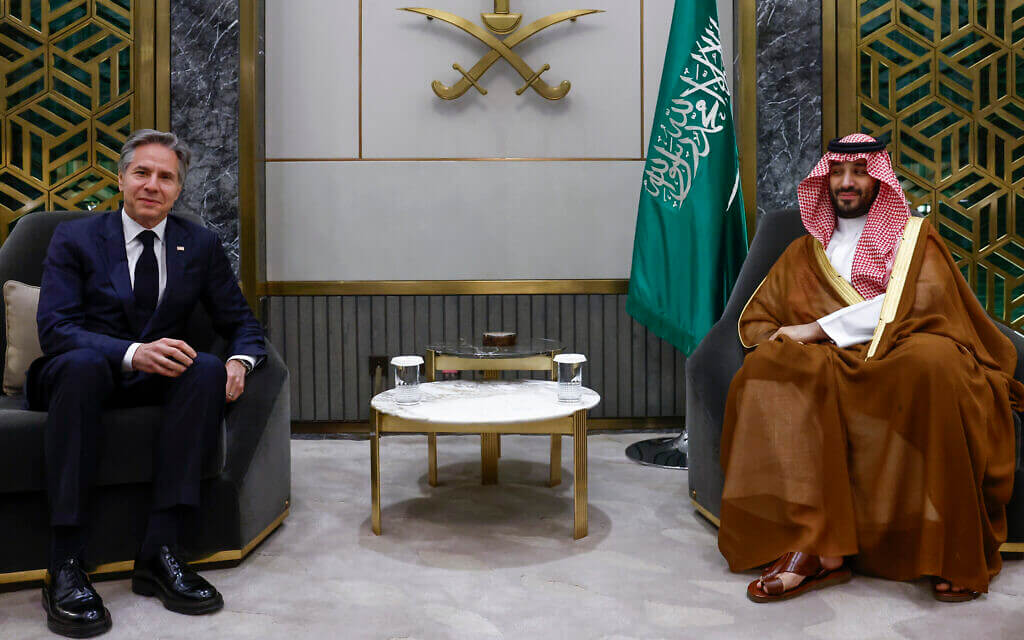
The window for US President Joe Biden’s administration to broker a long-sought normalization deal between Israel and Saudi Arabia before the November presidential election has closed, a Democratic lawmaker and a senior Republican Senate aide told The Times of Israel on Wednesday.
The normalization deal on its own was always an uphill battle, since Saudi Arabia is demanding that Israel agree to establish a pathway to a future Palestinian state — a framework Prime Minister Benjamin Netanyahu has repeatedly rejected.
But the US has sought to advance the normalization deal in parallel to its own defense pact with Saudi Arabia, which would require Senate ratification.
The two congressional sources speaking to The Times of Israel maintained that there is not enough time left in the congressional calendar for the Senate to hold the hearings necessary to approve the defense deal.
Indeed, there are less than four weeks in which the US Senate is in session before it recesses on September 27 for the last time until the election. This period includes the month of August, when Congress is only open for two days.
Senate Majority Leader Chuck Schumer could theoretically try and call lawmakers back from recess in October, but the two congressional sources acknowledged that the administration would not be able to secure the backing of the roughly 10 Republicans needed to approve the pact weeks before the presidential election.

A White House official, also speaking on condition of anonymity, didn’t go as far as the congressional sources, arguing that the window to secure a deal “hasn’t closed completely.”
But they agreed that a deal isn’t possible without a ceasefire first being reached in Gaza — a point made publicly by top US and Saudi officials, who have recognized that Riyadh will not be able to sell a normalization deal domestically or in the region if the Israel-Hamas war is still ongoing.
An Israeli official involved in the hostage release and ceasefire negotiations with Hamas told The Times of Israel earlier this week that progress had been made in recent days, while clarifying that the sides will likely need two or three more weeks before a deal is finalized, given the gaps that still remain and the pace of the talks thus far.
“The politics were already going to be extremely difficult, given Republicans’ aversion to giving Biden [achievements] in an election year and the aversion of many Democrats to giving such prizes to the current Israeli and Saudi leadership,” said the senior Republican Senate aide.
“But now the administration is fighting against time, which it just doesn’t have enough of,” the aide added.
US Senator Lindsey Graham — one of the few Republicans to declare up front that he would be prepared to back a deal brokered by a Democratic White House — surmised upon meeting Netanyahu in January that the administration had until June to finalize the normalization agreement.

The White House official clarified that even if Biden loses the election, the US could still finalize a deal in the lame-duck period between the November election and the January inauguration, but that would entail another level of political complexity.
A second Israeli official agreed with the conclusion of the congressional sources that the window for a pre-election normalization deal has shut, while a State Department spokesperson did not respond to a request for comment.
Conventional wisdom suggests that a deal might be easier to ratify under a Biden White House, because he could bring along Democrats wary of Jerusalem and Riyadh’s rights records along with Republicans who have overwhelmingly backed the Abraham Accords, the series of Israeli-Arab normalization deals brokered by former US president Donald Trump.
Under Trump, Senate Democrats wary of both Israel and Saudi Arabia

Source: Freepik.com
BRICS members India and Russia are forging new partnerships by putting their national payment systems at work to sideline the US dollar. India’s payment system RuPay and Russia’s MIR systems could soon be jointly integrated for seamless cross-border transactions between the two nations.
Also Read: After Pausing BRICS, Saudi Arabia Starts Issuing US Dollar Bonds
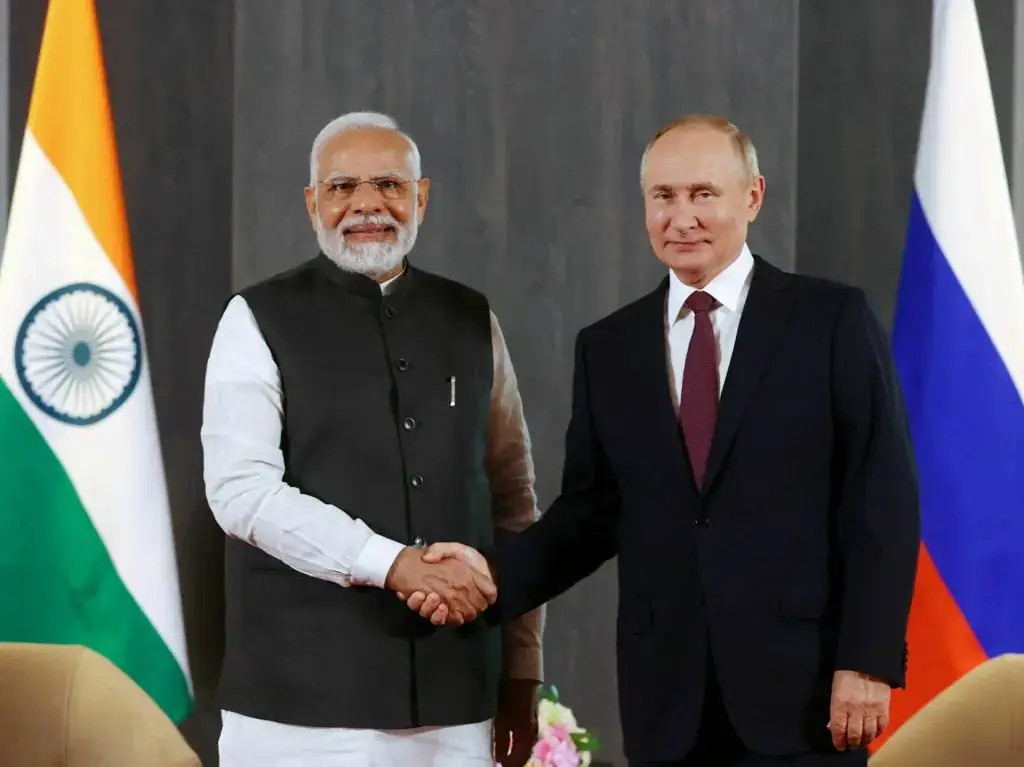
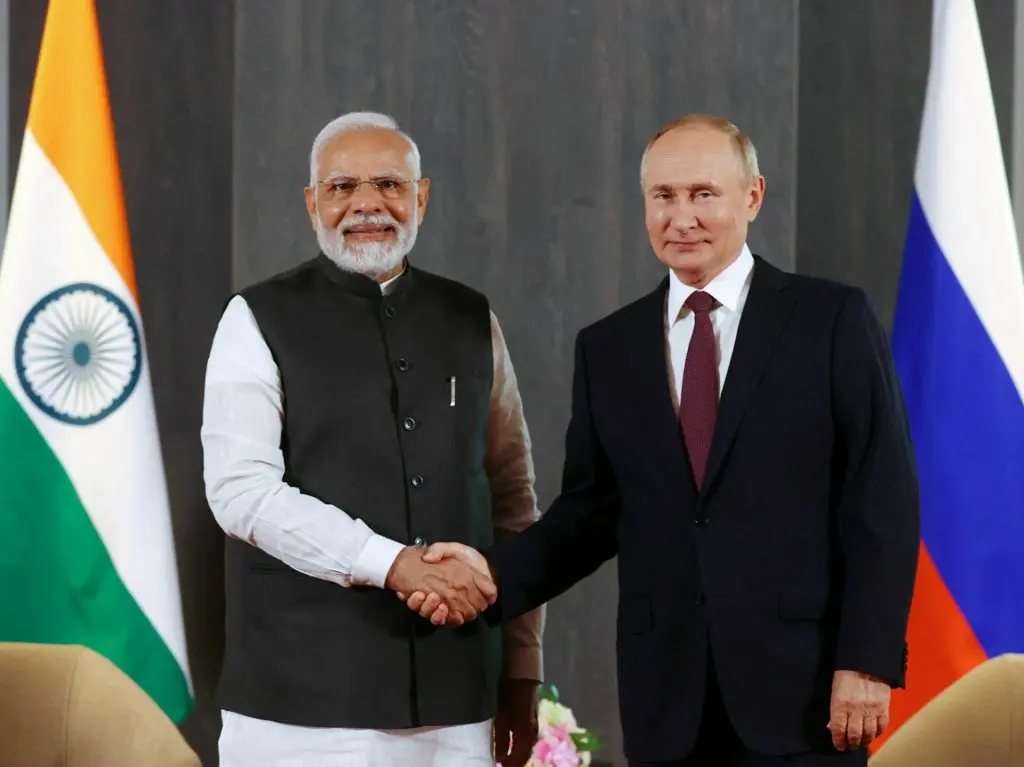
Russia welcomed India’s Prime Minister Narendra Modi to Moscow and the meeting forged new alliances and trade decisions. During the meeting, India confirmed that it is open to trade with its BRICS counterpart Russia using the RuPay and MIR payment systems. If BRICS countries begin using their national payment mechanisms for trade, the US dollar will be sidelined for all transactions.
Also Read: 3 Ways BRICS Started the De-Dollarization Process
The move will benefit India and Russia as their local currencies will be used and can save millions in exchange rates. The dependency on the US dollar will reduce strengthening their local currencies and native economies. BRICS is finding several ways to advance the de-dollarization agenda where the US dollar takes the back seat. Read here to know how many sectors in the US will be affected if BRICS ditches the dollar for trade.
Also Read: More Countries Are Looking To Join BRICS Alliance
BRICS: India and Russia Look To Use National Payment Systems, US Dollar Will Play No Role
Andrey Kostin, the CEO of Russia’s VTB Bank confirmed the development during a press conference on Wednesday. “We (BRICS) must develop our own settlement system that includes the global south enabling us to conduct transactions in our own national currencies” and not the US dollar, said Kostin.
Also Read: BRICS: Russia and Iran to Officially Ditch the US Dollar
“India has a positive attitude towards working with Russia,” he said. The CEO explained that the RuPay and MIR payment systems could soon be integrated for trade settlements. “We will make some progress given the complexities that exist,” he said. Kostin summed it up by saying that BRICS wants to be free from the US dollar, Euro, and Western currencies.