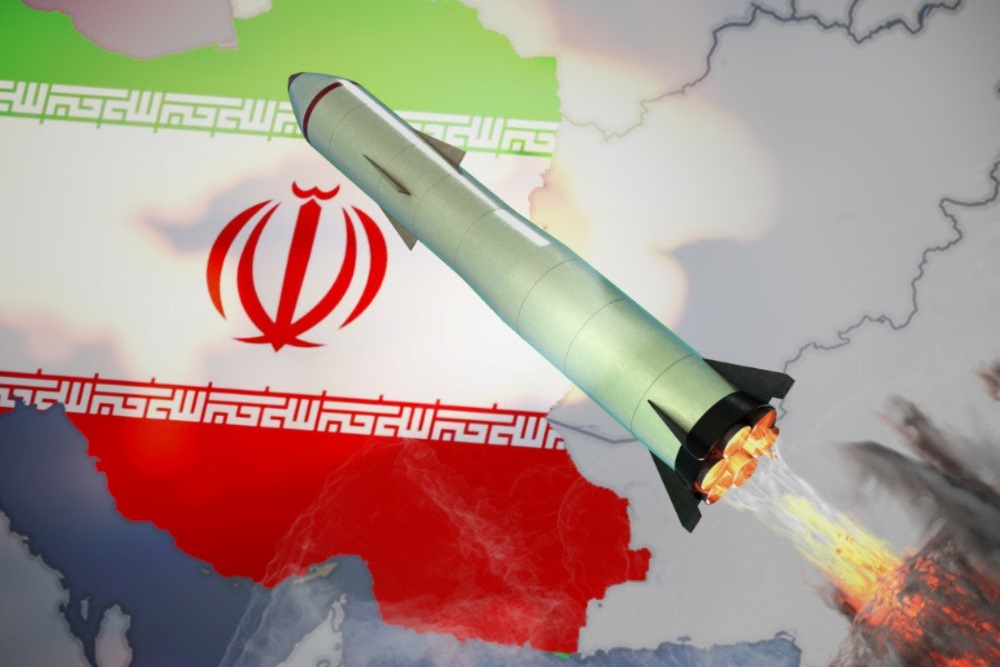
Dramatic Days in Mideast: Iran Advancing to Nuclear Bomb?

Iran threat alarms Israel (Archive: iStock.com/Vchal)

The nuclear threat is reemerging as a top priority for Israel as Iran takes alarming steps to advance a weapons program. With war still raging, Israel is rushing to refocus on the Iranian nuclear project while getting the US onboard for action against Tehran.

Israel fears that Iran will break out toward nuclear weapons while the US is preoccupied with the presidential election campaign. Tehran may also calculate that the ongoing conflicts in Gaza and Lebanon are diverting attention away from its nuclear moves.

Atomic watchdog IAEA warned that Iran is dramatically accelerating uranium enrichment by installing advanced centrifuges at Fordow. Tehran’s enrichment capacity is expected to increase by over 300%, allowing it to produce enough material for five atomic bombs within a month, according to a recent report.

New intelligence points to Iranian activities in recent months to shorten the time needed to build a nuclear bomb, Walla News reported. Dozens of scientists in Iran are said to be working on aspects of weaponization, including computer modelling related to nuclear devices.

Due to the escalating threat, PM Netanyahu re-established working groups of Israeli defense officials, intel officers and diplomats to focus on the Iranian nuclear project, the report said.

In parallel, the Israeli Air Force in recent weeks conducted several extensive training exercises simulating long-distance strikes on remote targets, potentially in preparation for military action against Iran.

The Israeli drills included long-range flights, midair refueling & strike operations, Israel Hayom reports. Notably, the Air Force created an Iran department during the current war, amid intel assessments indicating alarming Iranian progress toward nuclear weapons capabilities.

Mossad vs. Iran

Israel is seeking American help in stopping Tehran’s nuclear drive. Defense Minister Yoav Gallant is visiting Washington this week and warned that “time is running out” to block Iran’s nuclear path.

Gallant urged the US to honor American pledges to prevent Iranian nuclear weapons. He emphasized that the US and Israel must join forces to neutralize the “greatest threat” to the future of the world and the Middle East.

Former national security advisor Jacob Nagel called for a new US-Israeli paradigm to counter Iran’s nuclear ambitions. Instead of prioritizing uranium enrichment, Israel must shift its focus to Iranian weaponization while taking steps to weaken the regime, he wrote.

Israeli and US intel agencies should prioritize efforts to monitor Iran’s weaponization program, Nagel said. As part of this process, they should identify key assets and personnel involved in the Iranian project and build strike capabilities, he added.

Behind the scenes, Mossad continues to keep an eye on Iran’s nuclear program. An Israeli team led by Mossad is dedicated specifically to weaponization activities, Walla News said. As the threat level rises, Israel may reactivate its covert action networks inside Iran and intensify operations to disrupt Tehran’s nuclear progress.

Amid push for diplomatic solution, US official warns full-blown conflict with Hezbollah could break out with ‘little notice’, Gallant says Jerusalem ‘not looking for war’


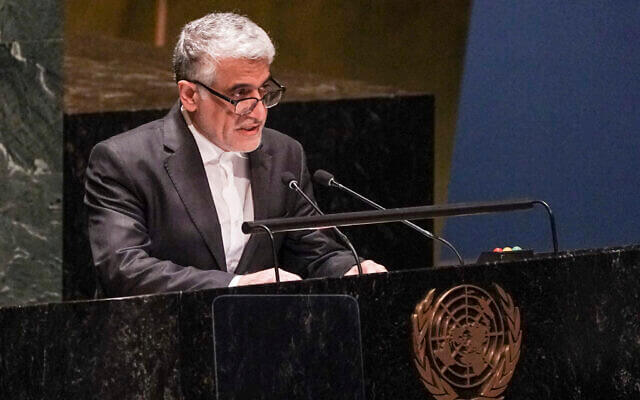
Iran's United Nations Ambassador Amir Saeid Iravani addresses the UN General Assembly at the body's headquarters in New York, February 23, 2023. (AP Photo/Bebeto Matthews)

Iran’s United Nations Ambassador Amir Saeid Iravani addresses the UN General Assembly at the body’s headquarters in New York, February 23, 2023. (AP Photo/Bebeto Matthews)

Iran’s mission to the United Nations said on Friday that if Israel embarks on a “full-scale military aggression” in Lebanon against Hezbollah, “an obliterating war will ensue.”

The warning came after the Israel Defense Force attacked several Hezbollah positions, in response to the Iran-backed terror group’s latest barrage on northern Israel hours earlier, amid escalating tensions on the Lebanese border.

Writing on X on Friday, the Iranian UN mission said that if Israel were to launch a war on Hezbollah, “all options, including the full involvement of all resistance fronts, are on the table.”

Iran’s “Axis of Resistance,” which includes Hezbollah, Hamas, Yemen’s Houthis, and other groups in Syria and Iraq, has been targeting Israel since October 7, when thousands of Hamas-led terrorists stormed southern Israel, killing 1,200 people and taking 251 hostages, sparking the war in Gaza.

Iran itself also launched an unprecedented missile-and-drone strike on Israel on April 14, two weeks after an alleged Israel airstrike near Tehran’s embassy in Damascus killed several senior officers of the Islamic Revolutionary Guard Corps. The Iranian strike was almost entirely repelled by Israel, the United States and other allies, though a 7-year-old girl was seriously injured in the attack.

Soon after Hamas’s October 7 massacre, Israel evacuated much of its north, fearing Hezbollah, Iran’s proxy in Lebanon, would carry out a similar attack. Some 60,000 residents of northern Israel remain displaced, as the country seeks to remove the terror group from its northern border.

Diplomatic efforts led by the US have so far failed to make the terror group retreat beyond the Litani River — some 30 kilometers (19 miles) north of the border with Israel — in accord with United Nations Security Council Resolution 1701, which ended the 2006 Israel-Hezbollah conflict.

Tensions between Israel and Hezbollah have been steadily mounting, with a US official cited in Politico on Thursday as saying that the risk of war is higher than it has been for weeks. According to the official, a major attack by either side could spark a war, which could happen with “little notice.”

In a June 19 speech, Hezbollah leader Hassan Nasrallah said “no place” in Israel would be spared from the group’s weapons in case of a full-blown war, adding that Hezbollah would fight with “no rules” and “no ceilings.”

He also threatened Cyprus for allowing Israel to use its territory for military exercises, and appeared to threaten Israel’s offshore gas rigs, saying Israel “knows that what also awaits it in the Mediterranean is very big.”

Hezbollah leader Hassan Nasrallah speaks at a ceremony commemorating a slain Hezbollah senior commander, June 19, 2024. (Screenshot)

Speaking at a ceremony commemorating senior Hezbollah commander Taleb Abdullah, whom Israel killed in an airstrike a week before, Nasrallah said the Shiite terror group does not want “total war” but is only acting in support of Hamas.

“We will continue to support Gaza and we are ready for anything. We are not afraid,” said Nasrallah. “Our demand is clear: A complete and permanent ceasefire in Gaza.”

Israeli security leaders have also said they would prefer a diplomatic resolution to the conflict, but were readying the military in case war became necessary.

Defense Minister Yoav Gallant speaks with troops at an Iron Dome battery in northern Israel, July 28, 2024. (Shachar Yurman/Defense Ministry)

Speaking to troops at an Iron Dome air defense battery in northern Israel on Friday, Defense Minister Yoav Gallant said the country was “not looking for war.”

“[We are] preparing the military force… and this can happen quickly. On the other hand, the political alternative is being prepared, it is always better,” said Gallant.

Emanuel Fabian contributed to this report. 


Atomic energy agency says Tehran’s four new cascades have been put in place but haven’t yet started enriching uranium in them


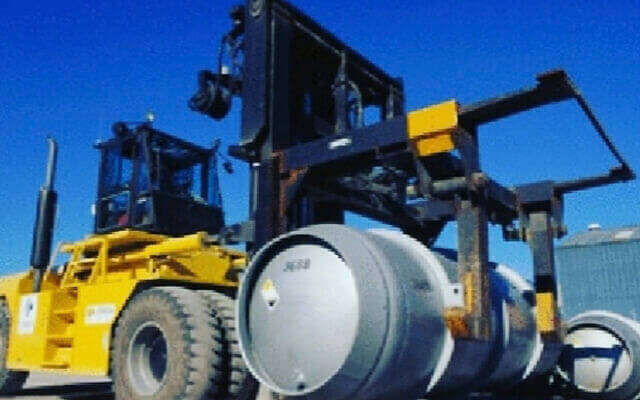
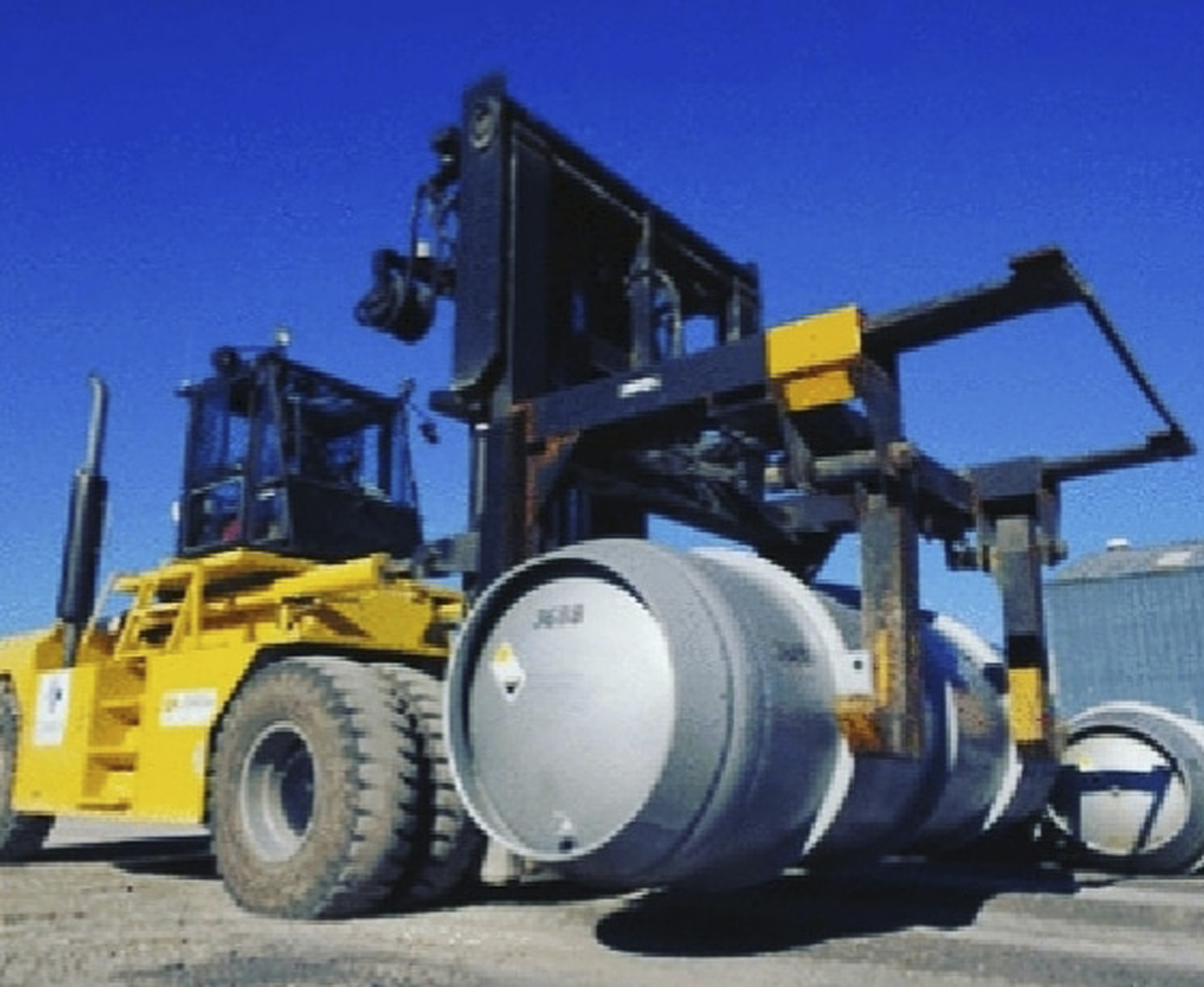
A lift truck carries a cylinder containing uranium hexafluoride gas for the purpose of injecting the gas into centrifuges in Iran's Fordow nuclear facility, November 6, 2019. (Atomic Energy Organization of Iran via AP)

A lift truck carries a cylinder containing uranium hexafluoride gas for the purpose of injecting the gas into centrifuges in Iran’s Fordow nuclear facility, November 6, 2019. (Atomic Energy Organization of Iran via AP)

VIENNA  – Iran has installed half the advanced uranium-enriching machines it said earlier this month it would quickly add to its Fordow site dug into a mountain but has not yet brought them online, the UN nuclear watchdog said in a report seen by Reuters.

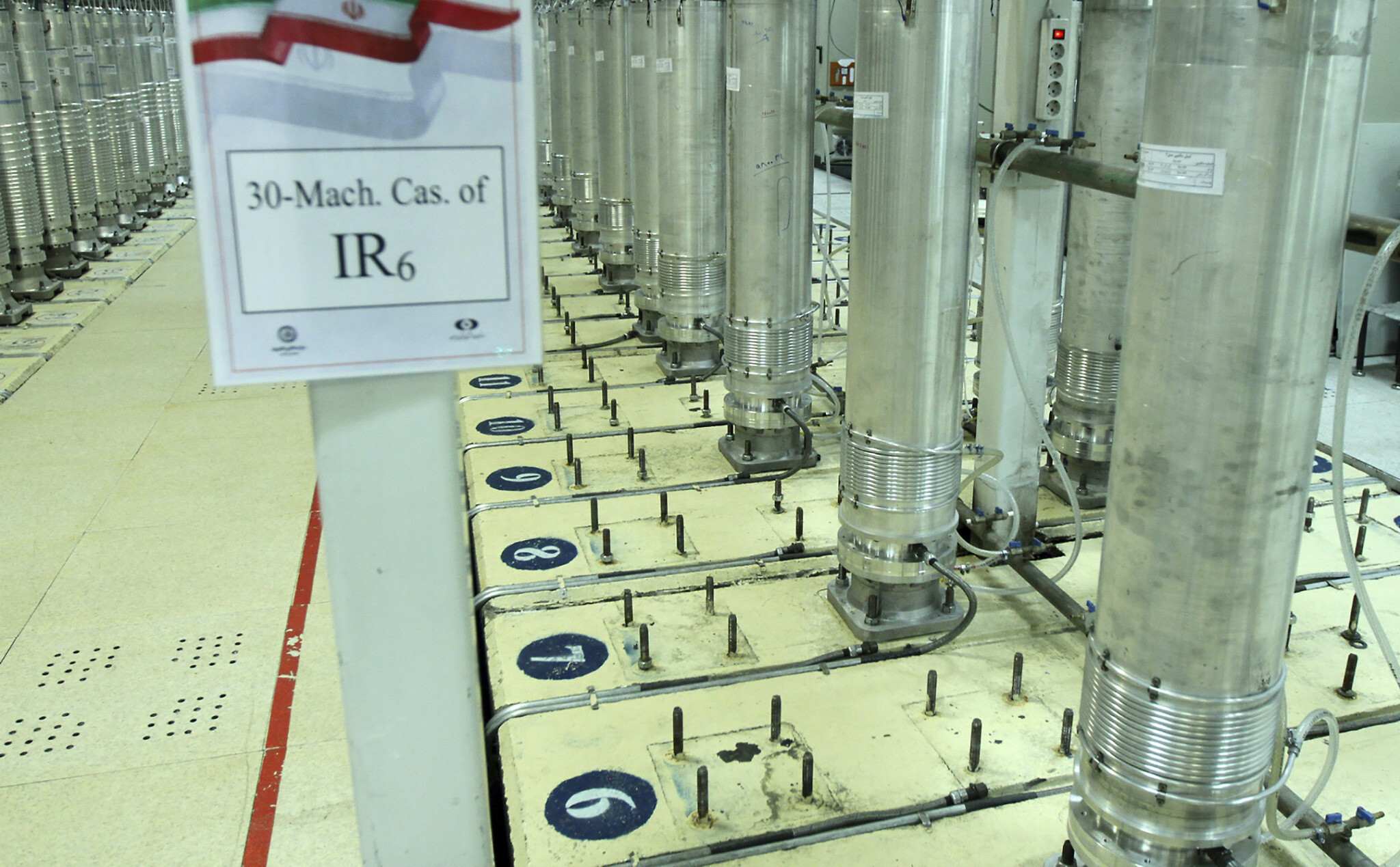
Iran informed the International Atomic Energy Agency two weeks ago it would rapidly expand its enrichment capacity at Fordow by adding eight cascades, or clusters, of IR-6 centrifuges at Fordow within three to four weeks.

Within two days the IAEA had verified that two of the cascades had been installed. In a confidential report to member states on Friday the agency said that number had now doubled.

“The Agency has verified that Iran has installed four of the aforementioned eight IR-6 cascades in Unit 1 at FFEP (Fordow Fuel Enrichment Plant),” the report said, adding that the verification happened on Sunday.

“Iran has not specified to the Agency when it would start feeding any of the cascades in Unit 1 with UF6 or the planned enrichment level,” it added, referring to uranium hexafluoride gas, the feedstock for centrifuges.

The United States announced new sanctions targeting Iran’s oil trade on Thursday, saying it was acting in response to “steps (by Iran) to further expand its nuclear program in ways that have no credible peaceful purpose.”

This photo released November 5, 2019, by the Atomic Energy Organization of Iran shows centrifuge machines in Natanz uranium enrichment facility near Natanz, Iran. (Atomic Energy Organization of Iran via AP, File)

Iran is enriching uranium to up to 60% purity, close to the roughly 90% of weapons grade, at two sites: Fordow and an above-ground pilot plant at Natanz. It has enough material enriched to up to 60%, if enriched further, for three nuclear weapons, according to an IAEA yardstick.

At Fordow, it is currently using the two only operating cascades of IR-6 centrifuges there to enrich to 60% from 20%.

Iran also informed the IAEA this month that it would bring online more of the dozens of advanced centrifuges it has installed at its largest enrichment site, the underground Fuel Enrichment Plant (FEP) at Natanz.

The report said Iran plans to feed UF6 into 15 cascades of IR-2m and IR-4 machines already installed but not yet enriching. The last quarterly IAEA report in May put the number of those machines installed but not operating at 21.

Iran has now carried out passivation, a process that involves feeding UF6 into centrifuges in preparation for enrichment without accumulating enriched uranium, on six of those cascades, Friday’s report said.

“Iran has started feeding, for passivation purposes, 4 natural UF 6 into an additional three IR-2m cascades and three IR-4 cascades for the first time,” it said.

Iran had also begun installing one of the 18 extra IR-2m cascades it said this month it would set up at the FEP, the report added.