International alarm grows over potential third Lebanon war involving Iran. Netanyahu warns of Iran’s multi-front threats while diplomats urge diplomatic solutions amid escalating tensions.

TOVAH LAZAROFF YAEL HALFON

Updated: JUNE 25, 2024 00:04
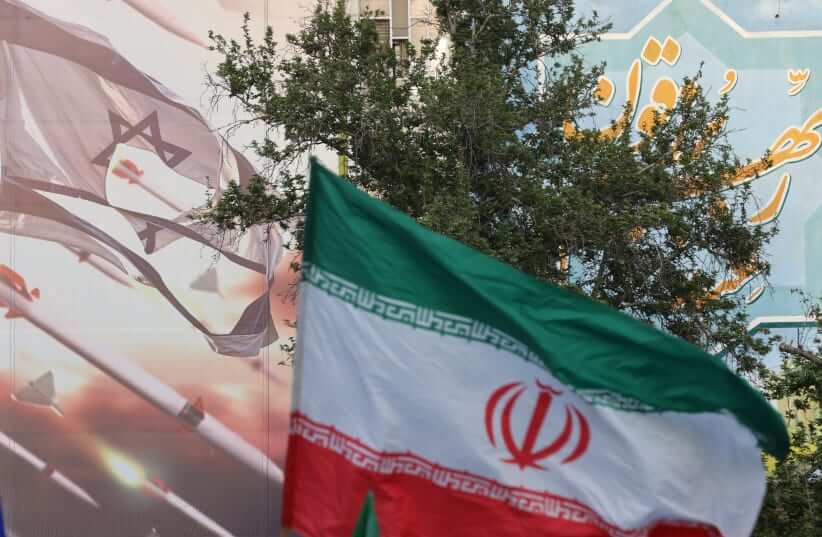
 An anti-Israel billboard is seen next to the Iranian flag during a celebration following the IRGC attack on Israel, in Tehran, Iran, April 15, 2024. (photo credit: Majid Asgaripour/WANA/via Reuters)
An anti-Israel billboard is seen next to the Iranian flag during a celebration following the IRGC attack on Israel, in Tehran, Iran, April 15, 2024.
(photo credit: Majid Asgaripour/WANA/via Reuters)

International alarm grew Monday over the prospects of a third Lebanon war that could spill over to include Iran, as Prime Minister Benjamin Netanyahu warned that the Islamic Republic was the force behind the country’s multi-front existential wars.

“We are in a fight for our existence, a fight being conducted on seven fronts. The attack against us is being led by Iran, which openly seeks to destroy us,” Netanyahu told the Knesset plenum on Monday.

“Iran and its proxies have been scheming to do this through missile attacks against Israel and by invading our territory. The more we deepen the war in the Gaza Strip, the more we discover additional evidence of the scope of the multi-front campaign against us,” Netanyahu said.

“We will thwart this campaign,” he stressed.

National Unity Party head MK Benny Gantz, who is a former defense minister and IDF chief of staff, told French President Emmanuel Macron in a phone conversation that the possibility of a diplomatic solution to the cross-border violence seemed more remote, and war more likely.

National Unity MK Benny Gantz speaks at the Tel Aviv conference at the Tel Aviv University on June 19, 2024 (credit: AVSHALOM SASSONI/FLASH90)

National Unity MK Benny Gantz speaks at the Tel Aviv conference at the Tel Aviv University on June 19, 2024 (credit: AVSHALOM SASSONI/FLASH90)

“Resorting to military means to remove the threat Hezbollah poses to the citizens of Northern Israel as part of the wider Shi’ite-Iranian axis of terror destabilizing the region, seems increasingly necessary,” Gantz told Macron, according to his spokesperson.

US and Israeli officials urge diplomatic solutions

Gantz stressed the importance of consolidating a new regional architecture based on an alliance of moderates to counter growing Iranian aggression, his spokesperson explained.

US State Department spokesperson Matthew Miller cautioned Israel that “we will continue to press the government of Israel that we don’t want to see further escalation.”

He spoke with reporters as Gallant met with US Secretary of State Antony Blinken in Washington. The two met after Gallant spoke face-to-face with US envoy Amos Hochstein, who visited Israel and Lebanon last week.

“We don’t want to see a full-scale war with Hezbollah. We think there ought to be a diplomatic resolution to the conflict across the Israel-Lebanon border that is keeping tens of thousands of families on each side of the border from returning to their homes,” Miller said.

US Ambassador to Israel Jack Lew told the 21st Herzliya Conference at the Reichman University on Monday that the US was “urging a diplomatic solution,” and that Hochstein had been traveling back and forth between Lebanon and Israel to try and achieve that goal.

“A diplomatic outcome… is, I think, closer than people think in terms of most of the issues,” Lew said. “We just are not at a point in time where there’s the kind of quiet in Gaza to permit that to get to a completion.”

Lew in Herzliya and Miller in Washington both stressed the importance of a Gaza ceasefire to the restoration of calm along Israel’s northern border.

US Chairman of the Joint Chiefs of Staff the Military, General C.Q. Brown, warned on Sunday that it was unlikely that America could provide the kind of security umbrella to Israel in the event of a war with Hezbollah, as it did when Iran attacked in April. His words carried added weight in light of concerns that Hezbollah missiles could overwhelm the Iron Dome system in the North.

German Foreign Minister Annalena Baerbock, who visited Israel on Monday en-route to Beirut, spoke of the growing tensions in the North when she addressed the Herzliya Conference.

“The risk of an unintended escalation and of all-out war is growing by the day,” she stated.

“We are extremely concerned about the increase in violence at the northern border,” Baerbock said. “I will pay a visit to Beirut tomorrow again exactly for this reason, where many also do not want another war. Together with our partners, we are working hard on finding solutions that can prevent more suffering,” she said.

“Israel has a right to defend itself against Hezbollah’s relentless attacks in the North,” she stressed. “It’s Hezbollah who started this violence” after the Hamas-led attack against Israel on October 7, “forcing tens of thousands of Israelis from their homes. No country in the world should have to accept that.”

The German Foreign Minister called on Hezbollah to withdraw the 2006 ceasefire line from the Second Lebanon war, as she called for the full implementation of UN Security Council resolution 1701 that codified that ceasefire.Earlier in the day, Baerbock participated in a meeting of European Union foreign ministers led by EU policy chief Josep Borrell.

He warned that the Middle East was close to seeing the conflict expanding into Lebanon, just days after Hezbollah threatened EU member Cyprus.

“The risk of this war affecting the south of Lebanon and spilling over is every day bigger,” Borrell told reporters ahead of a foreign ministers meeting in Luxembourg.

“We are on the eve of the war expanding,” he said.

Hezbollah chief Sayyed Hassan Nasrallah last week said that nowhere in Israel would be safe if a full-fledged war breaks out between the two foes, and also threatened EU member Cyprus for the first time and other parts of the Mediterranean.

“It is absolutely unacceptable to make threats against a sovereign state of the European Union,” Greek Foreign Minister George Gerapetritis said. “We stand by Cyprus and we will all be together in all kinds of global threats coming from terrorist organizations.”

Reuters contributed to this report.

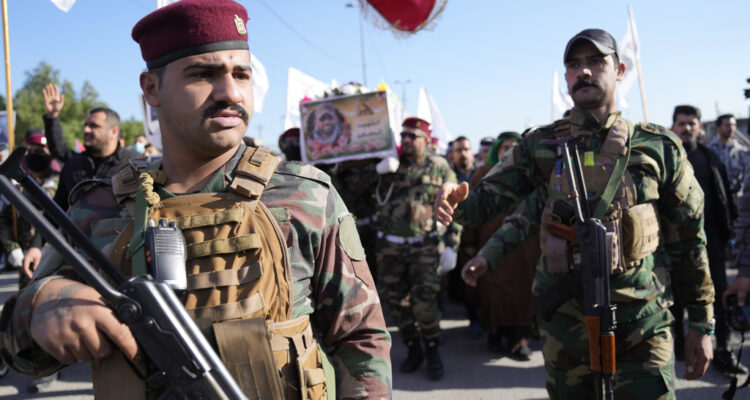
Thousands of Iran-backed fighters offer to join Hezbollah in its fight against Israel

Thousands of such terrorists are already deployed in Syria and could easily slip through the porous and unmarked border.

By The Associated Press

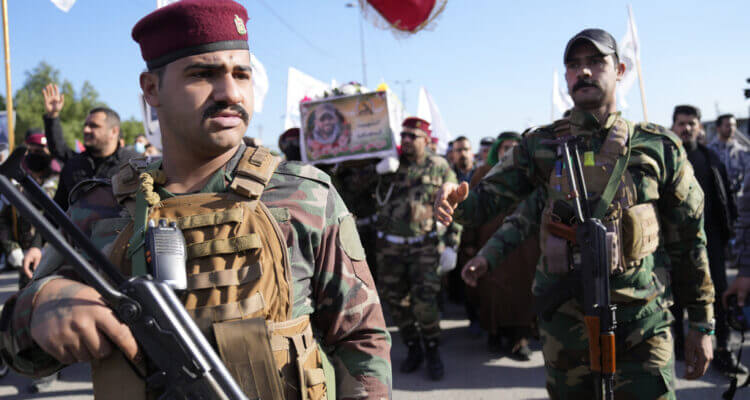
Thousands of fighters from Iran-backed groups in the Middle East are ready to come to Lebanon to join the terrorist Hezbollah group in its battle with Israel if the simmering conflict escalates into a full-blown war, officials with Iran-backed factions and analysts say.

Almost daily exchanges of fire have occurred along Lebanon’s frontier with northern Israel since terrorists from the Hamas-controlled Gaza Strip staged a bloody massacre in southern Israel in early October that set off a war in Gaza.

The situation to the north worsened this month after an Israeli airstrike killed a senior Hezbollah military commander in southern Lebanon. Hezbollah retaliated by firing hundreds of rockets and explosive drones into northern Israel.

Israeli officials have threatened a military offensive in Lebanon if there is no negotiated end to push Hezbollah away from the border.

Over the past decade, Iran-backed fighters from Lebanon, Iraq, Afghanistan and Pakistan fought together in Syria’s 13-year conflict, helping tip the balance in favor of Syrian President Bashar Assad.

Officials from Iran-backed groups say they could also join together again against Israel.

Hezbollah leader Hassan Nasrallah said in a speech Wednesday that terror leaders from Iran, Iraq, Syria, Yemen, and other countries have previously offered to send tens of thousands of fighters to help Hezbollah, but he said the group already has more than 100,000 fighters.

“We told them, thank you, but we are overwhelmed by the numbers we have,” Nasrallah said.

Nasrallah said the battle in its current form is using only a portion of Hezbollah’s manpower, an apparent reference to the specialized fighters who fire missiles and drones.

But that could change in the event of an all-out war. Nasrallah hinted at that possibility in a speech in 2017 in which he said fighters from Iran, Iraq, Yemen, Afghanistan and Pakistan “will be partners” of such a war.

Officials from Lebanese and Iraqi groups backed by Iran say Iran-backed fighters from around the region will join in if war erupts on the the Lebanon-Israel border.

Thousands of such terrorists are already deployed in Syria and could easily slip through the porous and unmarked border.

Some of the groups have already staged attacks on Israel and its allies since the Israel-Hamas war started Oct. 7. T

he groups from the so-called “axis of resistance” say they are using a “unity of arenas strategy” and they will only stop fighting when Israel ends its offensive in Gaza against their ally, Hamas.

“We will be (fighting) shoulder to shoulder with Hezbollah” if an all-out war breaks out, one official with an Iran-backed group in Iraq told The Associated Press in Baghdad, insisting on speaking anonymously to discuss military matters. He refused to give further details.

The official, along with another from Iraq, said some advisers from Iraq are already in Lebanon.

An official with a Lebanese Iran-backed group, also insisting on anonymity, said fighters from Iraq’s Popular Mobilization Forces, Afghanistan’s Fatimiyoun, Pakistan Zeinabiyoun and the Iran-backed rebel group in Yemen known as Houthis could come to Lebanon to take part in a war.

Qassim Qassir, an expert on Hezbollah, agreed the current fighting is mostly based on high technology such as firing missiles and does not need a large number of fighters.

But if a war broke out and lasted for a long period, Hezbollah might need support from outside Lebanon, he said.

“Hinting to this matter could be (a message) that these are cards that could be used,” he said.

Israel is also aware of the possible influx of foreign fighters.

Eran Etzion, former head of policy planning for the Israeli Ministry of Foreign Affairs, said at a panel discussion hosted by the Washington-based Middle East Institute on Thursday that he sees “a high probability” of a “multi-front war.”

He said there could be intervention by the Houthis and Iraqi militias and a “massive flow of jihadists from (places) including Afghanistan, Pakistan” into Lebanon and into Syrian areas bordering Israel.

Daniel Hagari, Israel’s military spokesman, said in a televised statement this past week that since Hezbollah started its attacks on Israel on Oct. 8, it has fired more than 5,000 rockets, anti-tank missiles and drones toward Israel.

“Hezbollah’s increasing aggression is bringing us to the brink of what could be a wider escalation, one that could have devastating consequences for Lebanon and the entire region,” Hagari said. “Israel will continue fighting against Iran’s axis of evil on all fronts.”

Hezbollah officials have said they don’t want an all-out war with Israel but if it happens they are ready.

“We have taken a decision that any expansion, no matter how limited it is, will be faced with an expansion that deters such a move and inflicts heavy Israeli losses,” Hezbollah’s deputy leader, Naim Kassem, said in a speech this past week.

The U.N. special coordinator for Lebanon, Jeanine Hennis-Plasschaert, and the commander of the U.N. peacekeeping force deployed along Lebanon’s southern border, Lt. Gen. Aroldo Lázaro, said in a joint statement that “the danger of miscalculation leading to a sudden and wider conflict is very real.”

The last large-scale conflict between Israel and Hezbollah occurred in the summer of 2006, when the two fought a 34-day war that killed about 1,200 people in Lebanon and 140 in Israel.

Since the latest run of clashes began, more than 400 people have been killed in Lebanon, the vast majority of them terrorists but including 70 civilians and non-combatants.

On the Israeli side, 16 soldiers and 11 civilians have been killed. Tens of thousands have been displaced on both sides of the border.

Qassir, the analyst, said that if foreign fighters did join in, it would help them that they fought together in Syria in the past.

“There is a common military language between the forces of axis of resistance and this is very important in fighting a joint battle,” he said.


Gen. Brown asked Israel to think of how a war would affect the region, as well as the impact it would have on US forces.

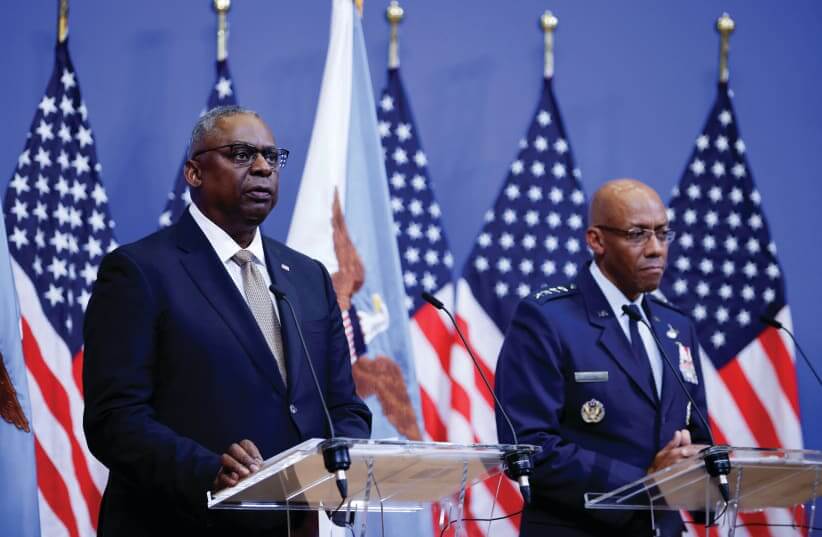
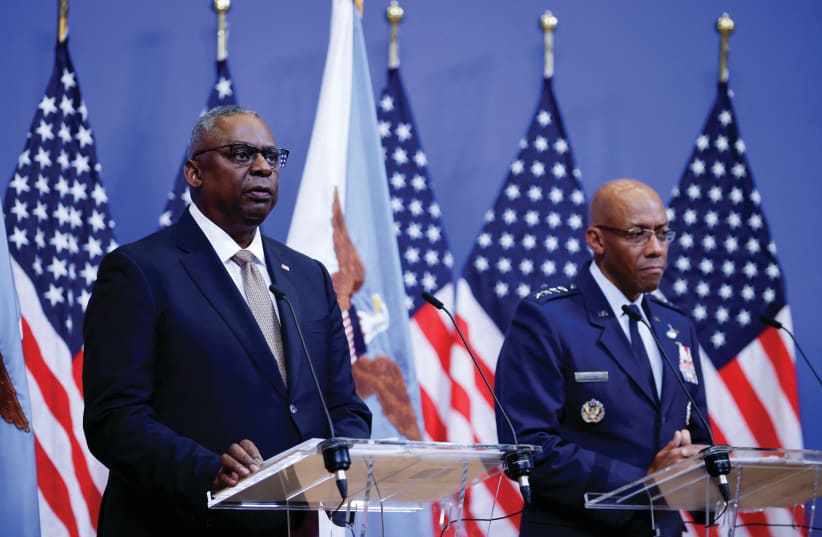
 US Defense Secretary Lloyd Austin and Chairman of the Joint Chiefs of Staff Gen. Charles Q. Brown hold a news conference during a meeting of NATO defense ministers in Brussels, in October. (photo credit: JOHANNA GERON/REUTERS)
US Defense Secretary Lloyd Austin and Chairman of the Joint Chiefs of Staff Gen. Charles Q. Brown hold a news conference during a meeting of NATO defense ministers in Brussels, in October.
(photo credit: JOHANNA GERON/REUTERS)
Air Force General Charles Q. Brown warned that the US would not be able to help defend Israel against an all-out war with Hezbollah in the same way that it stepped in during the Iran drone attack in April, the Associated Press (AP) reported on Monday.

Brown, the chairman of the Joint Chiefs of Staff, also said that Iran “would be more inclined to support Hezbollah.”

While the Islamic Republic supports Hamas, General Brown said that Tehran would stand more firmly behind Hezbollah, “particularly if they felt that Hezbollah was being significantly threatened.”

According to AP, he also said that any Israeli military offensive into Lebanon could risk triggering a broader war, putting US forces in danger.

Risk of escalation

In the event of war, Brown said the US would not provide the same assistance as it did when Iran carried out a missile and drone attack on Israel earlier this year. He also said it was hard to fend off the shorter-range rockets that Hezbollah fires across the border into Israel.

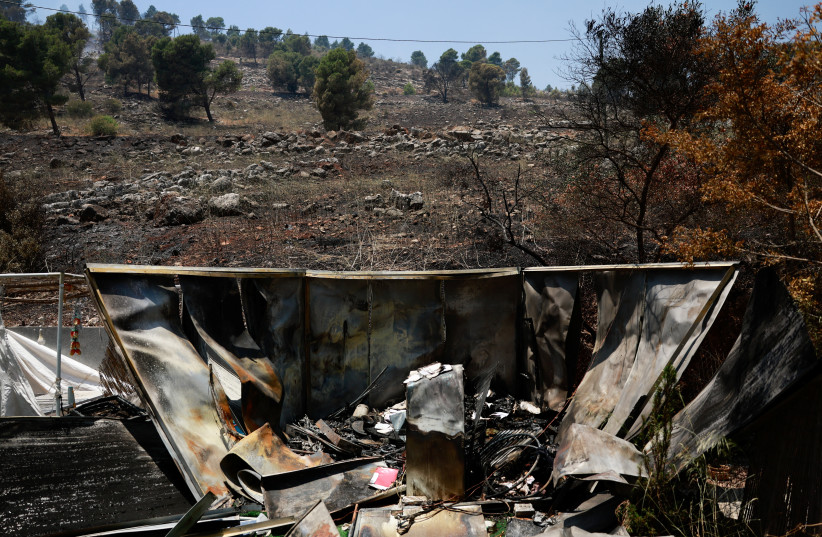
 Wreckage lies in the garden of a house hit in rocket attacks from Lebanon, amid ongoing cross-border hostilities between Hezbollah and Israeli forces, in Kiryat Shmona, northern Israel, June 4, 2024.  (credit: AMMAR AWAD/REUTERS)Enlrage image
Wreckage lies in the garden of a house hit in rocket attacks from Lebanon, amid ongoing cross-border hostilities between Hezbollah and Israeli forces, in Kiryat Shmona, northern Israel, June 4, 2024. (credit: AMMAR AWAD/REUTERS)

He asserted that the safety of US forces was the priority and reiterated that no attacks had been carried out on US bases in the region since February, AP added.

Brown said that the US continued to warn Israel against going to war with Lebanon.

“Think about the second order of effect of any type of operation into Lebanon, and how that might play out and how it impacts not just the region, but how it impacts our forces in regions as well,” Brown reportedly said.

Brown’s comments come amid heightened expectations that the IDF may launch a military campaign in Lebanon to oust Hezbollah from the territory on Israel’s border to stop its persistent attacks.

Prime Minister Netanyahu told Channel 14 on Sunday night that Israel is open to a diplomatic resolution to the Hezbollah threat, but he stressed, “It must be on our terms.”

“We will do what is necessary,” he said. “I can assure the citizens of Israel that if we are required to take on this challenge, we will do it. We can fight on several fronts, and we are also preparing for it.”

Tovah Lazaroff contributed to this report.