The former general’s comments follow recent warnings by President Vladimir Putin that Moscow may change its nuclear doctrine, which lays out the conditions in which such weapons could be used.
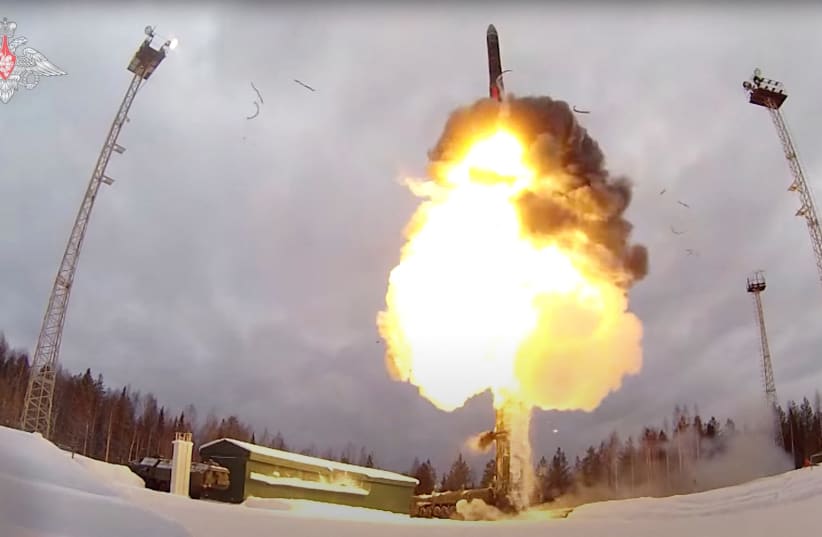
By REUTERSA Russian Yars intercontinental ballistic missile is launched during the exercises by nuclear forces in an unknown location in Russia, in this still image taken from video released February 19, 2022.(photo credit: Russian Defence Ministry/Handout via REUTERS)
Moscow may change the timing for use of its nuclear weapons if threats against Russia increase, the RIA state news agency cited Andrei Kartapolov, the head of the Russian lower house’s defense committee, as saying on Sunday.
The former general’s comments follow recent warnings by President Vladimir Putin that Moscow may change its nuclear doctrine, which lays out the conditions in which such weapons could be used.
“If we see that the challenges and threats increase, it means that we can correct something in (the doctrine) regarding the timing of the use of nuclear weapons and the decision to make this use,” the agency quoted Kartapolov as saying.
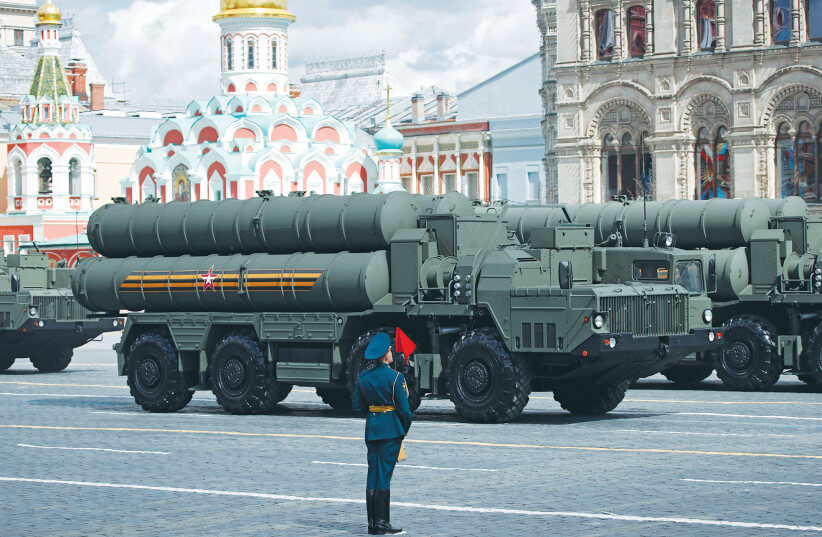
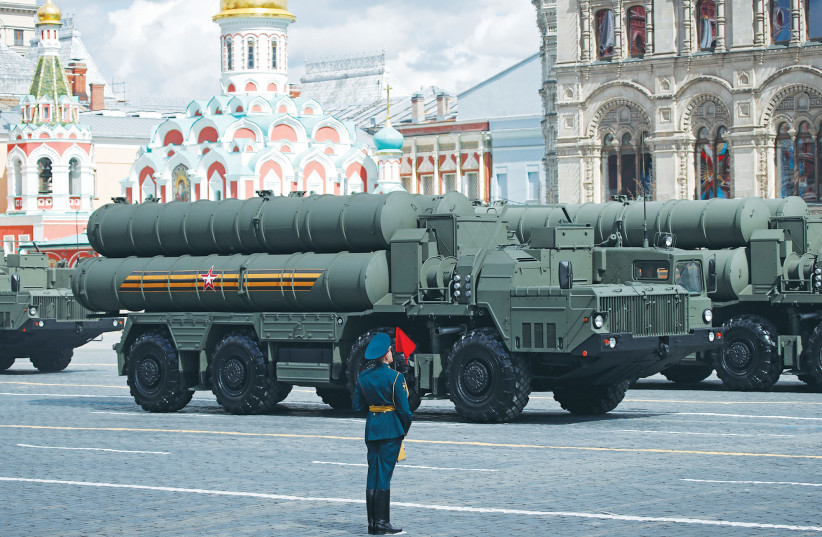
RUSSIAN S-400 ANTI-AIRCRAFT missile systems drive by during a rehearsal for the Victory Day parade in Moscow. (credit: MAXIM SHEMETOV/REUTERS)
‘Early to talk about specifics’
“But of course, it’s too early to talk about specifics now.”
Russia’s 2020 nuclear doctrine sets out when its president would consider using a nuclear weapon: broadly as a response to an attack using nuclear or other weapons of mass destruction, or conventional weapons “when the very existence of the state is put under threat.”
Putin has also said Russia could test a nuclear weapon, if necessary, though he saw no need to do so at the present time.
The heightened rhetoric on nuclear weapons comes as both Russian and US diplomats say that Russia’s war in Ukraine, launched against its smaller neighbor in 2022, is in the most dangerous phase yet.
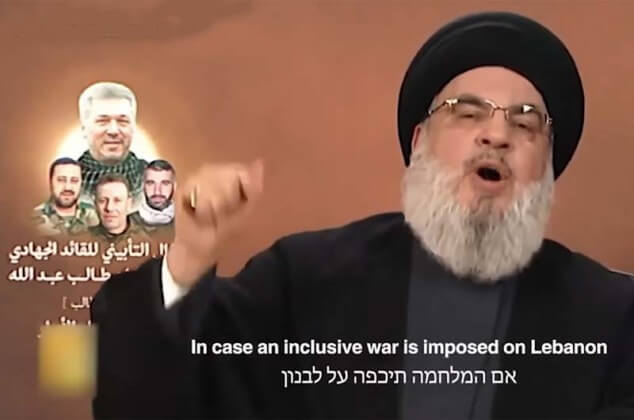
Hassan Nasrallah releases threatening video, June 23, 2024.
Hezbollah leader Hassan Nasrallah appears to be under increasing pressure, with Israeli leaders promising him a return to the stone age any time soon, and so, overnight Sunday, he released another threatening video, with English and Hebrew subtitles, displaying a series of targets in Israel’s center as well as the north. Each target is accompanied by latitude and longitude numbers.
The video includes snippets of Nasrallah’s latest speech in which he warns Israel that Hezbollah would fight with no restraints if war is imposed on Lebanon.
It’s always a chicken and egg thing with Nasrallah.
The Saudi proposal opens up the path to recognition of Israel by other states in the Middle East and in the Muslim world.
By ELIE PODEHIDF CHIEF of Staff Lt.-Gen. Herzi Halevi visits the North. His talks in Bahrain with Saudi, Bahraini, Emirati, Egyptian, and Jordanian chiefs of staff earlier this month, under the umbrella of the US Central Command, may attest to possibilities for a new security structure, says the writer.(photo credit: IDF/Reuters)
An important factor in every negotiation between states is the incentives put forward by one of the parties to the conflict or by the mediating party.
For example, Israel’s willingness to recognize the annexation of Western Sahara by Morocco was an incentive for Morocco to sign a normalization agreement with Israel. Similarly, the supply of F-35 warplanes by the United States was an incentive for the United Arab Emirates to sign a similar agreement with Israel.
Sometimes, there is a mega-incentive, one that cannot or should not be refused. Who, for instance, could have refused when Anwar Sadat proposed his historic visit to Jerusalem?
The idea of normalization with Saudi Arabia has featured prominently in recent headlines, following the Saudis’ willingness to pursue this idea in return for the establishment of a Palestinian state – or at the very least, significant progress in that direction. Israel’s opposition to such a deal stems from a combination of ideological, political, and security-related factors.
The idea is anathema to those who ideologically believe in the need to liberate all of the biblical Land of Israel and who refuse to acknowledge the existence of a Palestinian national identity. Security-wise, there are fears over the shrinking of Israel’s borders. And politically, normalization could lead to the disintegration of the current government and possibly the end of the Netanyahu era. These are all very strong reasons for opposing such a deal.
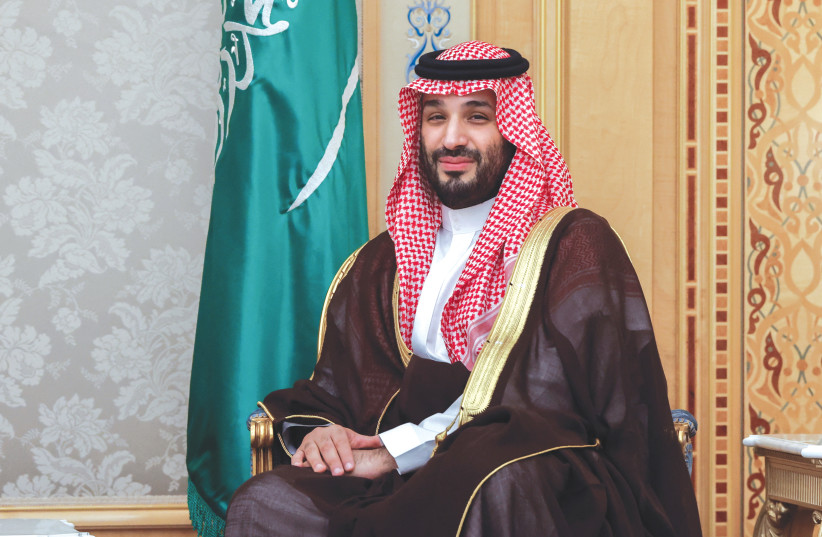
‘INTERACTIONS AND business cooperation between Israel and Saudi Arabia are slowly rising above the radar,’ Ofir told the ‘Post.’ Saudi Crown Prince Mohammed bin Salman has been more receptive to normalizing relations with Israel than previous Saudi leaders. (credit: REUTERS)
But for those willing to act in a rational and considered manner, the Saudi proposal is an incentive to something much bigger than just a bilateral agreement with Saudi Arabia. First, it opens up the path to recognition of Israel by other states in the Middle East and in the Muslim world.
Second, it would be a blow to the “axis of resistance” led by Iran, as one of its main goals has been to derail this normalization process.
Third, it would strengthen the integration of Israel into the region’s security architecture, as was manifested during the April missile attack by Iran.
The fact that the Israeli, Saudi, Bahraini, Emirati, Egyptian, and Jordanian chiefs of staff met in Bahrain under the umbrella of the US Central Command earlier this month may attest to the possibilities inherent in this new security structure.
Fourth, normalization with Saudi Arabia would reduce antagonism toward Israel, regionally and globally, and would halt the process of Israel’s becoming a pariah state.
Fifth, it would reinforce Israel’s economic ties with other states in the Middle East, especially with the United Arab Emirates and Saudi Arabia.
And finally, it would lead to Israel’s integration into a new economic architecture that will link the Far East and India with Europe, via sea and land corridors passing through Saudi Arabia, Jordan, and Israel.
Should Israel agree to Saudi normalization?
In and of itself, normalization with Saudi Arabia would be acceptable to the majority of Israelis. But the demand for the establishment of a Palestinian state may elicit fierce opposition from the Israeli public. These fears are natural and logical, particularly after the October 7 attack. Yet, this disaster has in fact led to three important developments that make the creation of a Palestinian state inevitable, sooner or later.
First, it restored the Palestinian question to its “natural” place at the core of the conflict. Israel’s attempts to relegate it to the margins or make it disappear entirely by signing normalization agreements with Arab states on the periphery of the Middle East have failed. Like the idea that Hamas would not attempt a large-scale attack from Gaza, this has proved to be another misjudgment.
Second, the disaster has revived the two-state solution, which before October 7 had become irrelevant in the eyes of many due to the growth of Israeli settlements in Area C in the West Bank. The one-state idea had gained traction in many circles, but the disaster demonstrated that, despite everything, separation is a necessity, while a single state for Israelis and Palestinians is a recipe for violence and destruction. The re-emergence of the idea of a Palestinian state has occurred in the international arena at both the state level and among international organizations and institutions, as well as in general public opinion.
Third, actors in the international and Arab arenas have come to understand that they need to be part of the solution, by giving recognition and guarantees to both sides, possibly even including the deployment of troops. Foreign involvement does not mean that Israel hands responsibility for its security to others, but that the solution requires regional and international partners who have an interest in the success and maintenance of any agreement.
A fateful decision is now required, of the kind that David Ben-Gurion made with the Declaration of Independence and that Menachem Begin made when agreeing the peace deal with Egypt. The problem is that Israel currently has a prime minister with a majority in the Knesset but without public legitimacy. No less serious is the fact that Palestinian leadership also suffers from legitimacy deficiency.
Moreover, Palestinian public opinion polls reveal widespread support for Hamas, and little support for the two-state solution. In other words, the Palestinian side will also have to undergo a process of sobering up to the realities of what is possible.
Normalization with Saudi Arabia is a mega-incentive that presents Israel with a dilemma: Should it continue with its ghetto mentality and self-victimization, clinging to the belief that “in every generation, someone rises up to destroy us,” or should it forge a new regional partnership and alliance? What happens next is not a historical inevitability; it will be decided by Israeli society and its leaders.
The writer teaches in the Department of Islamic and Middle Eastern Studies at the Hebrew University of Jerusalem and is a board member of Mitvim –The Israeli Institute for Regional Foreign Policies.