
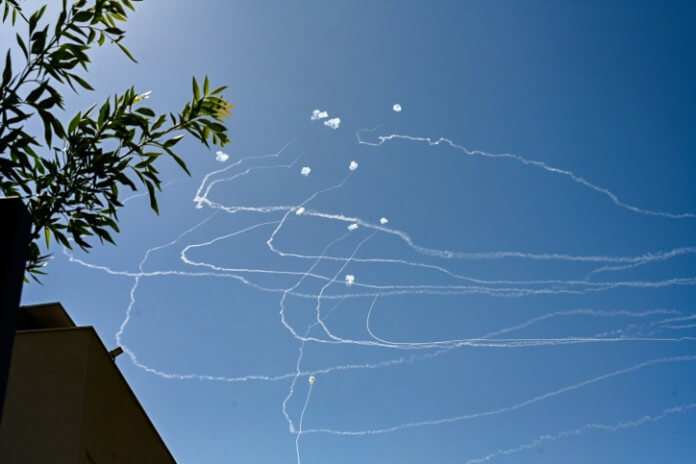
The Iron dome system fires interception missiles at rockets fired from Lebanon in the Golan Heights Israeli city of Katzrin, May 17, 2024.

A CNN Report on Thursday suggests that US and Israeli officials share grave concerns about the potential vulnerability of Israel’s northern air defenses, including the renowned Iron Dome system, in the event of a full-scale conflict with Hezbollah.

Last Tuesday, Hezbollah shared a video that was shot by one of its Iranian drones that flew undisturbed over large areas of northern Israel, including the military naval base and Rambam Hospital in Haifa. Interestingly, the posted video omitted areas that are Chinese properties in the Haifa harbor.

IDF Chief of Staff Major General Herzi Halevi stated in response, “Yesterday Hezbollah released a video with a capability that we are familiar with, and we are preparing and building solutions to deal with such capabilities, and other capabilities, whose implementation you will also see in due course.”

But as a Biden administration official put it to CNN on Thursday, “The fact that we have managed to even hold the front for this long has been a miracle. We’re entering a very dangerous period, something could start with little warning.”

Three US officials have disclosed to CNN that the Iran-supported terrorist group’s extensive arsenal of missiles and drones could potentially overwhelm these defenses. A source familiar with the threat assessment highlighted a key worry: Hezbollah’s potential use of a substantial number of precision-guided munitions and missiles. This capability could pose a significant challenge to Israel’s air defense network, including the Iron Dome system which has been crucial in intercepting incoming projectiles.

These apprehensions have intensified as Israel has increasingly signaled to US officials its preparations for a possible land and air offensive into Lebanon. According to US officials who spoke to CNN on Wednesday, Israel has communicated plans to reallocate resources from southern Gaza to northern Israel in anticipation of a potential operation against Hezbollah.

A senior administration official stated, “Our assessment indicates that at least some Iron Dome batteries may be overwhelmed” in such a scenario. This situation underscores the complex strategic challenges facing Israel and the potential limitations of even advanced defense systems against a determined and well-equipped adversary.

The typical air defense missile battery consists of a radar unit, a missile control unit, and several launchers, all located at the same site. Conversely, Iron Dome is built to deploy in a scattered pattern. Each launcher, containing 20 interceptors, is independently deployed and operated remotely via a secure wireless connection. The first Iron Dome battery was deployed on March 27, 2011, near Beer Sheva, with these reported scores:

April: 8 out of 10 (80%)
August: 22 out of 28 (79%)
October: 3 out of 9 (33%)
Total: 33 out of 47 (70%)

Although the system has undergone technical improvements and many more systems are available today compared to 2011, the fixed reality is that in each engagement the Iron Dome can only protect against a given number of missiles, and to overwhelm it, the enemy simply has to shoot more rockets. Also, as has been shown over the past few months, Iron Dome is not as good at hitting Hezbollah drones as it is other missiles.

In early June, Hezbollah disseminated footage allegedly depicting a drone attack that damaged an Iron Dome battery at a military installation in northern Israel. Israeli media outlets reported this as potentially the first documented successful strike against an Iron Dome system.

While the IDF stated they were not aware of any damage to the Iron Dome, two US officials revealed that Israeli officials had expressed concerns about the system’s potential vulnerabilities, particularly in the north. These Israeli officials have reportedly been taken aback by the sophistication of Hezbollah’s attacks thus far.

IDF Chief of Staff Major General Herzi Halevi on Wednesday visited air defense batteries on the northern border, and said, “We are over eight months into a long war, and you are over eight months into the defense, which is a complex defense. This defense gives a great deal of security to the civilians and the IDF, but we are not satisfied with that, we have many other forces in the IDF who are engaged in an attack on Hezbollah. And today we also killed some of their activists.”


 

Russian President Vladimir Putin, second left, and North Korea's leader Kim Jong Un, second right, shake hands during the official welcome ceremony in the Kim Il Sung Square in Pyongyang, North Korea, June 19, 2024. (Gavriil Grigorov, Sputnik, Kremlin Pool Photo via AP)

Russian President Vladimir Putin, second left, and North Korea’s leader Kim Jong Un, second right, shake hands during the official welcome ceremony in the Kim Il Sung Square in Pyongyang, North Korea, June 19, 2024. (Gavriil Grigorov, Sputnik, Kremlin Pool Photo via AP)

SEOUL, South Korea — A new agreement between Russia and North Korea reached by their leaders requires the countries to use all available means to provide immediate military assistance in the event of war, North Korean state media says.

The North’s official Korean Central News Agency reports the language of the comprehensive strategic partnership agreement reached by its leader Kim Jong Un and Russian President Vladimir Putin in Pyongyang on Wednesday. The agency says Article 4 of the agreement states that if one of the countries gets invaded and is pushed into a state of war, the other must deploy “all means at its disposal without delay” to provide “military and other assistance.”

The deal could mark the strongest connection between Moscow and Pyongyang since the end of the Cold War. Both Kim and Putin described it as a major upgrade of their relations, covering security, trade, investment, cultural and humanitarian ties.

The summit came as the US and its allies have expressed growing concerns over a possible arms arrangement in which Pyongyang provides Moscow with badly needed munitions for its war in Ukraine, in exchange for economic assistance and technology transfers that could enhance the threat posed by Kim’s nuclear weapons and missile program.


Attorney General Garland refuses to fight antisemitism

Why is Garland giving a free pass to those who attack and kill Jews?

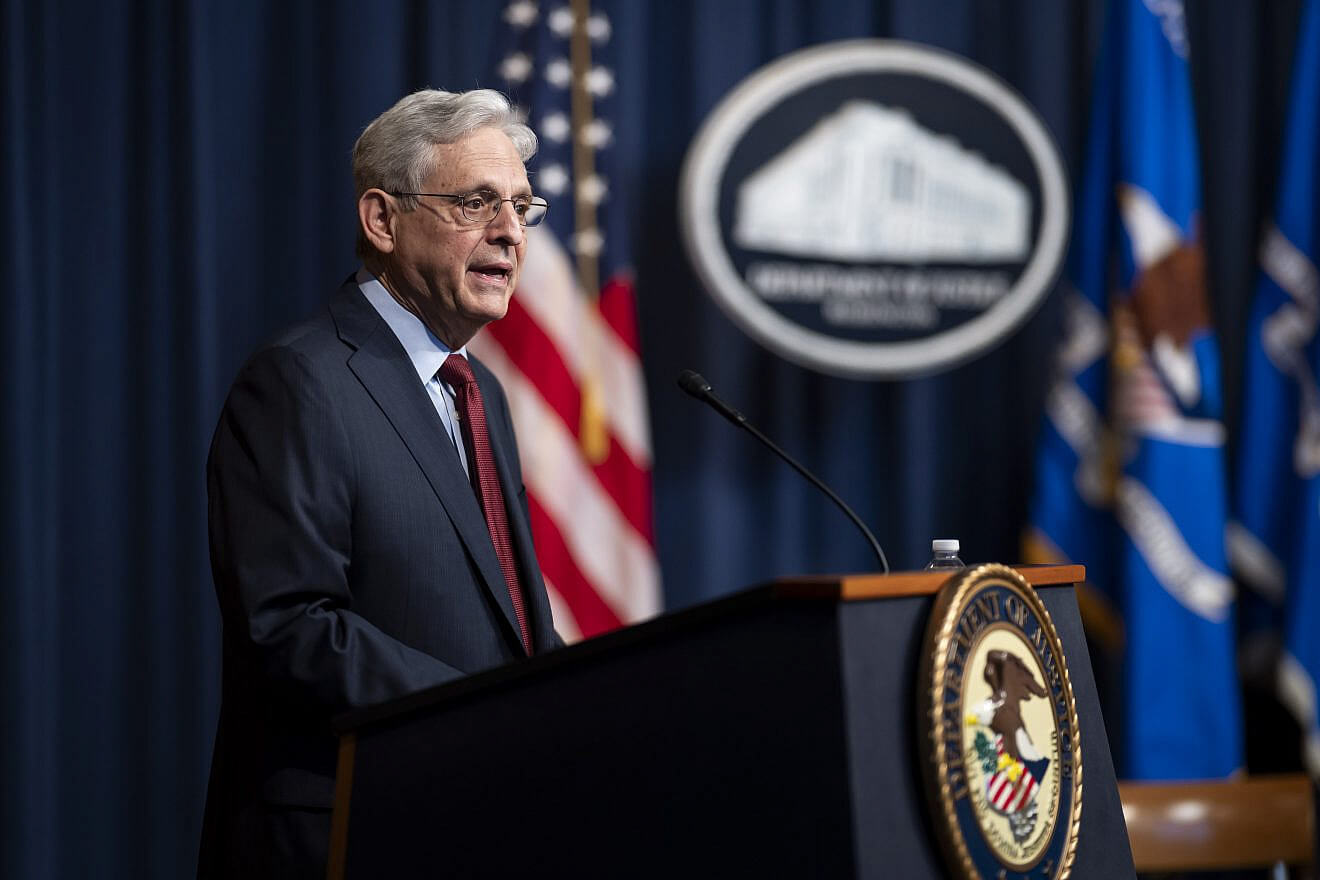
U.S. Attorney General Merrick Garland at the 2023 United States Attorneys’ National Conference hosted by the Department of Justice in Washington on Oct. 26, 2023. Credit: Tia Dufour/U.S. Department of Homeland Security.

U.S. Attorney General Merrick Garland at the 2023 United States Attorneys’ National Conference hosted by the Department of Justice in Washington on Oct. 26, 2023. Credit: Tia Dufour/U.S. Department of Homeland Security.

Attorney General Merrick Garland claims that he is enforcing the law in an unbiased fashion. However, his failure to do precisely this against those who attack Jews belies his claim.

As early as November 2022, FBI Director Christopher Wray noted, “A full 63% of religious hate crimes are motivated by antisemitism—targeting a group that makes up just 2.4% of our population.”

Despite the massive discrepancy between those attacking Jews and those attacking any other religious group—including Muslims—Garland went on to talk about “anti-Arab, anti-Muslim threats in this country that make all of these communities afraid.”

Garland went on, “We regard it as an important element of our civil rights work to deter and to investigate and to prosecute and to stop these threats.”

For example, university anti-Israel encampments have led to Jewish students being physically prevented from going to class. They have also included the harassment of Jewish students on campus.

There are no Jewish encampments on university campuses and no one is preventing Muslim students from going to class. Jewish demonstrations are completely peaceful. Jews are not invading school buildings. Yet the Jews must suffer and the antisemites get a free pass.

The fact is that under Garland’s leadership, there have not been anywhere near enough indictments and federal prosecutions of antisemitic attacks on Jews. Thus, there is no deterrence against such attacks and Jews in America feel afraid.

Not only Jews are being harassed. Even pro-Israel legislators like Sen. Ted Cruz, Sen. John Fetterman, Rep. Richie Torres and Rep. Brian Mast have been subject to demonstrations and harassment by antisemitic thugs, including at Cruz’s and Fetterman’s homes.

Jewish homes have also been subject to thuggery, including those involved in the Jewish Museum in Brooklyn and the former head of AIPAC in California.

There should be laws that restrict demonstrations outside private residences and the arrest and prosecution of demonstrators violating those laws.

In November 2023, 69-year-old American Jew Paul Kessler was demonstrating against a pro-Hamas “protest” in a suburb of Los Angeles. The “protest” included Muslim professor Loay Abdelfattah Alnaji. Alnaji was likely a leader of the pro-Hamas demonstration, as he was holding a megaphone used in that demonstration.

He then used that megaphone to hit Kessler on the head, killing him. County medical examiner Dr. Othon Mena testified that Kessler died from blunt force caused by the blow from the megaphone and the subsequent fall. Kessler’s DNA was found on Alnaji’s megaphone.

The police took over a week to charge Alnaji. Initially, the killer’s bail was set at $1,000,000. Then it was massively dropped to $50,000. After a preliminary hearing, Alnaji was charged with two felonies: involuntary manslaughter and battery causing serious bodily injury with special allegations of personally inflicting great bodily harm injury on each count.

Thus, Alnaji faces a maximum sentence of a little over four years. He was not even charged with a hate crime. The Ventura County District Attorney’s Office claimed that it did not do so because Alnaji did not say anything to Kessler before the attack.

It should have been obvious from Alnaji’s antisemitic social media posts and his presence at an antisemitic demonstration that his murderous attack on Kessler was a hate crime.

Attorney General Garland has the authority to charge Alnaji with a hate crime for violating Kessler’s civil rights. He has not done so. So much for “civil rights work.”

This is part of a pattern of depraved neglect. The group Americans Against Antisemitism recently examined 194 antisemitic attacks on persons and 135 attacks on Jewish property in the New York area that occurred since 2018. The group’s July 2022 report found that only two of the criminals were given jail time.

Attorney General Garland has the authority to prosecute many of those attackers for hate crimes. He has failed to do so. So much for his pledge “to prosecute and to stop these threats.”

Garland’s failure to enforce existing U.S. laws and prosecute those who attack and kill Jews like Paul Kessler has helped lead to the rapid rise of antisemitism in America. Garland must fulfill his promise to fight such hate by taking action. If he does not, his hypocrisy will speak much louder than his words.