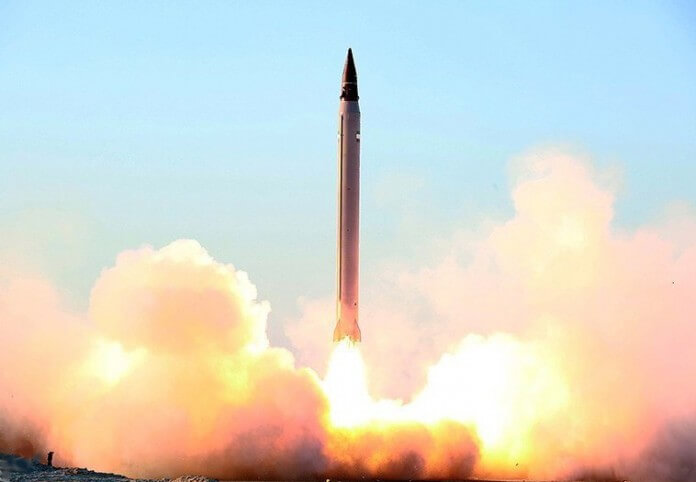
Iranian Emad long-range ballistic missile, range 1,700 kilometers. Iran launched more than 100 such missiles at Israel on April 14, 2024.

Iran has rejected a draft resolution this past Friday by the Group of Seven warning the Islamic Republic to cease its expansion of its uranium enrichment program.

Group of Seven Warns Iran Against Expansion of Nuclear Program

“We urge Tehran to cease and reverse nuclear escalations, and stop the continuing uranium enrichment activities that have no credible civilian justifications,” read the G7 statement, Reuters reported.

Tehran has significantly increased its stockpile of uranium enriched to 60 percent purity, which can easily and rapidly be upgraded to 90 percent, weapons-grade purity.

As of May 11, 2024, Iran’s stockpile of 60 percent highly enriched uranium rose 20.6 kilograms to 142.1 kilograms since its report in February — its highest level to date — according to the May report by the United Nations International Atomic Energy Agency (IAEA).

The nuclear watchdog agency says it is technically possible to create an atomic bomb with roughly 42 kilograms (92.5 pounds) of 60 percent enriched uranium, once it is enriched to 90 percent.

Iran’s total stockpile of enriched uranium now stands at 6,201.3 kilograms (13,671.5 pounds) — a 675.8 kilogram (1,489.8 pound) increase in three months, the IAEA reported.

Israel Hails IAEA Demand for Iran to Halt Nuclear Program

Iranian Foreign Ministry spokesperson Nasser Kanaani said Sunday that the G7 statement referring to the recent censure by the IAEA’s Board of Governors was a “political resolution”.

“Iran will continue constructive interaction and technical cooperation with the IAEA within the framework of its duties and rights,” the spokesman added. He emphasized that Tehran will press ahead with its “peaceful nuclear projects” in accordance with the NPT and the Safeguards Agreement, “irrespective of political pressures.”

Iran also rejected a G7 statement that the world body would enforce ‘new measures’ if Tehran transfers ballistic missiles to Russia.

Kanaai said Tehrain will “act decisively to protect and defend its national security and interests against any ill-advised measure … Any attempt to link the war in Ukraine to the bilateral cooperation between Iran and Russia is an act with only biased political goals.”
Hamas is “ready for a comprehensive deal which entails a ceasefire, withdrawal from the Strip, the reconstruction of what was destroyed, and a comprehensive swap deal,” Haniyeh said.

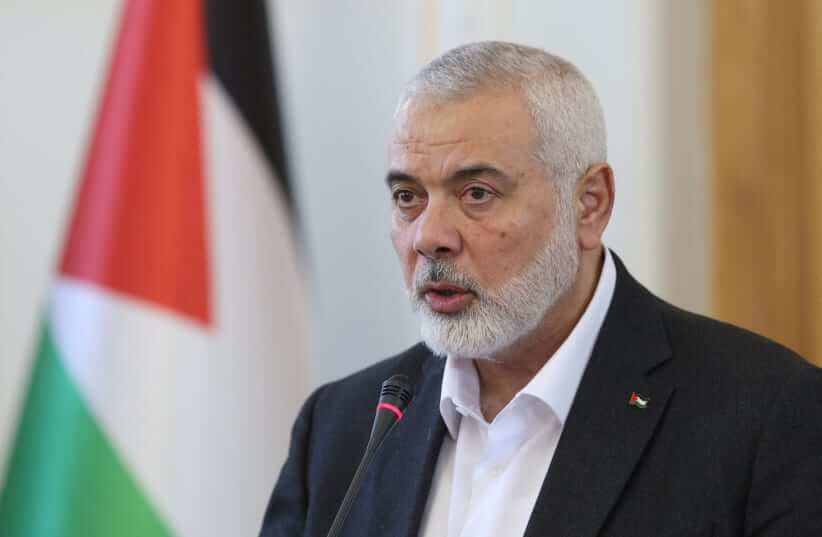
 Palestinian group Hamas' top leader, Ismail Haniyeh speaks during a press conference in Tehran, Iran, March 26, 2024. (photo credit: MAJID ASGARIPOUR/WANA)
Palestinian group Hamas’ top leader, Ismail Haniyeh speaks during a press conference in Tehran, Iran, March 26, 2024.
(photo credit: MAJID ASGARIPOUR/WANA)
Hamas’s response to the latest Gaza ceasefire proposal is consistent with the principles put forward in US President Joe Biden‘s plan, the terror group’s Qatar-based leader Ismail Haniyeh said in a televised speech on the occasion of the Islamic Eid al-Adha on Sunday.

‘Hamas ready for a comprehensive deal,’ says Haniyeh

“Hamas and the (Palestinian) groups are ready for a comprehensive deal which entails a ceasefire, withdrawal from the Strip, the reconstruction of what was destroyed, and a comprehensive swap deal,” Haniyeh said, referring to the exchange of Israeli hostages for Palestinian prisoners.

 US PRESIDENT Joe Biden speaks at the White House earlier this month. US policy toward Israel since its founding has been to prevent Israel from gaining as complete a victory as possible over its enemies, the writer maintains.  (credit: Nathan Howard/Reuters)Enlrage image
US PRESIDENT Joe Biden speaks at the White House earlier this month. US policy toward Israel since its founding has been to prevent Israel from gaining as complete a victory as possible over its enemies, the writer maintains. (credit: Nathan Howard/Reuters)

On May 31, Biden laid out what he called a “three-phase” Israeli proposal that would include negotiations for a permanent ceasefire in Gaza as well as phased exchanges of Israeli hostages for Palestinian prisoners held in Israel.

Egypt and Qatar – which, along with the United States, have been mediating between Hamas and Israel – said on June 11 that they had received a response from the Palestinian terror groups to the US plan without giving further details.

While Israel said Hamas rejected key elements of the US plan, a senior Hamas leader told Reuters that the changes the group requested were “not significant.”


Missiles launched by terror group hit Mount Meron air traffic control base as IDF says ‘no harm to the unit’s capabilities’; Israeli strike targets terror operative in Lebanon


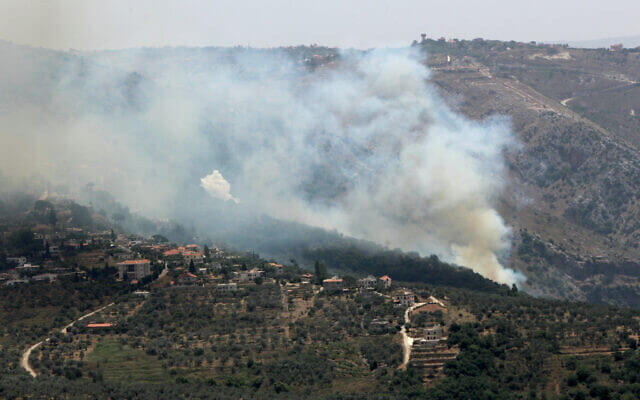
Smoke billows from fires ignited by Israeli shelling on the forested areas of the southern Lebanese village of Deir Mimas on June 15, 2024. (Rabih DAHER / AFP)

Smoke billows from fires ignited by Israeli shelling on the forested areas of the southern Lebanese village of Deir Mimas on June 15, 2024. (Rabih DAHER / AFP)

Two missiles launched from Lebanon on Saturday struck the Israeli military’s sensitive Mount Meron air traffic control base, amid growing international concern the cross-border fighting between Israel and Hezbollah could descend into a full-scale conflict.

The Israel Defense Forces said there were no injuries and “no harm to the unit’s capabilities” in the attack.

Hezbollah took responsibility for the incident, claiming to have targeted equipment at the base with guided missiles.

The terror group has attacked Mount Meron, located some eight kilometers (five miles) from the Lebanon border, several times throughout the ongoing war. It has launched large barrages of rockets at the mountain, as well as guided missiles at the air traffic control base that sits atop it.

In another attack, several explosive-laden drones launched by Hezbollah from Lebanon impacted near the northern community of Goren, sparking a fire. The IDF said it was investigating why it failed to down the drones.

Hezbollah in a statement claimed to have targeted a military base in the area. Like the missile attack on Mount Meron, the Iran-backed terror organization said the strike was carried out in response to Israel’s targeting this week of Taleb Sami Abdullah, the most senior Hezbollah commander killed so far in the fighting.

Meanwhile, the IDF confirmed carrying out a strike against a Hezbollah operative in southern Lebanon’s Aitaroun on Saturday morning. Video released by the military showed the strike against the operative riding a motorcycle.

Palestinian Islamic Jihad later announced the death of a member in an Israeli strike in southern Lebanon, thought it was unclear if it was the same attack.

He was named as Zuhair Jalbout, 45. No further details were given on the circumstances of his death.

Numerous Islamic Jihad operatives have been killed in Israeli strikes on Hezbollah positions in southern Lebanon during the ongoing fighting.

In a strike the night before, the IDF said fighter jets targeted a building in southern Lebanon’s Kafr Kila that was allegedly used by Hezbollah and was adjacent to an area from which the terror group fired rockets at Metula on Friday.

The latest skirmishes came as CBS News reported that US officials are increasingly concerned that an all-out war could break out between Israel and Hezbollah due to increasingly deeper attacks by the two sides.

Some US officials told the American network they believe recent Israeli strikes deeper in Lebanese territory were setting the stage for a broader operation, which they expressed concern would spark a war that Israel cannot complete with Washington’s support.

Other US officials quoted in the report said they were worried by a scenario in which intensifying Hezbollah rocket attacks could result in “unintended consequences” that give Israel cause to launch a major offensive.

In light of the US concerns, the Axios news site reported Friday that Amos Hochstein, a senior adviser to US President Joe Biden, will arrive in Israel on Monday to try to put a lid on the recent escalation between Israel and Hezbollah.

US envoy Amos Hochstein, left, meets with Defense Minister Yoav Gallant in Tel Aviv on March 5, 2024. (Shachar Yurman/Defense Ministry)

As part of the diplomatic efforts to defuse the tensions, French President Emmanuel Macron announced that Paris, Washington and Jerusalem would form a contract group to work on doing so, though Defense Minister Yoav Gallant on Friday ruled out Israeli involvement in comments that prompted a public spat with the Foreign Ministry.

Hezbollah has been attacking Israeli communities and military posts along the border on a near-daily basis since October 8, which it says it’s doing in solidarity with Palestinians in Gaza, amid the war started by ally Hamas’s terror onslaught.

So far, the skirmishes on the border have resulted in 10 civilian deaths on the Israeli side, as well as the deaths of 15 IDF soldiers and reservists. There have also been several attacks from Syria, without any injuries.

Hezbollah has named 342 members who have been killed by Israel during the ongoing skirmishes, mostly in Lebanon but some also in Syria. In Lebanon, another 63 operatives from other terror groups, a Lebanese soldier, and dozens of civilians have been killed.

Times of Israel staff contributed to this report.