
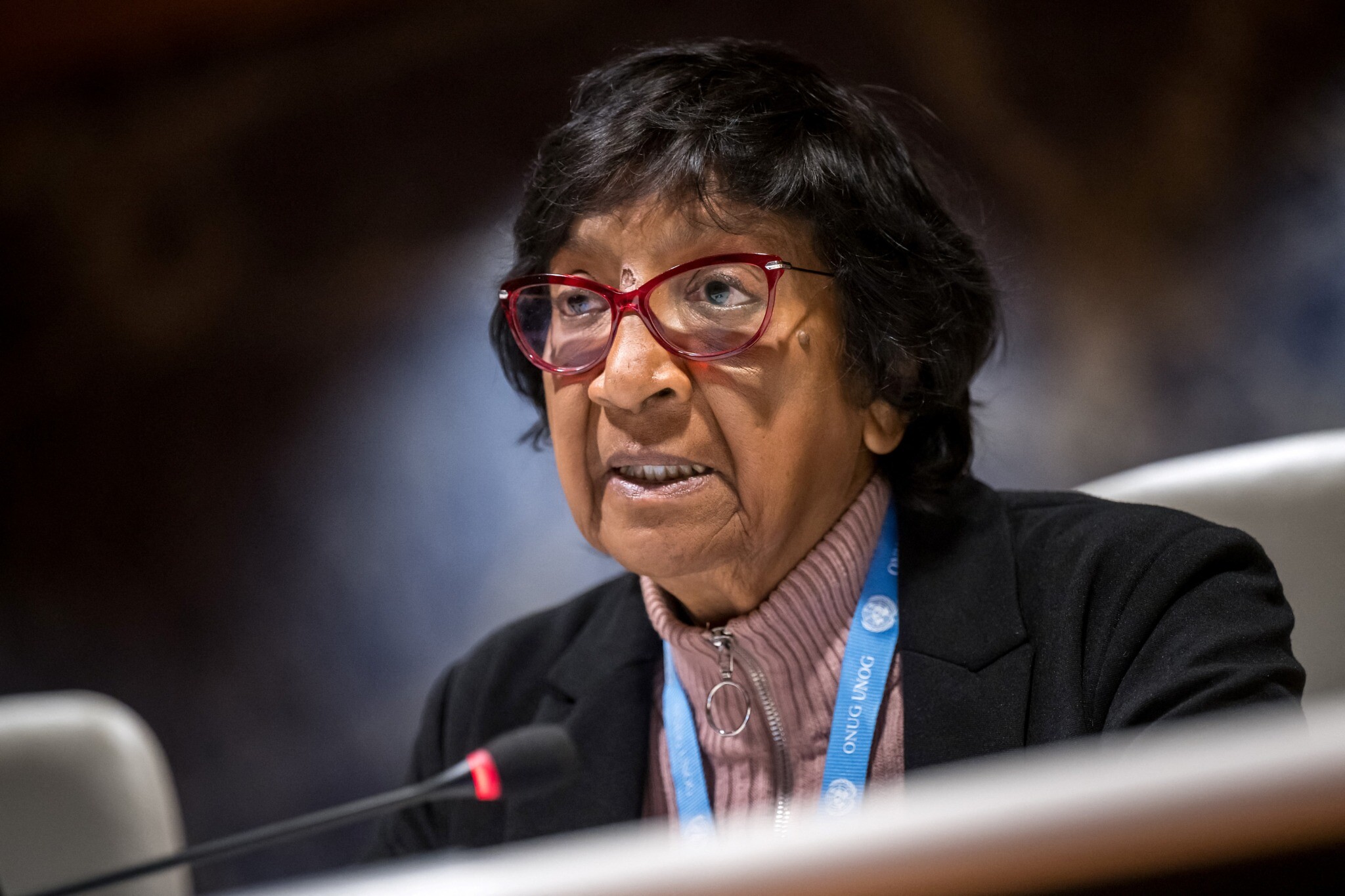
Chairwoman of the 'The United Nations Independent International Commission of Inquiry on the Occupied Palestinian Territory, including East Jerusalem, and in Israel,'  South-Africa's Navi Pillay (R) speaks during a briefing to UN member states about ongoing investigations of the Commission at the UN offices in Geneva, on April 16, 2024. (Photo by Fabrice COFFRINI / AFP)

Chairwoman of the ‘The United Nations Independent International Commission of Inquiry on the Occupied Palestinian Territory, including East Jerusalem, and in Israel,’ South-Africa’s Navi Pillay (R) speaks during a briefing to UN member states about ongoing investigations of the Commission at the UN offices in Geneva, on April 16, 2024. (Photo by Fabrice COFFRINI / AFP)

A United Nations investigation claims that Israel had committed crimes against humanity during the war in Gaza, including the crime of “extermination.”

“The crimes against humanity of extermination; murder; gender persecution targeting Palestinian men and boys; forcible transfer; and torture and inhuman and cruel treatment were committed,” the Commission of Inquiry says in a report, due to be presented to the UN Human Rights Council next week.

The probe also accuses several Palestinian terror groups of committing “war crimes” since the conflict in Gaza erupted on October 7, when Hamas-led terrorists stormed into Israel, killing some 1,200 people and capturing 251 hostages.

“It is imperative that all those who have committed crimes be held accountable,” says Navi Pillay, who chairs the Commission of Inquiry.

The commission was set up by the UN Human Rights Council in 2021 to investigate alleged violations of international humanitarian and human rights law in Israel and the Palestinian territories.

Israel rejects the findings and accuses the UN Commission of Inquiry of long-standing “systematic anti-Israeli discrimination.”

The Commission of Inquiry “has once again proven that its actions are all in the service of a narrow-led political agenda against Israel,” said Meirav Eilon Shahar, Israel’s ambassador to the United Nations in Geneva.


Israel’s Magen David Adom announced that it had not received any reports of casualties thus far.

 Screenshot from social media of the reported rocket attack on northern Israel. June 12, 2024. (photo credit: SCREENSHOT/X)
Screenshot from social media of the reported rocket attack on northern Israel. June 12, 2024.
(photo credit: SCREENSHOT/X)
Two barrages totaling roughly 150 rockets, including about 70 directed at the area of Meron, were fired at various locations across northern Israel on Wednesday morning, Israel’s Army Radio reported.

The cities of Safed and Tiberias were among those where rocket sirens blared.

“Following the sirens that sounded in northern Israel a short while ago, approximately 90 projectiles were identified crossing from Lebanon,” the IDF stated. “A number of the projectiles were intercepted and others fell in several locations in northern Israel. As a result, fires broke out in a number of areas. The details are under review.”

Israel’s Fire and Rescue Service reported that it was at the scene of a fire in an open area and was working to put it out.

Additionally, Magen David Adom announced that it had not received any reports of casualties thus far.

 Locations in which rocket alarms sounded in northern Israel on Wednesday morning. June 12, 2024. (credit: Screenshot/Tzeva Adom)Enlrage image
Locations in which rocket alarms sounded in northern Israel on Wednesday morning. June 12, 2024. (credit: Screenshot/Tzeva Adom)

Social media users, including former Israeli government spokesperson Eylon Levy, took to X, formerly Twitter, to post footage appearing to show rocket interceptions above northern Israel.


North ‘under massive attack’ from Hezbollah

“Northern Israel is under massive attack from Iranian proxy Hezbollah,” Levy wrote.

A correspondent for the Hezbollah-affiliated Al-Mayadeen reported that the rocket launching took place over the span of about thirty minutes.

These latest reports of rocket attacks in the North follow Israel’s alleged elimination of Taleb Abdallah, the senior-most Hezbollah commander to be killed since the start of Israel’s war with Hamas in October of last year.

Army Radio subsequently reported that in response to the attacks on northern Israel, the IDF conducted a wave of airstrikes in southern Lebanon.

Roughly an hour after the bombardment, rocket sirens again blared in numerous towns in the North.

Al Mayadeen reported that a number of Israeli military sites, including the Mount Meron air traffic control base, were targeted during the attacks. The IDF, however, has yet to confirm that any of its sites were targeted.

This is a developing story.


An Israeli official says that Jerusalem has received Hamas’s response to the hostage release and ceasefire deal offer presented by US President Joe Biden late last month, and that the reply from the terror group effectively rejects the proposal.

“This evening, Israel received, via the mediator, the Hamas response. In its response, Hamas has rejected the proposal for a hostage release that was presented by President Biden,” the Israeli official says, speaking on condition of anonymity.

The official adds that Hamas has changed the main parameters of the proposal.

The statement comes after Hamas announced that it had submitted a response to Qatari and Egyptian mediators expressing “readiness to positively” come to a deal in the ongoing war in Gaza, sparked by the terror group’s October 7 massacre in southern Israel.

The Hamas and Palestinian Islamic Jihad response to Israel’s latest hostage-ceasefire proposal reportedly includes amendments to the offer, including a new timeline for the hostage release and withdrawal of Israeli troops from Gaza.