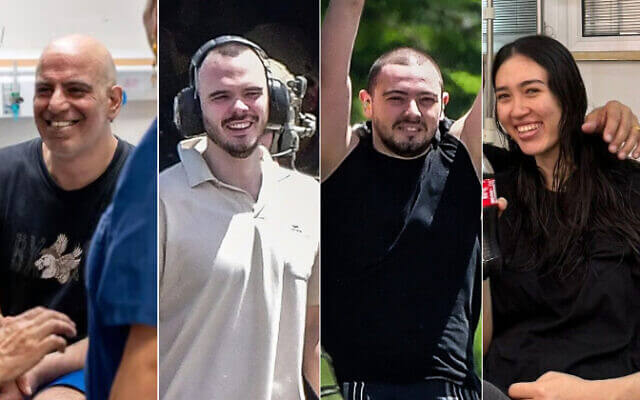
Noa Argamani, Almog Meir Jan, Andrey Kozlov, Shlomi Ziv clear post-captivity medical tests; rights body says Israel, Hamas may both be responsible for civilian deaths in rescue raid

The last of the four of the hostages rescued by Israeli commandos from the Gaza Strip on Saturday was released from the hospital on Tuesday, following a battery of medical tests and psychological care after eight months in Hamas captivity.
Noa Argamani, 26, was released on Tuesday afternoon from Ichilov Hospital in Tel Aviv following a series of checks, the hospital said. Still in the hospital is the released hostage’s mother, Liora Argamani, who is terminally ill with advanced brain cancer.
Argamani has been one of the most recognizable faces of those abducted on October 7, following a widely circulated video of terrorists taking her from the Nova music festival on October 7, and separating her from her boyfriend, Avinatan Or, who remains in captivity.
Video shared to social media on Tuesday showed Argamani reuniting with Or’s mother, while other footage shared by Israeli media and the IDF Spokesperson’s Unit showed Argamani reuniting with her father, Yaakov, who celebrated his birthday on the day of the rescue.
Argamani, Almog Meir Jan, 21, Andrey Kozlov, 27, and Shlomi Ziv, 41, were abducted on October 7 last year from the Nova music festival in southern Israel’s Re’im, when thousands of Hamas-led terrorists broke through the Gaza border, killing some 1,200 people and taking 251 hostages, initiating the ongoing war.
Israeli forces rescued the four hostages from two multi-story buildings in central Gaza’s Nuseirat, a built-up area to which the Israel Defense Forces had thus far avoided sending any ground troops. The area has seen an influx of Palestinian civilians fleeing fighting further south, in light of increased Israeli operations in the city of Rafah along the border between Gaza and Egypt.

Meir Jan, Kozlov and Ziv were released from Sheba Medical Center on Monday after they were carefully examined following their rescue.
Doctors who treated the rescued hostages said they were suffering from malnutrition, were beaten regularly and experienced great psychological distress during their captivity.
Meanwhile, the United Nations human rights office said on Tuesday that Israel may have committed war crimes in its Saturday operation to rescue the four hostages from Hamas captivity.
A spokesman for the office said in a statement that “hundreds of Palestinians, many of them civilians, were reportedly killed and injured,” presumably referring to reports by the local Hamas government, which said on Tuesday that 271 people had been killed in the operation, and 698 wounded.
“The manner in which the raid was conducted in such a densely populated area seriously calls into question whether the principles of distinction, proportionality and precaution – as set out under the laws of war – were respected by the Israeli forces,” the statement said.
IDF spokesman Rear Adm. Daniel Hagari said on Saturday that less than 100 Palestinians had been killed over the course of the operation, and that it was undetermined as of yet how many of those were combatants and how many were civilians.
The UN rights office noted in its statement that “Palestinian armed groups”— the office did not name Hamas, or any other terror group that has participated in the hostilities— “continue to hold many hostages, most of them civilians, which is prohibited by international humanitarian law.
“Furthermore, by holding the hostages in such densely populated areas, the armed groups doing so are putting the lives of Palestinian civilians, as well as the hostages themselves, at added risk from the hostilities,” the statement continued.
The statement went on to say that “High Commissioner for Human Rights, Volker Türk, welcomes Security Council Resolution 2735 calling for a ‘full and complete’ ceasefire, the release of hostages held by Palestinian armed groups, the return of the remains of dead hostages, and the exchange of Palestinian prisoners.”
“An immediate priority must be to ensure the full and unfettered flow of humanitarian aid to the desperate people of Gaza,” the statement said.
According to Israeli accounts, the rescue of Argamani, who was held separately from the three men rescued that day, was relatively smooth considering the circumstances, but a major gun battle erupted at the home where Meir Jan, Kozlov, and Ziv were held. During the firefight, Chief Inspector Arnon Zmora was critically wounded by Hamas fire.
A short while later, as the three hostages and Zmora were being extracted from Nuseirat, their vehicle came under fire, causing it to get stuck in Gaza. Other forces quickly reached the scene to rescue them, bringing them to a makeshift helipad in Gaza, from where they were airlifted to Tel Hashomer Hospital in central Israel.

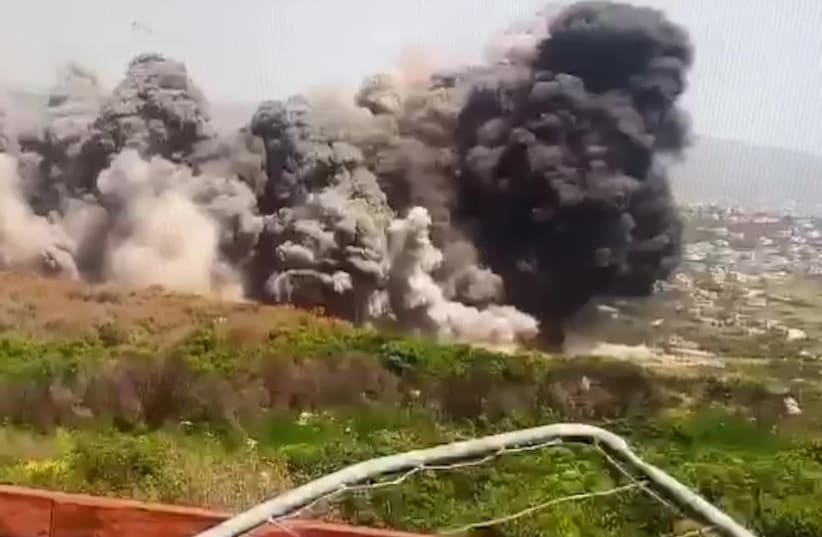
According to the IDF, the rescue forces faced a massive amount of gunfire and RPG fire in Nuseirat, leading the ground troops and the Israeli Air Force to carry out major strikes in the area. The strikes, targeting the areas from where Hamas operatives were opening fire, were aimed at protecting the rescue forces and the hostages.
The IDF acknowledged that it killed Palestinian civilians amid the fighting, but it placed the blame on Hamas for holding hostages and fighting in a dense civilian environment.
The military has also denied using civilian vehicles during the operation, an allegation that has been reported in the media.

It is believed that 116 hostages abducted by Hamas on October 7 remain in Gaza — not all of them alive — after 105 civilians were released from Hamas captivity during a weeklong truce in late November, and four hostages were released prior to that.
Seven hostages have been rescued by troops alive, and the bodies of 19 hostages have also been recovered, including three mistakenly killed by the military.
The IDF has confirmed the deaths of 41 of those still held by Hamas, citing new intelligence and findings obtained by troops operating in Gaza.
One more person is listed as missing since October 7, and their fate is still unknown.
Hamas is also holding two Israeli civilians who entered the Strip in 2014 and 2015, as well as the bodies of two IDF soldiers who were killed in 2014.

The Hamas-run Gaza health ministry says more than 36,000 people in the Strip have been killed or are presumed dead in the fighting so far. Of these, some 24,000 fatalities have been identified at hospitals or through self-reporting by families, with the rest of the figure based on Hamas “media sources.”
The tolls, which cannot be verified, include some 15,000 terror operatives Israel says it has killed in battle. Israel also says it killed some 1,000 terrorists inside Israel on October 7.
A total of 299 soldiers and one police officer have been killed during the ground offensive against Hamas and amid operations along the Gaza border. A civilian Defense Ministry contractor has also been killed in the Strip.
Emanuel Fabian contributed to this report.