Special forces simultaneously raid two Hamas buildings in Nuseirat, reaching Noa Argamani, Almog Meir Jan, Andrey Kozlov, and Shlomi Ziv; officer critically hurt dies of wounds


Israeli hostages pictured after their rescue from Hamas captivity in Gaza on June 8, 2024. From left: Shlomi Ziv (IDF); Andrey Kozlov and Almog Meir Jan (Avshalom Sassoni/Flash90), and Noa Argamani (Courtesy)

Israeli hostages pictured after their rescue from Hamas captivity in Gaza on June 8, 2024. From left: Shlomi Ziv (IDF); Andrey Kozlov and Almog Meir Jan (Avshalom Sassoni/Flash90), and Noa Argamani (Courtesy)

Four Israeli hostages were rescued alive from Hamas captivity Saturday in a daring daylight operation in the central Gaza Strip, the military announced.

Noa Argamani, 26, Almog Meir Jan, 21, Andrey Kozlov, 27, and Shlomi Ziv, 40, had been abducted from the Supernova music festival near the community of Re’im on the morning of October 7, when some 3,000 Hamas-led terrorists killed 1,200 people and took 251 hostages in a murderous rampage in southern Israel.

Officers of police’s elite Yamam counter-terrorism unit, along with Shin Bet agents, simultaneously raided two Hamas buildings in the heart of central Gaza’s Nuseirat, a joint statement said. Argamani was rescued at one site, while Meir Jan, Kozlov, and Ziv were at the second location.

Hundreds more soldiers of the Israel Defense Forces participated in the operation, according to the military.

Israel Defense Forces Spokesman Rear Adm. Daniel Hagari said the hostages were rescued by special forces while “under fire.” A Yamam officer was critically wounded in the operation and brought to an Israeli hospital, but died shortly after.

He was named as Chief Inspector Arnon Zamora.

Chief Inspector Arnon Zamora, who was killed in a mission to rescue hostages held in the Gaza Strip, June 8, 2024. (Israel Police)

Amid the operation, heavy airstrikes were carried out in the area against Hamas sites and in support of the ground troops, the military said. Hamas health authorities reported at least 50 Palestinians were killed, without noting how many were combatants.

The rescued hostages, who had been in Hamas captivity for eight months, were all in good condition, according to initial medical assessments. They were taken by helicopters from the Strip to hospitals in Israel for further evaluation.

“During the operation, we struck… threats to our forces in the area. These threats were struck from the land, air, and sea… for us to extract our forces [and the hostages],” Hagari said in a press conference.

Smoke rises after an Israeli air strike, in Nuseirat in the central Gaza Strip, on June 8, 2024. (Abed Rahim Khatib/Flash90)

Nuseirat is one of the few areas of Gaza where ground troops had not yet maneuvered into during the IDF’s ground offensive against the Hamas terror group.

Hagari said that the rescue had been in the works for “many weeks,” with “quality intelligence and complex operational planning.”

“The intelligence for this operation was very complex to obtain,” he said.

It was the third successful operation of its kind since October 7. The first was the rescue of soldier Ori Megidish in late October. In early December, the IDF attempted to rescue another hostage, but he was killed. And in February, hostages Fernando Marman, 61, and Louis Har, 70, were rescued from southern Gaza’s Rafah.

All of the hostages rescued by the IDF from Gaza, including the four on Saturday, were saved from buildings and not tunnels.

Rescued hostage Noa Argamani is seen reunited with her father, June 8, 2024 (Courtesy)

Argamani, was seen in a famous video screaming in fear as she was abducted to Gaza from the Supernova party on a motorbike. Her mother, who is terminally ill, had repeatedly begged to see her before she died. Argamani was also featured in a Hamas propaganda video published in January. Another clip featuring her voice was aired last week.

Footage posted to social media on Saturday showed Argamani reuniting with her father while en route to a hospital, where she was reunited with other family members.

Meir Jan, 21, was released from army service three months before his capture. He too was taken from the party.

Kozlov, 27, was working as a security guard at the rave when he was captured. He is a new immigrant to Israel, having moved here about a year and a half ago.

Ziv, 40, was also working as part of the security detail at the desert party. Ziv had gone to the party with two others, Aviv Eliyahu, his wife’s relative, and Jake Marlowe, a friend. Both were killed.

The Israel Defense Forces later Saturday released footage of all four hostages reuniting with members of their families at Ramat Gan’s Sheba Medical Center.

The rescue operation was hailed by Israeli leaders, with Prime Minister Benjamin Netanyahu saluting security forces for carrying out the daring mission.

“Once again you have proven that Israel does not surrender to terrorism and acts with creativity and boldness that knows no bounds, to bring home our hostages,” the premier said in a statement. “We are committed to doing so in the future as well. We will not let up until we complete the mission and return all our hostages home – both the living and the dead.”

Almog Meir Jan reunites with his parents at Sheba Medical Center after being rescued from Hamas captivity alongside Noa Argamani, Shlomi Ziv, and Andrey Kozlov, June 8, 2024. (IDF Spokesperson’s Unit)

Netanyahu later visited all four hostages at the hospital.

Defense Minister Yoav Gallant feted the mission as “one of the most heroic and extraordinary operations I have witnessed over the course of 47 years serving in Israel’s defense establishment.”

Rescued hostage Andrey Kozlov, freed by the IDF from Hamas captivity in Gaza, is escorted from an IDF helicopter on arrival at the Sheba Medical Center in Ramat Gan, June 8, 2024. (Avshalom Sassoni/Flash90)

“IDF, Shin Bet, and Yamam, as well as the forces who supported [those in the field] have conducted an unprecedented operation – daring in nature, planned brilliantly, and executed in an extraordinary fashion. The various security agencies cooperated closely — the IDF, Shin Bet, and Yamam — acting as one single unit,” he said in a statement, thanking all those involved.

Rescued hostage Shlomi Ziv at Sheba Medical Center, June 8, 2024 (IDF)

“I would especially like to express my appreciation to the IDF Chief of the General Staff Lt. Gen. Herzi Halevi, who is leading the the military. I would like to express my appreciation to the head of the Shin Bet and to the commander of Yamam for their leadership in these complex conditions,” Gallant continued, adding that the country has people they can count on and reasons to be proud.

He praised the military chief for acting for the benefit of the country, even though some politicians have criticized him over the handling of the war.

“This morning not only did we have a successful operation, but also an opportunity to fulfill the goals of this war,” Gallant stated.

Praising the soldiers who carried out “the complicated and brave operation,” war cabinet member Benny Gantz said his “heart is full”

“Even today, my heart goes out to all the families of the hostages. We are committed to doing everything to return them homes,” he said.

An Israeli military helicopter with released Israeli hostages arrives at Sheba Medical Center in Ramat Gan, June 8, 2024 (Avshalom Sassoni/Flash90)

Following Saturday’s rescue, 116 of the 251 hostages abducted by Hamas on October 7 still remain in Gaza, not all of them alive. A weeklong truce in late November saw 105 civilians released from Hamas captivity and four hostages were released before that.

In all, seven hostages have been rescued by troops alive, and the bodies of 19 hostages have also been recovered, including three mistakenly killed by the military.

Rescued hostage Almog Meir Jan raises his hands in celebration as he is escorted from an IDF helicopter on arrival at Sheba Medical Center in Ramat Gan, June 8, 2024. (Avshalom Sassoni/Flash90)

The IDF has confirmed the deaths of 41 of those still held by Hamas, citing new intelligence and findings obtained by troops operating in Gaza.

One more person has been listed as missing since October 7, and her fate is still unknown, although her family believes she is dead.

Shlomi Ziv embraces a soldier as he lands in Israel after being rescued from Hamas captivity, June 8, 2024. (IDF Spokesperson’s Unit)

Hamas has also been holding two Israeli civilians who entered the Strip in 2014 and 2015, as well as the bodies of two IDF soldiers who were killed in 2014.

The Hamas-run Gaza health ministry says more than 36,000 people in the Strip have been killed or are presumed dead in the fighting so far. Of these, some 24,000 fatalities have been identified at hospitals or through self-reporting by families, with the rest of the figure based on Hamas sources. The tolls, which cannot be verified, include some 15,000 gunmen Israel says it has killed in battle. Israel also says it killed some 1,000 terrorists inside Israel on October 7.

The IDF has said 295 soldiers have been killed during the ground offensive against Hamas and amid operations along the Gaza border. A civilian Defense Ministry contractor has also been killed in the Strip.
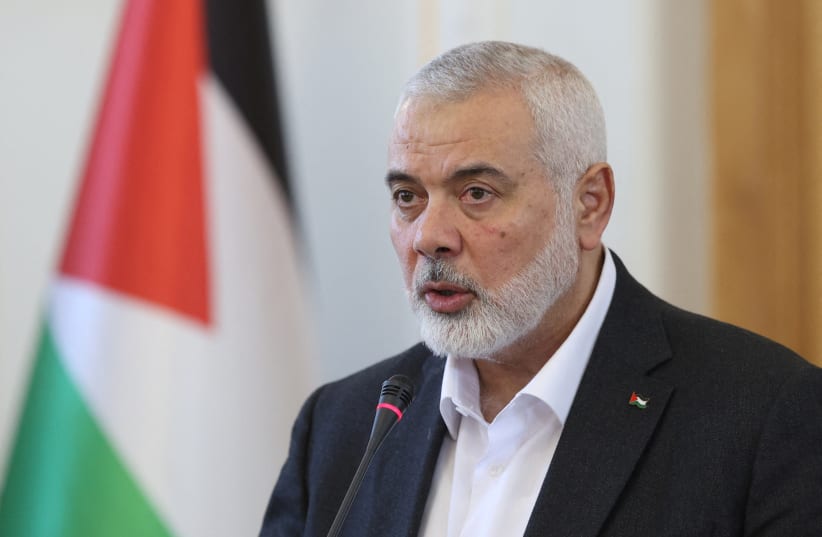
“If the occupation believes that it can impose its choices on us by force, it is delusional,” Ismail Haniyeh said.

 Palestinian group Hamas' top leader, Ismail Haniyeh speaks during a press conference in Tehran, Iran, March 26, 2024. (photo credit: MAJID ASGARIPOUR/WANA)
Palestinian group Hamas’ top leader, Ismail Haniyeh speaks during a press conference in Tehran, Iran, March 26, 2024.
(photo credit: MAJID ASGARIPOUR/WANA)
Shortly after Israeli forces freed hostages Noa Argamani, Andrey Kozlov, Shlomi Ziv, and Almog Meir on Saturday, Hamas published a statement from the terror organization’s leader, Ismail Haniyeh, in which the arch-terrorist asserted that Hamas would not surrender.

“Our people will not surrender, and the resistance will continue to defend our rights in the face of this criminal enemy,” Haniyeh reportedly said. “And if the occupation believes that it can impose its choices on us by force, it is delusional, and the movement will not agree to any agreement that does not achieve security for our people first and foremost.”

In the statement, the Hamas leader asserted that the Israeli military was engaging in massacres of the Palestinian people in Gaza.

“[Israel] continues the massacres against our people, children and women, the chapters of which are now taking place in Nuseirat and Deir al-Balah.”

Rescue operation occurred in the heart of Nuseirat

After securing the release of the hostages, the IDF reported that the rescue operation had taken place in two different locations in central Nuseirat.

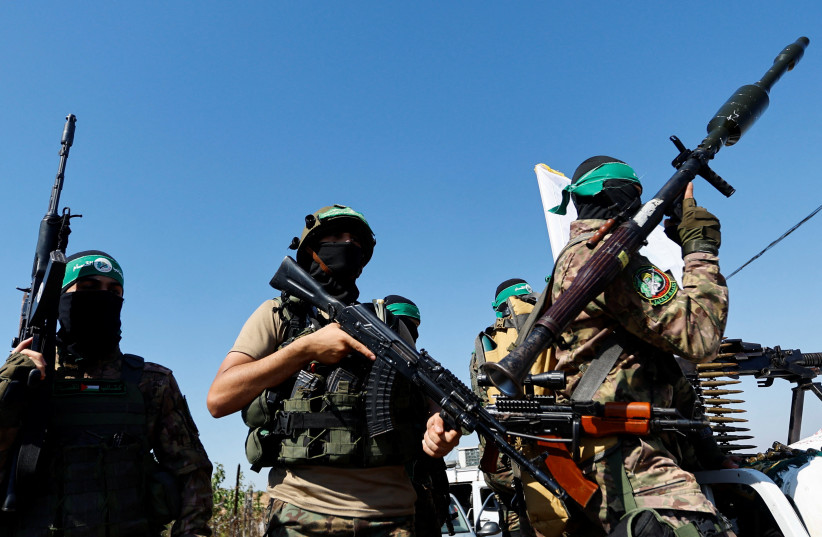
 Palestinian fighters from the armed wing of Hamas take part in a military parade to mark the anniversary of the 2014 war with Israel, near the border in the central Gaza Strip, July 19, 2023. (credit: REUTERS/IBRAHEEM ABU MUSTAFA)Enlrage image
Palestinian fighters from the armed wing of Hamas take part in a military parade to mark the anniversary of the 2014 war with Israel, near the border in the central Gaza Strip, July 19, 2023. (credit: REUTERS/IBRAHEEM ABU MUSTAFA)

According to the Hamas-run health ministry in Gaza, the bodies of at least 93 Palestinians who were killed during Israeli activities in Nuseirat and other areas in the central region of the Gaza Strip arrived at Al-Aqsa Martyrs Hospital on Saturday.

The ministry does not distinguish between combatants and civilians in its reporting, and the numbers published by the ministry have come under scrutiny, particularly in recent days, for its apparent inflating of the proportion of women and children killed during the war.

Later, Hamas put out another statement saying that the Israeli rescue operation would not “not change its strategic failure in the Gaza Strip” as the terrorist organization still held the bulk of the hostages.

Hamas also claimed that it was capable of capturing more hostages.

Reuters contributed to this report.


by Corey Walker

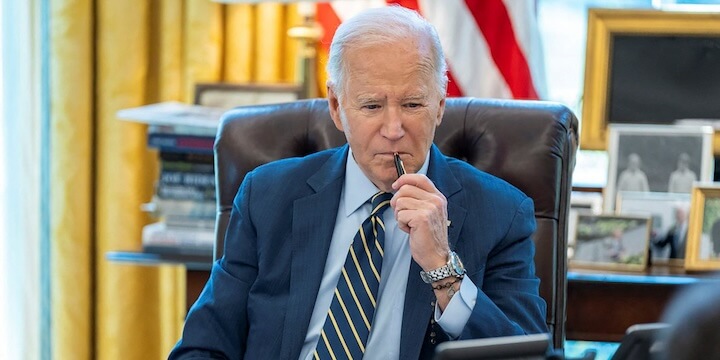
US President Joe Biden speaks on the phone with Israeli Prime Minister Benjamin Netanyahu in this White House handout image taken in the Oval Office in Washington, US, April 4, 2024. Photo: The White House/Handout via REUTERS

The Biden administration is still publicly pressuring both Israel and Hamas to accept a ceasefire deal unveiled by US President Joe Biden last week to end the fighting in Gaza, despite the Palestinian terror group seemingly rejecting the proposal and issuing statements irreconcilable with Israel’s position.

Leaders of Hamas, which rules Gaza, have for months refused to make concessions for a truce, insisting on a permanent ceasefire and full Israeli withdrawal in order to reach an agreement. The Islamist terror group, which launched the ongoing war with its Oct. 7 massacre across southern Israel, has argued that the current iteration of the ceasefire deal does not guarantee either condition.

“We informed the mediators that we could not agree to a deal that would not guarantee a permanent ceasefire and a complete withdrawal from the Gaza Strip, along with a serious prisoner deal,” senior Hamas official Osama Hamdan told a televised press conference earlier this week.

On Thursday, Hamdan dismissed the terms of the ceasefire as “just words.”

“There is no proposal — they are just words said by Biden in a speech,” he told AFP. “So far, the Americans have not presented anything documented or written that commits them to what Biden said in his speech.”

Another senior Hamas official, Sami Abu Zuhri, welcomed what he called “Biden‘s ideas” but similarly said Hamas’ demands were not met.

“The Israeli documents speak of open-ended negotiation with no deadline, and it speaks of a stage during which the occupation regains its hostages and resumes the war,” he told Reuters, referring to the hostages who Hamas terrorists kidnapped and brought to Gaza on Oct. 7. “We had told the mediators that such a paper wasn’t acceptable to us.”

Hamas political chief Ismail Haniyeh echoed those sentiments on Wednesday in what appeared to be the terrorist group’s reply to Biden’s proposal.

In a speech last Friday, Biden disclosed that a day earlier, a new three-phase Israeli proposal for a hostage deal was passed onto Hamas through Qatar and detailed some of its main terms.

Biden said the deal would “bring all the hostages home, ensure Israel’s security, create a better day after in Gaza without Hamas in power, and set the stage for a political settlement that provides a better future for Israelis and Palestinians alike.”

The first phase of the ceasefire plan, as described by Biden, would last six weeks and include a “full and complete ceasefire” between Israel and Hamas and the “withdrawal of Israeli forces from all populated areas of Gaza.” It would also include the “release of a number of hostages” in exchange for “the release of hundreds of Palestinian prisoners.”

During this six-week period, Israel and Hamas would negotiate the “necessary arrangements” in order to transition to the second phase and a “permanent end” to the war, including a full Israeli withdrawal from Gaza, Biden explained.

One sticking point could be whether Hamas is allowed to remain in power in Gaza.

Yahya Sinwar, the leader of Hamas in Gaza and the mastermind of the Oct. 7 massacre, asserted that the group will not accept any ceasefire deal that requires disarmament.

“Hamas will not surrender its guns or sign a proposal that asks for that,” Sinwar said this week, according to the Wall Street Journal.

Meanwhile, Israeli officials have also expressed reservations about the current version of the ceasefire deal, despite Biden describing it as an Israeli proposal. Israel has suggested the deal could prevent the Jewish state from achieving its war aims of freeing the hostages and eradicating the Hamas terror threat from its border.

On Saturday, the office of Israeli Prime Minister Benjamin Netanyahu released a statement saying that any deal must allow for “Israel to continue the war until all its objectives are achieved, including the destruction of Hamas’ military and governing capabilities.”

“Israel will continue to insist these conditions are met before a permanent ceasefire is put in place,” Netanyahu continued.

On Monday, Netanyahu said that Biden had disclosed only part of the proposal aimed at achieving a ceasefire in Gaza and securing the release of Israeli hostages, and added that he had not agreed to end Israel’s military operations against Hamas.

“The proposal contains more details that Biden did not mention,” Netanyahu reportedly told Israeli lawmakers.

“Biden omitted one crucial detail regarding the second stage” of the deal, Netanyahu said.

“Israel didn’t agree to end the war, but only to ‘discuss’ its end,” he explained, adding that such a discussion would occur after the hostages were returned and “only on our terms.”

“Despite what President Biden said, the number of hostages that will be released in the first phase has not yet been agreed upon. There are many details in the deal, and the war will not end without us achieving all of our objectives. We will not give up on absolute victory,” he said.

Senior Netanyahu adviser Ophir Falk on Sunday gave a lukewarm endorsement to the ceasefire proposal. He conceded that it’s “not a good deal,” but underlined the importance of securing the return of the remaining hostages currently being held captive in Gaza.

There is widespread dissatisfaction among senior Israeli officials who feel Biden’s remarks lacked specifics on how the stated goal of dismantling Hamas would be accomplished, fueling criticism that the US president misrepresented the full scope of Israel’s uncompromising stance in fully defeating the Palestinian terror group.

“People have unfortunately been led to believe that a permanent ceasefire kicks in without Israel’s conditions being met,” Falk told The Algemeiner on Monday. “The notion that there will be a permanent ceasefire before Hamas’ military and governing capabilities are destroyed and all our hostages are home is a non-starter.”

Despite repeated rejections of the ceasefire deal by Hamas and hesitance by Israel, the Biden administration has argued that an agreement between Israel and the terrorist group is still attainable.

White House national security adviser Jake Sullivan stated during a Wednesday interview that the ceasefire deal is still “on the table.”

State department spokesperson Matthew Miller confirmed on Thursday that the US has not received “an official response from Hamas” regarding the ceasefire deal and said the administration is still pushing for the agreement.

The White House released a joint statement on Thursday with the governments of Argentina, Austria, Brazil, Bulgaria, Canada, Colombia, Denmark, France, Germany, Poland, Portugal, Romania, Serbia, Spain, Thailand, and the United Kingdom, calling on Hamas to accept the ceasefire proposal.

“We call on Hamas to close this agreement, that Israel is ready to move forward with, and begin the process of releasing our citizens,” the statement read.

The US has recently praised Israel for its willingness to make compromises in ceasefire negotiations, while describing Hamas as an “obstacle” to a truce.

Neither the White House nor the US State Department responded to requests for comment on how the Biden administration hopes practically to achieve its ceasefire proposal given the recent statements from Israel and Hamas.