As US Secretary of State Antrony Blinken is set to visit Israel on Monday, a Hamas official called upon the US to pressure Israel into ending the war.
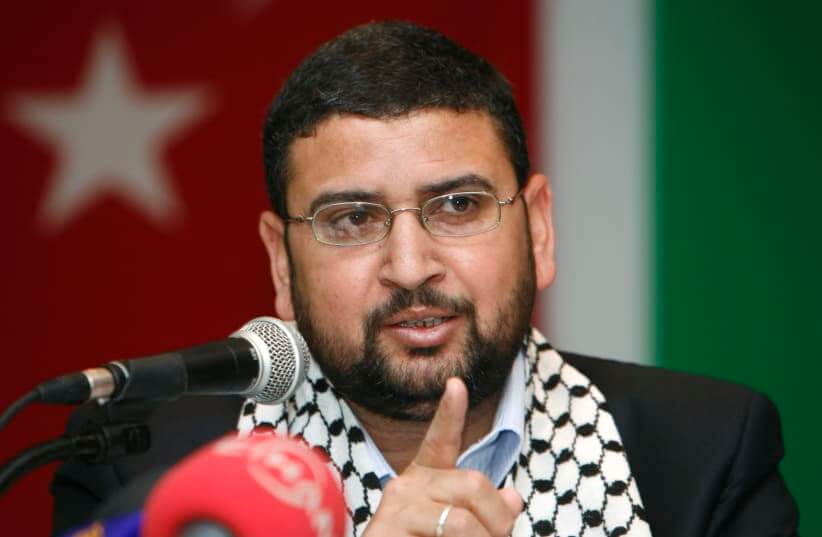
By REUTERSUpdated: JUNE 10, 2024 10:55Hamas spokesman Sami Abu-Zuhri.(photo credit: REUTERS/OSMAN ORSAL)
A senior Hamas official urged the United States on Monday to pressure Israel to end the war in Gaza, ahead of the planned visit on Monday by US Secretary of State Antony Blinken to the region to push forward ceasefire efforts.
Blinken is set to visit Egypt and Israel on Monday. He also aims to ensure the war does not expand into Lebanon.
“We call upon the US administration to put pressure on the occupation to stop the war on Gaza, and the Hamas movement is ready to deal positively with any initiative that secures an end to the war,” senior Hamas official Sami Abu Zuhri said.
In his eighth visit to the region since Hamas terrorists attacked Israel on Oct. 7, triggering the bloodiest episode in the decades-long Israeli-Palestinian conflict, Blinken is also set to travel to Jordan and Qatar this week.
He is set to meet with Egyptian President Abdel Fattah al-Sisi in Cairo before traveling to Israel later on Monday, where he will meet with Prime Minister Benjamin Netanyahu and Defense Minister Yoav Gallant, according to a State Department schedule.
US SECRETARY of State Antony Blinken testifies before the Senate Foreign Relations Committee, this week. The US administration still, with messianic devotion, thinks that the establishment of a Palestinian state must be diligently pursued post haste via pressure on Israel, the writer charges. (credit: KEVIN LAMARQUE/REUTERS)
Israel goes deeper into Gaza
On Monday, Palestinian residents said tanks had been trying to thrust deeper towards the north in the early hours of Monday, edging Shaboura, one of the most densely populated and terror stronghold neighborhoods at the heart of the city.
Israeli tank forces have since seized Gaza’s entire border strip with Egypt running through Rafah to the Mediterranean coast and invaded many districts of the city of 280,000 residents, prompting around one million displaced people who had been sheltering in Rafah to evacuate.
Blinken’s visit comes after US President Joe Biden on May 31 outlined a three-phase ceasefire proposal from Israel that envisions a permanent end to hostilities, the release of Israeli hostages and Palestinian prisoners, and the reconstruction of Gaza.
The Hamas October 7 massacre killed 1,200 people and took some 250 others hostage, according to Israeli tallies. In response, Israel launched an offensive in the Gaza Strip that has killed more than 37,000 Palestinians, the Hamas-run health ministry said in its Sunday update.
President Biden prefers to let the Iranian bomb program advance but not the IDF.
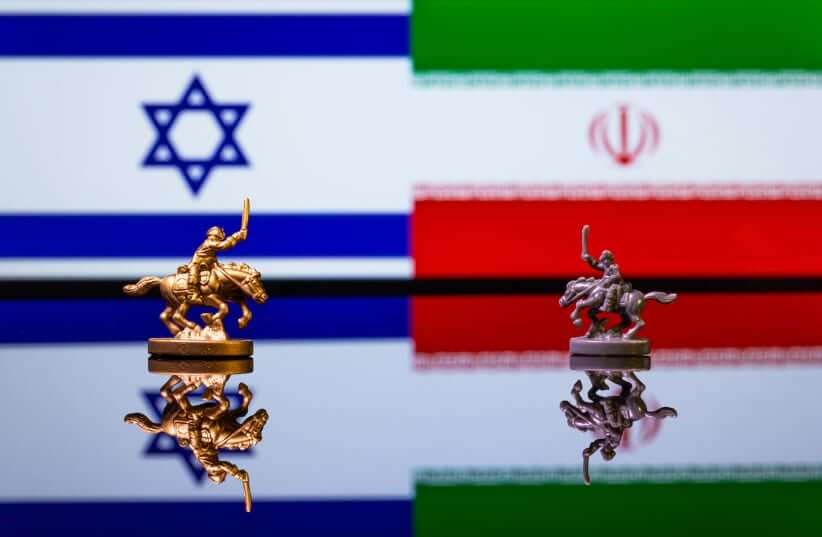
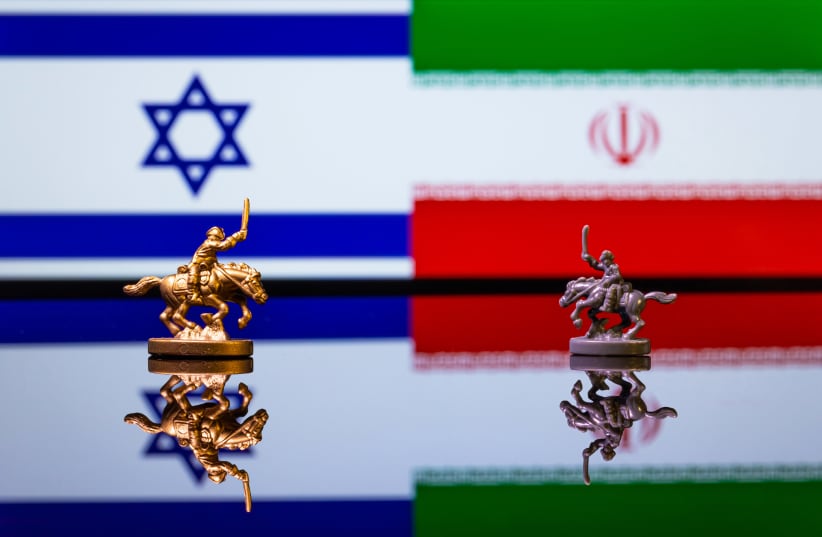
By DAVID M. WEINBERGA war between Israel and Iran (illustrative)(photo credit: INGIMAGE)
On the sidelines of the funeral in Tehran for Iranian president Ebrahim Raisi, who was killed in a helicopter crash last month, Supreme Leader Ayatollah Khamenei convened a meeting of his “resistance front” – with Hamas, Hezbollah, Palestinian Islamic Jihad, PFLP, and Yemeni Houthi chieftains.
The purpose: to decide how to “continue jihad and struggle until a complete victory is achieved in the Gaza Strip with the participation of all resistance groups in the region,” and to “confront American imperialism.” Khamenei calls this the “ring of fire” strategy to eliminate Israel and achieve regional hegemony.
Two days ago, acting Iranian Foreign Minister Ali Bagheri Kani visited Lebanon and Syria where he met with Syrian President Assad and Hezbollah chieftain Nasrallah “to discuss ways to counter the Zionist regime” – which apparently means, among other things, escalating Hezbollah’s attacks on Israel. Witness the precise missile attacks on military and intelligence sites in northern Israel this past week (and the resultant wild brush fires).
The mullahs of Tehran also are behind the increasingly sophisticated and well-equipped military infrastructure in Judea and Samaria. As far back as 2014, Khamenei began to openly advocate “exporting the Islamic revolution” to the hills of Samaria. He called for “serious planning to add the West Bank to the confrontation with Israel.” “Gaza is the center of resistance, but resistance groups in the West Bank are the key that can bring the Zionist enemy to its knees,” Khamenei said.
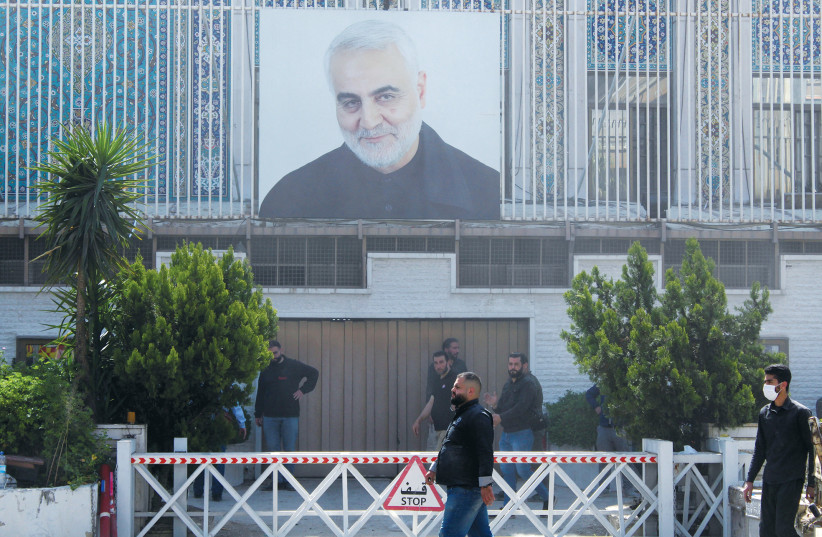
The notorious commander of the Iranian Islamic Revolutionary Guards Corps Quds Force, Qasem Soleimani (assassinated by the US in 2020), took-up the charge, making the arming of West Bank militias an Iranian priority.
A PICTURE of previously assassinated senior Iranian military commander Gen. Qasem Soleimani is placed on the Iranian Embassy building in Damascus after a suspected Israeli strike on Iran’s adjacent consulate killed key Quds Force figures. (credit: FIRAS MAKDESI/REUTERS)
Soleimani brought Hamas leader Ismail Haniyeh, his deputy Saleh al-Arouri, and Islamic Jihad leader Ziyad al-Nakhaleh to meet Khamenei and Raisi in Tehran. Hamas official Osama Hamdan then bragged about a “new stage of resistance” in which Iran would back the creation of “20 to 30 new battalions of 2,000 militants in Samaria.”
Al-Nakhaleh plainly told Iranian newspaper Al-Wefaq that anti-Israeli operation actions in the West Bank reflect directives coming from Iran. “No other country in the world takes such a stance so explicitly, a testament to Tehran’s support for the Palestinian resistance factions, with strong ties between PIJ, Hamas and the Islamic Republic.”
The result? Just yesterday the Shin Bet (Israel Security Agency) warned of “Iranian islands” flush with cash and weapons in Judea and Samaria.
This means that heavy battles are ahead. Israel cannot sit by and watch Judea and Samaria (the West Bank) in Israel’s center – adjacent to Israel’s three key cities of Jerusalem, Tel Aviv, and Haifa – become another full-fledged base of Iranian military operations against the Jewish state, like Gaza (on Israel’s southern border) and Lebanon (on its northern border).
Biden’s allowances for Iran
And where is all Iran’s cash coming from? Well, the Biden administration has unfrozen at least $6 billion in Iranian assets, and helped Tehran evade sanctions through waivers that have funneled billions more into its coffers. Iranian oil exports have consequently surged to 1.82 million barrels a day, the highest total since the Trump administration reinstated sanctions in 2018.
On behalf of Iran, Hezbollah and the IRGC also are invested heavily in drug production and distribution (Captagon pills and more) across the Middle East and Europe, and in money-laundering cryptocurrency schemes – as revealed last year by Israeli authorities.
Of even greater concern is Iran’s helter-skelter dash to nuclear bomb capability, under cover of the world’s lopsided focus on Israeli “crimes” in Gaza. The International Atomic Energy Agency says that Iran’s stockpile of 60% highly enriched uranium has doubled (!) since February from 20.6 kg to 42.1 kg and could be converted into weapons-grade enriched uranium in a matter of days. It would then be enough to fuel three nuclear weapons.
The international response? Well, the IAEA board on Wednesday condemned Iran “for its lack of cooperation” with agency watchdogs, with the US reluctantly going along at the last moment (after first lobbying European countries to avoid censuring Iran).
Wow. The Iranians must be shaking in their Islamic marching boots.
Of course, Biden’s approach to Iran is a function of the long-standing Obama-Biden obsession with appeasing Tehran’s ayatollahs, hoping that “they will become less medieval and more compliant if treated nicely” – as former US national security adviser and ambassador to the UN John Bolton wrote critically this week. It also is a function of Biden’s desire to keep gasoline prices low and foreign distractions to a minimum before November’s US presidential election.
THIS EXPLAINS the weak American responses to attacks upon its assets in the Arabian Gulf by Iranian proxies, carefully avoiding killing any Iranians themselves. It also explains Washington’s insistence that Israel not respond significantly to the massive April 14 Iranian missile attacks – an event that should have led to game-changing military action against the Islamic Republic on multiple fronts. But Washington publicly reassured Tehran that it would not take part in any offensive actions against Iran – and made sure that Israel could not do much either.
And then there is Gaza and Lebanon, where Biden has undermined Israel’s attempts to achieve crushing victories in the multi-front pincer war being waged against it by Iranian proxies. This includes withholding weaponry and ammunition; attempting to micro-manage IDF operations neighborhood-by-neighborhood and/or preventing them; forcing Israel into paralyzing, never-ending, and unlikely to succeed hostage negotiations; and insanely insisting that the supply of humanitarian aid to Gazans be Israel’s “priority.”
This is persistent strategic blindness. By concentrating energies on punishing Israel for daring to defend itself against extermination; by failing to give Israel the weapons and diplomatic cover it needs to achieve decisive victories; by refusing to acknowledge Iran’s hegemonic “ring of fire” strategy; by failing to confront the Houthis as they close international shipping routes through the Red Sea (and Suez Canal); and by failing to truly check Iran’s nuclear bomb program, which is moving towards all-out nuclear attack on Israel within a decade – the Biden administration is wreaking disaster on Israel and the West.
WHAT IS particularly sad is that there are ways of halting Iran’s march towards a nuclear bomb and regional hegemony.
A real Biden administration road map for countering Iran would include snapback sanctions on Tehran with tight supervision (especially of Iranian oil exports and dual-use technologies); terrorist designation of the IRGC across Europe; suspension of Iranian membership in international forums; sanctions and economic pressure on individuals and organizations involved in repressing human rights; penalties on key Iranian industries; covert disruptive measures against Iran’s nuclear program – and, most saliently: articulation and demonstration of a credible military threat against the Iranian regime.
The Foundation for the Defense of Democracies in Washington has outlined more than 200 specific measures in the military, cyber, financial, energy, legal, and diplomatic spheres that US government agencies can take in “deploying multiple elements of national power” to confront threats from the Islamic Republic of Iran.
Taken together, these measures would enhance American deterrence; reassure America’s true Mideast allies; pointedly punish Iran for terrorism; help Israel win its ground wars in Gaza, Judea and Samaria, and Lebanon; and perhaps prevent an Iranian nuclear breakout.
Alas, President Biden prefers to make allowances for Iran while reprimanding Israel; to spare the ayatollahs but scold Netanyahu; and to let the Iranian bomb program advance but not the IDF. Dangerous times indeed.
The writer is senior managing fellow at the Misgav Institute for National Security & Zionist Strategy, in Jerusalem. The views expressed here are his own. His diplomatic, defense, political, and Jewish world columns over the past 27 years are at davidmweinberg.com
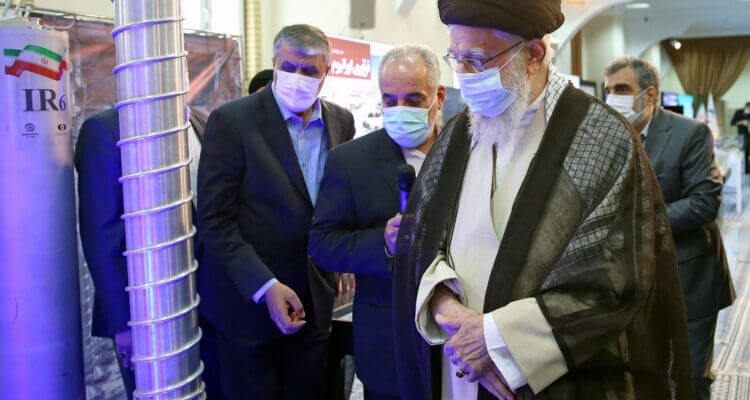
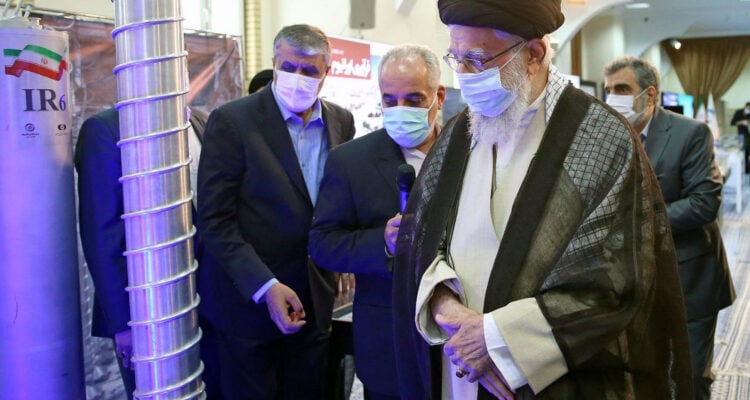
Supreme Leader Ayatollah Ali Khamenei tours an exhibition in Tehran on Iran’s nuclear industry, June 11, 2023. Source: Twitter.
Iran has enriched its uranium stockpile by 60% and possibly higher, a degree of purity that no country without an atomic weapon has ever pursued.
By Pesach Benson, TPS
As the International Atomic Energy Agency condemned Iran one analyst told The Press Service of Israel that the United Nations’ nuclear watchdog’s resolution was “too little too late,” and warned that with the world distracted by fighting in Gaza and Ukraine, Tehran might seek a nuclear breakout before the possible election of Donald Trump in November.
At the IAEA’s Board of Governors meeting in Vienna on Wednesday, members approved the resolution by a vote of 20-2 with 12 abstentions. Russia and China opposed the resolution. The Biden administration, which initially urged Europe to abstain, voted in favor.
Praising the resolution on X, formerly known as Twitter, Israeli Foreign Minister Israel Katz wrote, “I welcome the decision made today by the @iaeaorg Board of Governors, demanding that Iran comply with its international obligations and cease advancing its dangerous nuclear program.”
The resolution, which is not legally binding, followed up on a November 2022 resolution calling on Iran to cooperate with the IAEA’s investigation into traces of uranium that inspectors discovered at undeclared nuclear sites.
‘Too Little, Too Late’
Israeli Brig.-Gen. (res.) Yossi Kuperwasser, former head of the research division in the Israel Defense Force’s Military Intelligence told TPS-IL the resolution was “a step in the right direction,” but also “too little, too late.” Kuperwasser is currently a researcher at the Jerusalem-based Misgav Institute.
Asked about the timing of the resolution, Kuperwasser said that the monitors lost contact with many Iranian activities once they were barred from various nuclear sites, and the IAEA still has unanswered questions dating back to 2003.
According to Kupperwasser, the Europeans “Woke up when they lost control of what’s really happening inside the Iranian nuclear project.”
While uranium needs to be only 3.67% pure to generate nuclear power, Iran has enriched its uranium stockpile by 60% and possibly higher, a degree of purity that no country without an atomic weapon has ever pursued.
A nuclear bomb requires uranium to be enriched to 90% purity. Purifying the remaining 30% is regarded as a technical matter.
Meanwhile, American reluctance to support the resolution is being perceived as a sign of weakness by the Iranians, and may embolden Tehran to push for a nuclear breakout before Donald Trump’s possible return to the White House, he added.
ISRAELI OFFICIALS SUSPECT IRANIAN PRESIDENT KILLED IN CRASH, DENY ISRAEL INVOLVED IN INCIDENT
“The Biden administration wants to avoid any confrontation with Iran. They are afraid that if they move into confrontation, confrontational Iran may actually move towards having a bomb. But maybe [Iran’s leaders] believe that Trump is going to become the next president. They might actually try to break out a bomb now,” Kuperwasswer warned. “They have enough material to produce the fissile material that is necessary for three bombs within a month.”
If allowed to successfully break out a nuclear weapon, Iranian hegemony in the Middle East “is going to materialize very fast,” Kuperwasser insisted. “We saw how dangerous Iran was in their attempts to attack Israel with 350 projectiles immediately, right?”
However, said Kuperwasser, the world is distracted by wars in Gaza and Ukraine, and escalating tensions between China and Taiwan. “Look, when Biden gave his recent State of the Union address, he didn’t mention the nuclear project of Iran,” he noted.
Snapback sanctions could be triggered against Iran, but Europe would have to step up, because the US withdrew from the Joint Comprehensive Plan of Action, also known as the Iran nuclear deal.
With Iran’s allies, Russia and China, holding veto power in the UN Security Council, Kuperwasser suggested that “The best way to act is bypassing the Security Council and snapping back the sanctions that were when the JCPOA [Joint Comprehensive Plan of Action] came into effect. That’s the best way to handle it because if the Europeans don’t need the Security Council, they can do it directly.”