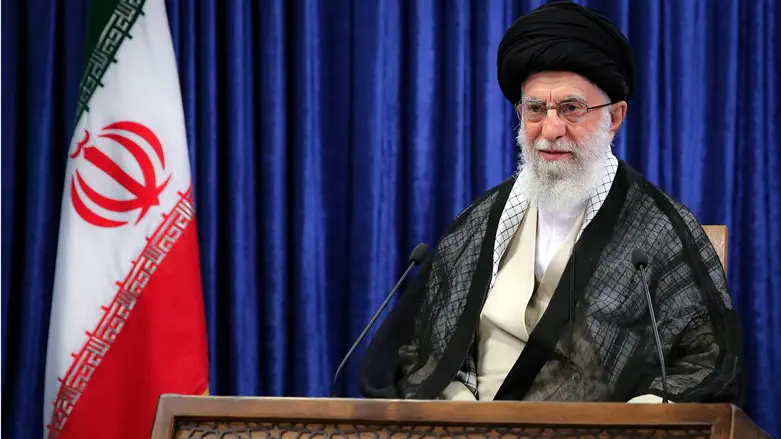
Iran’s Supreme Leader: Some people think that by forcing neighboring countries to normalize their ties with Israel the problem will be solved. They are wrong.
Iran’s Supreme Leader, Ayatollah Ali Khamenei, said on Wednesday that efforts underway to forge a normalization of ties between Israel and Arab countries will not resolve the crisis in the Middle East, reported the AFP news agency.
“Some people think that by forcing neighboring countries to normalize their ties (with Israel) the problem will be solved,” said Khamenei, adding, “They are wrong.”
“Palestine should be returned to them (Palestinian Arabs),” the Supreme Leader continued, adding, “They should form their own regime, their own system, then that system should decide how to deal with the Zionists.”
Khamenei’s remarks came after US Secretary of State Antony Blinken on Monday said Washington is nearly ready with a security package to offer Saudi Arabia if it normalizes relations with Israel.
Israel and Saudi Arabia appeared to be on track towards normalization before Hamas’ October 7 attack against Israel and the war in Gaza which followed.
Shortly after the start of the war in Gaza, sources told Reuters that Saudi Arabia is putting the US-backed plans to normalize ties with Israel on ice.
Saudi Foreign Minister, Prince Faisal bin Farhan, later saidthat he believes talks on normalization between Israel and Saudi Arabia will resume immediately after the conclusion of the war in Gaza.
More recently, the top Saudi diplomat indicated that normalization with Israel requires both an end to the fighting in the Gaza Strip as well as the establishment of a Palestinian state, which Saudi officials have long insisted is a condition for normalization with Israel.
Blinken said late last month that the United States and Saudi Arabia have made “good progress” in talks on normalizing ties between the kingdom and Israel.
“I believe we can reach an agreement, which would present a historic opportunity for two nations, but also for the region as a whole,” Blinken said.
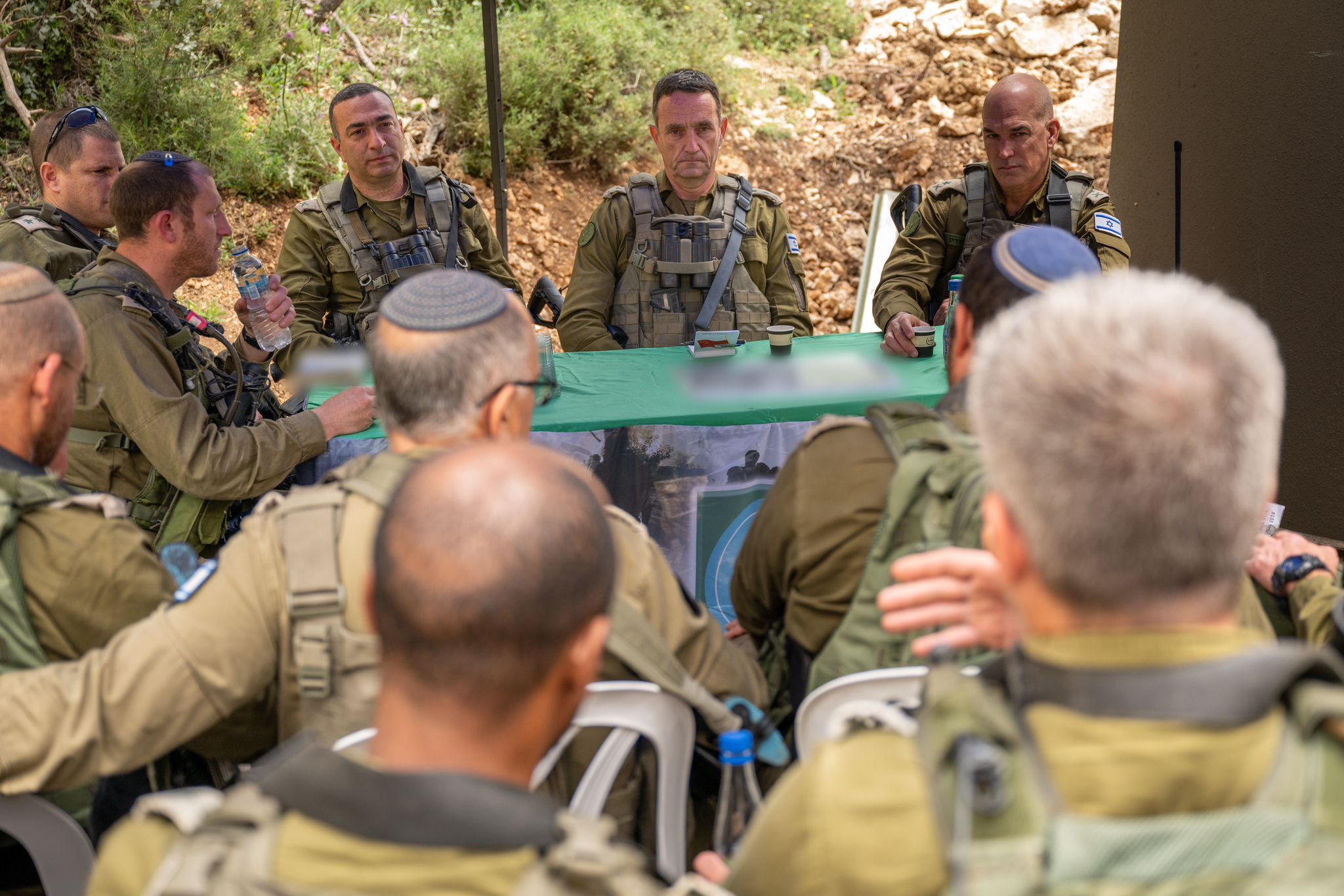
IDF Chief of Staff Lt. Gen. Herzi Halevi meets with officers and soldiers near the Lebanon border, May 1, 2024. (Israel Defense Forces)
During a visit to the Lebanon border, Israel Defense Forces Chief of Staff Lt. Gen. Herzi Halevi said the military was preparing for an offensive against the Hezbollah terror group, which continued to carry out attacks on northern Israel on Wednesday.
“You are doing an excellent job of operational defense in the north, and we are preparing for an offensive in the north,” Halevi said to reservists of the Etzioni Brigade at an undisclosed location on the border with Lebanon, in remarks published by the military.
The remarks were made following an assessment Halevi held with the chief of the Northern Command, Maj. Gen. Ori Gordin, the commander of the 146th Division, Brig. Gen. Yisrael Shomer, and other officers, the IDF said.
Speaking with the reservists, Halevi also said the IDF’s campaign in the Gaza Strip would continue “with strength.”
“Its objectives are both to restore security to the communities near the Gaza Strip and to bring the hostages back home securely,” he said.
The visit to the Lebanon border came amid repeated Hezbollah attacks on northern Israel amid the war in Gaza, including on Wednesday.
Heavy rockets fired by Hezbollah from Lebanon land in Kibbutz Hanita, northern Israel, on April 21, 2024. (Michael Giladi/Flash90)
Israel has threatened to go to war to force Hezbollah away from the border if it does not retreat and continues to threaten northern communities, from where some 70,000 people have been evacuated to avoid the fighting.
Hezbollah claimed responsibility for four separate attacks throughout Wednesday, including anti-tank missile fire on the largely evacuated border community of Metula, causing damage to homes.
The IDF said no injuries were caused in the attack, and troops shelled the launch sites in southern Lebanon with artillery.
Israeli fighter jets also struck two buildings used by Hezbollah in southern Lebanon’s Ayta ash-Shab and Marwahin on Wednesday evening, the military said.
Earlier in the day, another site belonging to the terror group in Tayr Harfa was hit, the IDF added.
In separate strikes overnight, fighter jets struck Hezbollah positions in five different areas of southern Lebanon, the military said Wednesday morning. The IDF said observation posts, buildings, and other Hezbollah infrastructure were hit in Khiam, Kafr Kila, Blida, Odaisseh, and Mays al-Jabal.
It published footage of the strikes.
Since October 8, Hezbollah-led forces have attacked Israeli communities and military posts along the border on a near-daily basis, with the terror group saying it is doing so to support Gaza amid the war there.
So far, the skirmishes on the border have resulted in nine civilian deaths on the Israeli side, as well as the deaths of 11 IDF soldiers and reservists. There have also been several attacks from Syria, without any injuries.
Hezbollah has named 290 members who have been killed by Israel during the ongoing skirmishes, mostly in Lebanon but some also in Syria. In Lebanon, another 56 operatives from other terror groups, a Lebanese soldier, and at least 60 civilians, three of them journalists, have been killed.
On Tuesday, French Foreign Minister Stéphane Séjourné was in Israel as part of a larger regional diplomatic trip in an effort to broker a de-escalation in the conflict on the border, and with Paris trying to act as an intermediary.
This handout picture provided by the Lebanese photo agency Dalati and Nohra shows France’s Foreign Minister Stephane Sejourne (L) meeting with Lebanon’s caretaker Prime Minister Najib Mikati, in Beirut, on April 28, 2024. (DALATI AND NOHRA / AFP)
Following a series of meetings in Lebanon on Sunday, Séjourné told journalists that France “is refusing to accept the worst-case scenario” of a full-scale war in Lebanon. “In southern Lebanon, the war is already here, even if it’s not called by that name, and it’s the civilian population who’s paying the price,” he said.
A French diplomatic official who spoke on condition of anonymity said the purpose of Séjourné’s visit was to convey France’s “fears of a war on Lebanon” and to submit an amendment to a proposal Paris had previously presented to Lebanon for a diplomatic resolution to the border conflict.
On Tuesday, Séjourné said that a number of modifications had been put to Israel following those consultations in Lebanon. “I call on Israeli authorities to take a public position on these French plans that will enable us to move to the next stage,” he said in an interview with Reuters.
“A number of proposals that we made to the Lebanese side have been shared (with you),” Sejourne said ahead of a meeting with Foreign Minister Israel Katz in Jerusalem.”We have a relationship with Lebanon, 20,000 citizens there, and the war in 2006 was particularly dramatic for them.”
Israel’s Foreign Minister Israel Katz, right, shakes hands with his French counterpart Stephane Sejourne as they pose for a picture before a meeting in Jerusalem, April 30, 2024. (AP Photo/Leo Correa)
Séjourné said the basis of the proposals was to ensure that the 2006 UN Resolution 1701 was implemented. Resolution 1701 required that Hezbollah withdraw its forces north of the Litani, a provision the Iranian proxy has ignored.
Earlier this year, Séjourné presented a written proposal to both sides that included Hezbollah’s forces pulling back 10km (6 miles) from the Israeli border and Israel halting strikes in southern Lebanon. The proposal also looked at long-term border issues and was discussed with partners including the United States, which is making its own efforts to ease tensions and exerts the most influence on Israel.
Hezbollah has maintained it will not enter any concrete discussions with Israel until there is a ceasefire in Gaza, where the war between Israel and Hamas has entered its seventh month.
US Secretary of State Antony Blinken opposes IDF operation in Rafah, emphasizing a need for civilian protection. Efforts continue for a hostage deal amidst escalating tensions.
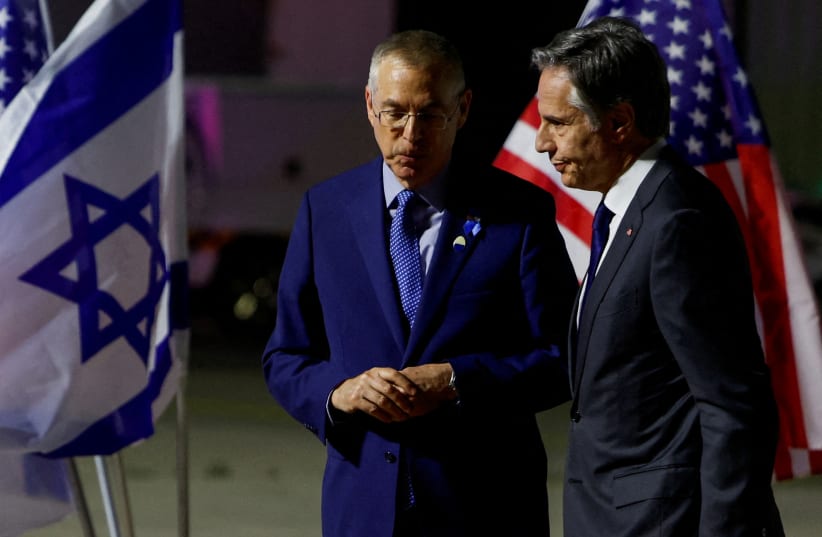
By TOVAH LAZAROFFUpdated: MAY 1, 2024 23:37US Secretary of State Antony Blinken is welcomed by Israeli Ambassador to the U.S. Mike Herzog, as he arrives at Ben Gurion Airport near Tel Aviv, Israel, April 30, 2024.(photo credit: REUTERS/EVELYN HOCKSTEIN/POOL)
US Secretary of State Antony Blinken stressed his opposition to an IDF operation in Rafah and the significance of a hostage deal while visiting the Jewish state as he and Israeli officials waited to receive an answer from Hamas to the latest proposal.
“We will not support a major military operation in Rafah. Absent an effective plan to make sure that civilians are not harmed,” Blinken said as he spoke briefly with reporters at the port in Ashdod, near Gaza.
During the day, he met with Prime Minister Benjamin Netanyahu, Defense Minister Yoav Gallant, and members of the war cabinet, including Ministers Benny Gantz and Gadi Eisenkot.
But as he stood in Ashdod, he told reporters, he had “not seen” a viable IDF plan to enter Rafah to destroy the Hamas battalions there that offered sufficient protection for the civilian population.
He said the Biden administration believes that “there are other ways … better ways of dealing with the real ongoing challenge of Hamas that do not involve a major military operation in Rafah.”
Before Blinken’s arrival, Netanyahu clarified that the IDF would enter Rafah, irrespective of whether there was a deal.
Israel has believed that a Rafah operation is a vital pressure lever to sway Hamas to make a deal to release the remaining 133 hostages. Still, it also fits in with the overall belief in Israel that the terror group must be ousted from the enclave.
Israel’s political struggle
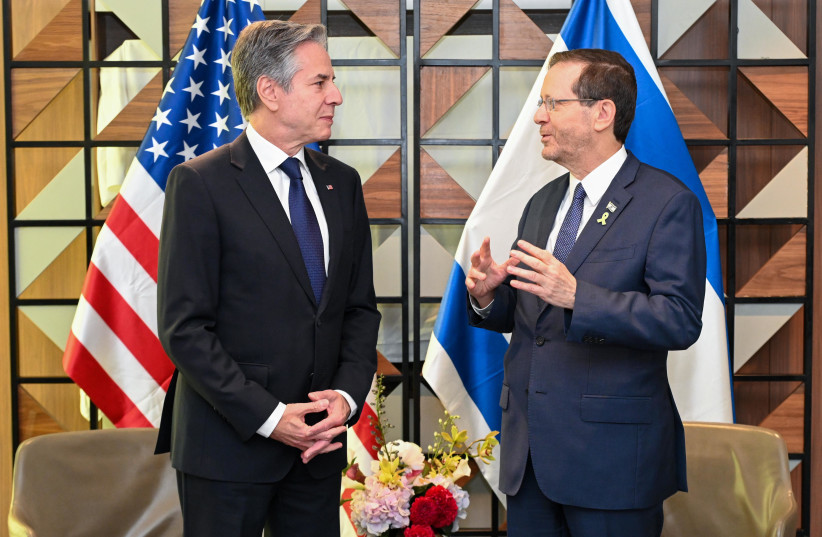
US Secretary of State Antony Blinken meets with Israeli President Isaac Herzog, May 1, 2024 (credit: MAAYAN TOAF / GPO)
Some of Netanyahu’s coalition partners have warned they will collapse his government if he does not enter Rafah.
The US has preferred to see a hostage deal that pauses the war and leads to a permanent ceasefire. It is concerned by the continual international and domestic backlash against Israel over the Gaza war, and it is also worried that the protracted conflict has complicated its efforts to work out a defense pact with Saudi Arabia.
Hamas’s instance that any deal must include an end to the war has been one of the sticking points in the agreement.
Blinken met with Netanyahu for over two hours on Wednesday, with media reports out of conversation stating that the Prime Minister had insisted that he must conduct a Rafah operation.
When pressed about Netanyahu’s position on Rafah, Blinken stressed that “we discussed today, among other things, getting this agreement, which involves an immediate ceasefire, hostages home, and then working to build on it.
“Let’s see if we can if we can get this done. But I think this is something that the whole world is watching. And if Hamas purports to care about the Palestinian people and wants to see an immediate alleviation of their suffering, it will. It will take the deal. If it doesn’t, I think that’s further proof that it doesn’t care a bit about the Palestinian people,” Blinken said.
Earlier in the day, he paused to speak with protestors outside his hotel, who waved American and Israeli flags and demanded a hostage deal.
“Bringing your loved ones home is at the heart of everything we’re trying to do, and we will not rest until everyone – man, woman, soldier, civilian, young, old – is back home,” Blinken said.
“We will not rest; we will not stop until you’re reunited with your loved ones,” Blinken said.
“So please keep strong, keep the faith. We will be with you every day until we get this done,” he stressed.
Earlier in the day, the Lebanese news site al-Akhbar published details of what it claimed was an outline of a three-phase plan presented to Hamas by Egypt, which, along with Qatar, is mediating a deal with the help of the US.
Thirty-three hostages would be freed during the first phase, which would last for 40 days: children under the age of 19, women civilians and soldiers, those over 50, and the sick and wounded.
Israel would free Palestinian prisoners jailed on security and terror-related charges, with the numerous varying.
For every female Israeli soldier released, Israel would release 40 Palestinian prisoners, of which 20 are serving life sentences and 20 whose remaining sentence is less than ten years. Those serving life seances would be freed to Gaza or exiled abroad.
In exchange for each elderly captive, Israel would free 20 elderly Palestinian prisoners who have less than ten years left to serve. Twenty Palestinian minors and female prisoners would be free for every Israeli woman and child held in captivity.
Hamas would free three hostages on the first day of the agreement and continue to do so every three days, starting with all the women.
The deal would include a temporary ceasefire, with the IDF withdrawing from populated sections of Gaza to areas closer to the border. This includes leaving the Netzarim corridor by the 22nd day. Displaced Palestinians would also be allowed to return home.
The remainder of the hostages would be accessible in the second phase, which would last 42 days. Those hostages that are deceased would be sent back to Israel during the last phase, which would cover another 42 period.
The agreement also called for the daily entry of 500 trucks of goods into Gaza, including 50 for fuel.
The issue of increasing the humanitarian assistance to Gaza, was one of the important elements of Blinken’s trip, which was his seventh regional trip that included Israel, since the start of the war on October 7. He arrived after visiting Saudi Arabia and Jordan.
“We have seen in recent weeks real, meaningful progress” in the increase of humanitarian assistance into Gaza, Blinken stated.
He noted that trucks with assistance from Jordan entered northern Gaza through the Erez crossing, which opened for the first time on Wednesday.
The crossing, which had been a pedestrian one, was closed after it was damaged by the Hamas attack on October 7. Israel had promised the US it would reopen it.
The opening of Erez, Blinken was the “result of a very important collaboration involving Israel,” Jordan, and the UN, he stated.
The US is also constructing a temporary pier on the Gaza coast for cargo ships to arrive from Cyprus, which Blinken said was a week away from opening.
He noted that he was in Ashdod because its port was also used as a transit option for cargo heading to Gaza. Earlier in the day he visited the Kerem Shalom Crossing, which is the main commercial passage into Gaza together with Gallant. They also toured Kibbutz Nir Oz, which was one of the communities Hamas attacked on October 7
“The progress is real, but given the immense need in Gaza, it needs to be accelerated,” he said.
But one of the challenges is making sure that the assistance is properly distributed and “that it’s not interfered with or impeded by Hamas,” Blinken said.
Gallant emphasized to Blinken that Israel was fighting Hamas and not the Palestinian civilians.
“We will facilitate the delivery of humanitarian aid. At the same time … I would like to emphasize – that this war was started by Hamas, a brutal terrorist organization that is located [mere] meters from the border of Israel, as a proxy of Iran.
“We are determined to destroy the Hamas organization and to bring the hostages back to their families,” Gallant stated.