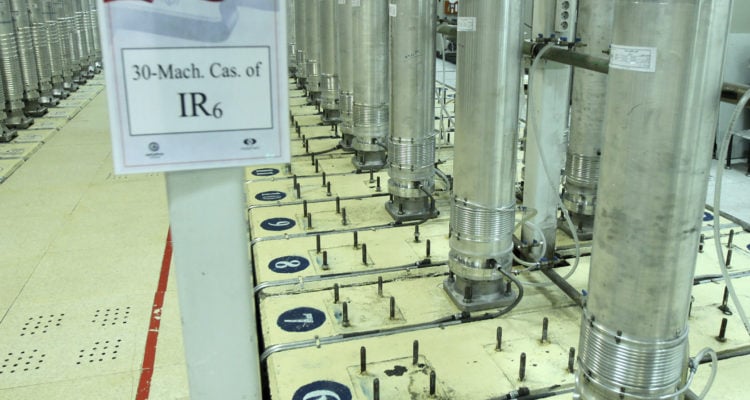
Centrifuge machines in the Natanz uranium enrichment facility. (Atomic Energy Organization of Iran via AP)
Russia, China, Turkey, and Pakistan are reportedly being discussed as possible transfer destinations.
By World Israel News Staff
A proposed “face-saving” deal regarding Iran’s stockpile of near weapons-grade uranium could allow both the United States and Iran to claim victory, with Tehran potentially transferring the material to countries such as Russia, China, Turkey, or Pakistan before it is eventually handed over to the U.S., according to a new report.
A source with direct knowledge of the discussions told the New York Post that Iran is currently weighing a proposal that would require it to surrender its estimated 1,000 pounds of enriched nuclear material, though not directly to the United States.
“We are trying to land on language that allows both sides to save face, and that’s how deals like this are done,” the source told the Post.
;“The president would still ideally like it to eventually wind up with the United States, but there are interim options being discussed as well. [And] they could turn into permanent options,” the source added.
Another option reportedly under discussion would see Iran significantly dilute the uranium so that it could no longer be used to produce a nuclear weapon.
Inside the Trump administration’s proposed nuclear deal
Under that arrangement, Iran would be permitted to retain the material inside the country. According to the source, Iran’s nuclear facilities were so heavily damaged during Operation Epic Fury that Tehran would not be able to secretly re-enrich the uranium to weapons-grade levels in the foreseeable future.
The source said details regarding that possible arrangement would likely be addressed after the signing of an initial extended ceasefire agreement that would reopen the Strait of Hormuz.
The dilution of enriched uranium is “one of the things that is going to be worked out in the second track,” the source told the Post.
;“I don’t think they want to hand it over — [and] the biggest thing is they don’t want to hand it over to the United States directly.”
Shortly after the Post published the official’s comments, Trump appeared to confirm key elements of the report in a post on his Truth Social account.
“The Enriched Uranium (Nuclear Dust!) will either be immediately turned over to the United States to be brought home and destroyed or, preferably, in conjunction and coordination with the Islamic Republic of Iran, destroyed in place or, at another acceptable location, with the Atomic Energy Commission, or its equivalent, being witness to this process and event,” Trump wrote.
Rubio: Epic Fury is over; Tehran’s nuclear shield has been destroyed
By Agencies and ToI StaffToday, 10:32 am
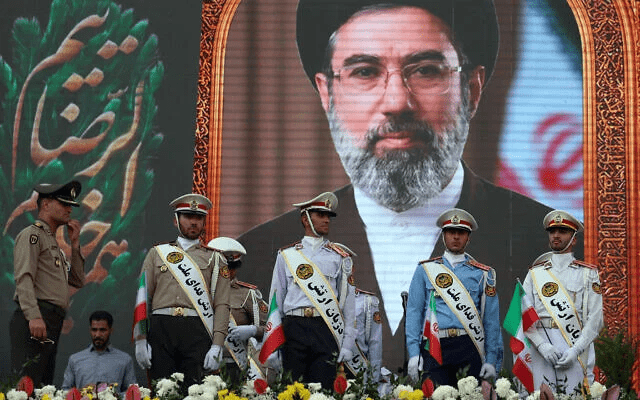
Iranian army soldiers stand in front of a picture of Iran’s Supreme Leader Ayatollah Mojtaba Khamenei during a pro-regime rally in Tehran, Iran, on April 29, 2026. (AFP)
Iranian Supreme Leader Ayatollah Mojtaba Khamenei says on his Telegram channel that Gulf powers will no longer be a shield for United States bases and the US will no longer have a safe haven in the region, as Tehran and Washington discuss a framework to end their three-month-old war.
Several US bases in the Middle East were attacked by Iran during the war.
His statement comes hours after US forces attacked missile sites in southern Iran and boats trying to lay mines.
The strikes threatened an already fragile ceasefire that began April 8 as the United States and Iran struggle to reach an accord to end a war that has rattled the global economy with a severe disruption of energy flows. Washington and Tehran have played down hopes for an imminent breakthrough.
Rubio insists deal still possible after strikes but is ‘a few days’ away from completion; Trump: Tehran must hand over enriched uranium or destroy it with international witnesses
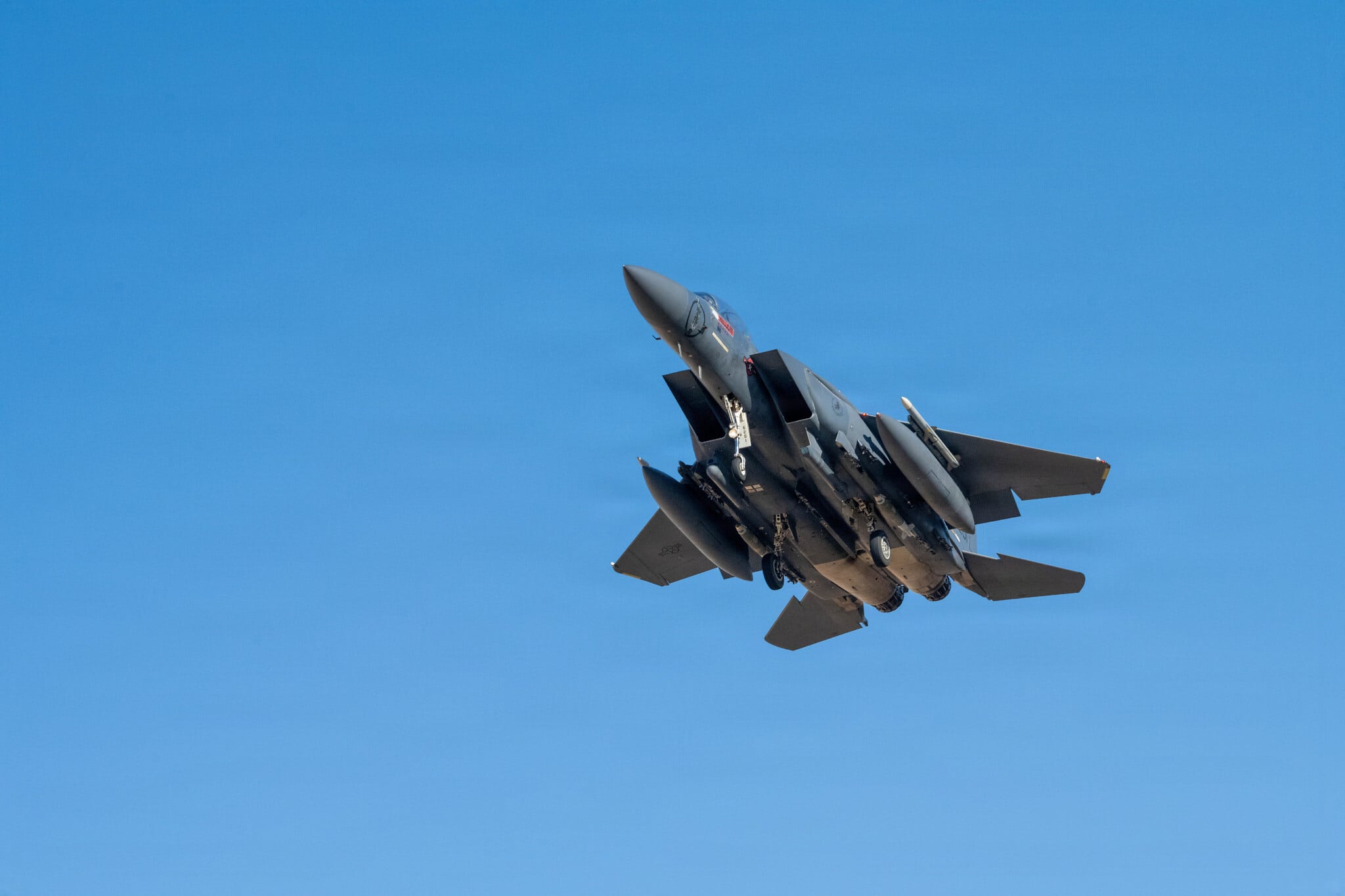
Illustrative: A US Air Force F-15E Strike Eagle aircraft takes off for a mission during Operation Epic Fury, March 9, 2026. (US Air Force)
US forces attacked missile sites in southern Iran and boats trying to lay mines on Monday, US Central Command said, as top Iranian negotiators arrived in Doha for talks to end the war.
“US forces conducted self-defense strikes in southern Iran today to protect our troops from threats posed by Iranian forces,” Tim Hawkins, a US Central Command spokesman, said in a statement.
It gave no details of the attacks and said only that the targets included missile launch sites and boats trying to “emplace mines.”
There was no immediate reaction to the development by Iranian officials.
Unconfirmed reports from Iran claimed four Revolutionary Guards members were killed in American strikes in southern Iran’s Bandar Abbas.
Iranian media reported explosions were heard in the port city and coastal areas near the Strait of Hormuz. The Mehr news agency said the situation in Bandar Abbas was under control.
The strikes threatened an already fragile ceasefire that began April 8 as the United States and Iran struggle to reach an accord to end a war that has rattled the global economy with a severe disruption of energy flows. Washington and Tehran have played down hopes for an imminent breakthrough.
US Secretary of State Marco Rubio told reporters in New Delhi earlier that the US would give diplomacy every chance to succeed before considering whether to deal with Iran in “another way.”
In comments following the strikes, he echoed his earlier remarks, saying that a deal with Iran was still possible, despite the latest US military action.
“There were some talks going on in Qatar today, so we’ll see if we can make progress. I think it’s a lot of talking back and forth going on about specific language in the initial document, so it’ll take a few days,” Rubio told reporters in Jaipur during an official visit to India.
US Secretary of State Marco Rubio speaks to reporters on board his plane at Jaipur International Airport in Jaipur, India, Tuesday, May 26, 2026. (AP Photo/Julia Demaree Nikhinson, Pool)
“The president expressed his desire to make it. He’s either going to make a good deal or no deal,” he said, warning that the Strait of Hormuz, a vital global shipping route, was “going to be open one way or another.”
“What’s happening there is unlawful, it’s illegal, it’s unsustainable for the world, it’s unacceptable,” Rubio added.
‘A Great Deal for all, or no Deal at all’
In a lengthy post on Truth Social on Monday, US President Donald Trump said talks with Iran were going “nicely,” but warned of fresh attacks if they failed. It “will only be a Great Deal for all, or no Deal at all,” he wrote.
Trump also said in a social media post that he expected Iran to hand over its enriched uranium to the United States to be destroyed, or have it destroyed in Iran with an international witness.
“The Enriched Uranium (Nuclear Dust!) will either be immediately turned over to the United States to be brought home and destroyed or, preferably, in conjunction and coordination with the Islamic Republic of Iran, destroyed in place or, at another acceptable location, with the Atomic Energy Commission, or its equivalent, being witness to this process and event,” Trump wrote on Truth Social.
The Atomic Energy Commission was a US government agency that was abolished in 1974.
Trump also did not specify whether he was concerned only with the 440 kilograms of highly enriched uranium in Iran’s possession, which is a short step away from weapons-grade, or if he was referring to its full stockpile, which US officials have reportedly insisted would need to be removed as part of any deal.
A woman crosses a street in front of a painting of the late Iranian revolutionary founder Ayatollah Khomeini in downtown Tehran, Iran, Sunday, May 24, 2026. (AP Photo/Vahid Salemi)
Iranian officials have repeatedly stressed that they are unwilling to discuss the nuclear issue until a memorandum of understanding allowing for a 60-day ceasefire and the reopening of the Strait of Hormuz is reached.
A US official briefed on Monday’s talks in Doha nevertheless told Reuters that the discussions focused on the Strait of Hormuz and Iran’s stockpile of highly enriched uranium, while Iran’s central bank governor attended to discuss the potential release of frozen Iranian funds as part of a final deal.
While the US and Iranian forces have observed the ceasefire, Iran has maintained controls on Gulf shipping through the Strait of Hormuz and the US Navy has sought to blockade Iran’s ports, extending a global energy crisis that began with the opening US and Israeli strikes on Iran on February 28.
Oil prices fluctuated on Tuesday morning but remained below $100, with West Texas Intermediate dropping more than five percent while international benchmark Brent crude was up.
Escalating Lebanon offensive could threaten deal
On another front of the war, Prime Minister Benjamin Netanyahu said Monday that he had ordered the military to intensify its offensive in Lebanon in an effort to “crush” Hezbollah, as the terror group continued to target Israel and its forces with drone attacks.
“I have ordered an even greater acceleration of our operations,” Netanyahu said in a video statement posted on his Telegram channel.
Iran has insisted that any deal with the US include a full ceasefire in Lebanon, where Israel and the Iran-backed Hezbollah have continued to trade blows despite an April 16 truce aimed at halting the deadliest spillover of the US-Israeli joint war on Iran.
Israel has avoided targeting the terror group in Beirut and other locations beyond southern Lebanon in recent weeks, facing pressure from Washington amid the talks with Iran.
According to Al Jazeera, Iran warned Washington following Netanyahu’s announcement that any Israeli strike in Beirut would jeopardize negotiations to end the war and reach a regional settlement.
Lebanese security sources said on Monday night that people had begun fleeing the southern suburbs of Beirut, a known Hezbollah stronghold, for fear of a renewed Israeli assault on the capital.