
Among the sources cited in the report are harsh Israel critics that include Amnesty International, Human Rights Watch, International Committee of the Red Cross and others.

By JNS

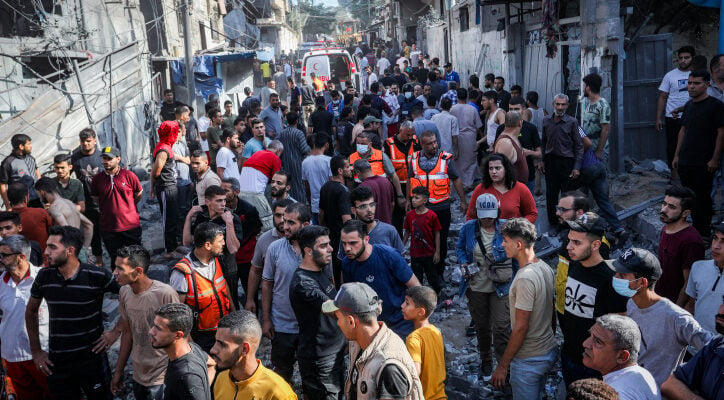
The Jewish state responded to Hamas’s Oct. 7 terror attack with “a sustained, wide-scale military operation in Gaza, which had killed more than 21,000 Palestinians and injured more than 56,000 by the end of the year,” according to the 2023 Country Reports on Human Rights Practices, which the U.S. State Department released on Monday.

Israel’s response to the Oct. 7 attack also “displaced the vast majority of Palestinians in Gaza and resulted in a severe humanitarian crisis,” according to the State Department report, whose section on Israel runs about 23,000 words. “The continuing conflict had a significant negative impact on the human rights situation in the country.”

Among dozens of “significant human rights issues,” which the report said Israel is accused of based on “credible reports,” are “arbitrary or unlawful killings, including extrajudicial killings,” “enforced disappearance” and “torture or cruel, inhuman or degrading treatment or punishment by government officials.”

Israel also is guilty of “harsh and life-threatening prison conditions,” “punishment of family members for alleged offenses by a relative” and “serious restrictions on freedom of expression and media freedom, including violence or threats against journalists, unjustified arrests or prosecution of journalists and censorship,” per the State Department.

“The government took some credible steps to identify and punish officials who may have committed human rights abuses,” it stated.
Among the sources that Foggy Bottom cites in its criticism of Israel are the harsh Israel critics Amnesty International, Human Rights Watch, International Committee of the Red Cross, Public Committee Against Torture in Israel, B’Tselem and Physicians for Human Rights Israel.

“Arab criminal organizations were involved in many intracommunity killings, with 244 Arab/Palestinian citizens of Israel who were victims of crime and violence within Arab communities, an increase of 134% over the previous year,” per the State Department, citing the nonprofit Abraham Initiatives, “making it the deadliest year ever for crime and violence within the society of Arab/Palestinian citizens of Israel.”

In a section on the “West Bank and Gaza,” which runs about 33,000 words, the State Department accuses Israel of “a sustained, wide-scale military operation in Gaza, which had killed more than 21,000 Palestinians (about 1% of Gaza’s population) and injured more than 56,000 (more than 2% of Gaza’s population) by the end of the year, displaced the vast majority of Palestinians in Gaza and resulted in a severe humanitarian crisis with estimates of 50%-70% of buildings destroyed or damaged.”

“The continuing conflict had a significant negative impact on the human rights situation in the West Bank and Gaza Strip,” the State Department added. “In the West Bank, the trend of violent attacks by Israeli settlers against Palestinians, as well as attacks by Palestinian militants against Israelis, had already increased in the first nine months of the year to record levels, and spiked sharply after Oct. 7.”

  ‘STOP IT NOW’: FIRST LADY TELLS BIDEN TO END GAZA WAR

In the “West Bank,” the report alleged that there are “serious problems with the independence of the judiciary,” “violence or threats of violence against journalists, unjustified arrests or prosecutions of journalists and censorship,” “serious restrictions on internet freedom,” “extensive gender-based violence,” “violence or threats of violence motivated by antisemitism,” “crimes involving violence or threats of violence targeting lesbian, gay, bisexual, transgender, queer or intersex persons” and “existence of the worst forms of child labor.”

In Gaza, the report accuses Hamas of crimes that include “severe physical abuses and cruel, inhuman, and degrading treatment or punishment,” “serious problems with the independence of the judiciary,” “conflict-related sexual violence or punishment,” “unlawful recruitment or use of children in armed conflict,”violence or threats of violence against journalists, unjustified detentions of journalists and censorship,” “serious restrictions on internet freedom,” “inability of citizens to change governance peacefully through free and fair elections,” “crimes involving violence or threats of violence motivated by antisemitism,” “crimes involving violence or threats of violence targeting lesbian, gay, bisexual, transgender, queer or intersex persons” and “existence of the worst forms of child labor.”

“Palestinian Authority authorities took some steps to identify and punish officials accused of committing human rights abuses, but human rights groups criticized Palestinian Authority officials for not taking sufficient action or implementing measures against officials implicated in human rights abuses,” per the State Department. “This lack of response raised concerns about accountability.”

  WATCH: DEMOCRATIC CONGRESSMAN REAFFIRMS US SUPPORT FOR ISRAEL AMID ‘CLASH OF PERSONALITIES’

“There were no legal or independent institutions capable of holding Hamas in Gaza accountable for acts of terror, and impunity was widespread,” it added. “Several militant groups with access to heavy weaponry, including Palestinian Islamic Jihad, also operated with impunity in and from Gaza.”
Syria strike wiped out IRGC regional command: Report

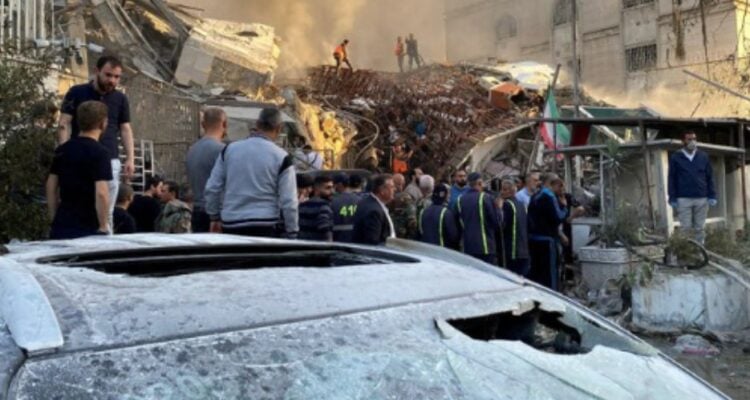
The IRGC’s top brass in Lebanon and Syria were meeting with Zahedi in a building adjacent to the Iranian consulate in Damascus on April 1st.

By World Israel News Staff

New details are emerging about an airstrike in Syria earlier this month, in which IRGC General Mohammed Reza Zahedi was killed. The attack is widely believed to have been carried out by Israel.

According to a report from Bloomberg News, the strike was carefully timed to not just assassinate Zahedi, but other senior members of the IRGC responsible for coordinating the activity of Iran’s terror proxies in the region.

The IRGC’s top brass in Lebanon and Syria were meeting with Zahedi in a building adjacent to the Iranian consulate in Damascus on April 1st.

The alleged Israeli strike assassinating the entirety of the terror organization’s most senior regional leadership, seriously crippling IRGC activity in the area.

The timing of the attack has led Iran to suspect that Syrian groups may be feeding intelligence regarding the whereabouts of Iranian assets to Israeli intelligence agencies, according to the Bloomberg report.

Military and intelligence leaders who approved the strike had “badly miscalculated” the potential ramifications, according to an Israeli official who spoke to the New York Times, mistakenly believing that “Iran would not react strongly” to the slayings.

According to the Times, U.S. officials were only notified of the impending strike several minutes before it was carried out.

In response to the airstrike, Iran launched an unprecedented aerial assault on the Jewish State.

Some 300 drones, cruise missiles, and ballistic missiles were fired directly from Iranian soil to Israel, in an historic first.

Iran also activated its proxies in the region, including Hezbollah in Lebanon and the Houthis in Yemen, to simultaneously fire at Israel.

Although Israeli air defenses, with extensive support from the American, British, French, and Jordanian air forces, were able to down the vast majority of the weapons, several strikes were reported on the Nevatim air base in the southern Negev desert.

Additionally, a 7-year-old Bedouin-Israeli girl was critically wounded when shrapnel from an interception crashed through the roof of her hokme.


Hamas leaders traveled to Ankara amid a new phase of support for Hamas in the region, which could have major ramifications for the Gaza conflict.

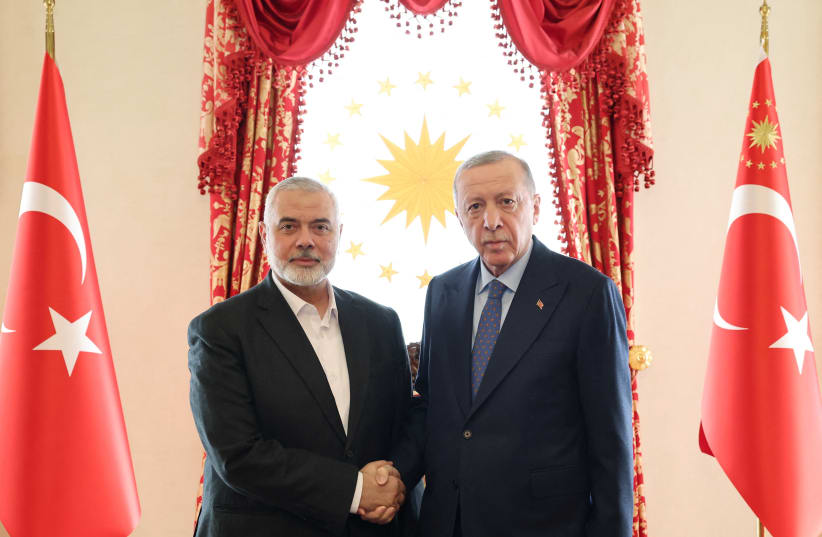
 Turkey's President Tayyip Erdogan meets with Ismail Haniyeh, leader of the Palestinian Islamist group Hamas, in Istanbul, Turkey, April 20, 2024. (photo credit: Murat Cetinmuhurdar/Turkish Presidential Press Office/Handout via REUTERS)
Turkey’s President Tayyip Erdogan meets with Ismail Haniyeh, leader of the Palestinian Islamist group Hamas, in Istanbul, Turkey, April 20, 2024.
(photo credit: Murat Cetinmuhurdar/Turkish Presidential Press Office/Handout via REUTERS)
Turkey’s president hosted Hamas leaders over the weekend in highly symbolic and important meetings that reflect Hamas’s increased influence and power in the region after the October 7 attack on Israel.

In the wake of the Hamas massacre of more than 1,000 people and the kidnapping of 250, the largest massacre of Jews since the Holocaust, Hamas has found that it has more clout in Tehran, Moscow, Beijing, Ankara, Doha, and other places. Instead of being isolated after its historic crimes against humanity, Hamas has been embraced. Hamas leaders traveled to Ankara amid a new phase of support for Hamas in the region, which could have major ramifications for the Gaza conflict.

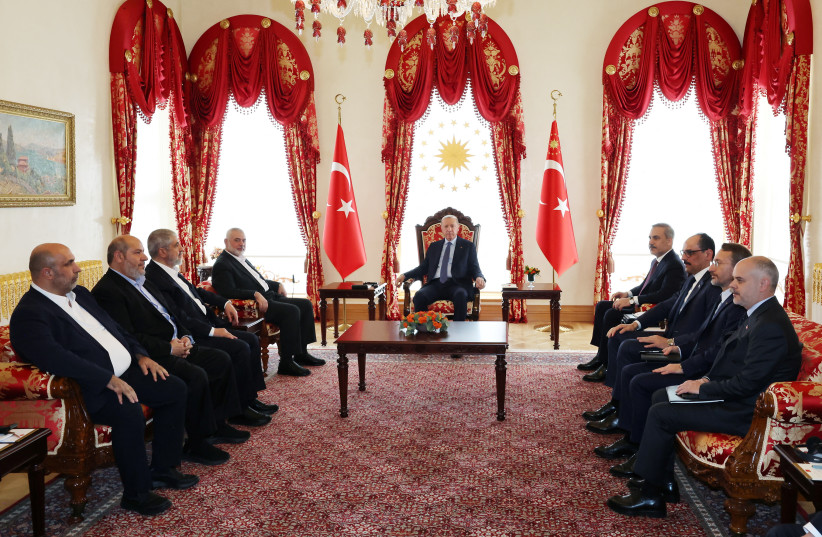
 A symbol of this embrace occurred in Istanbul on April 20. Hamas leaders were seated in chairs opposite Turkey’s top officials, getting a red carpet style reception with the Turkish leader. Ankara was proud of this meeting, distributing a handout about it and posting about it. Turkish media had wall-to-wall coverage. The handout about the meeting shows the Hamas leadership, facing their Turkish counterparts, with Turkey’s President Recep Tayyip Erdogan in the middle. Hamas leader Ismail Haniyeh was hosted at the Dolmabahce Presidential working office in Istanbul.

Ankara has paid lip service to supporting Palestinian unity, but it does not roll out the red carpet like this for the Palestinian Authority. Instead, it sidelines the PA and Mahmoud Abbas. “It is vital that Palestinians act with unity in this process. The strongest response to Israel and the path to victory lie in unity and integrity,” Turkey’s leader said. However, Ankara could have hosted both Hamas and the PA leadership. It chooses to boost Hamas with this meeting, which is highly symbolic.

The meeting, and others like it in Moscow, Iran, and Doha, have shown that Hamas has received increased support and influence for massacring 1,000 people. No other group in history has massacred 1,000 people, many of them civilians, taken 250 hostages, and then received so many high-level meetings in such a short period of time, including by two US allies in the region. Hamas is hosted by Doha, a major non-NATO ally of the US, and Turkey is a NATO ally. Hamas, therefore, is unique in history as a group that massacred hundreds of civilians and is hosted by Western allies. Hamas still holds 133 hostages.

Hamas reportedly compares its attack to Turkish war of Independence

During the meeting with Hamas, the Turkish leader compared their attacks on Israel to Turkey’s war of independence, Turkey’s Daily Sabah said.  “We are well aware of the cost of saying this but the world must know the truth,” Turkey leader said. The report also said that Turkey’s foreign minister recently met Haniyeh in Doha. Turkey’s foreign minister also met with is Iranian counterpart on April 19, according to Turkish media. They discussed the region. Turkey and Iran often coordinate in the region. They both back Hamas and both oppose the US presence in Syria.

 Turkey’s media has wall-to-wall coverage of Gaza and numerous articles bashing Israel. This is clearly a message of discipline amidst the Hamas meetings. For instance, Turkey’s foreign ministry also slammed Israel over the weekend for “massacring 35,000 Palestinians.” According to the foreign ministry spokesman in Ankara, “It is the Israeli authorities who should be ashamed. They have massacred nearly 35,000 Palestinians, most of them women and children.” Turkey has also said that the conflict in Gaza is the main reason for instability in the region and has warned of spillover from the war. Hamas started the war, and it is likely that countries that back Hamas, such as Turkey, could have prevented October 7 by telling Hamas to moderate. However, the message from Turkey is to blame Israel for a conflict that Hamas started.

 Turkey's President Tayyip Erdogan meets with Ismail Haniyeh, leader of the Palestinian Islamist group Hamas, in Istanbul, Turkey, April 20, 2024. (credit: Murat Cetinmuhurdar/Turkish Presidential Press Office/Handout via REUTERS)Enlrage image
Turkey’s President Tayyip Erdogan meets with Ismail Haniyeh, leader of the Palestinian Islamist group Hamas, in Istanbul, Turkey, April 20, 2024. (credit: Murat Cetinmuhurdar/Turkish Presidential Press Office/Handout via REUTERS)

Ankara has also said that it wants to “bring the massacre in Gaza to an end,” according to Turkey’s Foreign Ministry spokesman Oncu Keceli. The messaging from Ankara during the Hamas visit is intended to increase public support for Hamas more than six months after the war. This is likely coordinated with Iran. Turkey has also spoken to Egypt and other countries in recent days. Turkey also says it wants to boost aid to Gaza. The right-wing populist newspaper Yeni Safak in Turkey also ran an article about Hamas this week, calling for increased tensions in the West Bank. This was in response to a multi-day raid in Tulkarm by Israeli forces. Clearly, Hamas wants to inflame the West Bank. Ankara may view this as in its interests.

At the same time, a new Freedom Flotilla Coalition (FFC) is pushing for a flotilla to set sail from Turkey and head to Gaza. Supporters include the Turkish NGO Humanitarian Relief Foundation (IHH), which played a role in the last flotilla in 2010. Another half dozen NGOs are listed as part of the new flotilla initiative. Some reports said it may set sail as soon as the eve of Passover, a symbolic date. Last Passover, Hezbollah enabled terrorist groups in Lebanon to fire rockets at northern Israel near the community of Shlomi.

The high-level delegation of Hamas to Turkey is not the first time Turkey has hosted Hamas. In 2019-2020, Turkey increased its number of public high-level visits by Hamas. This was during the Trump administration and in the wake of the US embassy move to Jerusalem. However, between 2021 and 2022, there was apparent reconciliation between Israel and Turkey.

Some experts suggested Israel should reduce its burgeoning ties with Greece and Cyprus and redirect more trade to Turkey so that Israel would be dependent on Ankara for energy needs and other trade. It was clear at the time that Ankara was trying to make Israel dependent so that when Hamas was operationalized to attack, and there was a war in Gaza, Turkey would have more leverage over Israel.

Turkey and Qatar are close allies, and Doha hosts Hamas. Ankara and Doha both have close ties to Tehran. This concept of leverage over Israel in 2021-2022 was clearly an initiative that led Israel to think that funding flowing to Hamas would deter Hamas from further actions. In 2023, this all came together to produce the sense of security that led to October 7. Hamas’ visit to Turkey on April 20 is the culmination now of this process, which appears to be entering a new phase. It remains to be seen if Ankara’s backing of Hamas will lead to increased tensions in the West Bank and new initiatives in the region.