Senior official denies Israel has received terror group’s response to its latest ceasefire-for-hostages proposal, following report that Hamas turned it down
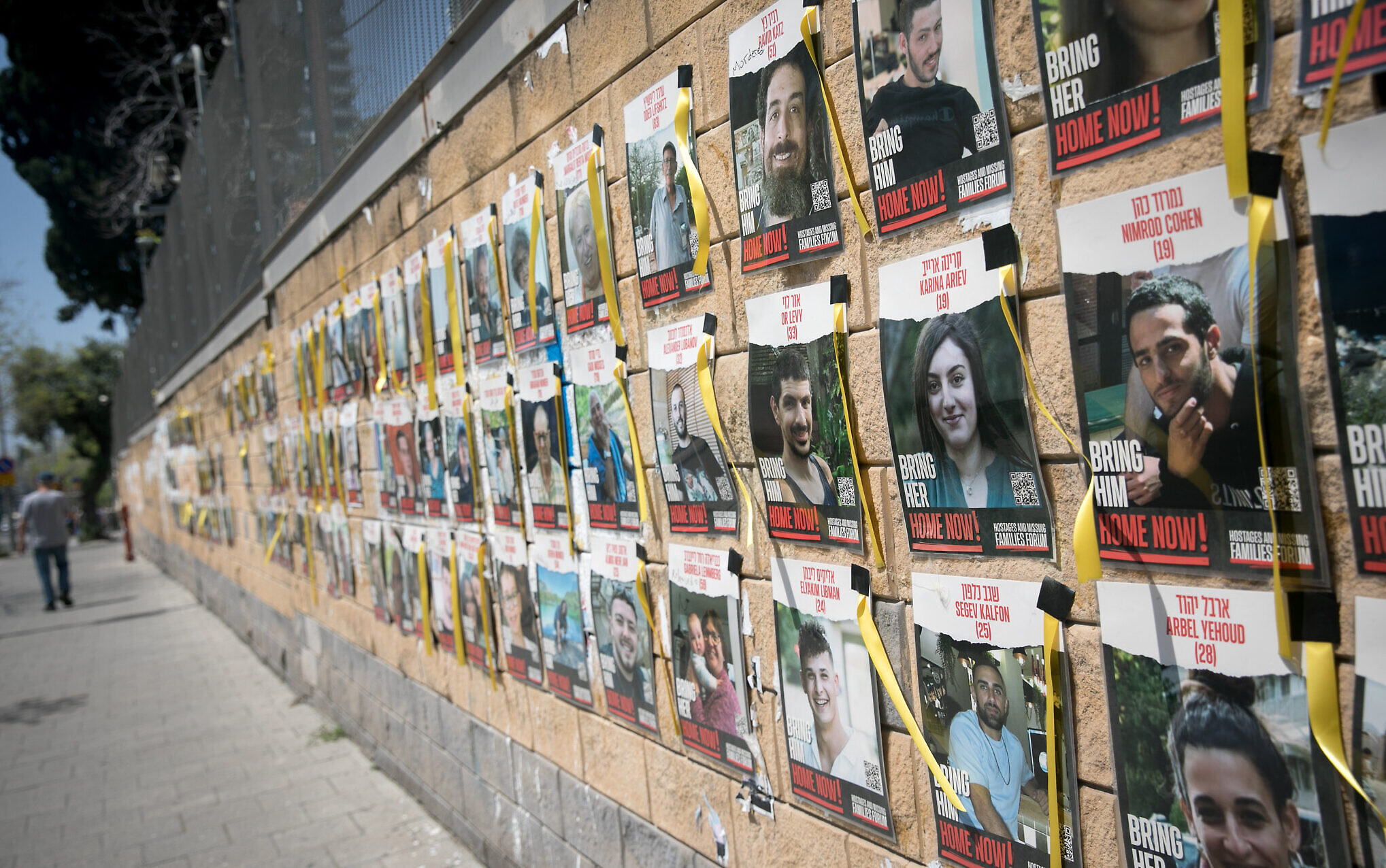
 

Posters of Israelis held hostage by Hamas are seen on the wall of the Defense Ministry in Tel Aviv, April 3, 2024. (Miriam Alster/Flash90)

The mediators of hostage negotiations between Israel and Hamas are failing to exert any pressure on the terror group, a senior Israeli official told The Times of Israel on Friday.

Hamas leader in Gaza Yahya “Sinwar is dragging his feet and does not want a deal, despite Israel’s tremendous flexibility,” the senior Israeli official claimed.

“No pressure [on Hamas] is being jointly applied by the Qatar-led mediators. Qatar has refrained from deporting the Hamas leaders it hosts, nor has it closed their bank accounts, which hold hundreds of millions of dollars used for terrorism,” the senior Israeli official asserted.

“Sinwar does not want a deal. He is not interested in the suffering of his people in Gaza,” the official continued. “He is waiting for tensions to increase and for there to be further escalation.”

The senior official also said Jerusalem has still not received any answer from Hamas to Israel’s latest hostage deal proposal, after CNN reported earlier Friday that the terror organization turned it down.

Citing a diplomat familiar with the talks, the American cable network said the latest Israeli proposal did not meet Hamas’s demands for the unrestricted return of Palestinians to northern Gaza and a complete withdrawal of IDF troops from the Strip. It also reported that Israel insisted on inspections of those returning to the north and refused to pull-out from central Gaza.

“They refused and asserted it doesn’t include any reply to their asks,” the diplomat said, adding Hamas believes “that [the] Israeli proposal includes nothing new, so they see no need to change their proposal.”
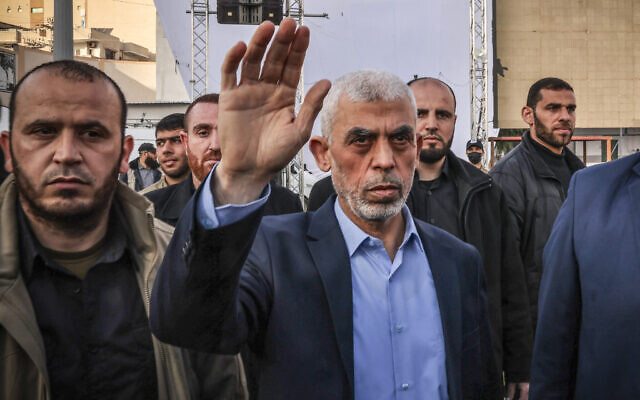
Yahya Sinwar (C), Hamas’s Gaza Strip chief, waves to supporters in Gaza City, on April 14, 2023. (MOHAMMED ABED / AFP)

Also Friday, a senior administration official told The Times of Israel that US President Joe Biden wrote to the leaders of Egypt and Qatar, calling on them to press Hamas to agree to a hostage deal with Israel.

The official, who spoke on the condition of anonymity to discuss the private letters, said Biden’s national security adviser will meet Monday with family members of some of the estimated 100 hostages who are believed to still be in Gaza.

The letters to Egyptian President Abdel Fattah el-Sissi and Qatar’s ruling emir, Sheikh Tamim bin Hamad Al Thani, came as Biden deployed CIA Director Bill Burns to Cairo for talks this weekend about the hostage crisis. The negotiations in Cairo are also due to be attended by Israel’s Mossad Director David Barnea and Shin Bet Director Ronen Bar, Qatari Prime Minister Mohammed bin Abdulrahman al-Thani and Egypt’s intelligence chief Abbas Kamel.

White House officials have said negotiating a pause in fighting between Israel and Hamas to facilitate the exchange of hostages held in Gaza for Palestinian security prisoners held in Israel is the only way to put a temporary cease-fire into effect and boost the flow of badly needed humanitarian aid into the territory.

However, the administration has drifted away from the message in recent weeks, sometimes issuing statements and allowing a UN Security Council resolution to pass that hadn’t directly conditioned a ceasefire on a hostage deal.

The senior administration officials said Biden discussed the upcoming round of hostage talks in Cairo this weekend with Prime Minister Benjamin Netanyahu during their call Thursday.
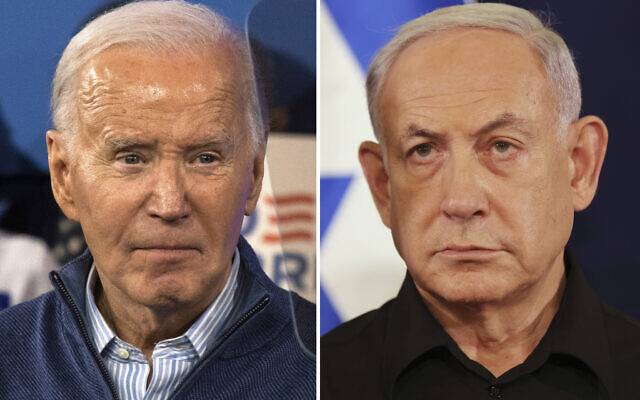
This combination photo shows US President Joe Biden, left, on March 8, 2024, in Wallingford, Pennsylvania, and Prime Minister Benjamin Netanyahu in Tel Aviv, October 28, 2023. (AP Photo)

Biden “made clear that everything must be done to secure the release of hostages, including American citizens, now held by Hamas terrorists for nearly six months,” the official said.

“They discussed the importance of fully empowering Israeli negotiators to reach a deal, which in its first phase would secure the release of women, elderly, sick, and wounded hostages,” the senior US official added.

“This basic fact remains true: There would be a ceasefire in Gaza today had Hamas simply agreed to release this vulnerable category of hostages – the sick, wounded, elderly, and young women,” the official continued. “Holding these innocent people is outrageous and a reminder as to how this war started in the first place. The onus is on Hamas to release the hostages and bring relief to the people of Gaza through a prolonged ceasefire.”

“Nobody on President Biden’s team will rest until the hostages are returned to their families,” the official said.

During a press briefing Friday, White House national security spokesperson John Kirby said Biden told Netanyahu the day before to empower his negotiators in Cairo so that a deal can be reached as soon as possible.

“Let’s get a deal in place so that we can get a ceasefire for a matter of weeks in place, so that it’s easier to meet those commitments on humanitarian assistance being increased,” Kirby told reporters on Friday.

Times of Israel staff and agencies contributed to this report.

by Reuters and Algemeiner Staff

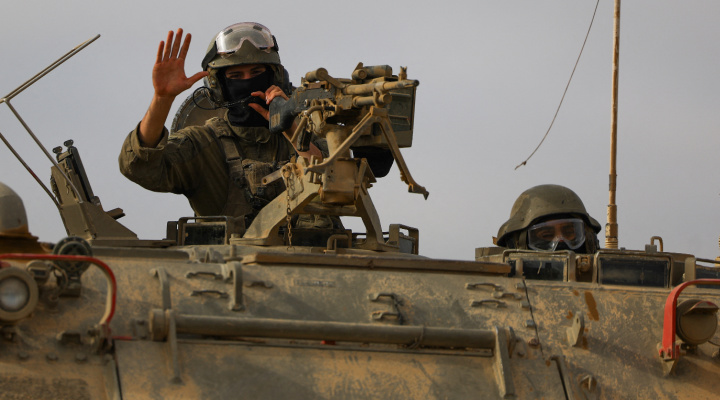
Israeli military personnel drive an armored personnel carrier (APC) near the Israel-Gaza border, amid the ongoing conflict between Israel and Hamas, as seen from Israel, April 3, 2024. Photo: REUTERS/Hannah McKay

Israel braced on Thursday for the possibility of a retaliatory attack after its suspected killing of Iranian generals in Damascus this week, and Prime Minister Benjamin Netanyahu said the country would target “whoever harms us or plans to harm us.”

His comments came after Israel’s armed forces — stretched by nearly six months of war in the Gaza Strip and on the Lebanese front — announced they were suspending leave for all combat units, a day after they said they were mobilizing more troops for air defense units.

The possibility of Iran retaliating for Monday’s presumed Israeli air strike on Iran‘s embassy compound in Damascus has raised the specter of a wider war, though two Iranian sources said Tehran’s response would be calibrated to avoid escalation.

“For years, Iran has been acting against us both directly and via its proxies; therefore, Israel is acting against Iran and its proxies, defensively and offensively,” Netanyahu said at the start of a security cabinet meeting late on Thursday.

“We will know how to defend ourselves and we will act according to the simple principle of whoever harms us or plans to harm us, we will harm them,” he said.

The White House said US President Joe Biden spoke with Netanyahu and they discussed Iran‘s threats. Biden made clear that the United States strongly supports Israel in the face of that threat, Washington said.

Reuters journalists and residents of Israel’s commercial hub Tel Aviv said GPS services had been disrupted, an apparent measure to help ward off guided missiles.

Iran, Israel’s arch-enemy, has sworn revenge for the killing of two of its generals along with five military advisers in an air strike on an Iranian diplomatic compound in the Syrian capital on Monday.

Israel is believed to have carried out the strike, among the most significant yet on Iranian interests in Tehran’s close ally Syria. Israel has neither confirmed nor denied involvement. Netanyahu made no mention of the attack.

Israel has been pressing its war on Hamas in Gaza since the Palestinian Islamist terrorists led a cross-border killing and kidnapping spree on Oct. 7, and has also been trading fire almost daily with Iran-backed Hezbollah in Lebanon.

Yemen’s Houthi rebels, which are aligned with Tehran, have launched occasional long-range rockets at Israel’s Eilat port.

CAUTIOUS IRAN?

Until now, Iran has avoided directly entering the fray, while supporting allies’ attacks on Israeli and US targets.

The Islamic Republic has several options. It could unleash its heavily armed proxies in Syria and Iraq on US forces, use Hezbollah to hit Israel directly, or ramp up its uranium enrichment program. That would raise concern among the United States and its allies about Tehran’s potential to make a nuclear bomb, which the West has long sought to curb.

But many diplomats and analysts say Iran‘s clerical elite does not want an all-out war with Israel or the US that might endanger its grip on power, and would prefer to keep using proxies to carry out selective tactical attacks on its foes.

Such proxy strikes on US forces in the region ceased in February after Washington retaliated for the killing of three US soldiers in Jordan with dozens of air strikes on targets in Syria and Iraq linked to Iran‘s Islamic Revolutionary Guards Corps and militias it supports.

US officials said at midweek they had not yet picked up intelligence suggesting Iran-backed groups were looking to target US troops following Monday’s attack.

While mindful that Israeli strikes on regional adversaries can put US soldiers at risk of retaliation, US officials are sympathetic to Israel’s desire to restore deterrence after Oct. 7 and to stop flows of arms and fighters that may threaten it.

One US official, speaking on condition of anonymity, said there was a growing concern Iran would make good on its threats to retaliate, raising the risk of volatile, regional escalation.

Iranian leaders have publicly indicated that Iran, which has deep-seated economic problems wrought in part by US sanctions and took months to put down recent popular unrest, does not want a big war that could destabilize the country.

Amos Yadlin, a former Israeli intelligence chief, said Iran might choose Friday — the last in the Holy Muslim month of Ramadan and Iranian Quds (Jerusalem) Day — to respond to the Damascus strike, either directly or through a proxy.

“I will not be surprised if Iran will act tomorrow. Don’t panic. Don’t run to the shelters,” said Yadlin, now at the Kennedy School’s Belfer Center at Harvard University, citing Israel’s aerial defense systems.

“Be tuned for tomorrow and then, depending on the consequences of the attack, it may escalate.”


US: Iran is a viable threat to Israel’s safety

Iran, Israel’s arch-nemesis, has sworn revenge for the killing of two of its generals along with five military advisers in an air strike on an Iranian diplomatic compound in Damascus.

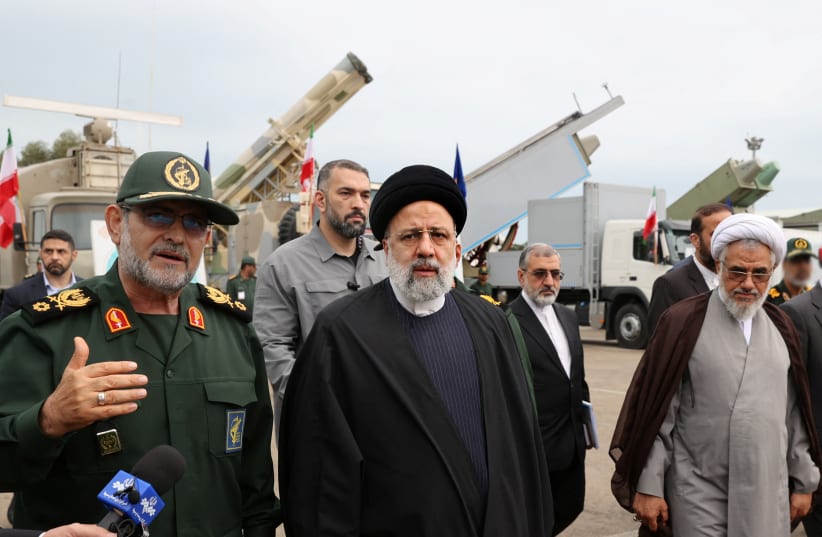
 Iranian President Ebrahim Raisi visits the military equipment of IRGC Navy in Bandar Abbas, Iran, February 2, 2024. (photo credit: IRAN'S PRESIDENCY/WANA (WEST ASIA NEWS AGENCY)/HANDOUT VIA REUTERS)
Iranian President Ebrahim Raisi visits the military equipment of IRGC Navy in Bandar Abbas, Iran, February 2, 2024.
(photo credit: IRAN’S PRESIDENCY/WANA (WEST ASIA NEWS AGENCY)/HANDOUT VIA REUTERS)
Tehran is posting a public and viable threat to Israel, the United States said on Thursday, as Israel braced for the possibility of a retaliatory attack after its suspected killing of Iranian generals in Damascus this week. Israel said it would respond forcefully, signaling it had stiffened its military preparedness.

US President Joe Biden and Prime Minister Benjamin Netanyahu discussed that threat during a short phone call they held on Thursday night.

“They did talk about a very public and very viable real threat by Iran to Israel security,” US National Security Communications Advisor John Kirby told reporters in Washington.

The White House, in a read-out of the calls, clarified that Biden “made clear that the US strongly supports Israel in the face of those threats.”

At the start of a security cabinet meeting on Thursday night, Netanyahu said “Iran has been acting against us for years, directly and through its proxies.

“Israel is acting against Iran and its proxies, both defensively and offensively,” Netanyahu stated. “We will know how to defend ourselves, and we will act based on the principle that we will harm those who attack us or intend to attack us.”

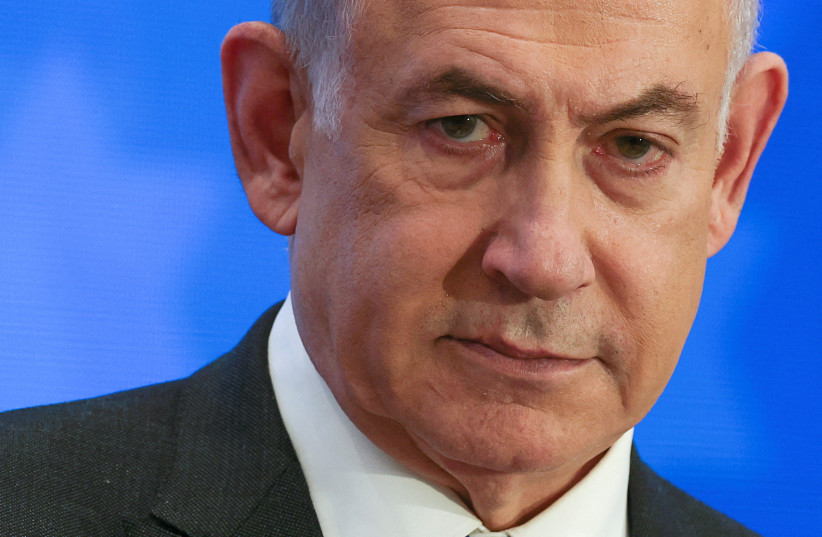
 Israeli Prime Minister Benjamin Netanyahu addresses the Conference of Presidents of Major American Jewish Organizations, amid the ongoing conflict between Israel and Hamas, in Jerusalem, February 18, 2024. (credit: REUTERS/RONEN ZVULUN/FILE PHOTO)Enlrage image
Israeli Prime Minister Benjamin Netanyahu addresses the Conference of Presidents of Major American Jewish Organizations, amid the ongoing conflict between Israel and Hamas, in Jerusalem, February 18, 2024. (credit: REUTERS/RONEN ZVULUN/FILE PHOTO)

Israel’s armed forces – stretched by nearly six months of the war in the Gaza Strip and on the Northern front – announced they were suspending leave for all combat units a day after they said they were mobilizing more troops for air defense units.

The possibility of Iran retaliating for Monday’s alleged Israeli air strike on Iran’s embassy compound in Damascus has raised the specter of a wider war, though two Iranian sources said Tehran’s response would be calibrated to avoid escalation.

Reuters journalists and residents of Israel’s commercial hub, Tel Aviv, said GPS services had been disrupted, an apparent measure to help ward off guided missiles.

Iran swears revenge

Iran, Israel’s arch-nemesis, has sworn revenge for the killing of two of its generals along with five military advisers in an air strike on an Iranian diplomatic compound in the Syrian capital on Monday.

Israel is believed to have carried out the strike, among the most significant yet on Iranian interests in Tehran’s close ally Syria. Israel has neither confirmed nor denied involvement.

Since then, investors have been on edge. The Tel Aviv Stock Exchange’s main TA-125 share index fell another 2.2% on Thursday to extend losses this week to around 4%. The shekel was 0.6% weaker versus the dollar at a 3.73 rate and government bond prices were down as much as 0.4%.

“In accordance with the situational assessment, it has been decided that leave will be temporarily paused for all IDF combat units,” the military said in a statement. “The IDF is at war and the deployment of forces is under continuous assessment according to requirements.”

With Israelis anxious about a possible escalation, the military later issued a statement clarifying that no changes had been made in its guidelines for the home front and that there was no need to gather food, cash, or generators.

Israel has been pressing its war on Hamas in Gaza since the terrorist group led a cross-border killing and kidnapping spree on October 7 and has also been trading fire almost daily with Iran-backed Hezbollah in Lebanon.

Yemen’s Houthi rebels, who are aligned with Tehran, have launched occasional long-range rockets at Israel’s Eilat Port.

Earlier in the evening, Netanyahu met with a Republican US Congressional Delegation organized by the American Israel Policy Affairs Committee (AIPAC).

He told them that US support for Israel has never been more vital, as he explained that Israel was battling forces that were also hostile to the United States, including the Iranian proxy groups Hamas and Hezbollah.

“Our battle is your battle. Our victory is your victory. And if we don’t have a victory, this will have enormous implications for American security, for our common future,” he said.

Passage of the supplemental bill offering military aid to Israel and Ukraine would help Jerusalem secure a faster victory, Netanyahu stressed.

”Give us the tools, and we’ll do the job. Give us the tools faster, and we’ll finish the job faster. I’m talking about the supplemental. I hope you find a way to give it as fast as you can,” he stated.

Reuters contributed to this report.