
The White House urged Hamas terrorists in Gaza to release women, elderly and wounded hostages and accept a temporary ceasefire.
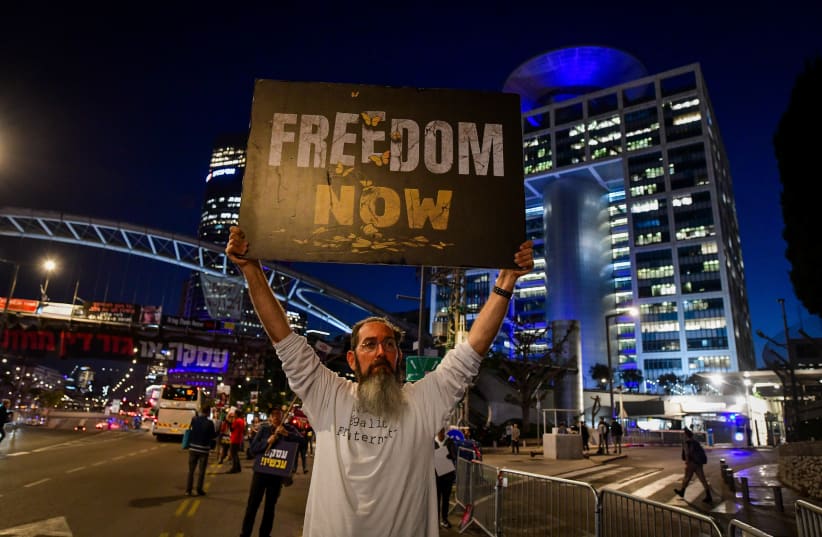
 Activists calling for the government to find a solution to have the hostages released, in Tel Aviv, March 12, 2024 (photo credit: AVSHALOM SASSONI/FLASH90)
Activists calling for the government to find a solution to have the hostages released, in Tel Aviv, March 12, 2024
(photo credit: AVSHALOM SASSONI/FLASH90)
Hamas and Israel must “stay at the table,” United States National Security Advisor Jake Sullivan told reporters on Tuesday while stressing that a deal was still possible for the release of 40 hostages in exchange for a six-week pause to the fighting.

“We will stay at it. We are determined to try to generate a ceasefire with the hostages coming out and then build on it for something more enduring,” Sullivan said.

“We have encouraged Israel to stay at the table, stay engaged because we believe there still is scope for this deal to get done” even though the Ramadan period has begun, Sullivan said.

“As we press particularly on our friends in Israel to do their part, to help deliver this ceasefire fire, it is incumbent for voices around the world to call on Hamas to step up to do their part to release innocent women, wounded and elderly hostages as a first step and then we can move from there,” he said.
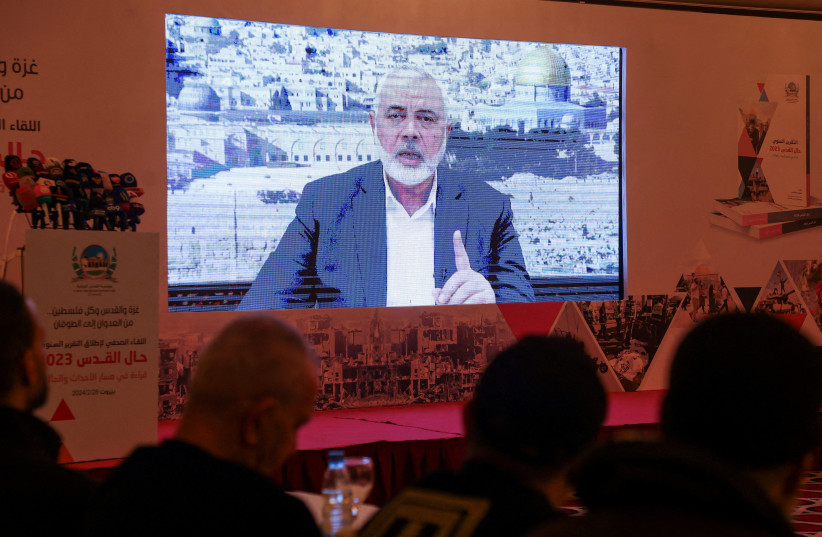
 : Hamas leader, Ismail Haniyeh, speaks in a pre-recorded message shown on a screen during a press event for Al Quds International Institution in Beirut, Lebanon February 28, 2024. (credit: REUTERS/MOHAMED AZAKIR/FILE PHOTO)Enlrage image
: Hamas leader, Ismail Haniyeh, speaks in a pre-recorded message shown on a screen during a press event for Al Quds International Institution in Beirut, Lebanon February 28, 2024. (credit: REUTERS/MOHAMED AZAKIR/FILE PHOTO)

Sullivan said all the top US officials are engaged in making this happen, explaining that US President Joe Biden, Secretary of State Antony Blinken, Middle East envoy Brett McGurk, and CIA Director William Burns have all been heavily involved in this effort.

On Tuesday night, Al Arabiya reported that Hamas could agree to a modified US proposal for a second hostage deal and planned to send a delegation to Cairo to finalize the arrangement in the coming days.Sullivan said he had not heard that Hamas was amenable to a deal.

“If there is an offer from Hamas to start releasing prisoners as part of a ceasefire, that would be welcome news,” he said.

He charged that a “ceasefire is on the table today,” but the hang-up was Hamas, which could make a deal happen if it would just “simply release women, children and elderly.”

Sullivan stressed that the “fact that they will not do so says a lot to me about Hamas’s [lack of] regard for innocent Palestinian civilians.” As the US pushed for a deal, it also increased its efforts to bring humanitarian assistance into Gaza.

US is to build a temporary pier for humanitarian aid in Gaza

Three US Army vessels departed to the Gaza coast on Tuesday to begin the process of building a temporary pier to ramp up humanitarian assistance, the Pentagon announced on Tuesday afternoon. The Pentagon has not yet said specifically where the pier will be established.

The ships are “carrying the equipment and supplies needed to support this mission. Once in theater, these vessels and their crews will establish a roll-on-roll-off pier capability that allows ship-to-shore humanitarian assistance to the people of Gaza,” Pentagon Press Secretary Air Force Maj. Gen Pat Ryder said during a news briefing.

Ryder indicated that the Pentagon’s only efforts in the region will be assisting in the delivery of humanitarian aid.The United Nations used a new land route on Tuesday to deliver food to northern Gaza for the first time in three weeks.

Jamie McGoldrick, UN aid coordinator for the Occupied Palestinian Territory, told Reuters that a World Food Programme (WFP) convoy had used an Israeli military road that runs alongside the Gaza border fence to reach the enclave’s north.WFP spokesperson Shaza Moghraby said enough food for 25,000 people was delivered to Gaza City in the early hours of Tuesday. It was WFP’s first delivery to the north since Feb. 20 and “proves that moving food by road is possible.”

“We are hoping to scale up, and we need regular and consistent access, especially with people in northern Gaza on the brink of famine,” said Moghraby. We need entry points directly to the north.”

The UN has warned that at least 576,000 people in Gaza – one-quarter of the population – are on the brink of famine.Sullivan said the US was working with Israel to increase the amount of aid “by ground both through Kerem Shalom and through a new crossing, where we had the first trucks get in last night, and we need to see more where that came from.”

Israel’s military did not immediately respond to a request for comment on the WFP convoy’s use of the military road.Limited aid via land has been reaching southern Gaza through the Rafah crossing from Egypt and Kerem Shalom from Israel.

“Life-saving relief for Palestinians in Gaza is coming in trickles – if it comes at all,” UN Secretary-General Antonio Guterres said on Monday.

UN spokesman Stephane Dujarric said on Tuesday that the UN and aid groups were “working to deliver desperately needed assistance, despite ongoing fighting and Israeli bombardment, as well as insecurity, frequent border closures and access constraints that continue to impede safe and efficient aid operations.”

The UN had been pushing Israel for weeks to allow aid convoys – once inspected in the south – to use the military road along the Gaza border fence road, McGoldrick said last week. The plan was for trucks to cross into Gaza from the Israeli village of Beeri.

The United States, Jordan, and others have conducted airdrops of aid in Gaza, and on Tuesday, a ship carrying 200 tonnes of aid left Cyprus in a pilot project to open a sea corridor to deliver supplies. While UN officials have welcomed new aid routes, they stress there is no substitute for land access.

Yael Halfon contributed to this report.

With Biden’s rhetoric on Israel sharpening and Netanyahu on the defensive, questions are arising about the domestic factors driving a wedge between Washington and Jerusalem.

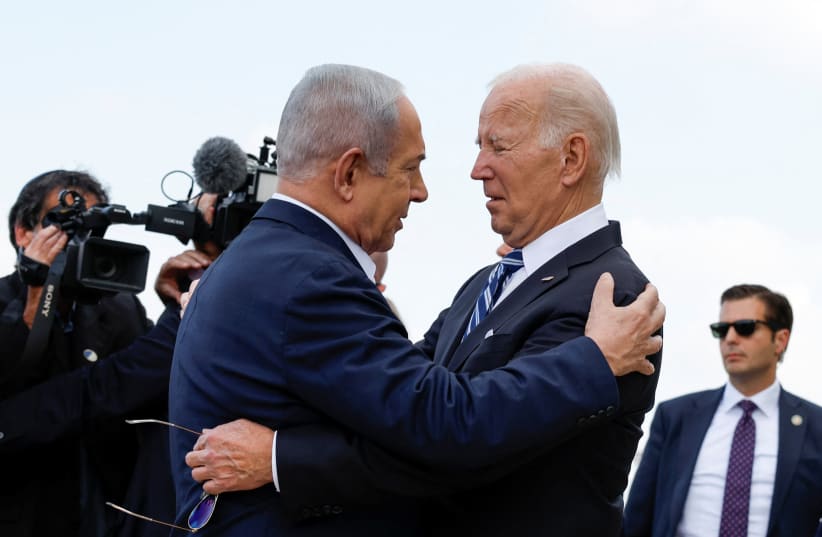
 US President Joe Biden is welcomed by Israeli Prime Minster Benjamin Netanyahu, as he visits Israel amid the ongoing conflict between Israel and Hamas, in Tel Aviv, Israel, October 18, 2023 (photo credit: REUTERS/EVELYN HOCKSTEIN)
US President Joe Biden is welcomed by Israeli Prime Minster Benjamin Netanyahu, as he visits Israel amid the ongoing conflict between Israel and Hamas, in Tel Aviv, Israel, October 18, 2023
(photo credit: REUTERS/EVELYN HOCKSTEIN)
“The fight between our governments is unnecessary, it is meant for domestic politics,” opposition leader Yair Lapid said on Monday in a video speech to an AIPAC conference in Washington.

“We have people here, at the highest levels, who mistakenly think that it will help them with their political base,” he added.

Speaking from Israel, the “here” Lapid referred to was Jerusalem, meaning that there are people at the highest level of the Israeli government who are feeding off the current round of tension between Washington and Jerusalem for political gain. First and foremost: Prime Minister Benjamin Netanyahu.

And he is right.

Tensions becoming political capital

Netanyahu is using the recent tiff with US President Joe Biden to score political points and to firm up his base of support. This gives him a message for the next election, whenever that may be, when almost all of the polls indicate he will confront an avalanche of anger over the October 7 debacle. His message: “Despite what happened on October 7, I can stand up to world pressure, even to pressure from our most cherished and important ally, the United States.”

But Netanyahu is not the only partner in this dance “using the fight between our governments” as Lapid put it, for political purposes. So is Biden.

There is no doubt that Biden’s tone on Israel has changed significantly since those first weeks after October 7, when he set a new standard of support by an American president for Israel and the Jewish people during a time of crisis. In the process, he earned the appreciation and affection of the vast majority of Israelis, many of whom were frankly surprised by the depth and sincerity of that support.

Back then he pledged to give Israel all the military support it needed to defeat Hamas, whose bloodthirstiness and brutality he compared with that of ISIS. On October 10 he said, “We will make sure Israel has what it needs to take care of its citizens, defend itself, and respond to this attack.”

Back then he doubted the casualty numbers coming out of Gaza’s Hamas-run Health Ministry, saying on October 26 – when this number stood at some 7,000 Palestinians killed – that he had “no confidence” in those casualty figures.

Biden’s change in tone

Five months later, as the terrifying images from Israel on October 7 were replaced by haunting images from Gaza, his tone has changed. It has changed so much so that on Tuesday, Politico quoted four anonymous US officials as saying that Biden will consider conditioning military aid to Israel if it goes forward with plans to move into Rafah.

This stands in stark contrast to his previous stance five months ago, when he said the US would make sure Israel has what it needs to respond to the Hamas massacre.

And whereas in the past he doubted casualty figures from Gaza, in his State of the Union address on Thursday night he referenced the 30,000 figure now being circulated by Hamas as if it were indisputable truth, making no distinction between Hamas terrorists killed – a number Israel estimates at 13,000 – and the rest.

Obviously, this change has to do with the length of the fighting and the suffering inside Gaza. Everyone realized that the support and empathy he showed for Israel on his visit here on October 18 would gradually diminish as the war dragged on and the suffering increased.

But that is not the only reason why the tone has changed. Biden is no less a political animal than Netanyahu, and his changing tone has to do with helping his political base, as Lapid said of Netanyahu.

Enter Biden’s reelection campaign

Biden is in a pickle. To beat Donald Trump in November, he needs the youth and progressives not only to turn out and vote for him, but also to campaign for him; to bring the same energy to the upcoming campaign as they did in 2020.

But that enthusiasm and excitement are simply not there this time around. While this is not only because of the war in Gaza – even if there were no war waging, it is hard to think a Biden candidacy would fire up Democrats to the same degree as last time – the situation in Gaza is undoubtedly not helping matters.

 Protestors rally for a cease fire in Gaza outside a UAW union hall during a visit by U.S. President Joe Biden in Warren, Michigan, U.S. February 1, 2024. (credit: REBECCA COOK/REUTERS)Enlrage image
Protestors rally for a cease fire in Gaza outside a UAW union hall during a visit by U.S. President Joe Biden in Warren, Michigan, U.S. February 1, 2024. (credit: REBECCA COOK/REUTERS)

So Biden is changing his tone. But he has to be careful, lest he alienate that not insignificant slice of the American public that remains strongly pro-Israel. It’s not going to help Biden come November if, as a result of shifting policy on Israel, he can win Michigan, with its large Muslim population, but loses Pennsylvania, Arizona, and Nevada – with significant Jewish and pro-Israel voters – in the process. He needs to keep progressive and pro-Israel supporters at the same time.

But how can that be done? One way is to try to separate Israel from its government; turn Netanyahu into the bogeyman, coming down heavy on him to appease the progressives, while at the same time – to keep from alienating the pro-Israel crowd – saying that he doesn’t represent the Israeli people.

Listen to US Vice President Kamala Harris during a CBS interview on Friday: “I think it’s important for us to distinguish, or at least to not conflate, the Israeli government with the Israeli people,” she said.

On Saturday night, Biden seemed to be reading from the same script and trying to drive a wedge between the Netanyahu government and the Israeli people, accusing him in an MSNBC interview of “hurting Israel more than helping Israel.”

But this strategy is founded on wishful thinking, with the Biden administration misinterpreting an Israeli dislike for the current Netanyahu government – something borne out in the polls – as a dislike for government policy vis-a-vis Hamas, the war, Rafah, and a Palestinian state, something not borne out by the polls.

Questions of whether Israel will operate in Rafah

The main bone of contention between Jerusalem and Washington now is over Rafah, with the US warning Israel against a ground incursion there to finish off the remaining Hamas battalions, because of the fear of a humanitarian catastrophe, and Netanyahu saying that Israel will have to go into Rafah, because only by going into Rafah can Israel effectively finish off Hamas as a military threat.

The idea that somehow this is a narrow position only held by Netanyahu and his government, and that the Israeli public is not there, is a misguided one. An Israel Democracy Institute poll on Sunday found that the majority of Israelis (64.5%), and even a greater majority of Israeli Jews (74%) believe that Israel needs to go into Rafah, including even 30% of those who identify themselves as on the Left.

Israelis may not like Netanyahu, but they do not necessarily oppose some of his policies, both his intent to go into Rafah and his opposition to a Palestinian state.

Netanyahu, in a Monday interview on Fox, responded to Biden’s recent comment about setting a redline for Israel in Rafah and having a “come to Jesus meeting,” by saying, not without merit, that “the overwhelming majority of Israelis supports my policies that we have to eradicate Hamas as a terrorist and governing organization, that we have to get our hostages back and have to make sure that Gaza does not form a threat to us anymore.”

Netanyahu also pointed out that the Knesset recently voted 90-9 backing his opposition to any unilateral recognition of a Palestinian state.

“So, when people say we have to talk with Netanyahu because he is holding back this wondrous prospect of peace with a Palestinian state, you don’t have an issue with me, you have an issue with the entire people of Israel,” he said. “They are united as never before in uniting to destroy Hamas and ensure that we don’t have a Palestinian terror state like the one we had in Gaza that could threaten the State of Israel.”

Netanyahu here is correctly representing public opinion, though this should not be seen as support for Netanyahu himself nor a desire to see him continue as prime minister.

Or, to use Harris’s language, the US should not conflate the dislike much of the public feels toward Netanyahu with a rejection of his positions about the need to destroy Hamas, go into Rafah, and oppose a Palestinian state. These are policies that would likely be pursued right now were National Unity Party head Benny Gantz or even Lapid in power.


Netanyahu: Wrong to hold Israel to standard no one else held to

“For Israel, every civilian death is a tragedy. For Hamas, every civilian death is a strategy,” he said.

PRIME Minister Benjamin Netanyahu delivers a video address to AIPAC in 2019. (photo credit: KEVIN LAMARQUE/REUTERS)
PRIME Minister Benjamin Netanyahu delivers a video address to AIPAC in 2019.
(photo credit: KEVIN LAMARQUE/REUTERS)
 The international community must stop applying double standards when it comes to IDF actions during the Israel-Hamas war, Prime Minister Benjamin Netanyahu told the American Israel Public Affairs Committee on Tuesday in a virtual address.

“You cannot say you support Israel’s goal of destroying Hamas and then oppose Israel when it takes the action necessary to achieve that goal,” Netanyahu stated.

“You cannot say that you oppose Hamas’s strategy of using civilians as human shields and then blame Israel for the civilian casualties that result from this cynical Hamas strategy.

“For Israel, every civilian death is a tragedy. For Hamas, every civilian death is a strategy,” he said.

“It is wrong and immoral to hold Israel to a standard for avoiding civilian casualties that no other country on Earth is held to,” he stated.


 PRIME MINISTER Benjamin Netanyahu speaks at the AIPAC Policy Conference in Washington, in 2018. (credit: HAIM ZACH/GPO)Enlrage image
PRIME MINISTER Benjamin Netanyahu speaks at the AIPAC Policy Conference in Washington, in 2018. (credit: HAIM ZACH/GPO)

Growing tension between Netanyahu’s government and Biden administartion

Netanyahu spoke amid growing tension between his government and the Biden administration over Israel’s policies concerning the Hamas war.

The US had hoped to finalize a six-week pause to the war, that would allow for the release of some 40 out of the remaining 134 hostages held in Gaza and to expand the absence of those hostilities into a deal for a permanent ceasefire.

Instead, the continuation of the war into the Muslim holy month of Ramadan, which began on Sunday night, has deepened the humanitarian crisis in the enclave and increased the risk that combat in Gaza could spark a regional war.

The international community has increasingly pressed Israel to halt the war, even though it has not achieved its goal of destroying Hamas, a goal many countries including the United States support.

The US and the international community are concerned in particular about the pending Israeli military operation into Rafah in southern Gaza, which is considered to be the last Hamas stronghold.

It has also been concerned by unverified Hamas assertions that over 31,000 Palestinians have been killed in Gaza war-related violence. Israel has said that over 13,000 of the Palestinian fatalities are Hamas combatants.

Before the Hamas war, in speaking of modern-day conflicts the UN had said that 90% of wartime casualties are civilian.

US National Security Communications Adviser John Kirby, however, has repeatedly said that one civilian casualty is unacceptable and United Nations experts have spoken of an unusually high casualty count in this war.

US President Joe Biden in his Ramadan message on Sunday said that more than 30,000 Palestinians have been killed, most of them civilians, including thousands of children.

Netanyahu defended Israel’s casualty record in his AIPAC speech, explaining that the IDF has “taken measures to minimize civilian casualties that no other army has taken in history. Just ask Colonel John Spencer, a world expert on urban warfare, in charge of urban warfare at West Point. We have taken measures to minimize civilian casualties that no other army has taken in history.”

He held fast to Israel’s determination to finish its military campaign to destroy Hamas by conducting a final military operation in Rafah, a move which he said is essential to ending the war.

“To win this war, we must destroy the remaining Hamas battalions in Rafah. If not, Hamas will regroup, rearm, and reconquer Gaza and then we’re back to square one. And that’s an intolerable threat that we cannot accept,” Netanyahu told AIPAC.

“We will finish the job in Rafah while enabling the civilian population to get out of harm’s way,” he stated.

In Washington, National Security Adviser Jake Sullivan told reporters that Israel must present a credible plan to safeguard Palestinians in Rafah before it launched a military operation there.

In the absence of a creditable humanitarian plan, the “long-term solution to stability and peace in the region doesn’t lie in smashing into Rafah, where there are 1.3 million people,” Sullivan said.

He clarified that Israel had yet to provide a credible humanitarian plan for Rafah.

“As things stand today, we have not seen what that plan is,” Sullivan said.