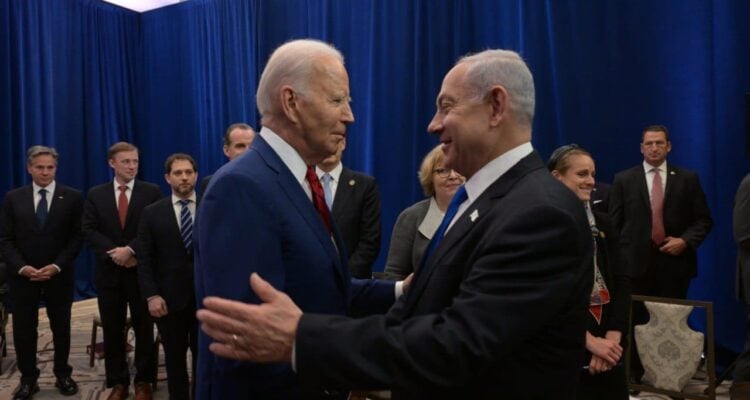
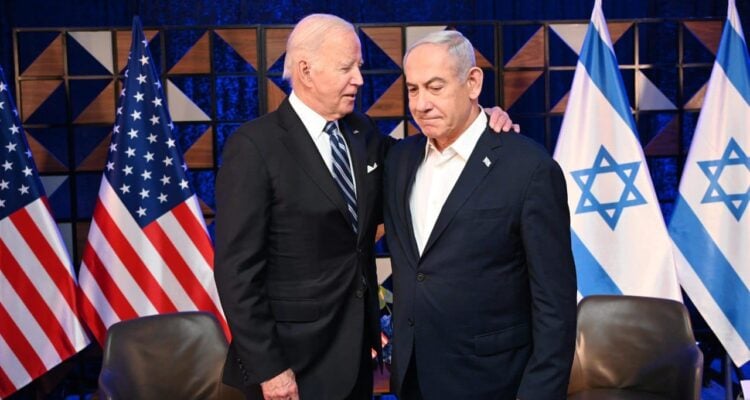
Prime Minister Benjamin Netanyahu responded publicly and directly on Sunday to biting personal criticism from US President Joe Biden the day before, saying in an interview that the US president was “wrong” when asserting that he is “hurting Israel more than helping Israel” with his handling of the war against Hamas.
Responding to Biden’s comments to MSNBC, Netanyahu told Politico, “I don’t know exactly what the president meant, but if he meant by that I’m pursuing private policies against the wish of the majority of Israelis, and that this is hurting the interests of Israel, then he’s wrong on both counts.”
“These are not my private policies only,” Netanyahu continued. “They are policies supported by the overwhelming majority of Israelis.”
The comments appeared to be a direct rebuke of White House messaging seemingly aimed at telegraphing unhappiness with Netanyahu while still signaling strong support for Israel by highlighting gaps between the Israeli people and their prime minister.
The idea was underlined by US Vice President Kamala Harris, who said Saturday that it was important to avoid conflating the Israeli government and Israeli people.
A statement from Netanyahu’s office distributing the interview clip Sunday stated explicitly in its title that Netanyahu was responding directly to Biden.
An Israeli official told The Times of Israel on Sunday afternoon that Netanyahu’s decision to grant an interview to Politico was made after Biden’s State of the Union address on Thursday in which the president warned that humanitarian aid “cannot be a secondary consideration or a bargaining chip,” lamented the fact most of the “more than 30,000 Palestinians” killed in Gaza were not Hamas members, and said “the only real solution” to the Israeli-Palestinian conflict “is a two-state solution.”
Netanyahu told Politico that Israelis “say the last thing we should do is install the Palestinian Authority” in Gaza, and that they support his position that “we should resoundingly reject the attempt to ram down our throats a Palestinian state.”
“The majority of Israelis understand that if we don’t do this, what we will have is a repetition of the October 7 massacre, which is bad for Israel, bad for the Palestinians and bad for the future of peace in the Middle East,” Netanyahu said.
The official said Netanyahu’s office believes Politico is read by Biden and his aides, and was therefore a fitting outlet in which to respond.
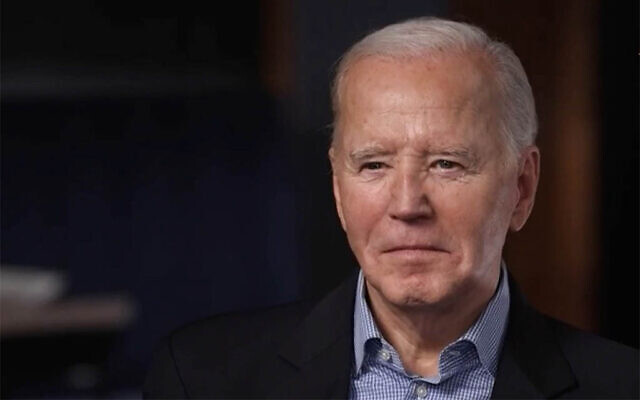
US President Joe Biden is interviewed by MSNBC on March 9, 2024. (Screen capture/MSNBC)
In his hard-hitting interview published by MSNBC Saturday, Biden highlighted deep US concerns over civilian deaths in Gaza and called the planned IDF operation in southern Gaza’s Rafah a “red line.” He also said there was no way he was going “to cut off all weapons so that they don’t have the Iron Dome [missile defense system] to protect them, but without pledging to maintain supplies of offensive weaponry.
There have been multiple reports in recent weeks that Biden is fed up with Netanyahu, including that he has referred to the prime minister as an “asshole” in private on multiple occasions.
He has publicly denounced Netanyahu’s hard-right coalition and become increasingly public about his frustration with the Netanyahu government’s unwillingness to open more land crossings for critically needed aid to make its way into Gaza. In his State of the Union speech, he announced plans to build a temporary port on the Gaza coast to facilitate direct delivery of aid.

In this image obtained from the US Central Command (CENTCOM), military personnel prepare to load humanitarian aid into US Air Force C-130 planes at an undisclosed location on March 5, 2024, in a joint US-Jordan operation. (Handout/US Central Command/AFP)
The president’s criticisms in the MSNBC interview also reflected intensified frustration following a mass-casualty incident on February 29 in which dozens of Palestinians were killed trying to collect humanitarian aid in Gaza City, where law and order has collapsed amid desperate conditions.
Biden has expressed frustration to confidants, according to NBC News, over his “inability to persuade Israel to change its military tactics in Gaza.”
He is also flummoxed by Netanyahu’s rejection of deals that the US president thinks are a win for Israel, like Saudi normalization in exchange for movement toward a Palestinian state.
The Washington Post reported in February that the US and several Arab partners were preparing a detailed plan for a comprehensive peace deal between Israel and the Palestinians that includes a “firm timeline” for a Palestinian state.

IDF troops operate in the Gaza Strip in a photo cleared for publication on March 10, 2024. (Israel Defense Forces)
Biden’s vision for the end of the war, rejected by Israel, starts with an extended truce secured by a hostage deal followed by Arab stakeholders helping to rehabilitate the Strip, a reformed Palestinian Authority returning to govern the enclave, Saudi Arabia normalizing ties with Israel, the creation of a pathway toward a Palestinian state and the bolstering of broader regional alignment against Iran.
Netanyahu’s government insists fighting cannot end until Hamas is completely destroyed, which necessitates expanding the military operation to Rafah. It has also rejected the PA having a role in governing post-war Gaza, noting Ramallah’s lack of condemnation for the October 7 massacre in southern Israel, in which some 1,200 were slaughtered and 253 were kidnapped into Gaza.
Top Biden aides warned visiting war cabinet minister Benny Gantz last week that Jerusalem could well end up indefinitely occupying Gaza with no help from the international community if it does not begin advancing a viable alternative to Hamas’s rule.
Despite the increasing visible rift, Biden and members of his administration have continued to insist that Israel has the right to defend itself against Hamas and have avoided publicly backing a permanent ceasefire before the terror group is toppled and all hostages are freed.
Biden was caught on a hot mic telling a Democratic lawmaker after his Thursday State of the Union address that he recently told Netanyahu that the two of them were going to have a “come to Jesus” meeting.

US President Joe Biden speaks to Sen. Michael Bennet (C) after his State of the Union address in Washington on March 7, 2024. (Screen capture/X)
The Biden interview aired hours after one on CBS in which Harris drew a distinction between Israelis and their government, saying the two should not be conflated.
Israelis deserve security and the United States will continue to “stand for the security of Israel and its people,” Harris told CBS when asked whether Jerusalem was at risk of losing support from Washington over its management of the war in Gaza, triggered by Hamas’s October 7 terror onslaught in Israel.
“It’s important for us to distinguish or at least not conflate the Israeli government with the Israeli people. The Israeli people are entitled to security – as are the Palestinians. In equal measure,” Harris said.