One of 3 reportedly killed said to be weapons technician in division that operates alongside Hezbollah; military says it also hit positions belonging to Tehran-backed terror group
A UNIFIL (the United Nations Interim Force in Lebanon) patrol drives past the wreckage of a car that was targeted in an Israeli strike on March 2, 2024, near the southern Lebanese town of Naqoura. (AFP)
The Israel Defense Forces said it struck a vehicle near southern Lebanon’s Naqoura on Saturday, targeting operatives belonging to the Imam Hossein Division, an Iranian militia that operates alongside Hezbollah.
According to the IDF, the operatives were involved in recent rocket fire on northern Israel.
Arab media reports, citing Lebanese sources, said three people were killed in the strike on a vehicle on a coastal road.
One of the men was a weapons technician, a security source in Lebanon told the Reuters news agency.
The IDF also said fighter jets carried out strikes on Hezbollah positions in Labbouneh, and two more buildings belonging to the terror group in Blida overnight.
It published footage showing the strike on the vehicle and the Hezbollah compounds.
Meanwhile, on Saturday, Hezbollah announced the deaths of seven more members killed “on the road to Jerusalem,” its term for operatives slain in Israeli strikes.
Hezbollah has named 229 members who have been killed by Israel during the ongoing skirmishes, mostly in Lebanon, but some also in Syria. In Lebanon, another 37 operatives from other terror groups, a Lebanese soldier, and at least 30 civilians, three of whom were journalists, have been killed.
Since October 8, Hezbollah-led forces have attacked Israeli communities and military posts along the border on a near-daily basis, with the group saying it is doing so to support Gaza amid the war against Hamas there.
So far, the skirmishes on the border have resulted in six civilian deaths on the Israeli side, as well as the deaths of ten IDF soldiers and reservists. There have also been several attacks from Syria, without any injuries.
Illustrative: Building in Kiryat Shmona damaged by rocket fire from Lebanon on February 28, 2024. (Kiryat Shmona Municipality)
Officials close to US President Joe Biden are concerned that Israel is planning to launch a ground operation against Hezbollah in Lebanon in the coming months, US media reported Thursday.
According to the CNN report, the Biden administration has held intelligence briefings on the matter, preparing for the possibility that the Iran-backed Hezbollah terror group cannot be made to retreat from the border through diplomatic measures.
Speaking to the network on the condition of anonymity, one senior official said that the Biden administration was “operating in the assumption” that a ground operation would occur in the coming months.
The Biden administration has tasked special envoy Amos Hochstein with forging a deal to end the fighting. Additionally, France delivered a written proposal to Beirut aimed at ending hostilities last month. It included negotiations to settle the disputed Lebanon-Israel frontier and a withdrawal of Hezbollah’s Radwan elite unit 10 kilometers (6 miles) from the border.
Israel has warned that it will no longer tolerate the presence of Hezbollah along the Lebanon frontier, where it could attempt to carry out an attack similar to the massacre committed by Hamas in the south on October 7.
Hezbollah fighters and supporters attend the funeral of Ali al-Debs, one of the terror group’s commanders killed by an Israeli air strike two days earlier, in Lebanon’s southern city of Nabatieh on February 16, 2024. (Mahmoud Zayyat/AFP)
A failure of international diplomacy to force Hezbollah away from the border would necessitate an Israeli offensive, the country has said.
The Israeli strikes on Iranian targets in Lebanon came a day after Iran alleged a member of Iran’s Revolutionary Guards navy serving as a military adviser in Syria was killed in an IDF strike.
Iranian media reports said Reza Zarei was killed along with two members of Lebanon’s Iran-backed Hezbollah terror group.
The IRGC have scaled back deployment of their senior officers in Syria due to a spate of deadly Israeli strikes and were relying more on allied Shiite militia to preserve their sway there, Reuters reported in February.
There was no comment from Syrian authorities.
There was also no statement from Israel, which rarely comments on individual strikes targeting Syria, but it has repeatedly said it will not allow Iran, which backs Syrian President Bashar Assad’s government, to expand its presence there.
The October 7 attack taught Israel that it has no other choice but to confront Iran-backed threats on all fronts, sooner or later.
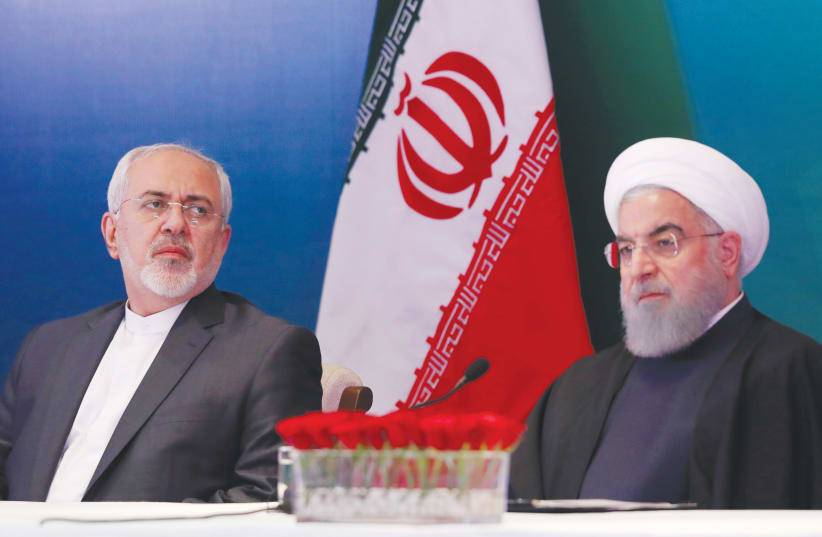
By JACOB NAGEL, MARK DUBOWITZUpdated: MARCH 2, 2024 22:52IRANIAN PRESIDENT Hassan Rouhani (right) and Foreign Minister Javad Zarif. Who wanted to pay the price of moral action to truly stop Iran?(photo credit: DANISH SIDDIQUI/ REUTERS)
Israel’s wars in Gaza and Lebanon remain a priority for the Jewish state as it fights to dismantle Hamas and confront Hezbollah. But Jerusalem risks falling into a trap set by Iran’s supreme leader Ali Khamenei. In supporting Hamas’s brutal attack on October 7 and keeping multiple Israeli military battalions tied down in the north and in the simmering West Bank, Khamenei has unleashed a weapon of mass destruction that is consuming the attention of Israel’s military, intelligence, and political establishment. This fits neatly into the supreme leader’s strategy of advancing his atomic weapon of mass destruction.
Iran’s nuclear weapons capability grows daily. Last week, the International Atomic Energy Agency confirmed that the Islamic Republic reduced its 60 percent enriched uranium stockpile, a stone’s throw from weapons-grade, by diluting some of its enriched material. But those media outlets had buried the real story: Iran took this insignificant step to try and head off censure at an upcoming IAEA board of governors meeting.
That strategy likely will work: While the E3 – France, Germany, and the UK – support a censure resolution of Iran, the Biden administration is looking to block it, according to our sources. This American tolerance of Iran’s nuclear malfeasance is wrongheaded: Tehran can now produce enough weapons-grade uranium for seven nuclear weapons during the first month of a breakout, according to the nonproliferation experts at the Washington-based Institute for Science and International Security. Its dilution of some of its 60 percent stockpile to 20 percent is almost meaningless: 20 percent enriched uranium is more than 90 percent of the effort required to make weapons-grade uranium.
The IAEA also called out Tehran for denying access to its nuclear program to the IAEA’s most senior inspectors and for refusing to cooperate with a nearly six-year investigation into Iran’s secret nuclear weapons work. Even worse, the IAEA has lost their monitoring capability into Iranian facilities for production of advanced centrifuges parts and assembly lines.
Tehran is building a new enrichment facility near Natanz to complement its existing facilities in Natanz and Fordow. This third enrichment plant will be buried deeper underground potentially impervious to Israeli and perhaps even American bombs. When this facility is complete, the Islamic Republic can use its thousands of advanced centrifuges produced under the 2015 nuclear deal for large scale enrichment to build multiple nuclear weapons.
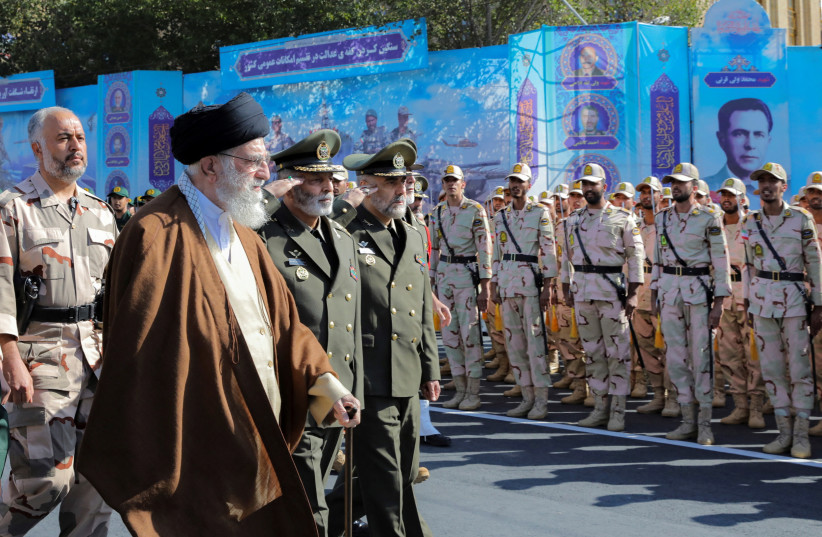
Iran’s Supreme Leader Ayatollah Ali Khamenei reviews armed forces during a graduation ceremony, in Tehran (credit: Office of the Iranian Supreme Leader/WANA (West Asia News Agency) via REUTERS)
Meanwhile, the IDF and the Israeli war cabinet are focused on two main fronts, Gaza and Lebanon, and secondary fronts, Judea and Samaria, the Houthis and the Iranian militias in Syria.
The main priority in Gaza is to eliminate Hamas’s military and governance capabilities, capture or kill all Hamas leaders and those responsible for the massacre of October 7, and free the hostages still held by the terrorists. Israel’s main priority in the north is to create a security situation that will allow its 100,000 citizens to return home and prevent Hezbollah from rebuilding its forces on the border to threaten Israeli villages. Iran is retaining Hezbollah as an insurance policy to deter Israeli attacks on its nuclear weapons program and unleash its terror proxy in a future confrontation.
These are compelling national security priorities for the Israeli government and military but their overriding objective needs to be to prevent Iran’s supreme leader from taking advantage of the chaos of war to achieve his nuclear ambitions.
The October 7 attack was undoubtedly part of the Islamic Republic’s decades-long effort to destroy Israel, and the first stage in Tehran’s grand plan to drag Jerusalem into a multi-front campaign in which the Islamic Republic would not take part directly. The doctrine and weapons used by Hamas’s “Nukhba” commando forces were copied from Hezbollah’s “Radwan” forces.
The Islamic Republic provided the training, financing, and weaponry to Hamas with clear strategic and operational coordination between Iran’s Islamic Revolutionary Guard Corps-Quds Force, Hezbollah, Hamas and Islamic Jihad. The next stage of Khamenei’s plan is to produce and conceal enough military-grade fissile material for several bombs, and to build multiple nuclear warheads that can be affixed to long-range missiles capable of striking Israel, America’s other allies and US forces in the region. Next, the completion of Iran’s long running ICBM program would put the American homeland at risk.
The American response to Iranian nuclear expansion mirrors its approach to Iranian regional aggression. As Tehran violently escalates, the White House has followed a strategy of maximum deference involving significant sanctions relief through the non-enforcement of oil sanctions and access to billions in frozen oil funds. Under President Biden, the Iranian economy has grown faster than the American economy.
The White House launched a belated and misdirected response to over 160 Iran-backed attacks against US troops in the region that killed three American soldiers and wounded dozens more, and against dozens of attacks from Iran-backed Houthi forces that have paralyzed shipping in the Red Sea. The Biden administration prefers a game of whack-a-mole against Khamenei’s proxies then strikes against the Iranian forces that are directing these attacks.
While the Islamic Republic is attacking American forces and allies, US officials are conducting the own whack-a-mole nuclear negotiations with Tehran in Oman and other capitals. They still hold out hope that Khamenei can be bribed into some diplomatic agreement that will prevent a nuclear breakout.
The Biden administration’s strategy began in 2021 with a commitment to return to the 2015 nuclear agreement under which Tehran would achieve an industrial size nuclear enrichment capability and an estimated $1 trillion in sanctions relief by 2030 when restrictions expired. President Biden promised then to negotiate a longer, stronger, and broader deal to address these fatal flaws in the original deal. When that all failed, the administration tried a desperate two-year effort to persuade Tehran to adopt a shorter and weaker deal, which is where the current negotiations likely remain focused.
The Biden administration’s main goal is to keep the Iran nuclear debate quiet until after the election, but they are playing into the regime’s grand strategy. In October 2025, the US will lose its snapback leverage under which Washington can unilaterally reinstate all UN sanctions including the expired arms and missiles embargoes. In the meantime, Tehran will continue building clandestine enrichment facilities powered by advanced centrifuges buried deep underground and protected from outside attacks.
They also will complete their development of nuclear warheads. US and Israeli intelligence agencies believe this weaponization work has not yet officially begun, but the knowledge is continuing to accumulate. It will take 18 to 24 months once the decision is made, and the intelligence services will probably not detect it when it starts. Once Iran can move enough weapons-grade enriched uranium to a secret underground site, however, Israel and the US would find it very difficult to act militarily to stop the effort. After Israeli intelligence failures on October 7 and American failures on Iraq’s nuclear weapons program and al-Qaeda’s 9/11 attacks, we must be cautious: the Islamic Republic can build warheads in small labs that are very difficult to detect.
What is to be done about Iran
What is to be done? First, the American and Israeli intelligence communities must refocus on the Iranian nuclear weapons threat. The Americans are distracted by Putin’s invasion of Ukraine and Russian threats to NATO countries. Meanwhile, Chinese threats to Taiwan and other Indo-Pacific allies are putting a burden on American intelligence capabilities.
The Israelis have redirected many of their intelligence capabilities to Gaza, the northern front and the West Bank. Both countries need to collect intelligence on Iranian weaponization progress and build the capabilities to strike all of the program’s components and scientists inside and outside the Islamic Republic. Gone should be the view that Khamenei is not willing to suffer the loss of hundreds of thousands of Iranians in his obsessive pursuit of the destruction of Israel.
Israel and US should work together to target nuclear assets and leaders inside Iran. The NSA, CIA, Unit 8200 and Mossad, must continue identifying key Iranian targets and determine their vulnerabilities. The war in Israel and the US elections should not prevent these operations. The Israeli prime minister and war cabinet have assigned the mission to Mossad to kill Hamas leadership around the world. It’s equally important that they plan and kill the Iranian nuclear weapons scientists capable of developing a nuclear warhead.
In the past, Israeli leaders have rightly talked about targeting the head of the Iranian octopus rather than becoming tangled up in its tentacles. Lebanese Hezbollah, the Houthis in Yemen, and the Shiite militias in Iraq and Syria are all dangerous tentacles, as are Hamas and Palestinian Islamic Jihad. But the head is in Tehran, and it is pursuing a weapon that could pose a true existential threat to Israel, the US and the world.
Any plan must assume that Hezbollah is likely to launch an all-out war perhaps together with Tehran after any attack on Iran’s nuclear facilities. Israel must degrade Hezbollah before the regime acquires enough enriched uranium and secretly perfects its ability to weaponize. That includes targeting Radwan forces and remaining bases and intelligence posts near the Israeli northern border and deeper inside Lebanon. It also should include an assault on Hezbollah’s long-range precision-guided munitions and production facilities, command and control centers in Beirut, and the terror organization’s leaders.
Finally, it is long past the time to squeeze the Islamic Republic’s finances. The Biden administration has tried sanctions relief to no effect; it’s time to aggressively enforce oil sanctions against the Chinese traders, refineries and banks that are keeping the regime in the black. Tens of billions of dollars in off-the-books trade through cutouts and front companies run with the assistance of America’s allies should also be on the chopping block.
The October 7 attack taught Israel that it has no other choice but to confront Iran-backed threats on all fronts, sooner or later. Israel can no longer allow Tehran to encircle it in a ring of fire. But the dagger of atomic fire is what threatens Israel’s very existence. It would be better to confront this threat with Israel’s closest ally in Washington. But Israel must be fully prepared, and without a moment to waste, to prepare to go alone.
Brig. Gen. (res.) Jacob Nagel is a senior fellow at the Foundation for Defense of Democracies (FDD) and a professor at the Technion. He served as National Security Advisor to Prime Minister Netanyahu and as acting head of the National Security Council. Mark Dubowitz is FDD’s chief executive and an expert on Iran’s nuclear program and sanctions. In 2019, he was sanctioned by Iran.
Biden administration officials signaled that Israel has agreed to a ceasefire agreement in exchange for the return of its hostages, in a recent development in the Israel-Hamas war.
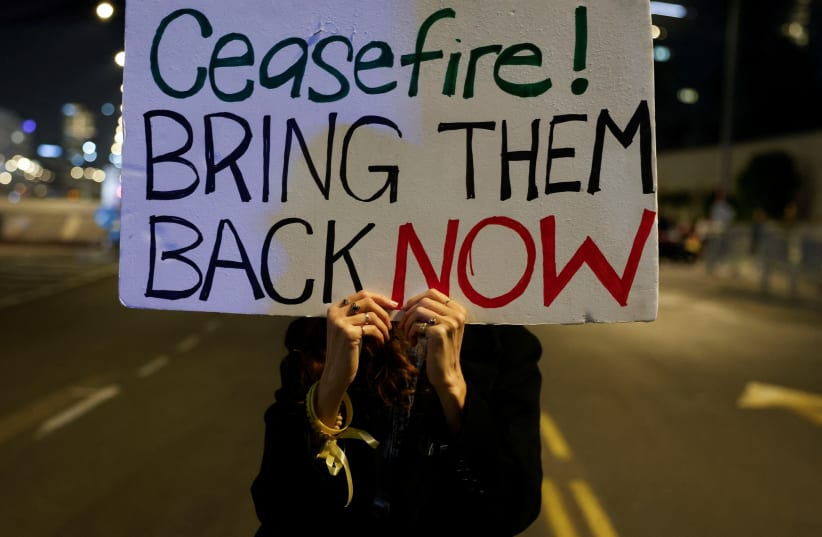
By BARAK RAVID, REUTERSUpdated: MARCH 2, 2024 22:43Supporters of hostages take part in a protest calling for their release, in Tel Aviv(photo credit: REUTERS/SUSANA VERA)
A senior figure in the American government said on Saturday evening that Israel had agreed to a deal wherein the hostages held by Hamas would be released and a ceasefire would be implemented.
“In order to address the humanitarian needs of the population in Gaza to the necessary extent, there needs to be a ceasefire,” the official said. “The way to a ceasefire at the moment is to reach a deal for the release of the captives.
“The Israelis have agreed to the terms of the deal,” he continued. “If Hamas agrees to the terms and agrees to release the captives, a six-week ceasefire will begin immediately. This deal is on the table. Talks are ongoing with Hamas in Qatar, and we hope to reach an agreement by Ramadan. The ball is in Hamas’s court. We continue to push this as hard as we can.”
Washington’s immediate goal in reaching a deal
As part of the ongoing negotiations to see a ceasefire between Israel and Hamas, US Vice President Kamala Harris on Monday will meet with Israeli war cabinet member Benny Gantz.
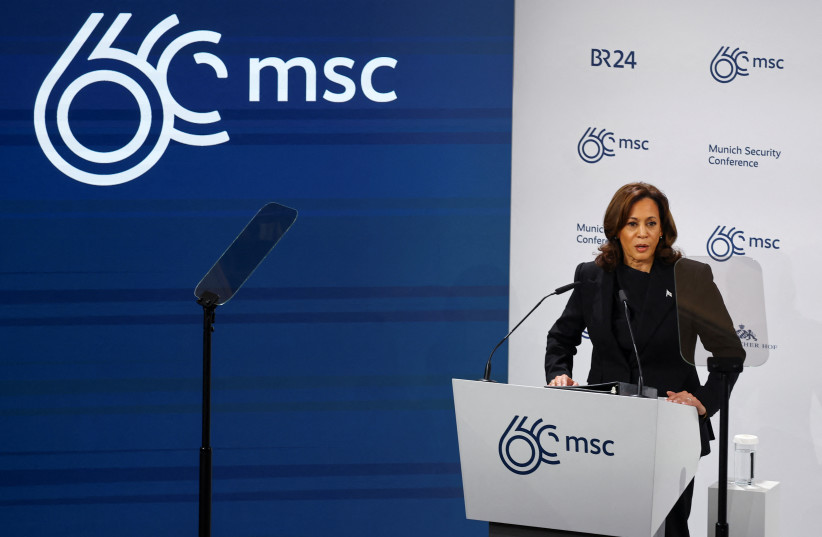
US Vice President Kamala Harris speaks during the Munich Security Conference (MSC) in Munich, Germany February 16, 2024 (credit: REUTERS/KAI PFAFFENBACH)
Washington seeks to reach a deal for a temporary ceasefire and increase the flow of aid to Gaza.
The talks, first reported by Reuters, are expected to span topics including reducing Palestinian civilian casualties, securing a temporary ceasefire, the release of hostages held in Gaza, and increasing aid to the territory, a White House official said.
“The Vice President will express her concern over the safety of the as many as 1.5 million people in Rafah,” the official said, adding that Israel also had a “right to defend itself in the face of continued Hamas terrorist threats.”