Four-and-a-half months after Prime Minister Benjamin Netanyahu declared war on Hamas, the terror group has yet to be destroyed.
While badly damaged, with a significant portion of its fighting force dead or wounded, Hamas still appears to have the ability to function as a coherent organization, and would likely be able to reassert control over the Gaza Strip if Israel left.
Hamas fighters are still able to mount attacks in parts of Gaza that Israel conquered in the initial stage of the incursion, and its operatives pop up in the northern Strip to make sure it gets whatever it wants from aid trucks.
One hundred and thirty-eight days into a war touched off by Hamas’s murderous attack inside Israel, none of Netanyahu’s declared war aims have been achieved. Hamas is not destroyed, over 100 hostages remain in Gaza, and none of its senior leaders have been killed.
Yet for some time now, the IDF has not been using anything resembling “all its strength,” which the premier had vowed to utilize to crush the group.
And despite Netanyahu’s unequivocal declaration on the day of the worst massacre of Jews since the Holocaust, Israel is no longer pursuing a campaign that can still be accurately described as a war.

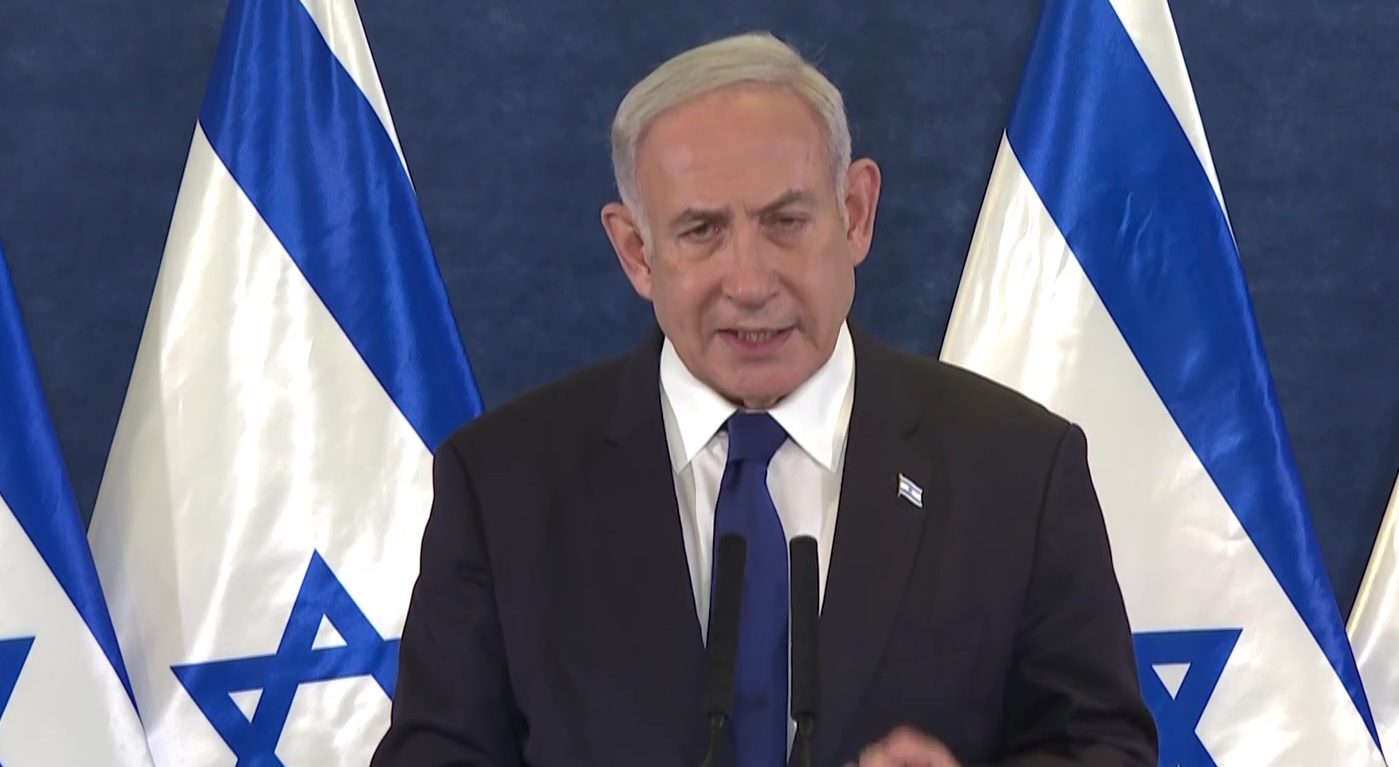
Prime Minister Benjamin Netanyahu delivers a televised address on October 7, 2023. (Screenshot/ GPO)
The dwindling offensive
Earlier this month, the IDF announced it was pulling the last reserves unit, the 646th Paratroopers Brigade, out of the Gaza Strip, leaving only active duty units to continue the fight.
At the height of the war, five maneuvering divisions were fighting simultaneously in Gaza, with around 10,000 to 20,000 soldiers each. Now only two divisions — the 98th and 162nd — are still fighting, both of them operating in much smaller numbers than earlier in the war.
For almost two months, the fighting in Gaza has looked more like a military operation — robust but limited in scope — than a full-fledged war in which the IDF is trying to achieve a decisive battlefield victory over its enemy.

IDF troops from the Nachal Brigade operate south of Gaza City, February 20, 2024 (Lazar Berman/Times of Israel)
Some of the drawdown of forces can certainly be attributed to operational realities, even successes.
When Defense Minister Yoav Gallant announced a transition to a “new combat approach” in the northern Gaza Strip in early January — ahead of a visit by US Secretary of State Antony Blinken — the IDF had conquered the cities and Hamas strongholds in the area, and was shifting to clearing out small pockets of resistance.
And it doubtlessly didn’t hurt ties with the US and general international pressure to show that the worst of the fighting was over, and that coming operations would be more targeted.
But those aren’t the only reasons the campaign is losing intensity, and falling short of the dynamic maneuvers that led to Israel’s quick battlefield victories over Arab armies in the past.

Palestinians watch an Israeli helicopter fly over Khan Younis, Gaza Strip, February 15, 2024. (AP Photo/Mohammed Dahman)
Even at the height of the IDF offensive in Gaza, the army pursued an approach that failed to take advantage of Israel’s ability to speedily deploy force to multiple areas at once.
The last approved IDF contingency plan to conquer the Gaza Strip if necessary — a plan that was terminated by the army almost a decade ago — foresaw simultaneous attacks on Gaza City, Khan Younis and Rafah, taking the key cities in two weeks.
The current campaign, officially dubbed Swords of Iron, has been much slower and more deliberate. This is a likely consequence, at least in part, of the Israeli leadership’s lack of confidence in the immediate aftermath of October 7 in the IDF’s ability to effectively use ground maneuver — large forces slicing through enemy formations where opportunities arise. This was both due to Israel avoiding such action for decades, and the shock of Hamas’s successful attacks, which immediately put military competence in question.
Once the maneuver did begin, Israel spent the first part of the war taking Gaza City and its suburbs. Focusing there at the outset made sense, as Hamas’s best rocket units were in the area, as was much of Hamas’s governing apparatus, according to Israeli estimates.
It later started broadening its operations to the enclave’s central and southern regions.

Israeli soldiers are seen on a Namer APC near Palestine Square in Gaza City’s Rimal neighborhood, December 19, 2023. (Emanuel Fabian/Times of Israel)
However, by moving methodically through the Strip, Israel slowly pushed over a million Gazans into Rafah along Gaza’s southern border. It is only now poised to take Hamas’s last remaining stronghold, with international opposition, even among Israel’s closest friends, reaching a fever pitch.
Taking it slow also limited its ability to use reserve forces. Three months of keeping taxpayers away from work and family was a serious drag on the economy, and pressure rose for fathers and husbands to be allowed to return home and to the workplace. The need to release reservists had a direct impact on the scale of the campaign Israel can pursue.
The army training schools — the 261st Infantry Brigade, the 828th Infantry Brigade, the 460th Armored Brigade — all fought in the early weeks of the ground incursion, but have since returned to their core function of creating the next generation of IDF commanders.

Lt. Col. (res.) Yisrael, the commander of the 261st Brigade’s 8717th “Alon” Battalion, in northern Gaza’s Salatin, close to Jabaliya, December 7, 2023. (Emanuel Fabian/Times of Israel)
By waiting weeks to begin the ground incursion, and by moving slowly, Israel now finds itself without the bulk of its force, and with the job unfinished.
Hamas leaders are no doubt encouraged by Israel’s shrinking offensive. They know that they have weathered the worst of Israel’s military pressure, and believe they have survived with enough of their force intact to regroup.
All they have to do is outlast Israel.
Even if the IDF does enter Rafah and breaks apart the four middling Hamas battalions there, the group’s fighting force could still return in one form or another.
“After you finish the operations against battalions, it becomes hide-and-seek against guerrillas in tunnels,” explained military theorist Brig. Gen. (res.) Eran Ortal.
Just last week, Israel’s military intelligence circulated a document to Israeli leaders warning that even if the army succeeds in dismantling Hamas as an organized military force in Gaza, it will survive as “a terror group and a guerrilla group.”
“Guerillas’ stamina is better than ours,” Ortal cautioned.
A blueprint for victory
At the same time, the scaled-back campaign doesn’t mean Israel can’t finish the job of ensuring that Hamas no longer rules the Strip.
Even though Hamas rears its head wherever it can, it is in no way currently in control of Gaza. Its fighters are hiding in tunnels, and its organs of civil control over the population are being employed in a very limited fashion.

Hamas’s Gaza Strip leader Yahya Sinwar allegedly seen in a tunnel in southern Gaza’s Khan Younis, October 10, 2023 (IDF Spokesman)
The key now is to ensure that Hamas is not able to reassert substantive control. Any withdrawal by Israel, including under a hostage deal, would create a vacuum that Hamas would do everything it can to fill as it emerges from its tunnels.
Speaking to The Times of Israel, Meir Ben-Shabbat, Netanyahu’s former national security adviser, laid out his vision for preventing Hamas from reasserting its authority in Gaza.
The first goal, he said, must be to prevent the terror group from taking over humanitarian shipments, a key element of its continued control over Gaza’s population. This can be done by creating safe zones controlled by Israel where civilians can receive aid, and by striking Hamas operatives whenever they emerge to grab aid convoys.
Where Israel has been forced to deplete its forces, the IDF should increase its air surveillance and strikes to maintain the active threat to Hamas forces, he went on.

National Security Adviser Meir Ben-Shabbat speaks during a press conference about the coronavirus COVID-19, at the Prime Minister’s Office in Jerusalem on March 25, 2020. (Olivier Fitoussi/Flash90)
Ben-Shabbat also insisted that Israel must, for the time being, “prevent the return of residents who were evacuated from the northern Gaza Strip.”
Those measures might assist in holding off Hamas in the coming months, but Israel still needs a long-term solution. That means actively replacing Hamas while it is still underground.
“What stands between running in place in Gaza and toppling Hamas is a different civil government,” Ortal insisted.
But Netanyahu is averse to discussing his vision for who will replace Hamas, saying only that he will not hand over power to the Palestinian Authority which he distrusts, and that Israel will maintain full security control.
“After the great sacrifice of our civilians and our soldiers, I will not allow the entry into Gaza of those who educate for terrorism, support terrorism and finance terrorism,” he said. “Gaza will be neither Hamastan nor Fatahstan.”

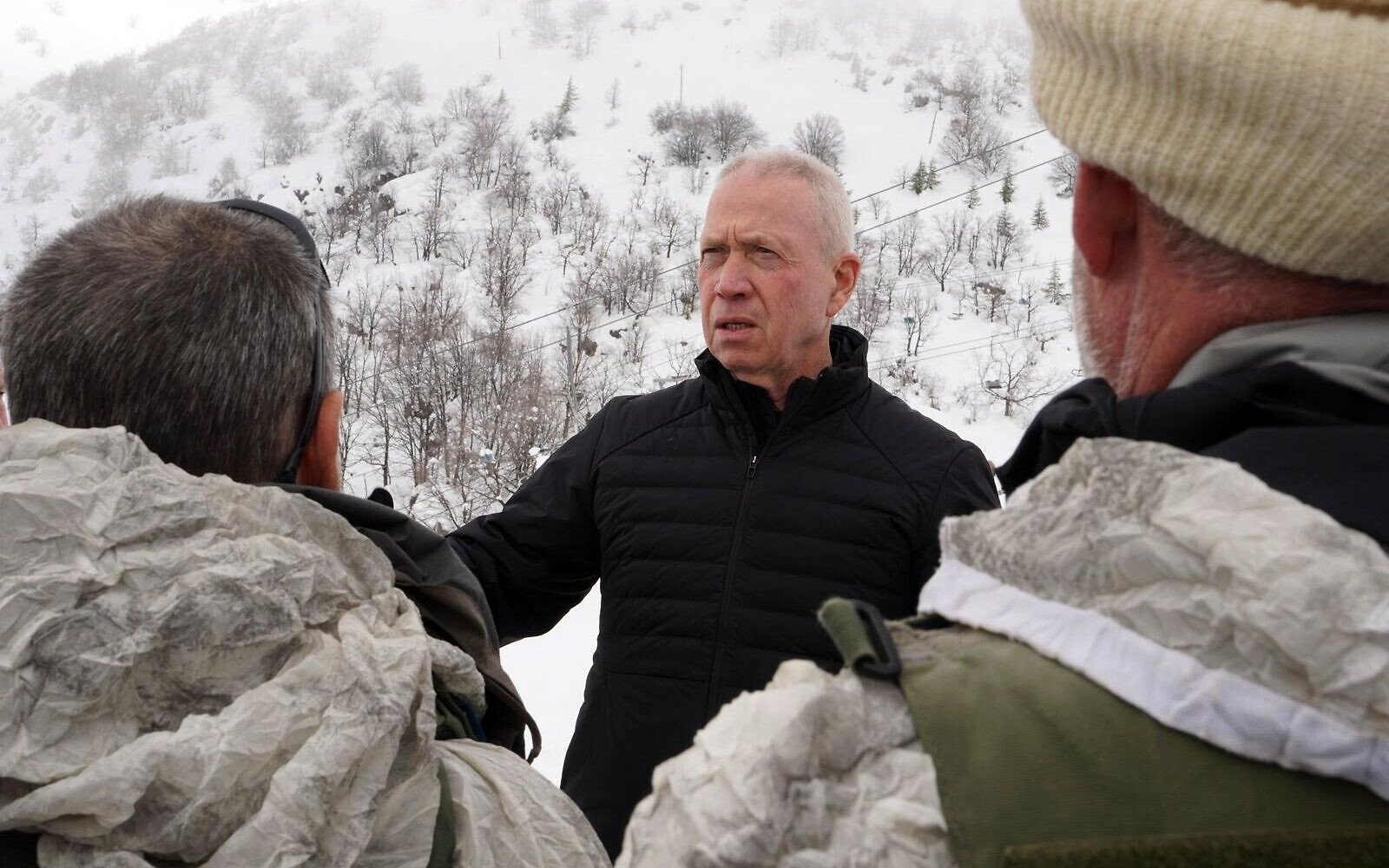
This handout photo shows Defense Minister Yoav Gallant meeting with soldiers in the IDF’s Alpine Unit at Mount Hermon, February 2, 2024. (Ariel Hermoni/Defense Ministry)
In January, Defense Minister Yoav Gallant presented a general vision for Gaza, calling for a multinational task force, led by the US in partnership with European and moderate Arab nations, to take responsibility for running civil affairs and the economic rehabilitation of the Strip. Local Palestinian authorities would handle the day-to-day functioning of services.
Discussing a plan for the future governance of Gaza brings with it political complications for Netanyahu, especially from the hard-right flank of his coalition. Even Gallant’s outline was met with public condemnation from Finance Minister Bezalel Smotrich, who called it “a re-run of the ‘day before’ October 7.”
Netanyahu’s opacity is frustrating the Americans, but also alarms IDF intelligence.
Given that there is currently no practical effort being made to put in place a plan for Gaza on the “day after” the war, the military intel circulated last week warned, “Gaza will become an area in deep crisis.”
After more than four months of war, the IDF has done impressive work in an unprecedented environment to wrest control of the Strip from Hamas and dismantle most of its military structure. Even though the military campaign has slowed down, conditions are in place for Hamas to be replaced while its forces remain pinned underground.
But that will necessitate difficult and bold decisions by its war cabinet — the same leaders who pledged to lead the country to total victory over the terrorists.