‘You can’t have 2-state solution with Gaza still controlled by those responsible for Oct. 7,’ foreign secretary says on trip to Lebanon; ‘need to give Palestinian people a horizon’


Britain's Foreign Secretary David Cameron, left, speaks with Lebanese caretaker Prime Minister Najib Mikati in Beirut, Lebanon, Thursday, Feb. 1, 2024. (AP Photo/Bilal Hussein)

Britain’s Foreign Secretary David Cameron, left, speaks with Lebanese caretaker Prime Minister Najib Mikati in Beirut, Lebanon, Thursday, Feb. 1, 2024. (AP Photo/Bilal Hussein)

British Foreign Secretary David Cameron said his country could officially recognize a Palestinian state after a ceasefire in Gaza without waiting for the outcome of what could be years-long talks between Israel and the Palestinians on a two-state solution.

UK recognition of an independent state of Palestine, including in the United Nations, “can’t come at the start of the process, but it doesn’t have to be the very end of the process,” Cameron, a former British prime minister, said on Thursday during a visit to Lebanon.

“It could be something that we consider as this process, as this advance to a solution, becomes more real,” Cameron said. “What we need to do is give the Palestinian people a horizon towards a better future, the future of having a state of their own.”

That prospect is “absolutely vital for the long-term peace and security of the region,” he added.

Cameron said the first step must be a “pause in the fighting” in Gaza that would eventually turn into “a permanent, sustainable ceasefire.”

Hamas has so far taken the position that its leaders would not leave the enclave as part of a ceasefire deal.

Britain, the US and other Western countries have supported the idea of an independent Palestine existing alongside Israel as a solution to the region’s most intractable conflict, but have said Palestinian independence should come as part of a negotiated settlement. There have been no substantive negotiations since 2009.

On Monday, Cameron said the UK was considering recognizing a Palestinian state as a way to mark progress toward a two-state solution after a ceasefire in Gaza.

Speaking to the Conservative Middle East Council at the House of Commons, Cameron said such recognition – after Hamas releases all hostages – would represent “irreversible progress to a two-state solution and, crucially, the establishment of a Palestinian state.”

“We have a responsibility there because we should be starting to set out what a Palestinian state would look like; what it would comprise; how it would work,” he said. “As that happens, we, with allies, will look at the issue of recognizing a Palestinian state, including at the United Nations. This could be one of the things that helps to make this process irreversible.”

The UK is pushing a five-point plan that would see an end to the fighting, the release of hostages held in Gaza, a “political horizon” for a two-state solution, and a technocratic Palestinian government that would run both Gaza and the West Bank.

It would necessitate Hamas leaders being expelled to another country, a move they have rejected.


New report says terror groups can’t launch long-range operations but still ‘harbor global ambitions’; threat high in Africa conflict zones, Afghanistan, rise in Europe


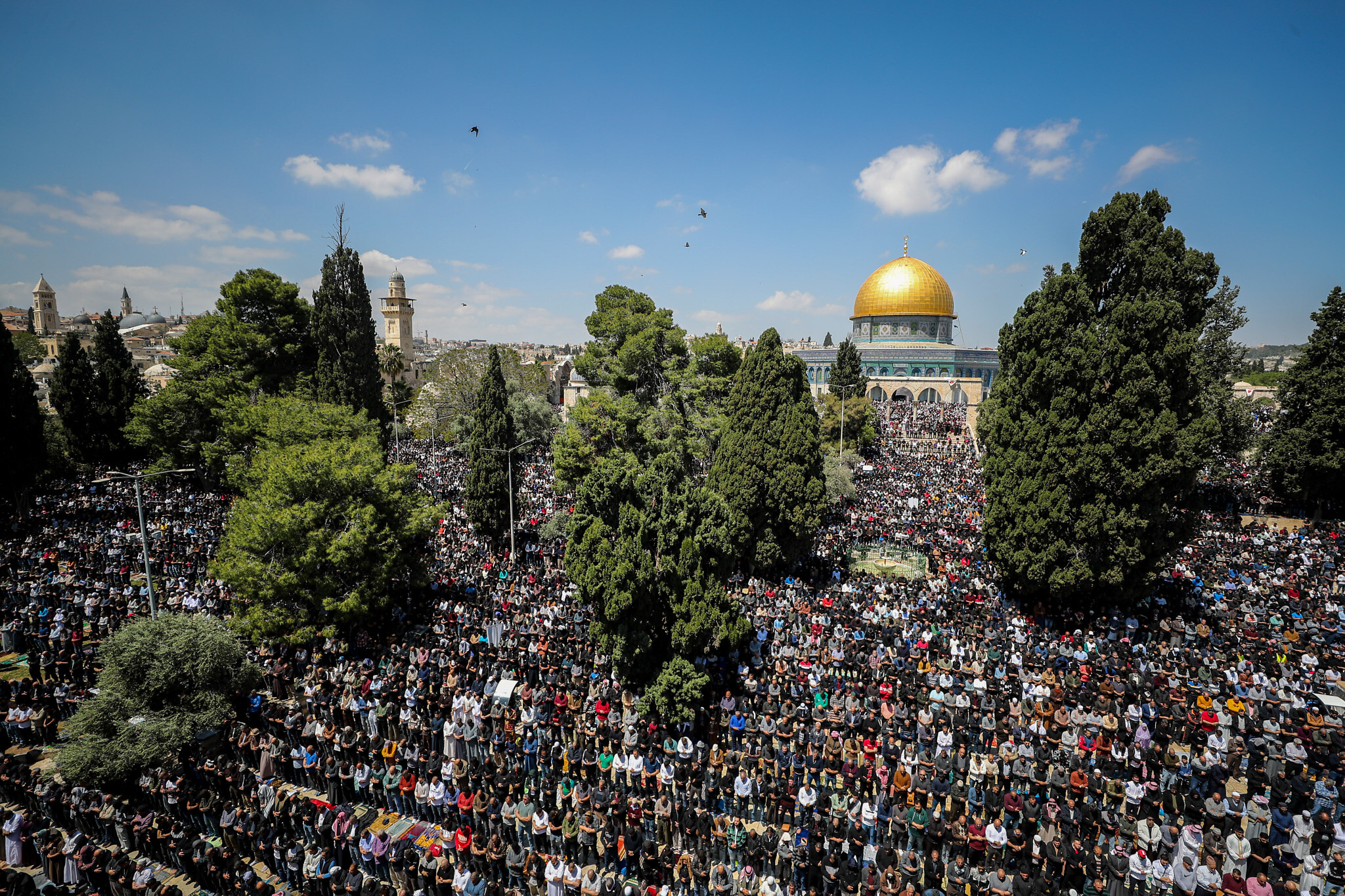
Tens of thousands of Muslim worshipers attend the last Friday prayers of the holy month of Ramadan, at the Al-Aqsa Mosque Compound atop the Temple Mount in Jerusalem's Old City, April 14, 2023. (Jamal Awad/Flash90)

Tens of thousands of Muslim worshipers attend the last Friday prayers of the holy month of Ramadan, at the Al-Aqsa Mosque Compound atop the Temple Mount in Jerusalem’s Old City, April 14, 2023. (Jamal Awad/Flash90)

Al-Qaeda has changed its messaging since Hamas’s October 7 attacks to focus on “the sanctity” of Jerusalem’s Al-Aqsa mosque, UN experts said in a new report to the UN Security Council circulated on Wednesday.

The panel of experts noted in the 23-page report that al-Qaeda has improved its media productions, which appeared aimed at restoring the extremist group’s credibility, attracting recruits, and filling the void over its inability to announce a new leader.

But that messaging changed after Hamas’s grisly October 7 massacres, the experts said, when some 3,000 terrorists burst across the border into Israel from the Gaza Strip, killing some 1,200 people — most of them civilians, slaughtered amid executions, the burning of bodies, rapes and other atrocities — and seizing over 250 hostages, some 130 of whom are still held.

In response to the onslaught — referred to by Hamas as “Operation Al Aqsa Flood” — Israel vowed to destroy the terror group and launched a wide-scale offensive in Gaza which the Hamas-run health ministry says has killed over 27,000 people. These figures cannot be independently verified, and are believed to include both civilians and Hamas members killed in Gaza, including as a consequence of the terror groups’ own rocket misfires. The IDF says it has killed over 10,000 operatives in Gaza, in addition to some 1,000 terrorists inside Israel on October 7.

The experts said Al-Qaeda has focused on the mosque, the third holiest site in Islam which is on the Temple Mount in the Old City of Jerusalem, the holiest site for Jews, with some communications stressing “an obligation for individuals to take action to the limits of their own ability.”

“Member States are concerned that it (al-Qaeda) could exploit the situation to recover relevance and tap into popular dissent about the extent of civilian casualties, providing direction to those keen to act,” the panel said, and they “are concerned that the renewed narrative could inspire self-initiated attacks globally.”

The report, which covered the period until December 16, 2023, also said that the terrorist threat from al-Qaeda, the Islamic State group and their affiliates remains high in conflict zones in Africa and in Afghanistan – and threat levels have risen in some regions including Europe.
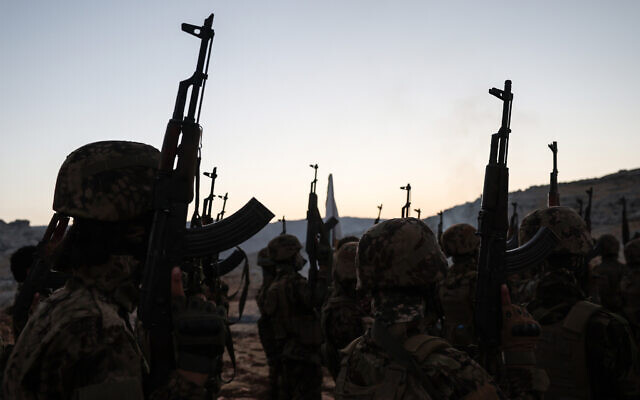
Fighters from the jihadist group Hayat Tahrir al-Sham (HTS), headed by ex-members of Syria’s former Al-Qaeda franchise, stand to attention during a military training graduation ceremony in the country’s rebel-held northwestern Idlib province on August 16, 2023. (Omar Haj Kadour/AFP)

The panel of experts said the relationship between Afghanistan’s Taliban rulers and al-Qaeda remains close, and unnamed member states report that “the high concentration of terrorist groups” in the country is undermining the security situation in the region.

The greatest threat within Afghanistan still comes from the Islamic State “with its ability to project into the region and beyond,” the experts said in the report. Regionally, they pointed to a succession of attacks in neighboring Iran and Pakistan and threats in Central Asian nations.

The panel said, however, that while none of the al-Qaeda affiliated groups have recovered the capability to launch long-range operations, “they harbor global ambitions.” And it said “covert and calibrated efforts to rebuild capability” have been reported.
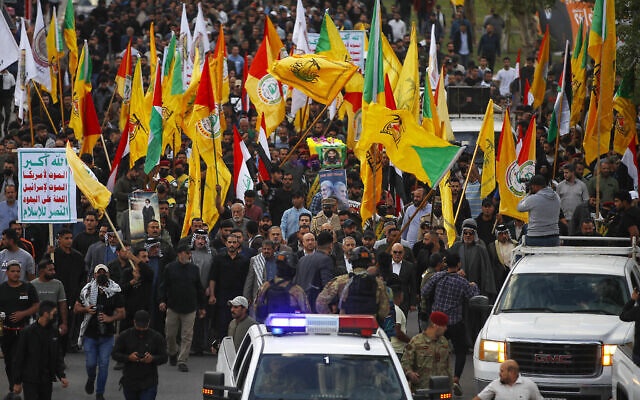
Iraqi mourners carry the coffin of Fadel al-Maksusi, a Kataeb Hezbollah terrorist and part of the Islamic resistance in Iraq. The group has claimed all recent attacks against US troops in Iraq and Syria, during a funeral in Baghdad on November 21, 2023. (Ahmad Al-Rubaye / AFP)

The Islamic State group broke away from al-Qaeda over a decade ago and attracted supporters from around the world. Despite its defeat in Iraq in 2017 and in Syria two years later. The panel said the combined IS strength in the two countries is still between 3,000 and 5,000 fighters. In Iraq, they are carrying out “a low-intensity insurgency with covert terrorist cells” while in Syria attacks have intensified since November, the experts said.

The panel said the three-month delay in naming the current IS leader, Abu Hafs al-Hashemi al-Qurayshi, following the death in fighting of his little-known predecessor “is judged indicative of internal difficulties and security challenges”

Some unnamed UN member nations have assessed that serious pressure from counter-terrorism operations in Syria and Iraq raises the possibility that the Islamic State could move its leadership and “center of gravity” to Africa or Afghanistan, with Africa more likely, the experts said.

In West Africa and the Sahel, the panel said, “violence and threat have escalated again” in conflict zones, raising concerns among UN member nations. The experts point to “a deficit in counterterrorism capabilities,” which Islamic State and al-Qaeda affiliated groups are continuing to exploit.

“The situation is becoming ever more complex with the conflation of ethnic and regional disputes with the agenda and operations of these groups,” they said.

In East Africa, the experts said, the Somali government is continuing its military offensive against al-Shabab, an al-Qaeda affiliate, but they said UN member nations assess that despite significant losses from air strikes and military operations, “al-Shabab remains resilient. It has an estimated 7,000 to 12,000 fighters, and an estimated $100 million annual income, mostly from illegal taxation in the capital Mogadishu and southern Somalia, they said.

Across Europe, the experts said, “formal terrorist threat levels have risen … following fatal attacks in late 2023 in France and Belgium, in addition to numerous non-lethal terrorist incidents and arrests in several European countries.”


Syrian state media said only material damage was caused by the airstrikes.

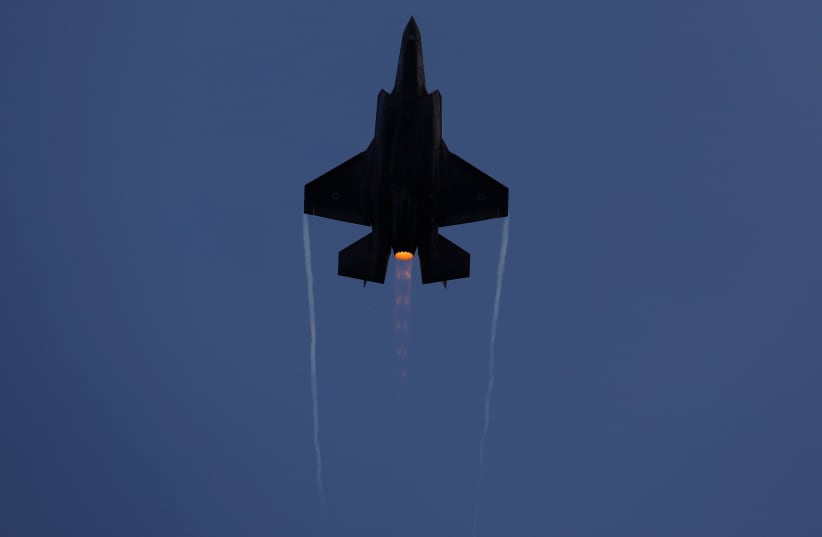
An Israeli Air Force F-35 fighter jet flies during an aerial demonstration at a graduation ceremony for Israeli air force pilots  (photo credit: REUTERS/AMIR COHEN)
An Israeli Air Force F-35 fighter jet flies during an aerial demonstration at a graduation ceremony for Israeli air force pilots
(photo credit: REUTERS/AMIR COHEN)
Alleged Israeli airstrikes targeted Sayyidah Zaynab, a stronghold of Iranian militias, near Damascus early on Friday morning, according to Syrian reports.

The strikes targeted the Sayyidah Zaynab area, an area which has been targeted several times by alleged Israeli airstrikes in recent months, according to the Syrian Capital Voice news site.

Sites near Aqraba, south of Damascus, were targeted as well, according to Nour Abo Hassan, a journalist in southern Syria.

The Syrian state news agency SANA reported that the airstrikes were carried out from over the Golan Heights and that the airstrikes only caused material damage without any casualties.

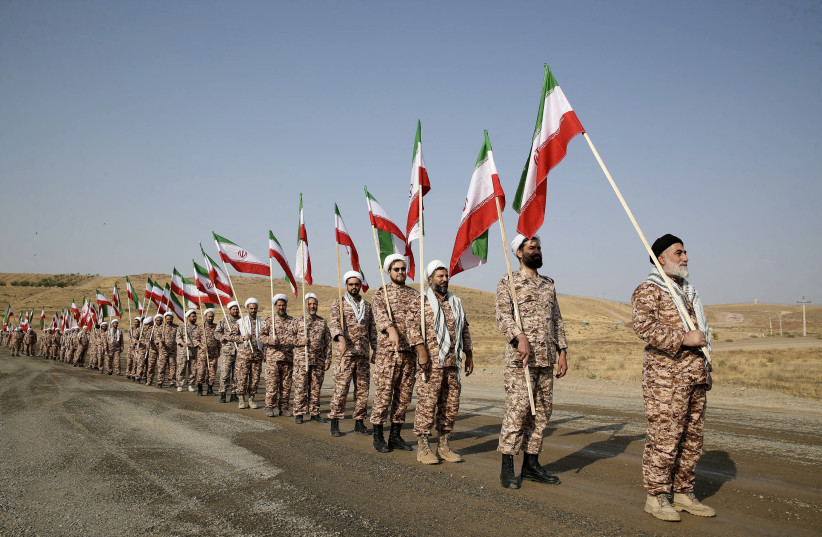
 Members of the Islamic Revolutionary Guard Corps (IRGC) attend an IRGC ground forces military drill in the Aras area, East Azerbaijan province, Iran, October 17, 2022. (credit: IRGC/WANA/HANDOUT VIA REUTERS)Enlrage image
Members of the Islamic Revolutionary Guard Corps (IRGC) attend an IRGC ground forces military drill in the Aras area, East Azerbaijan province, Iran, October 17, 2022. (credit: IRGC/WANA/HANDOUT VIA REUTERS)

Reported airstrikes come just days after previous strike

The strikes are the latest attributed to Israel in Syria as tensions continue to rise across the region. The last strike on the Sayyidah Zaynab area was reported just a few days ago, with four members of Iran’s Islamic Revolutionary Guard Corps (IRGC) reported killed in that strike.

On Thursday, Reuters reported that the IRGC scaled back deployment of their senior officers in Syria due to a spate of deadly Israeli strikes, adding that the IRGC will rely more on allied Shi’ite militia to preserve their sway there.

Since December, Israeli strikes have killed more than half a dozen of their members, among them one of the Guards’ top intelligence generals. Several of the strikes in which IRGC members were killed targeted the Sayyidah Zaynab area, according to Syrian reports.

On Tuesday night, the Israeli Air Force struck military infrastructure belonging to the Syrian Army in the Daraa Governorate of southern Syria after several rockets were fired towards the Golan Heights.

Reuters contributed to this report.