“We’re not going to get into the business… of rebuilding Gaza, only to have it leveled again in a year or five years,” Antony Blinken reported Arab leaders as saying.
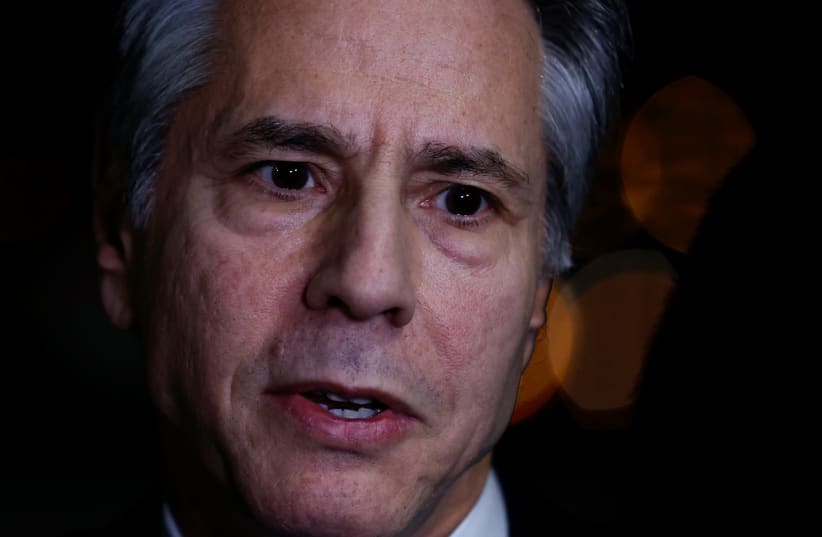
U.S. Secretary of State Antony Blinken speaks to the media as he departs for Tel Aviv, during his week-long trip aimed at calming tensions across the Middle East, in Manama, Bahrain, January 10, 2024. (photo credit: REUTERS/EVELYN HOCKSTEIN/POOL)
U.S. Secretary of State Antony Blinken speaks to the media as he departs for Tel Aviv, during his week-long trip aimed at calming tensions across the Middle East, in Manama, Bahrain, January 10, 2024.
(photo credit: REUTERS/EVELYN HOCKSTEIN/POOL)
Palestinian statehood is the best path to the reconstruction of Gaza and normalized Israeli ties with its Arab neighbors, including Saudi Arabia, US Secretary of State Antony Blinken told CNBC on Monday.

He said Arab countries are saying, “Look, we’re not going to get into the business, for example, of rebuilding Gaza, only to have it leveled again in a year or five years and then be asked to rebuild it again,” as he spoke to the network on the sidelines of the World Economic Forum in Davos, that drew top policymakers from around the globe, including the Middle East.

The Israel-Hamas war in Gaza, a two-state resolution to the conflict, and the potential revival of a deal between Riyadh and Jerusalem are expected to be among the key discussion points.

As Israel shifts to a lower-intensity assault phase and displaced civilians have begun to return to northern Gaza, world leaders have begun to tackle the issue of Gaza reconstruction.

Qatari Prime Minister Mohammed Bin Abdulrahman al-Thani addressed the Davos forum with sentiments similar to Blinken’s, stating that Arab countries won’t inject funds into rebuilding Gaza “unless we address the real issue, which is the two-state solution” to the conflict, he said.
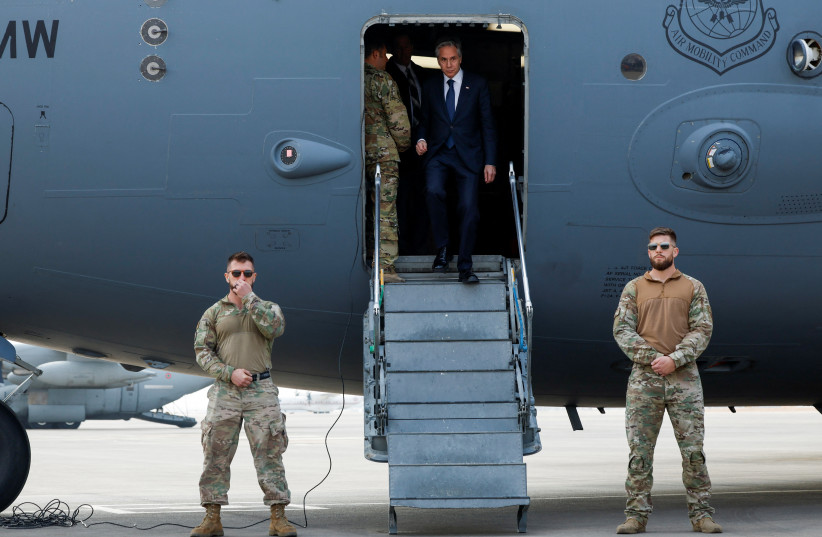
 U.S. Secretary of State Antony Blinken exits a plane as he arrives in Cairo, during his week-long trip aimed at calming tensions across the Middle East, in Egypt, January 11, 2024. (credit: REUTERS/EVELYN HOCKSTEIN/POOL)Enlrage image
U.S. Secretary of State Antony Blinken exits a plane as he arrives in Cairo, during his week-long trip aimed at calming tensions across the Middle East, in Egypt, January 11, 2024. (credit: REUTERS/EVELYN HOCKSTEIN/POOL)

“Right now, unfortunately, there are some politicians who thought this matter can be just put under the rug and people will forget about it,” Thani said.

The war in Gaza, which began on October 7, has shown that this is not possible, he said. The only active talks now, Thani said, are for the release of Israeli hostages in Gaza in exchange for a ceasefire, but one also has to focus on the larger peace process.

“We need to address the two-state solution”

“We need to address the two-state solution,” Thani said. He cautioned that any two-state process must be “time-bound” and “irreversible” so that future governments in Israel can’t rescind decisions made for a final-status agreement.

“We cannot be hostage to [Israeli] elections,” Thani said.

Blinken said that Israel has a “fundamental” choice to make about its future once the Gaza war is over.

He described how the Hamas-led attack against Southern Israel in which over 1,200 people were killed and some 250 hostages seized that sparked the Gaza war could be transformed from a disaster to an impetus to reshape the region.

The US had been pushing for a normalization deal between Israel and Saudi Arabia before October 7 and at Davos, and leaders including Blinken said that the deal was still possible.

“You’re in a place right now where, again, Arab countries, including countries like Saudi Arabia, are prepared to do things in their relationship with Israel they were never prepared to do before. That opens up an entirely different future. A much more secure future,” Blinken said.

The region is prepared to give Israel “the kind of security assurances and commitments and guarantees that they never would have given in the past,” he said.

That can only happen if the Palestinians receive statehood, Blinken stressed.

“Until that question is resolved, you’re never really going to have peace and stability. And, for that matter, Israel is never going to know true security.

“So, when you, when you put together integration in the region, Israel’s normalization of relations with, with every country, security assurances and commitments, a Palestinian state. You’ve created an entirely new region. And then Israel’s biggest challenge, the biggest problem, for us as well, Iran, is isolated. It answers that problem very powerfully as well,” he said.

Norway’s foreign minister, Barth Eide, said at Davos that several European states, “concerned” Arab countries, and the United States are working on a concept for a unified Palestinian government that could attract reconstruction funds, Norway’s foreign minister said in an interview in Davos.

“Several countries are working with us… trying to build a broad unity government,” he said, without naming the specific countries.

Norway is of the view that a unified Palestinian territory should be run by the Palestinian Authority, but “prefacing everything, it has to be what the Palestinians want,” he added.

Norway served as a facilitator in the 1992-1993 talks between Israel and the Palestine Liberation Organization (PLO) that led to the Oslo Accords in 1993.

Since the Oslo talks, Norway has chaired a donor group coordinating international assistance to the Palestinian territories, the Ad Hoc Liaison Committee (AHLC), and worked with others to try to revive a diplomatic channel between Israel and the Palestinians.

Eide said work on a two-state solution was becoming urgent as the conflict was spreading in the region, but that only the United States and the Israeli people could influence Israel’s position.

“What we can do is work on Palestinian unity and think about models with interested countries,” he said.

“The long-term stability of Israel and peace and prosperity for Palestinians does require a two-state solution,” Eide said.

Saudi Arabian Foreign Minister Foreign Minister Faisal bin Farhan said, “We agree that regional peace includes peace for Israel, but that can only happen through peace for Palestinians through a Palestinian state,”

“This is something that we have been working on with the US administration,” Farhan said, saying that Israel’s failure to halt the Gaza war “is putting the prospect for regional peace at risk.”

Farhan pointed to the high cost of the war for Palestinians. Hamas has asserted that close to 24,000 Palestinians have been killed in war-related violence. Israel has said that some 9,000 of those fatalities are combatants .

He clarified that both Israel and Hamas must commit to a ceasefire.

There is a pathway toward a much better future for the region, that is peace, and we are fully committed to that,” Farhan said, adding that within that wider regional context, his country would recognize Israel.

Reuters contributed to this report.
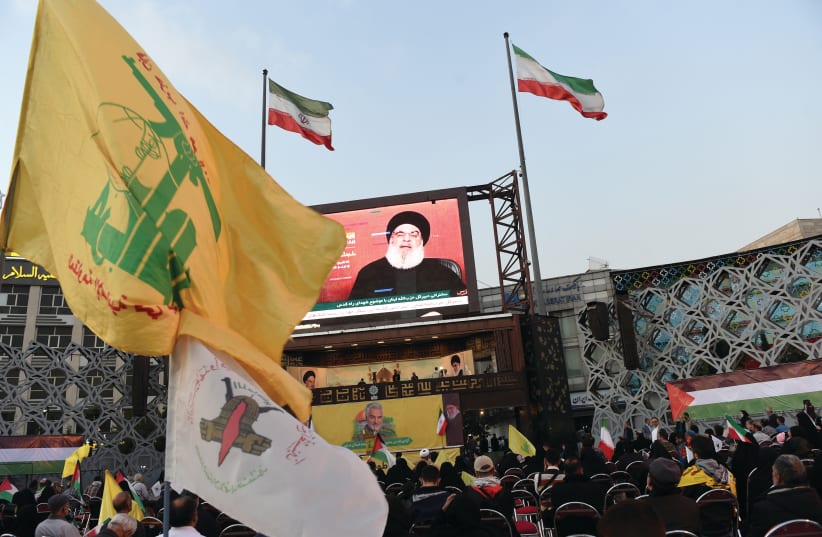

Initiated by Hezbollah at the behest of its paymaster, Iran, the true function of the cross-border skirmishes is to fulfill Iran’s desire to cause as much trouble in the Middle East as possible.

 A CROWD in Tehran watches an address, on the screen by Hezbollah leader Hassan Nasrallah, in November. Hezbollah is virtually a state within a state, sucking the lifeblood out of Lebanon at the instigation of Iran, says the writer. (photo credit: WEST ASIA NEWS AGENCY/REUTERS)
A CROWD in Tehran watches an address, on the screen by Hezbollah leader Hassan Nasrallah, in November. Hezbollah is virtually a state within a state, sucking the lifeblood out of Lebanon at the instigation of Iran, says the writer.
(photo credit: WEST ASIA NEWS AGENCY/REUTERS)
A war with Israel is the last thing that Lebanon needs. The Lebanese people are in the midst of a severe economic downturn, facing soaring prices and severe shortages of food and basic commodities.

Hezbollah-allied political, financial, and business leaders, the source of the graft and corruption at the heart of the nation, have allowed Lebanon’s economy to deteriorate to crisis level.

The nation is in a catastrophic economic situation that has lasted for years. If Hezbollah’s leader, Hassan Nasrallah, were to initiate a full-scale conflict with Israel, he would find little support from the hard-pressed Lebanese.

Even the continuous armed skirmishes over the Lebanon-Israel border serve little purpose beyond administering an Israeli tit for a Hezbollah tat. They achieve nothing of any value for either side. Initiated by Hezbollah at the behest of its paymaster, Iran, their true function is to fulfill Iran’s desire to cause as much trouble in the Middle East as possible.

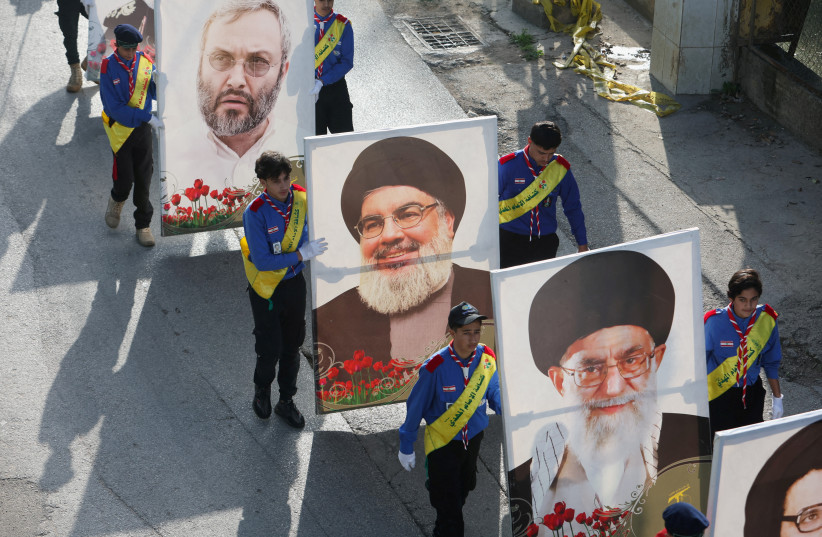
 Members of Hezbollah attend the funeral of Wissam Tawil, a commander of Hezbollah's elite Radwan forces in Lebanon, January 9, 2024 (credit: REUTERS/AZIZ TAHER)Enlrage image
Members of Hezbollah attend the funeral of Wissam Tawil, a commander of Hezbollah’s elite Radwan forces in Lebanon, January 9, 2024 (credit: REUTERS/AZIZ TAHER)

Hezbollah was established in 1982 specifically to counter Israel’s invasion of Lebanon, undertaken in response to constant attacks on Israel from Lebanese territory by Palestinian militants. But when the subsequent Israeli occupation of southern Lebanon ended in 2000, Hezbollah’s aim was achieved. 

What purpose can the constant armed interchanges have now?

One truth, long unacknowledged in the Western world but the cornerstone of Iran’s Islamic Revolution in 1979, is that the Iranian regime is in relentless pursuit of its own agenda, namely to dominate the Middle East as a first step toward spreading the Shi’ite tradition of Islam eventually to the whole world.

This was clearly spelled out by the instigator of Iran’s Islamic revolution, Ayatollah Ruhollah Khomeini, on more than one occasion: “We shall export our revolution to the whole world. Until the cry ‘There is no god but Allah’ resounds over the whole world, there will be struggle.”

As essential stages in this process, the revolutionary leaders envisaged the overthrow of Zionism (i.e., Israel) and of capitalism (i.e., the US) – a fact which one-time US president Obama, and now President Joe Biden, have seemed peculiarly reluctant to acknowledge.

Time and again, attempts at mollifying the Iranian regime have proved useless – its ultimate aim remains unaltered. It still regards America as the Great Satan, and Israel as its smaller manifestation – both destined for obliteration.

Iranian leaders pursue their goals

IN PURSUIT of their objective, Iran’s leaders recognize no bounds. They sponsor terrorist activities and deploy their puppet organizations – among others, Hamas in Gaza, the Houthis in Yemen, and Hezbollah in Lebanon – to undertake them.

In Lebanon, Iran has nurtured, financed, and equipped Hezbollah ever since 1982 to harry Israel. UK media reported on January 12 that Iran is paying Hezbollah fighters a wage of $1,300 per month.

Lebanon’s problem as a sovereign state has been its inability to prevent the accretion of political, social, and above all, military power by Hezbollah over the past 40 years – a process that has left the sovereign state of Lebanon in thrall to Hezbollah.

A state within a state

In 2024, Hezbollah is virtually a state within a state, sucking the lifeblood out of Lebanon at the instigation of Iran. It has effectively brought Lebanon’s political process to a standstill ­– since October 31, 2022, the nation has been without a president and has hobbled along with only caretaker government ministers.

Every attempt to resolve the political difficulties has been frustrated by Hezbollah and its political allies.

As for Hezbollah’s armed forces, it is generally believed that they are larger and more powerful than the Lebanese national army.

The Hezbollah military has, after all, been in receipt of sophisticated technology from Iran for years, and has built up a formidable state-of-the-art armory directed at Israel.

The two armed forces exist side by side within the same state, and although under the previous president, Michel Aoun, there was often a degree of collaboration between them, Hezbollah steers its own course, and is not answerable to Lebanon‘s political leaders for its activities.

Hezbollah’s last full-scale clash with Israel was brought to an end in August 2006 by UN Security Council Resolution 1701. One main purpose of the resolution was to keep Hezbollah troops far from the Israel-Lebanon border, thus forestalling any future conflict.

In accordance with the resolution, 15,000 UN international troops, operating alongside the Lebanese army, were deployed to police the Lebanon-Israel border. There are currently just over 9,500. Known as UNIFIL (United Nations Interim Force in Lebanon), they have been in place for the past 18 years, their authority largely ignored by Hezbollah.

ANOTHER PROVISION of Resolution 1701 that neither Iran nor Hezbollah had any intention of meeting was the UN’s strong demand, laid down in previous resolutions, that all armed groups in Lebanon, other than those of the Lebanese state, should be disarmed.

On the day that Resolution 1701 passed unanimously in the UN Security Council, Hezbollah secretary-general Hassan Nasrallah said that Hezbollah would honor the call for a ceasefire provided Israel agreed to end its military actions. Resolution 1701 was approved by the Lebanese government one week after it was passed by the UN.

As it did so, Nasrallah reiterated his pledge that once the Israeli offensive ceased, Hezbollah’s rocket attacks on Israel would also stop.In practice, of course, 1701 has failed utterly to maintain stability along the Israel-Lebanon border. Hezbollah, marching to the beat of Iran’s drum, has prevented UNIFIL from performing its mission.

It has used its militia to control the area, has deployed its forces there, has launched thousands of rockets into Israel, and has constructed tunnels under the border to enable its terror units to penetrate Israel.

Its bombardment of Israel with rockets, missiles, and drones has been unceasing. UNIFIL has proved ineffective, unwilling to confront Hezbollah head-on.

It has failed to prevent Hezbollah’s continuous activity along the border in blatant violation of 1701.

For its part, the UN has failed to insist that its UNIFIL forces actually enforce adherence to its Resolution 1701. As a result, Iran, through its Hezbollah pawn, has been empowered to disrupt regional stability, just as it has done by fortifying Hamas in Gaza, and using the Houthis in Yemen to attack shipping in the Red Sea and deploy missiles directly into Saudi Arabia.

The perpetual Hezbollah-Israel skirmishes across the Lebanon border serve no one’s purposes except those of the Iranian regime. In the end, it will be necessary to tackle the organ-grinder rather than his monkey.

The writer is the Middle East correspondent for Eurasia Review. His latest book is Trump and the Holy Land: 2016-2020. Follow him at: www.a-mid-east-journal.blogspot.com.


Shin Bet exposes several online platforms allegedly operated by Iranian security agents.

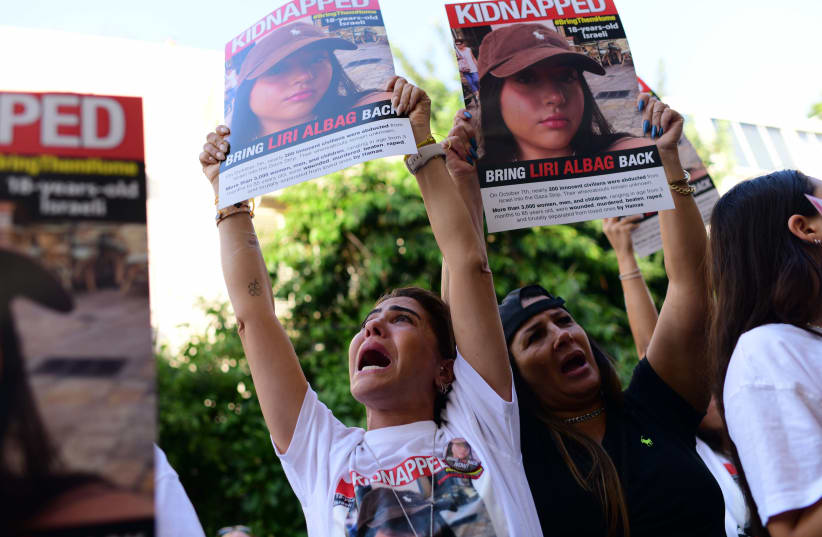
Families of Israelis held hostage by Hamas terrorists in Gaza hold up photographs of their abducted family members, outside the Egyptian embassy in Tel Aviv, October 26, 2023. (photo credit: TOMER NEUBERG/FLASH90)
Families of Israelis held hostage by Hamas terrorists in Gaza hold up photographs of their abducted family members, outside the Egyptian embassy in Tel Aviv, October 26, 2023.
(photo credit: TOMER NEUBERG/FLASH90)
Iran is using fake online profiles to gather intelligence in Israel, the Shin Bet (Israel Security Agency) reported Monday.

Among its tactics are operations to photograph the homes of security personnel and public figures who oppose Iran in the media, it said. Public demonstrations for the hostages’ return are used as a platform to photograph participants, it added.

Iranian operatives are also targeting the families of hostages via fake expressions of grief, such as sending bouquets and messages to the families’ homes, the Shin Bet said. Other means of intelligence-gathering include fake survey prompts and volunteer forms that are used to gather information about personal details and skill sets, it said.

According to the Shin Bet, Iranian intelligence has used these online platforms to gather information:

Tears of the War spreads “disinformation and incitement” and is presented as a tool to recruit Israelis for activism on behalf of hostages, along with fake job postings.

Here+ poses as a research and survey platform, using a logo that appears to be based on that of Israel’s Channel 11. The platform is believed to use phishing to collect personal details of Israelis.

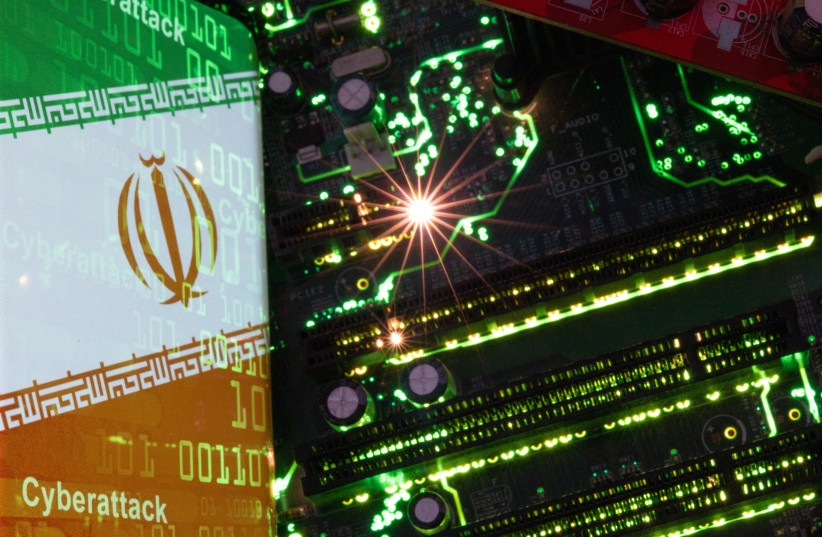
 A smartphone with a displayed Iranian flag with the word ''Cyberattack'' and binary codes over it is placed on a computer motherboard in this illustration taken February 23, 2023. (credit: DADO RUVIC/REUTERS)Enlrage image
A smartphone with a displayed Iranian flag with the word ”Cyberattack” and binary codes over it is placed on a computer motherboard in this illustration taken February 23, 2023. (credit: DADO RUVIC/REUTERS)

BringHomeNow is active mostly on Telegram, posing as a movement for the return of the hostages, using false volunteer forms to collect Israelis’ personal information.

Several other fake platforms purport to align with different political movements and are designed to deepen divides in Israeli society, the Shin Bet said.

Israeli organization ‘Fake Reporter’ responds

FakeReporter is an Israeli watchdog organization that exposes false reporting, bots, and similar activities online. Since the start of the war with Hamas, the organization claims to have exposed several foreign influence networks that attempt to employ Israelis, with violence at the center of their goal.

In response to the Shin Bet report, FakeReporter said: “We have been warning for a long time that the online ‘borders’ have been breached. These latest reports prove that the ‘fences’ have been breached on the Internet for a long time and that the enemies have settled among us.”

The state is “not doing enough to protect the public within virtual borders,” it said.

FakeReporter also called for a national plan for online safety that would allow Israelis to report online attacks in a similar way to how they report in-person attacks.