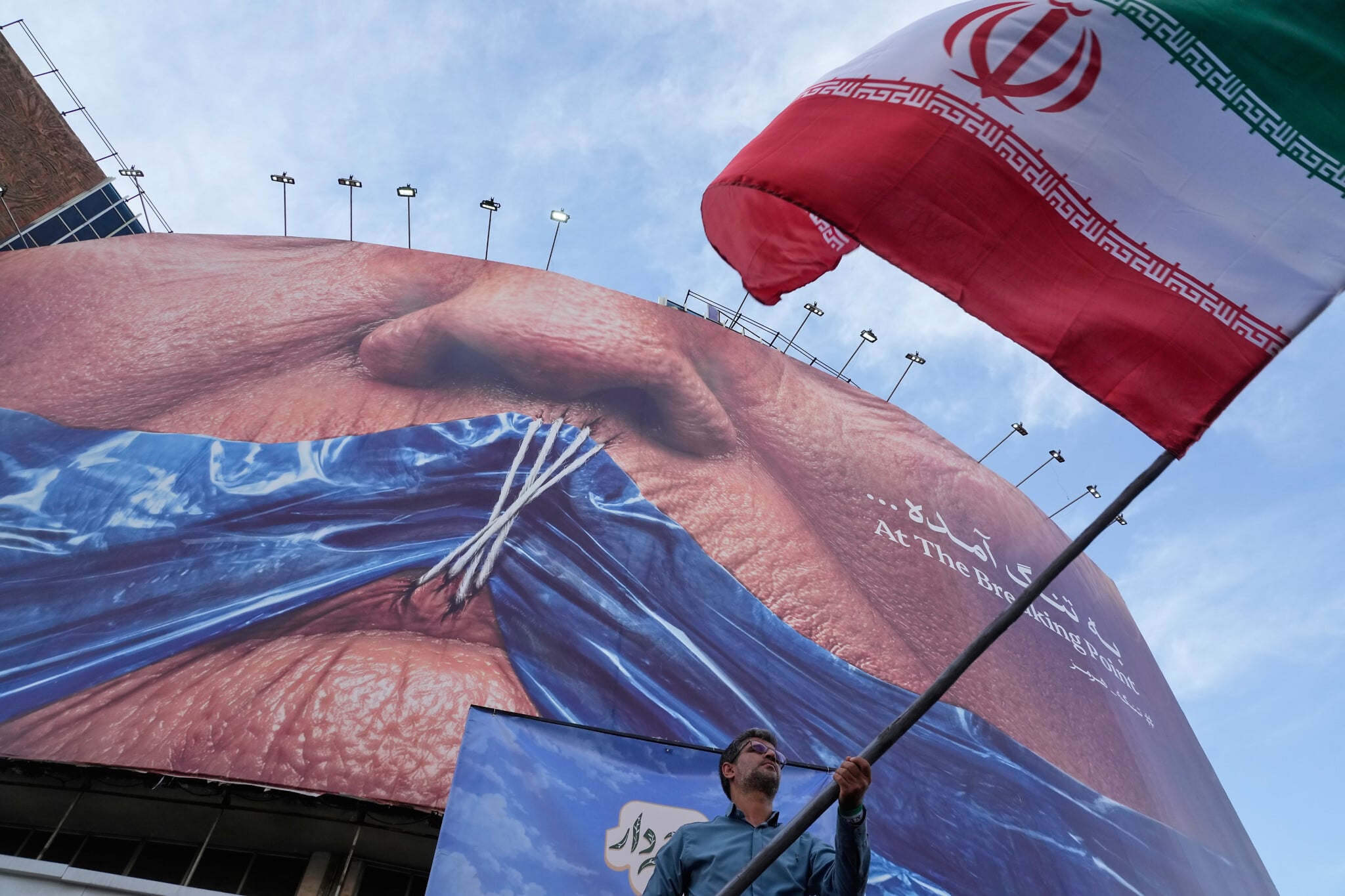
A man waves an Iranian flag for a pro-government campaign under a billboard with graphic showing Strait of Hormuz and sewn lips of US President Donald Trump in a square in downtown Tehran, Iran, May 6, 2026. (AP Photo/Vahid Salemi)
After US President Donald Trump publicly derided as “totally unacceptable” Iran’s response to the latest American offer to end the war, Tehran says its response was a rejection of the US proposal.
Iranian state television reports that Tehran rejected the proposal as amounting to “surrender,” insisting instead on “war reparations by the US, full Iranian sovereignty over the Strait of Hormuz, an end to sanctions, and the release of seized Iranian assets.”
The response also calls on the US to end its naval blockade, guarantee no further attacks and end a US ban on Iranian oil sales, the semi-official Tasnim news agency says.
The European Union Foreign Ministers’ Council is scheduled to meet on May 11, where actions against Israeli settlements could potentially be approved.
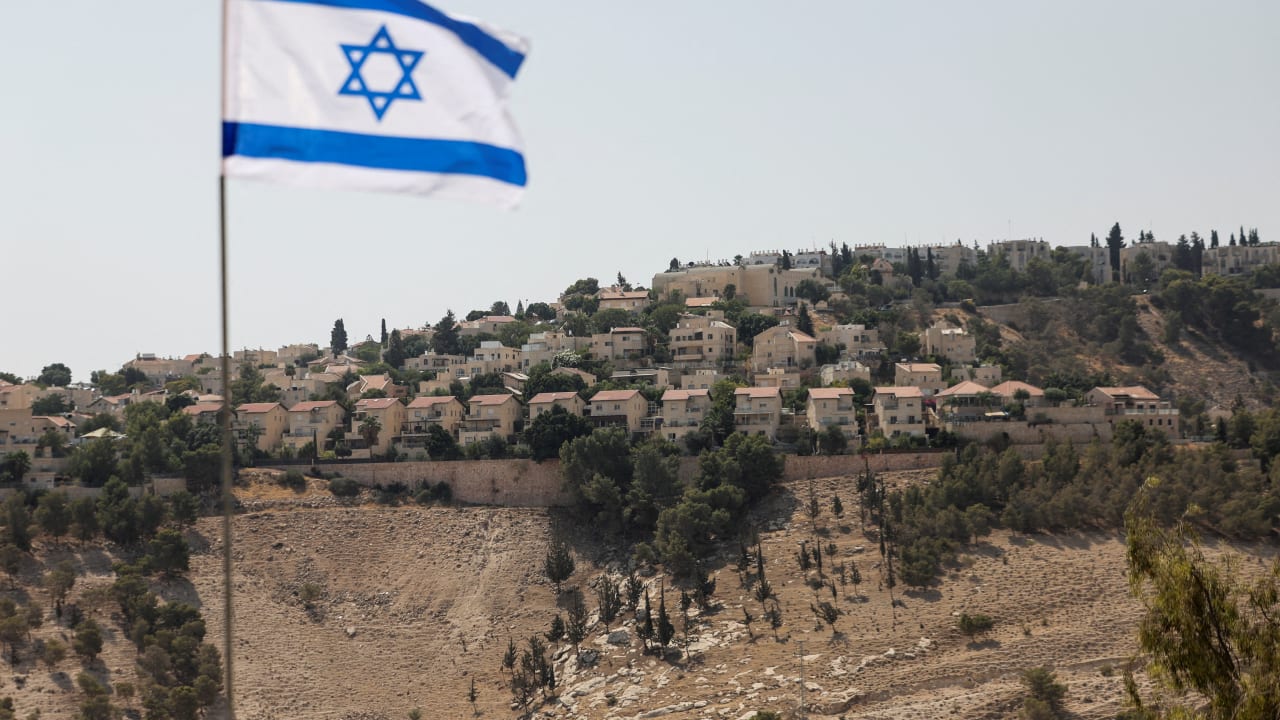
An Israeli flag flutters, with Ma’aleh Adumim is visible in the background, in the West Bank, August 14, 2025. (photo credit: REUTERS/RONEN ZVULUN/FILE PHOTO) ByJERUSALEM POST STAFFThe European Union is moving closer to imposing new sanctions on Israeli settlements in the West Bank, the EU Ambassador to Israel, Michael Mann, confirmed on Thursday.
Speaking at the annual conference of the Berl Katznelson Foundation, titled “A Year of Decision and Correction,” Mann strongly indicated an upcoming political shift regarding sanctions on extremist settlers.
Mann addressed the recent political changes in Hungary, which he suggested could lead to new actions against Israel. Hungary had previously blocked sanctions against Israel, but following Viktor Orbán’s election defeat, its policy is expected to change.
“For a long time, we had plans in Brussels to impose additional sanctions on extreme settlers in the West Bank. This was blocked by one country’s vote.”
“I’m not sure I can confidently say that this will change now, but it definitely seems like this is the direction,” Mann said during the conference.
Settlements are ‘red line’ for the EU
The ambassador also discussed other potential sanctions, including a French-Swedish initiative to ban imports from the settlements.
“There are, of course, other initiatives on the table aimed at persuading Israel to change its policies. We have received some requests from Israel, and discussions are taking place in Brussels about whether it is possible to lift the blockade on these steps. There may be progress,” Mann added.
He emphasized that for the EU, the settlement issue is a “red line,” and the union will do “everything in its power” to stop settlement expansion, which may include additional sanctions.
A senior European official who is familiar with the details told N12 about the sanctions issue, “It seems increasingly likely that sanctions will soon be imposed on the settlements, especially now that the Hungarian veto has been lifted and there is a shift in sentiment across the continent. Europe is growing weary of the situation in the West Bank and wants to convey a clear message to Israel.”
The official also warned N12 of an increasing rift between Israel and its European allies.
The European Union Foreign Ministers’ Council is scheduled to meet on May 11, where actions against Israeli settlements could potentially be approved.
In Israel, more severe measures, such as completely canceling the association agreement that governs relations between the EU and Israel, have been successfully blocked.
Hamas has not yet agreed to disarm under the Trump administration’s 20-point Gaza peace plan as negotiations continue over guarantees, Israeli withdrawal, and the role of the ISF.
Palestinian members of al-Qassam Brigades, the armed wing of the Hamas movement.(photo credit: ABED RAHIM KHATIB/FLASH90)ByAMICHAI STEINUpdated: While attention has focused on Iran and Lebanon, the situation in Gaza and the question of Hamas’s demilitarization have been pushed to the sidelines, even as the second phase of the Gaza peace plan has centered on disarmament, technocratic governance, and reconstruction.In recent weeks, Nickolay Mladenov, director-general of the Board of Peace, and other senior officials have been engaged in intensive negotiations over Hamas’s disarmament and the continuation of the Trump administration’s 20-point peace plan for Gaza.Two sources told The Jerusalem Post this week that Hamas has not agreed to the plan and that significant gaps remain, although talks are ongoing amid broader debate over the future of Hamas’s weapons and the structure of postwar Gaza.
In a conversation with the Post, Dr. Bishara Bahbah, a prominent Palestinian-American scholar, former mediator in the hostage deal talks, and board member of the Gaza Soup Kitchen, discussed the chances of Hamas accepting the plan as international actors continue to examine how Gaza could be stabilized after the war.
According to Bahbah, who maintains regular contact with various stakeholders in the region, the situation on the ground is defined by a near-total lack of trust.
Dr. Bishara Bahbah. (credit: Courtesy)
Hamas seeks guarantees before disarmament
Bahbah said Hamas leaders have indicated a willingness to hand over heavy equipment and, eventually, smaller arms, provided that what he described as their “paramount fears” are addressed.
“One [Hamas leader] told me: ‘We are not only willing to hand over our weapons, but we can destroy those weapons in front of the world,’” Bahbah said.
However, the path to such a symbolic step remains blocked by a “chicken-and-egg” dilemma. Hamas is demanding an Israeli withdrawal and the entry of an international stabilization force before disarming, while Israel is demanding demilitarization before any withdrawal.
“Hamas needs guarantees that the Israelis won’t come after them individually, that they won’t be targeted and assassinated,” Bahbah said.
He added that Hamas currently views the existing guarantors – the US, Egypt, Qatar, and Turkey – as insufficient to prevent future Israeli operations against its members.
“For an agreement to hold, the issue of amnesty must be addressed,” he said.
Dispute over Israeli control in Gaza
Bahbah said another major sticking point is the percentage of territory Israel currently controls in the Gaza Strip. He pointed to data suggesting that the area under Israeli control has expanded from 51% to approximately 59%.
This expansion of the “yellow line,” he argued, has created a situation in which many Palestinians are unaware that Israel has claimed additional territory, leading to further clashes and a deeper erosion of trust.
Bahbah also described the humanitarian situation in Gaza, saying that while the food crisis has eased in some areas, economic hardship remains severe.
“I don’t get calls from people saying they are starving,” Bahbah said, citing the 14 soup kitchens his organization operates seven days a week across Gaza, “but prices are high because the Israelis restrict the number of trucks. Many people cannot afford to eat chicken or beef on a regular basis.”
Beyond the issue of food, Bahbah cited reports that between 8,000 and 10,000 people remain buried under the rubble.
“There is one tractor in the entire Gaza Strip to excavate bodies,” he said, describing the logistical paralysis that has prevented any return to normalcy or proper sanitation.
Bahbah warned that Gaza remains “a hostage” to broader regional tensions involving Iran.
He recalled that during previous escalations, Hamas reacted angrily when he suggested that the Gaza issue should be decoupled from Iran. “We are facing a situation where they find it very hard to come to an agreement while there are hostilities with Iran,” he said.
Still, Bahbah said he remains optimistic that the current deadlock is temporary and that reaching a solution is “a question of time.”