Herzog: Now’s not the time for two-state solution

Israel’s president said Israel must first deal with its emotional trauma after Oct. 7 and its need for security.

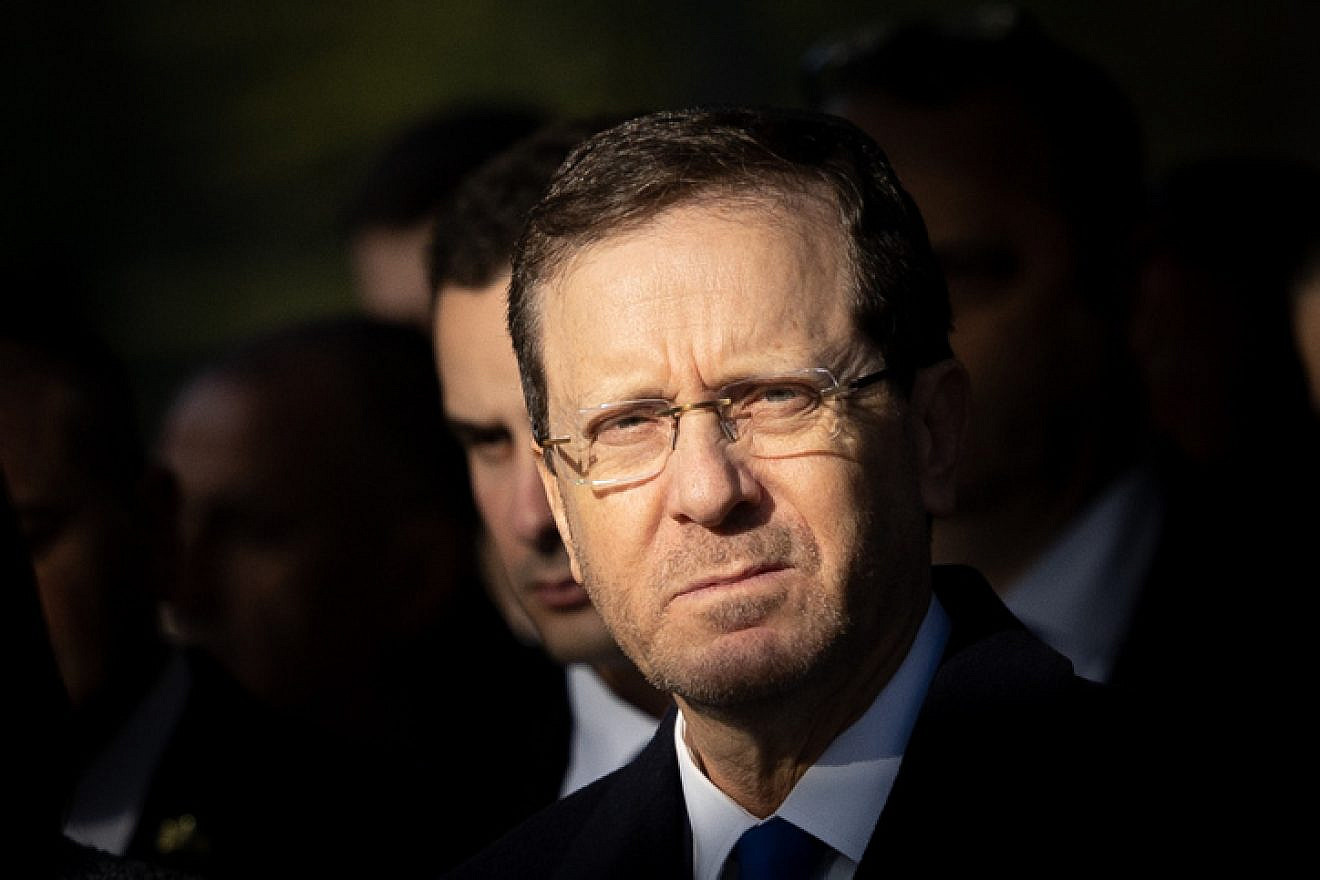
Israeli President Isaac Herzog attends the funeral of former Knesset Speaker Shevah Weiss at the Mount Herzl Cemetery in Jerusalem, Feb. 5, 2023. Photo by Yonatan Sindel/Flash90.

Israeli President Isaac Herzog attends the funeral of former Knesset Speaker Shevah Weiss at the Mount Herzl Cemetery in Jerusalem, Feb. 5, 2023. Photo by Yonatan Sindel/Flash90.

Israel’s head of state has added his name to the ranks of officials speaking out against a two-state solution following the war in Gaza.

“What I want to urge is against just saying two-state solution. Why? Because there is an emotional chapter here that must be dealt with. My nation is bereaving. My nation is in trauma,” President Isaac Herzog told the Associated Press in a Dec. 14 interview.

Politicians across Israel’s political spectrum, from Prime Minister Benjamin Netanyahu to opposition leader Yair Lapid, have come out against handing the Gaza Strip over to the Palestinian Authority—a move advocated by the United States as a first step towards a two-state solution.

Herzog, whose position is that of a ceremonial figurehead meant to represent consensus positions, argued that speaking about the creation of a Palestinian state is a mistake if for no other reason than that the Oct. 7 attack is too fresh.

“In order to get back to the idea of dividing the land, of negotiating peace or talking to the Palestinians, etc., one has to deal first and foremost with the emotional trauma that we are going through and the need and demand for [a] full sense of security for all people,” he said.

Herzog once led Israel’s Labor Party, which calls for a two-state solution, but following the Oct. 7 massacre by Hamas such a position has become politically untenable, particularly as the P.A. has allocated $3 million for slain Hamas terrorists as part of its “pay-for-slay” program while its Fatah party boasts of members taking part in the attack.

At the same time, the P.A. has falsely blamed the Israeli military for killing nearly 400 partygoers at a rave on Oct. 7, not Hamas.

In a new survey, slightly more than three in four Palestinians have a positive view of Hamas in the wake of its terrorist attack.

Almost 80% regard the role of Hamas’s Al-Qassam Brigades “military” wing as positive. The Al-Qassam Brigades killed more than 1,200 people, mostly civilians, and wounded thousands on Oct. 7.


Under the proposed deal, Hamas will release at least 50 hostages and Israel will free 300 Palestinians

Sources said a 'tentative agreement' to pause fighting in Gaza for hostage and detainee swaps was clinched in a meeting on Wednesday in Egypt. AP
Live updates: Follow the latest news on Israel-Gaza

Hamas and Israel have reached a tentative deal on a new truce in Gaza and a prisoner and hostage swap, sources with direct knowledge of the negotiations told The National on Saturday.

They said the arrangement would be similar to one that lasted a week before it collapsed on December 1, when Israel resumed its relentless bombardment of Gaza and shifted its ground offensive to the south of the coastal enclave.

The Egyptian sources said the new deal was reached after a series of meetings between negotiators from Israel, Qatar, Egypt, the US and, indirectly, Hamas in Doha, Ramallah and Cairo.

The tentative agreement, they added, was clinched in a meeting on Wednesday in Egypt in which Hamas leader Yahya Sinwar – Israel’s most wanted man – was personally involved, albeit remotely and indirectly.

Israeli Prime Minister Benjamin Netanyahu appeared to confirm on Saturday that new Qatar-mediated negotiations were under way to recover hostages held by Hamas.

If finalised, the new deal will provide for the release from Israeli prisons of 300 Palestinians, including Mustafa Barghouti, a senior official of the mainstream Palestinian Fatah faction, according to the sources, who spoke on condition of anonymity because of the sensitivity of the subject.

Mr Barghouti, who is serving a life sentence, is popular among Palestinians of all political stripes and his name has sometimes been floated as a possible replacement for Palestinian President Mahmoud Abbas, who is 88.

Hamas, for its part, will release at least 50 of the estimated 137 hostages it is still holding. Among those to be freed will be six active members of the Israeli military, said the sources.

Like the last deal, also negotiated by the US, Egypt and Qatar, the release of the hostages and prisoners will be staggered and its continuation will depend on both sides sticking to the terms of the deal.

There was no official word immediately available from any of the parties involved in the negotiations that a tentative deal has been reached. The negotiations, like previous rounds, are held behind closed doors.

The sources said the Gaza negotiations will move next week to Europe, possibly to the Norwegian capital Oslo, where the deal would be announced and deliberations will begin on what to do with Gaza after the end of hostilities, or what has become known as “day after” scenarios.

They said some delegates were already in Oslo, but they have no details.

The sources did not give a precise date for the announcement of the new deal, saying only it would be made mid to late next week.

News of a new deal emerged after the head of Israel’s Mossad spy agency met Qatar’s prime minister in Europe late on Friday, according to Reuters.

The meeting between David Barnea and Prime Minister Mohammed bin Abdulrahman Al Thani was apparently the first between senior officials from Israel and Qatar since the collapse of the last truce.

In another sign of a possible breakthrough, Israeli media said Prime Minister Benjamin Netanyahu would convene his security cabinet and deliver a televised statement later on Saturday evening.

The Gaza war, the fifth between Hamas and Israel since 2008, began on October 7 when fighters from Hamas and other Gaza-based militant groups went on a rampage in southern Israel, killing 1,200 people and taking about 240 hostages back to Gaza.

Israel responded with a bombardment of the enclave, killing more than 18,700 people, mostly women and children, displacing 1.9 million of the territory’s 2.3 million residents and laying waste large swathes of built-up areas, particularly in Gaza city.

The fighting has created a massive humanitarian crisis in Gaza, where food, clean drinking water and health care are in acutely short supply.

On Saturday, Israeli forces bombarded targets across Gaza, including a crowded YMCA building, with dozens of Palestinians reported killed or wounded, despite a renewed US call to scale down the campaign and focus on Hamas leaders.

Israeli officials publicly emphasised that they would continue the war until they eradicate Hamas. Washington appeared to acknowledge disagreement, with National Security Advisor Jake Sullivan saying the timing was under “intensive discussion” between the two close allies.


Majority of all respondents support Israel, but results from 18-24 age group show majority think IDF campaign ‘genocidal,’ while saying calls for genocide of Jews is are legitimate


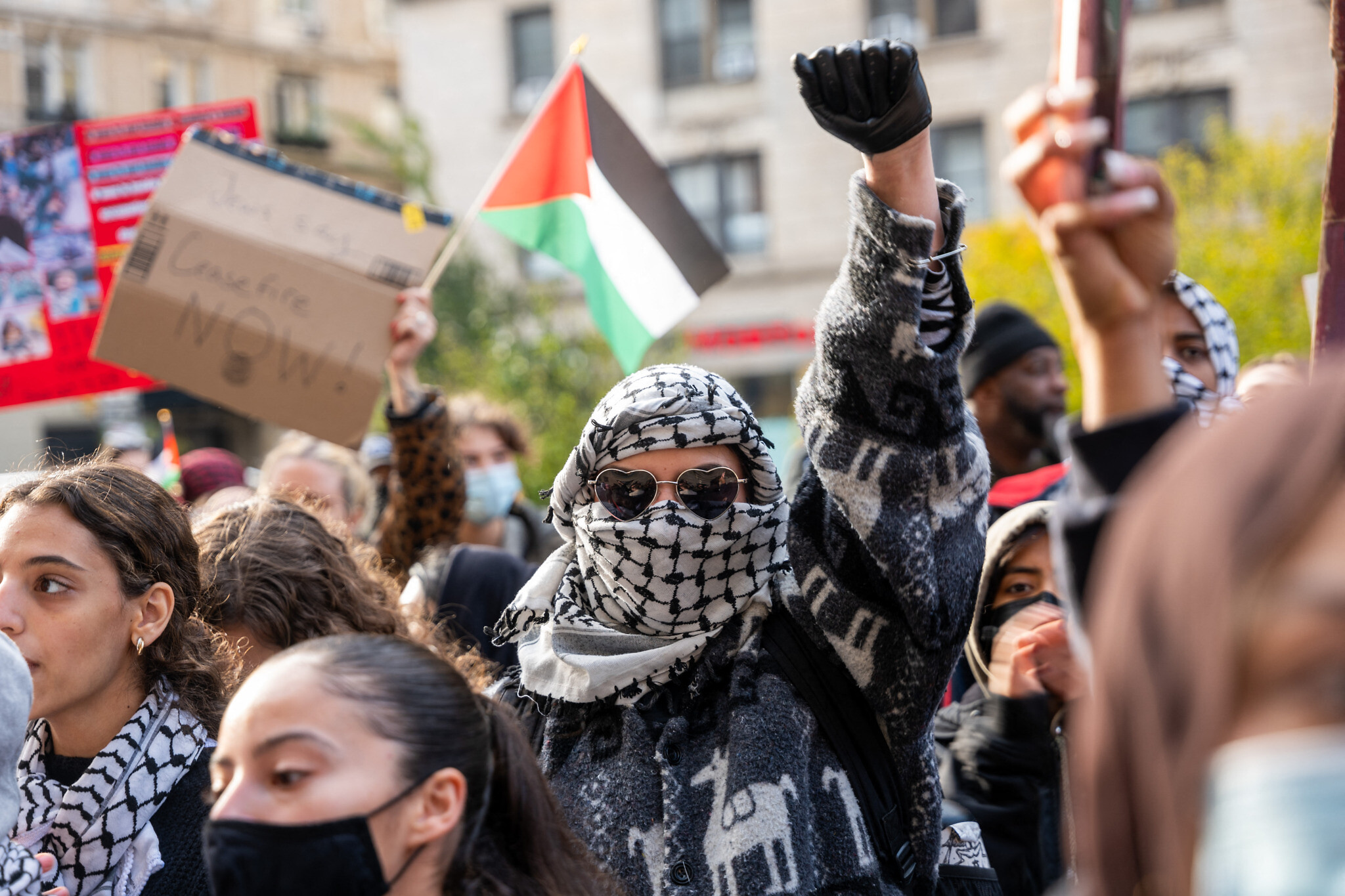
Pro-Palestinian, anti-Israel demonstrators rally near Columbia University in New York on November 15, 2023. (SPENCER PLATT / Getty Images via AFP)

File: Pro-Palestinian, anti-Israel demonstrators rally near Columbia University in New York on November 15, 2023. (SPENCER PLATT / Getty Images via AFP)

Over half of young Americans surveyed on Israel’s conflict with Hamas believe the Jewish state should cease to exist, and instead be replaced by a Palestinian entity, according to an online poll conducted this week.

The monthly Harvard CAPS/Harris poll found continuing support for Israel in its campaign against Hamas among every age demographic but 18- to 24-year-olds.

Overall, the survey found that 81 percent of respondents back Israel. Among the youngest age bracket, though, support is evenly split between Israel and Hamas.

On several questions, voters in that age group seemed to express contradicting or muddled views. For instance, despite 51% replying in the affirmative when asked if Israel should be “ended and given to Hamas and the Palestinians,” 58% of respondents in the group also thought Hamas should be removed from running Gaza.

However, most of the entire pool of respondents (60%) preferred a two-state solution to the conflict.

File: Israeli soldiers walk past houses destroyed by Hamas terrorists in Kibbutz Be’eri on the Gaza border, October 14, 2023. (AP Photo/Ariel Schalit)

Overall, 73% of respondents said the onslaught was genocide, and similarly 73% believed it to be unjustified.

Additionally, a majority of all respondents across the board view the October 7 massacre — when Hamas-led terrorists rampaged through southern communities, killing 1,200 people, mostly civilians, and kidnapping some 240 to Gaza — as a terrorist attack (84%), including 73% in the 18-24 bracket.

Sixty-three percent of all respondents answered that Israel was trying to defend itself with its military offensive aimed at eliminating Hamas, which has ruled the Strip since 2007. But 60% of 18- to 24-year-olds said that the campaign constitutes genocide against Gazans.

The Hamas-run health ministry in Gaza has claimed that, since the start of the war, more than 18,800 people have been killed, mostly civilians. These figures cannot be independently verified and are believed to include some 7,000 Hamas terrorists, according to Israel, as well as civilians killed by misfired Palestinian rockets. Another estimated 1,000 terrorists were killed in Israel during and in the wake of the October 7 onslaught.

Young people were also against the overall trend on the question of a ceasefire: While 64% of respondents said a ceasefire should be agreed to only after the release of hostages and Hamas being booted from power, 67% of 18- to 24-year-olds favored an unconditional deal that would leave things as they are.

The poll also asked respondents about antisemitism on university campuses, which has been on the rise since the beginning of the war.

Smoke rises following an Israeli bombardment in the Gaza Strip, as seen from southern Israel, Saturday, Dec. 16, 2023. (AP/Ariel Schalit)

Many 18- to 24-year-olds seemed to be okay with hate speech at universities: According to the poll, 53% of young people thought students should be free to call for Jewish genocide on campus without punishment, though 70% said such calls constituted hate speech.

Out of all respondents, 74% answered that those who make the calls should face disciplinary action, while 79% said the calls were hate speech.

The survey also asked respondents about the congressional hearing on college antisemitism earlier this month, when the presidents of Harvard, MIT, and the University of Pennsylvania failed to answer in the affirmative that calls for Jewish genocide violate the universities’ code of conduct, saying only that they do so in certain contexts.

Their responses provoked a backlash from Republican opponents, along with alumni and donors who said the university leaders are failing to stand up for Jewish students on their campuses. Penn’s president Liz Magill resigned due to the criticism, while the other two have remained in their positions.

While 67% of 18-to 24-year-olds think the presidents of Harvard, MIT, and Penn universities went far enough in condemning antisemitism, when faced with comments they made during congressional testimony — that calls for Jewish genocide are only punishable depending on the context — 73% said they should resign.

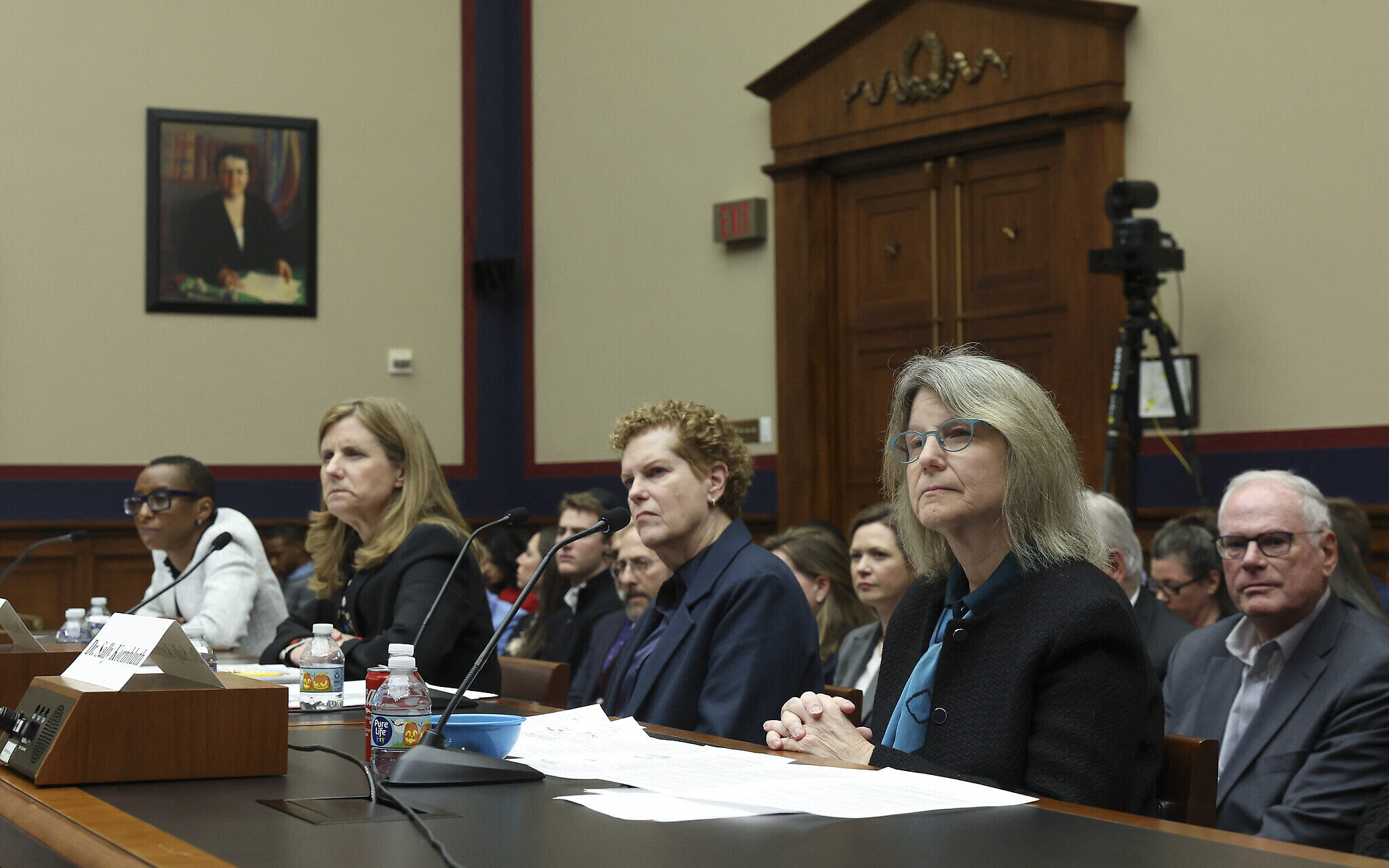
Dr. Claudine Gay, president of Harvard University, Liz Magill, president of University of Pennsylvania, Dr. Pamela Nadell, professor of History and Jewish Studies at American University, and Dr. Sally Kornbluth, president of Massachusetts Institute of Technology, testify before the House Education and Workforce Committee at the Rayburn House Office Building on December 5, 2023 in Washington, DC. The committee held a hearing to investigate antisemitism on college campuses. (Kevin Dietsch / GETTY IMAGES NORTH AMERICA / Getty Images via AFP)

Furthermore, a majority of respondents (68%) acknowledged that antisemitism is prevalent on university campuses, with 63% of 18- to 24-year-olds responding in the affirmative.

The poll also asked respondents who they believed was responsible for antisemitism on campus, with 24% saying the hatred has always had a presence; 20% blamed students; 18% left-wing political movements; 11% university presidents and administrators; 11% foreign funding of universities and student groups; 7% university professors; and 8% answered none of the above.

Only 8% in the 18-24 bracket believed antisemitism had always existed on campus.

Most of those in that age bracket said they watched or read about the presidents’ testimonies in the poll, which was conducted online among 2,034 registered voters on December 13 and 14.

JTA contributed to this report.