He also noted that “Israel has not achieved any accomplishment that it can present to its citizens; they are still unable to present an image of ‘victory’ or an image of ‘defeat’ to the resistance.”
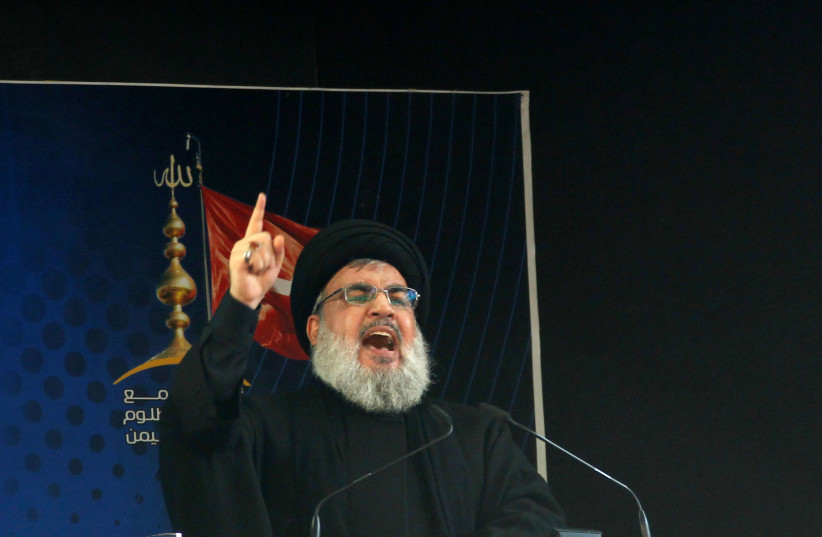
By MAARIV ONLINELebanon’s Hezbollah leader Sayyed Hassan Nasrallah addresses his supporters during a public appearance at a religious procession to mark Ashura in Beirut’s southern suburbs, Lebanon October 12, 2016(photo credit: AZIZ TAHER/REUTERS)
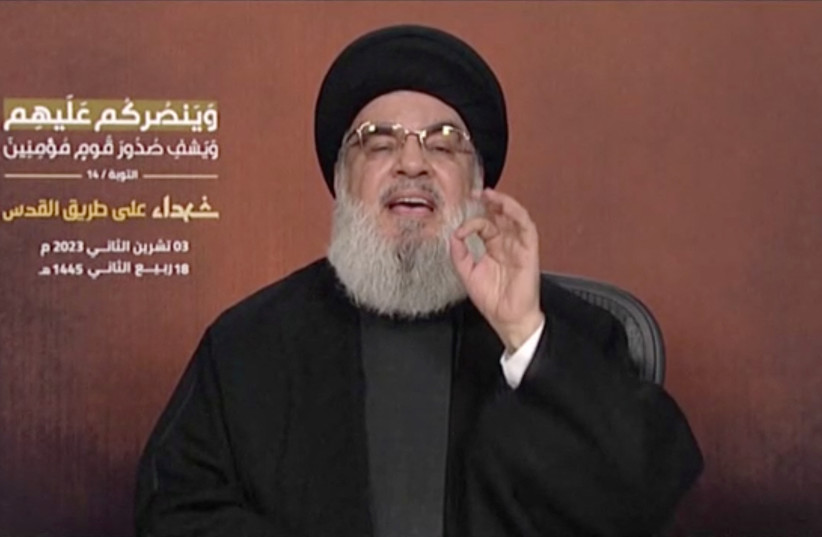
The leader of Hezbollah, Hassan Nasrallah, spoke Saturday afternoon, addressing the recent hostilities initiated by Hezbollah against Israel and the IDF forces and also warning against Israeli reactions in Lebanese territory.
“The Israeli cruelty is intended to subjugate the people of the region and crush the legitimate demand for rights,” Nasrallah declared in his speech.
At the beginning of his remarks, Nasrallah referred to the conflict in Gaza, stating, “In Gaza, there are two events that are developing. The first event is the Israeli aggression against the residents of Gaza, and the second event is the visible and significant response of Palestinian resistance against the enemy forces.
“The occupation turns to Lebanon after its crimes in Gaza and deliberate and cruel killings,” the leader continued. “The occupation is making a mistake again, and all its objectives will fail.”
Attacks on the United States
According to Nasrallah: “The one who can stop the aggression is the one who manages it – the United States. The one who manages and decides this battle is the American government, and all pressure must be directed towards the Americans.”
Hezbollah leader Sayyed Hassan Nasrallah delivers his first address since the October conflict between Palestinian group Hamas and Israel, from an unspecified location in Lebanon, in this screenshot taken from video obtained November 3, 2023 (credit: AL-MANAR VIA REUTERS)
He also noted that “Israel has not achieved any accomplishment that it can present to its citizens; they are still unable to present an image of ‘victory’ or an image of ‘defeat’ to the resistance.”
As a reminder, Nasrallah spoke about similar issues a week ago, referring to the war that began after the massacre of Hamas militants in Israel.
Advertisement
“The war has expanded to more than one front – we salute the armies of Iraq and Yemen that have entered this blessed battle. There is no more legitimate and justifiable battle from a humanitarian, moral, and religious perspective than the battle against the Zionists,” he said last week.
According to Nasrallah: “The Palestinians entirely planned and executed the attack on October 7. We have two goals before us: Stopping the fighting for humanitarian reasons and achieving a victory for Gaza and Hamas.
“The possibility that the Lebanese front will expand is a real option.”
MIDDLE ISRAEL: Technically, Israel faces Hamas, Hezbollah, and the Houthis, but strategically, it all leads to one address – Tehran.
By AMOTZ ASA-ELUpdated: NOVEMBER 10, 2023 16:18IRANIAN DEMONSTRATORS burn US and Israeli flags during a protest in Tehran on October 18.(photo credit: Majid Asgaripour/WANA/via Reuters)
As the war with Hamas enters its second month, a strange question arises: Who is the enemy – A city? An organization? A country? A nation? An idea?
It used to be a simple question. The enemy was the Arab world, and its enmity’s fuel was nationalism. The enemy was the Arab world because every Arab government denied Israel’s right to exist and actively fought it, if not militarily, then diplomatically and economically.
That’s not what we face today. With more than 150 million Arabs formally at peace with Israel, this war is not with the Arab world. If anything, many Arab governments detest Hamas and would welcome its decimation. In fact, Israel’s current fighting is not with any state but with three seditious organizations.
In Gaza, Hamas won a legislative election, but it never won a general election. Instead, its goons violently removed the Palestinian Authority’s representatives in 2006 and have since ruled Gaza’s streets.
In Lebanon, Hezbollah was never elected to lead the country. Even so, it has effectively hijacked the Lebanese government, ignored Lebanon’s army, and paralyzed its parliament. Lastly, in Yemen, the Houthis, who have just fired missiles at us from across the Red Sea, are also rebels, insurgents who launched a gruesome civil war in 2004 and seized the capital, Sanaa, in 2014.
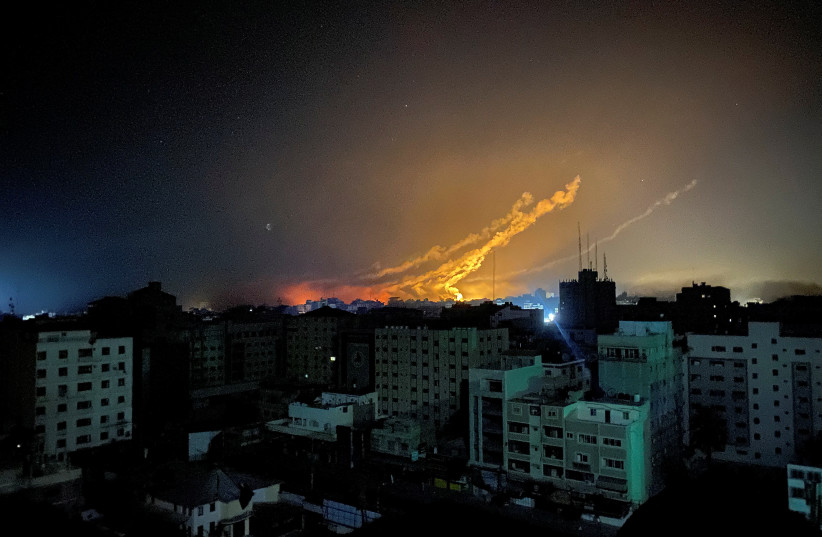
Smoke and flames rise during Israeli strikes, amid the ongoing conflict between Israel and Hamas, in Gaza City, November 9, 2023 (credit: REUTERS/DOAA ROUQA)
The common denominator among these three insurgencies, besides their hostility toward Israel, is that they are driven by religion, and more specifically by Islamist jihadism. Is this, then, the enemy?
THE ARAB challenge to Israel was originally secular. Gamal Abdel Nasser, Hafez Assad, and Saddam Hussein were all secular. Yes, they deployed religious rhetoric, especially against Israel, but domestically they fought Islamism, often violently.
If anything, what we now face is this record’s inversion: religious fanatics citing nationalist concepts in which they don’t believe. Most laughable in this regard is their usage of terms like “resistance,” “occupation,” or “decolonization,” all of which connote one land’s fight for freedom. In fact, they are part of an effort to impose their faith on the whole world and eradicate the freedom they claim to hail.
The jihadist scourge is not local. It’s global. It has stuck everywhere, from London, Paris, and New York to Bali, Mumbai, and Sharm el-Sheikh. So yes, morally speaking, the enemy we face is jihadism, for which Israeli Jewry is a version of the warm-up act that German Jewry was for Nazism while it prepared for World War II. If it’s up to the jihadists, the Black Sabbath massacre will be recalled as Kristallnacht’s sequel.
The ultimate enemy is in Iran
Jihadism, then, is the moral engine that drives the people fighting us these days from their foxholes in Gaza, Lebanon, and Yemen. Even so, the ultimate enemy we face nests not in Gaza, Beirut, or Sanaa but in Tehran.
THE ENEMY’S transformation took a while to notice, not only because its cause shifted from nationalism to religion but also because its ethnicity shifted, from Arab to Persian.
The new enemy’s transfiguration became even trickier to notice because it was careful to deploy non-Iranians wherever it kindled its revolution’s fires. In some cases, Tehran deployed Arab Shi’ites. That’s what happened in Iraq and Lebanon.
In others, they harnessed Arabs with looser affiliations to Shi’ism. That’s what happened with Syria’s Alawites and Yemen’s Houthis. And in some cases, they inspired Arab Sunnis. That’s what happened in Gaza.
Strategically, all this is academic. What matters is that all the violence we now face has a clear source, not only ideologically and spiritually but also financially and militarily.
The extent to which Iran has been directly involved in the Black Sabbath massacre has yet to be established. Intuitively, millions of Israelis, as well as many elsewhere, especially in foreign intelligence services, assume Iran was involved, at least in conceiving and planning the slaughter, and in training and equipping its perpetrators.
But even in the unlikely event that Iran played no role at all in this atrocity, it had enough of a role elsewhere. Hezbollah’s artillery barrages are clearly ordered from Iran, and clearly an act of war, as are the Yemeni shots. The casus belli that sparked the 1967 Six Day War – Egypt’s blockading of the Red Sea – was less flagrant than firing rockets into Israelis’ living rooms. This is besides Tehran’s enthusiastic applause of the Black Sabbath massacre.
It follows that whatever the aftermath of the fighting in Gaza, Iran emerges from this cataclysm as an active aggressor toward the Jewish state, and also of the Jewish people, as Tehran openly and consistently denies the Jews’ right to their ancestral land, in addition to having assaulted Jewish communities abroad.
What this implies in terms of action is a separate discussion, one which had best be conducted in arenas less public than a newspaper. Two principles, however, should be said publicly. The first is that, unlike Arab nationalism, Iranian fundamentalism threatens not only Israel, and not only the Middle East, but the entire world.
The second is that the enemy, as argued here in the past (“Don’t bomb Tehran,” November 4, 2011), is not the Iranian people. The enemy is the Iranian regime; the ayatollahs and mullahs who have let our blood.
The Iranian nation, by contrast, was Israel’s friend for three decades. We Jews don’t forget such things, just like we don’t forget Cyrus, the Persian king who restored the Land of Israel to the Jews; just like we don’t forget Haman, the Persian minister who sought “to destroy, kill, and annihilate all the Jews, young and old, women and children”; just like we don’t forget how that man of hatred ended up hanged on the very gallows he had built for the first man in any literature to be called “the Jew.”
www.MiddleIsrael.net
The writer, a Hartman Institute fellow, is the author of the bestselling Mitzad Ha’ivelet Ha’yehudi (The Jewish March of Folly, Yediot Sefarim, 2019), a revisionist history of the Jewish people’s political leadership
WHO chief: A child is killed on average every 10 minutes in the Gaza Strip.
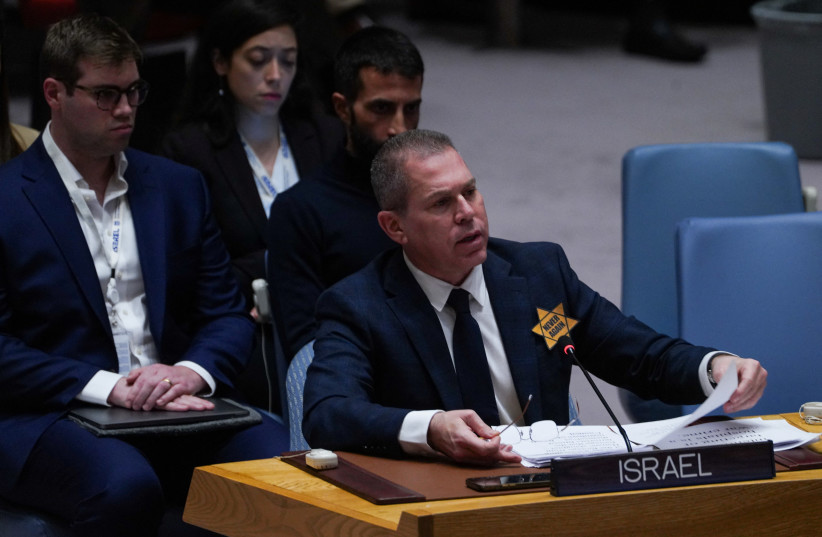
By MAAYAN JAFFE-HOFFMAN, REUTERSUpdated: NOVEMBER 11, 2023 10:58srael’s Ambassador to the United Nations Gilad Erdan attends a meeting of the United Nations Security Council on the conflict between Israel and Hamas on November 10, 2023(photo credit: David ‘Dee’ Delgado/Reuters)
Israel strongly “vehemently” rejected what it called another “one-sided” draft resolution by the UN Educational, Scientific and Cultural Organization (UNESCO) calling for an immediate cessation of all attacks on Palestinians.
“The decision completely ignores the terrorist attack by Hamas terrorists on October 7, in which they murdered, massacred, and killed approximately 1,200 people and abducted 240, among them infants, children, women, and the elderly,” the Foreign Ministry said.
Hayat clarified that while most Israeli media outlets had been reporting around 1,400 deaths from the massacre, around 1,200 is now the official number. Israel is still working to identify and locate hundreds of victims.
The ministry said that the resolution “gives the green light to the Hamas terrorist organization, which is worse than ISIS, to continue killing, abducting, and using the residents of the Gaza Strip as human shields.
“UNESCO is actively collaborating with the distortion of basic facts and the denial of the massacre, aligning itself with extreme governments and supporters of terror,” the ministry continued, condemning the minute of silence that the UN Security Council stood for on Friday at the start of the meeting, which Israel said was “only for Palestinian victims.”
The UN said the moment was meant for the civilians killed both in Israel and Gaza, including some 100 people working with the UN Palestinian refugee agency, UNRWA.
The UNESCO resolution, which passed by a majority of votes, specifically calls for the immediate cessation of all attacks on Palestinians, especially children, women, youth, teachers and all those working in the field of education.
The ministry said that UNESCO “should be ashamed of itself and its discussions. Israel expresses gratitude to the countries that supported it and opposed the decision, including the adjustments proposed by the United States.”
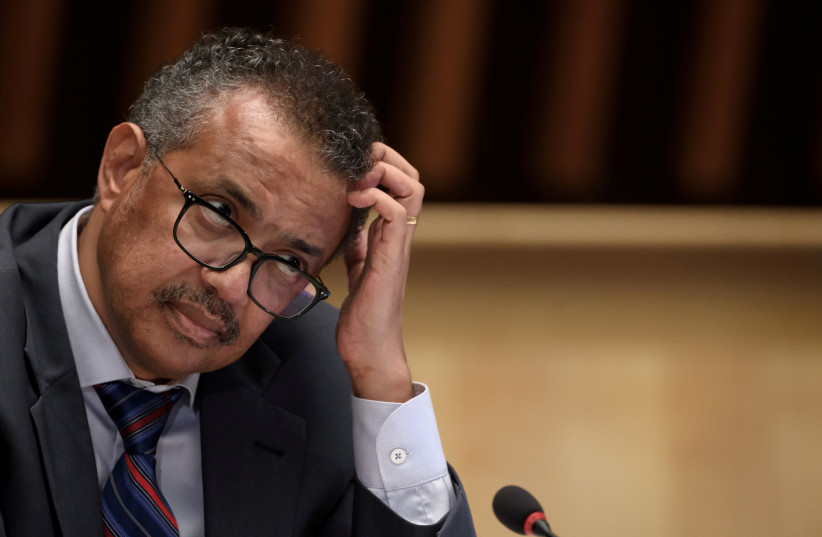
World Health Organization (WHO) Director-General Tedros Adhanom Ghebreyesus attends a news conference organized by Geneva Association of United Nations Correspondents (ACANU). July 3, 2020 (credit: FABRICE COFFRINI/POOL VIA REUTERS)
WHO chief: A child is killed every 10 minutes in Gaza
The resolution came soon after the UN Security Council met on Friday to once again deliberate about the Israel-Hamas war, including a lengthy address by World Health Organization Director-General Tedros Adhanom Ghebreyesus.
A child is killed on average every 10 minutes in the Gaza Strip, Tedros told the council, warning: “Nowhere and no one is safe.”
He said that half of Gaza’s 36 hospitals and two-thirds of its primary healthcare centers were not functioning, and those operating were way beyond their capacities, describing the healthcare system as “on its knees.” Since October 7, the WHO has verified more than 250 attacks on healthcare in Gaza and the West Bank, while there have been 25 attacks on healthcare in Israel, Tedros said.
“Hospital corridors crammed with the injured, the sick, the dying. Morgues overflowing. Surgery without anesthesia. Tens of thousands of displaced people sheltering at hospitals,” Tedros told the 15-member council.
Israel says Hamas hides weapons in tunnels under hospitals, charges Hamas denies.
Israel’s UN Ambassador Gilad Erdan told the Security Council that Israel had created a task force to establish hospitals in southern Gaza. On October 12, Israel ordered some 1.1 million people in Gaza to move south ahead of its ground invasion.
“Israel is in advanced talks with the United Arab Emirates, with the ICRC [International Committee of the Red Cross] and with other European countries regarding the establishment of field-hospital and floating-hospital ships,” Erdan said. “Israel facilitated the Jordanian airdrop of medical aid to hospitals in northern Gaza.”
“Sadly, Israel is doing far more for the well-being of Gazans than the WHO or any other UN body,” he said.
Erdan also addressed what he called the UN Security Council’s bias toward Israel, including its neglect of the trauma endured by Israeli society.
‘Do Israeli lives matter less?’
“Do Israeli lives matter less?” Erdan asked in his address. “I urge the council to invite me to share a screening of the footage from Hamas’s slaughter. Footage that the terrorists filmed themselves. Once you see the savagery with your own eyes, you will understand the evil that Israel is defending itself against.
“Will you address these crimes today?” Erdan continued. “Will you condemn Hamas for murdering Israeli medical personnel? Will you call out Hamas for torching Israeli ambulances?”
He questioned how a briefing on the medical situation in Gaza could be held without discussing the situation in Israel.
“Does this not wreak of bias? Do Israeli lives matter less?” Erdan concluded.
Tedros did acknowledge “the anger, grief and fear of the Israeli people following the horrific, barbaric and unjustifiable attacks by Hamas and other armed groups on Israeli civilians on October 7.” He also said that the WHO “is gravely concerned for the health and well-being of Israeli hostages in Gaza, many of whom are older people, children and those with urgent medical needs.”
US: Working to get fuel to Gazan hospitals
However, he noted that before the massacre and the start of the Shields of Iron War, an average of 500 trucks a day were crossing into Gaza with essential supplies. Since October 21, instead of the expected 10,000 trucks, just 650 have entered.
Israel later updated that more than 820 trucks had entered Gaza since October 21.
A senior official from the United States at the UN said that the US is working to assist in obtaining fuel for hospitals in Gaza.
“We know that hospitals desperately need fuel. The US is working tirelessly to establish mechanisms that will allow fuel to reach hospitals and provide other urgent needs in the south,” said Robert Wood, the US representative at the UN. “But I also want to clarify that we share Israel’s concerns about the hoarding and diversion of fuel by Hamas in northern Gaza. This is unacceptable, and we all need to make that clear.”
Wood, like Erdan, said Hamas had been using civilians as human shields.
“These cowardly tactics do not diminish Israel’s responsibility to distinguish between civilians and terrorists in its fight against Hamas,” he said. “The risks of harm to civilians at sites that Hamas is using for military purposes absolutely have to be considered when planning an operation.”