Shortly after the strike, Iran-backed militias targeted three US bases in Syria and Iraq.
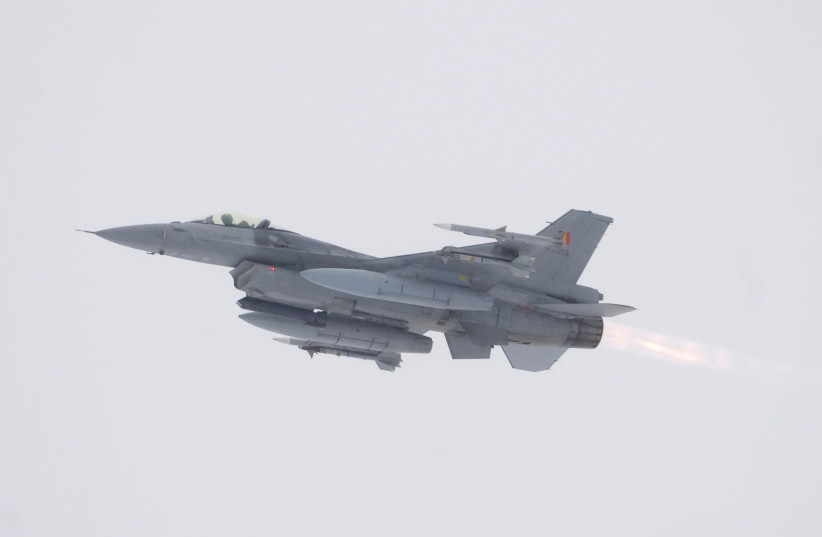
By TZVI JOFFREUpdated: NOVEMBER 9, 2023 07:41US Air Force F-15 fighter flies over the Amari military airfield, Estonia February 1, 2022.(photo credit: Ints Kalnins/Reuters)
The US struck a facility used by Iran’s Islamic Revolutionary Guard Corps (IRGC) and Iran-backed militias in the Deir Ezzor region of eastern Syria on Wednesday night in response to repeated recent rocket and drone attacks against US forces in Syria and Iraq.
“Following a series of attacks against US persons in Iraq and Syria, US Central Command (USCENTCOM) forces conducted an airstrike against a facility in Syria used by Iran’s Islamic Revolutionary Guard Corps (IRGC) and affiliated groups,” said CENTCOM. “We will take all necessary measures to defend our people against those who are responsible for the attacks and will respond at a time and place of our choosing.”
US Secretary of Defense Lloyd Austin said that the strike was conducted by two US F-15s and targeted a weapons storage facility.
“This precision self-defense strike is a response to a series of attacks against US personnel in Iraq and Syria by IRGC-Quds Force affiliates. The president has no higher priority than the safety of US personnel, and he directed today’s action to make clear that the United States will defend itself, its personnel, and its interests,” said Austin.
“The United States is fully prepared to take further necessary measures to protect our people and our facilities. We urge against any escalation. US personnel will continue to conduct counter-ISIS missions in Iraq and Syria.”
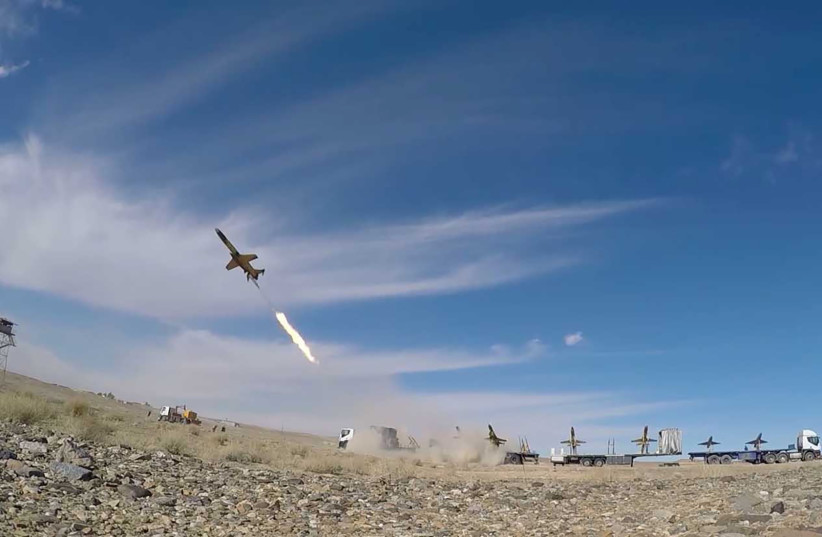
A drone is launched during a large-scale drone combat exercise of Army of the Islamic Republic of Iran, in Semnan, Iran January 6, 2021 (credit: IRANIAN ARMY/WANA/REUTERS)
Deaths and injuries reported in airstrike
The Syrian Sada AlSharqieh news outlet reported that deaths and injuries were caused in the airstrike and that it targeted a site near the Deir Ezzor military airport. A local news site, Naher Media, reported that at least ten Iranian and Iran-backed militants were killed or injured in the strike.
Shortly after the airstrike, Iran-backed militias in Iraq said that they had launched two drones at the Harir airbase in northern Iraq, which hosts US forces.
Advertisement
Additionally, after the airstrike, a number of rockets were fired at a US base in the al-Omar oil field and a base in the Conoco gas field, both in eastern Syria, according to Al-Mayadeen TV, a network affiliated with Iran’s “Axis of Resistance.”
Iran-backed militias throughout the region have intensified attacks on US forces in the region in the weeks since the outbreak of the war between Hamas and Israel on October 7.
On Wednesday night, the Iran-backed Houthi militia said that it shot down a US MQ-9 Reaper drone off the coast of Yemen. Unnamed US officials confirmed the report to a number of US media outlets.
No redlines for Israel’s military operations in Gaza, White House says.
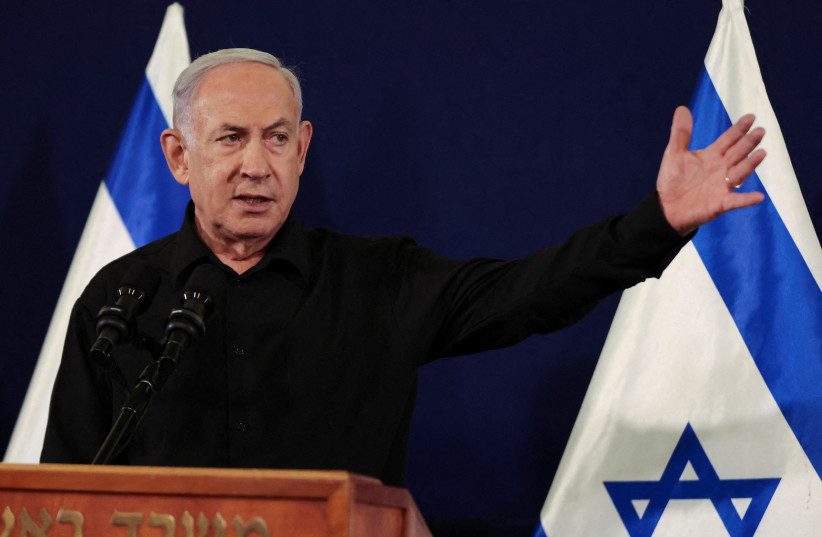
By TOVAH LAZAROFFUpdated: NOVEMBER 7, 2023 22:47Israeli Prime Minister Benjamin Netanyahu holds a press conference with Defense Minister Yoav Gallant and Cabinet Minister Benny Gantz (not pictured) in the Kirya military base in Tel Aviv , Israel , 28 October 2023.(photo credit: ABIR SULTAN POOL/Pool via REUTERS)
Prime Minister Benjamin Netanyahu warned Hezbollah against attacking Israel as he touted the IDF’s success in Gaza, insisting that Israel won’t agree to a ceasefire without the release of the hostages.
“We will not accept a reality in which Hezbollah or its henchmen Hamas-Lebanon will harm our communities and citizens” on the northern border with Lebanon, Netanyahu stated in a video address to the Israeli public.
He spoke as the IDF struck at Hezbollah targets, after the Iranian proxy group fired 20 rockets at Israel from Lebanon on Tuesday afternoon.
“We will continue to respond with strong fire to any attack against us. We have attacked many Hezbollah targets. We eliminated many terrorists,” Netanyahu said.
The Biden administration on Tuesday continued with its efforts to contain the Gaza war and to prevent a two-front war that would include Hezbollah.
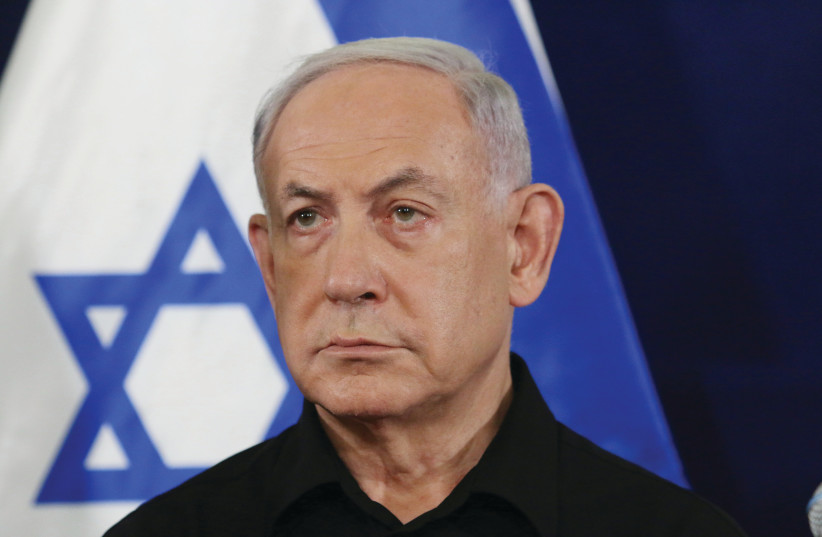
PRIME MINISTER Benjamin Netanyahu speaks at a press conference at the Defense Ministry in Tel Aviv. (credit: Dana Kopel/Pool)
US special envoy Amos Hochstein visited Lebanon in an effort to underscore that message as he met with Lebanese officials, including caretaker Prime Minister Najib Mikati.
In Washington, US National Security Council spokesperson John Kirby told reporters, “We have been trying to send a strong signal of deterrence to any other actor in the region, be it a nation-state or a terrorist group, that now is not the time to think about widening and escalating and keeping this conflict.”
Advertisement
Regarding the Hezbollah rocket launches in the North, “that does not necessarily mean that the war is widening and that these other actors have decided to go all in to help Hamas out,” Kirby said.
“We do believe we have sent a strong signal about how seriously we take our national security in the region,” he said, adding that the US has beefed up its military in the region.
In Israel, Netanyahu said in his video address, “If Hezbollah chooses to enter the war – it will make the mistake of its life.”
In addressing the situation in the South, “The war in Gaza is progressing with an intensity that Hamas has never known,” Netanyahu said.
PM: we are increasing the pressure on Hamas every hour, every day
“Gaza City is surrounded. We are operating within it,” Netanyahu said, emphasizing that “we are increasing the pressure on Hamas every hour, every day.”
He repeated statements he had said since the start of the war, that Israel would not accept any ceasefire until Hamas releases the hostages.
On Monday night, he did acknowledge that Israel could consider a small tactical pause to the war for an hour or so, in an interview he gave to David Muir of ABC’s World News Tonight program.
“As far as tactical little pauses, an hour here, an hour there, we have had them before,” Netanyahu said.
“We will check the circumstances in order to enable humanitarian goods to come in or individual hostages to leave,” he stated on Tuesday.
Earlier in the day, he spoke with US President Joe Biden about the possibility of such a pause to the war, which was sparked on October 7, when Hamas killed over 1,400 people in southern Israel and kidnapped over 240 others.
According to the White House, “The two leaders discussed the possibility of tactical pauses to provide civilians with opportunities to safely depart from areas of ongoing fighting.”
Such pauses, the White House said, would “ensure assistance is reaching civilians in need, and… enable potential hostage releases.”
Israel: any ceasefire must include release of all hostages
Israel has insisted that any ceasefire must include the release of all the hostages, and that even then it could happen only with the understanding that the IDF still intends to pursue its military campaign to oust Hamas from Gaza.
The United States has backed Israel on that point, but the two sides have differed on a mechanism for humanitarian pauses, with Israel fearing that such a break in the fighting could become a de facto ceasefire.
Kirby told reporters on Tuesday that the US had not put any redlines on Israel’s military operation in Gaza. He noted that if anything, it has used only a small tactical force to enter Gaza City.
Netanyahu, in defending the continuation of the military campaign, told ABC, “A ceasefire would be a surrender to Hamas. It would be a victory for Hamas and you would no more have it than you would have a ceasefire after the al-Qaeda bombings of the World Trade Center” in New York in 2001.
“There will be no general ceasefire in Gaza without the release of our hostages,” he stressed.
A ceasefire would hamper the “war efforts” as well as efforts to secure the release of the hostages, he said.
“The only thing that works on these criminals in Hamas is the military pressure we are exerting,” Netanyahu said.
PM: ground op created pressure to release hostages
“Until we started the ground operation there was no pressure on them to release hostages. What we see is that the minute we started the ground action there was pressure,” he added.
Netanyahu also appeared to indicate that Israel might have some intelligence on the location of the hostages.
He also addressed the civilian cost of the campaign to Palestinians in Gaza, in light of the UN’s reporting that some 1.5 million of the 2.7 million people living in the coastal enclave have been displaced due to the war. Hamas has asserted that over 10,000 people have been killed.
Netanyahu said the number included at least several thousand Palestinian combatants.
“Every civilian lost is a tragedy. We are fighting an enemy that is particularly brutal. They are using their civilians as human shields,” he said, referencing the fact that Hamas places its infrastructure in civilian areas.
“It’s important to understand that there is no way to defeat terrorists” embedded in civilian areas without incurring civilian casualties, he stated.
Muir also asked Netanyahu if he took responsibility for the Israeli security failure that led to the October 7 attack.
“The responsibility of the government is to protect the people and that clearly was not met,” Netanyahu said, but he added that the issue was best addressed after the war.
Netanyahu agreed with Muir that he needed to take responsibility but not while conducting a military campaign.
When the war is over, he said, “tough questions are going to be asked and I am going to be among the first to answer them.”
In Brussels on Tuesday, met with Jordan’s King Abdullah and accused Israel of disproportionally attacking Gaza.
“Bombing down a refugee camp because it allegedly houses one Hamas leader is completely disproportionate. It is never acceptable that so many civilian casualties are caused trying to eliminate one person,” De Croo said.
“Civilians and civilian places must be protected, but of course Hamas cannot use them as a shelter either because that only complicates matters.”
He also said both Israel and Hamas disregard international humanitarian law on a daily basis.
He added that Hamas should also release as soon as possible innocent hostages, saying it could be an important part of halting the “spiral of violence.”
Reuters and Jerusalem Post Staff contributed to this report.
The comments follow report which said that Biden urged Netanyahu to agree to a three-day pause in the fighting to allow progress in releasing hostages.
US President Joe Biden confirmed on Tuesday that he asked Prime Minister Benjamin Netanyahu for a pause in the fighting in Gaza.
“I asked Prime Minister Netanyahu for a pause in the fighting in Gaza in a call on Monday,” Biden said, as quoted by Reuters.
Biden’s comments came hours after Barak Ravid of Axios reported that Biden urged Netanyahu in their call on Monday to agree to a three-day pause in the fighting to allow progress in releasing some of the hostages held by Hamas in Gaza.
According to a proposal that is being discussed between the US, Israel and Qatar, Hamas would release 10-15 hostages and use the three-day pause to verify the identities of all the hostages and deliver a list of names of the people it is holding, a US official told Ravid.
The two US and Israeli officials said Netanyahu told Biden he doesn’t trust Hamas’ intentions and doesn’t believe they are ready to agree to a deal regarding the hostages.
He also said that Israel could lose the current international support it has for the operation if the fighting stops for three days, the officials said.
The Israeli official told Axios that part of Netanyahu’s reservation is because Hamas attacked a group of Israeli soldiers, kidnapped one of them, and killed several others during a humanitarian pause during the 2014 Operation Protective Edge.
The Prime Minister’s Office declined to comment. The White House referred Axios to the readout of Tuesday’s call between Biden and Netanyahu, which said the two leaders “discussed ongoing efforts to secure the release of hostages held by Hamas.”
The White House added that it does not comment on Biden’s private conversations.
The US has been pushing for so-called “humanitarian pauses” in the fighting in order to allow for more humanitarian aid to enter the Gaza Strip and facilitate and the potential release of hostages being held by Hamas.
During a visit to Israel last Friday, US Secretary of State pushed for such a pause. Prime Minister Benjamin Netanyahu later made clear that Israel will not agree to a ceasefire in Gaza without the release of the hostages being held by Hamas.
On Saturday, Biden said that progress had been made on securing a so-called “humanitarian pause” in the fighting between Israel and Hamas, though he would not provide further details.
In an interview with ABC News on Monday, Netanyahu once again rejected the idea of a ceasefire in Gaza unless hostages are released.
“There will be no ceasefire, general ceasefire, in Gaza without the release of our hostages,” Netanyahu stressed. “As far as tactical little pauses, an hour here, an hour there. We’ve had them before, I suppose, will check the circumstances in order to enable goods, humanitarian goods to come in, or our hostages, individual hostages to leave. But I don’t think there’s going to be a general ceasefire.”
Asked if there would be such a pause if Hamas to agree to the release of hostages, the Prime Minister responded, “There will be a ceasefire for that purpose.”