Efforts to reach a normalization agreement between Israel and Saudi Arabia had reportedly been put on ice.

US National Security Advisor Jake Sullivan meets with Saudi Arabian Defense Minister Prince Khalid bin Salman Al Saud in Washington, DC, US. October 30, 2023. (photo credit: SAUDI PRESS AGENCY/HANDOUT VIA REUTERS)
US National Security Advisor Jake Sullivan meets with Saudi Arabian Defense Minister Prince Khalid bin Salman Al Saud in Washington, DC, US. October 30, 2023.
(photo credit: SAUDI PRESS AGENCY/HANDOUT VIA REUTERS)
Saudi Arabia is still open to a normalization deal with Israel despite the Gaza War, US National Security Council spokesperson John Kirby told reporters in Washington on Tuesday.

“We are still committed to it. It’s clear to us that the Saudis are still committed to it, but obviously we are all focused on what is going on there in Gaza,” Kirby said.

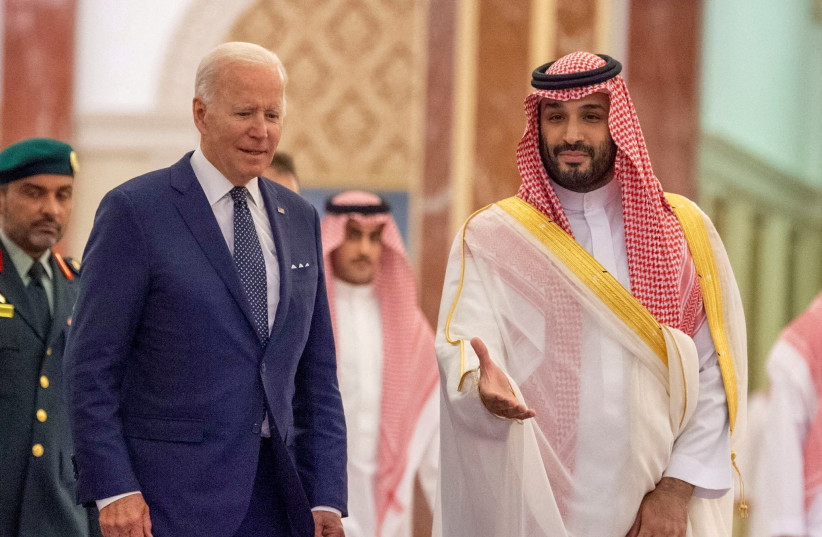
 Saudi Crown Prince Mohammed bin Salman receives U.S. President Joe Biden at Al Salman Palace upon his arrival in Jeddah, Saudi Arabia, July 15, 2022. (credit: BANDAR ALGALOUD/COURTESY OF SAUDI ROYAL COURT/REUTERS)
Saudi Crown Prince Mohammed bin Salman receives U.S. President Joe Biden at Al Salman Palace upon his arrival in Jeddah, Saudi Arabia, July 15, 2022. (credit: BANDAR ALGALOUD/COURTESY OF SAUDI ROYAL COURT/REUTERS)

Saudi defense minister, US national security advisor discuss Israeli-Palestinian peace

He spoke after US National Security Advisor Jake Sullivan on Monday met with Saudi Arabian Defense Minister Prince Khalid bin Salman Al Saud.

“We came away from those discussions confident that there will be a path to get back towards to normalization,” Kirby said.

“There is still interest in the Saudi side in pursuing that,” he added.

“What is going on between Israel and Hamas makes it harder to make practice progress on it right now,” Kirby said.

Before the Gaza War, which began on October 7, the Biden administration had pursued a complex regional deal that involved a security pact between Washington and Riyad, which would also include a normalization deal with Israel and a possible interim agreement with the Palestinians.

Advertisement

A key component of that deal for Riyadh was the protection the US would provide to Saudi Arabia against any attack by Iran.

During Sullivan’s meeting with the Saudi Defense Minister on Monday, the two men affirmed the importance of deterring any state or non-state actor from seeking to expand the conflict, according to the White House.

The two men also “emphasized the importance of working towards a sustainable peace between Israelis and Palestinians, building on the work that was already underway between Saudi Arabia and the United States over recent months,” the White House stated.


In accordance with the situational assessment and as part of defensive efforts in the area, on Tuesday Israeli Navy missile boats arrived in the area of the Red Sea, the IDF confirmed.

On Tuesday night, the IDF Aerial Defense Array intercepted an aerial threat that was identified in the area of the Red Sea, south of the city of Eilat. According to the IDF, no threat was posed to civilians and no infiltration into Israeli territory was identified.

Earlier, residents of Eilat had reported hearing explosions in the city and seeing the trail of a missile interception in the sky. No siren was sounded.

On Tuesday morning, sirens sounded in Eilat and the area, warning of a hostile aircraft infiltration. Shortly afterwards, Israel’s defense echelon said that the air defense system intercepted a UAV that was headed towards Eilat while it was still over the Red Sea. The interception, which was successful, took place outside Israel’s borders.

The IAF later said it thwarted an aerial threat in the area of the Red Sea – its first operational interception by the “Arrow” Aerial Defense System since the beginning of the war.

On Tuesday afternoon, a spokesman for the Iran-backed Houthi rebels in Yemen claimed responsibility for recent attacks against Israel. “We launched missiles and drones and pledge to continue the attacks on Israel until the end of Israeli aggression in Gaza.”

Related articles:
Following nighttime intercept, Eilat mayor imposes restrictions
IDF intercepts aerial threat south of Eilat
IAF thwarts Houthi attack on southern Israel
Houthis likely responsible for UAV launched towards Eilat
On Friday morning, the IDF thwarted an aerial threat in the Red Sea.

Earlier last week, the US Army’s CENTCOM, which is responsible for the US forces in the Middle East, published footage of the missile and the UAV interceptions by the Arleigh Burke-class guided-missile destroyer USS Carney in the waters of the Red Sea.

According to a CNN report, the duration of the interception of the four cruise missiles and 15 UAVs launched by the Houthis, Iran’s allies, lasted nine whole hours.wing threats from Yemenite Houthis, Israeli Navy sends missile boats towards Red Sea.
Israel National News
Nov 1, 2023, 8:54 AM (GMT+2)
Navy
Red Sea
Swords of Iron

00:02
Play
00:00
00:07
Mute

Settings
Enter fullscreen

Play

In accordance with the situational assessment and as part of defensive efforts in the area, on Tuesday Israeli Navy missile boats arrived in the area of the Red Sea, the IDF confirmed.

On Tuesday night, the IDF Aerial Defense Array intercepted an aerial threat that was identified in the area of the Red Sea, south of the city of Eilat. According to the IDF, no threat was posed to civilians and no infiltration into Israeli territory was identified.

Earlier, residents of Eilat had reported hearing explosions in the city and seeing the trail of a missile interception in the sky. No siren was sounded.

On Tuesday morning, sirens sounded in Eilat and the area, warning of a hostile aircraft infiltration. Shortly afterwards, Israel’s defense echelon said that the air defense system intercepted a UAV that was headed towards Eilat while it was still over the Red Sea. The interception, which was successful, took place outside Israel’s borders.

The IAF later said it thwarted an aerial threat in the area of the Red Sea – its first operational interception by the “Arrow” Aerial Defense System since the beginning of the war.

On Tuesday afternoon, a spokesman for the Iran-backed Houthi rebels in Yemen claimed responsibility for recent attacks against Israel. “We launched missiles and drones and pledge to continue the attacks on Israel until the end of Israeli aggression in Gaza.”

Related articles:
Following nighttime intercept, Eilat mayor imposes restrictions
IDF intercepts aerial threat south of Eilat
IAF thwarts Houthi attack on southern Israel
Houthis likely responsible for UAV launched towards Eilat
On Friday morning, the IDF thwarted an aerial threat in the Red Sea.

Earlier last week, the US Army’s CENTCOM, which is responsible for the US forces in the Middle East, published footage of the missile and the UAV interceptions by the Arleigh Burke-class guided-missile destroyer USS Carney in the waters of the Red Sea.

According to a CNN report, the duration of the interception of the four cruise missiles and 15 UAVs launched by the Houthis, Iran’s allies, lasted nine whole hours.


Stance by secretary of state marks first time idea publicly uttered by Biden administration, which has been floating it privately with regional partners since October 7

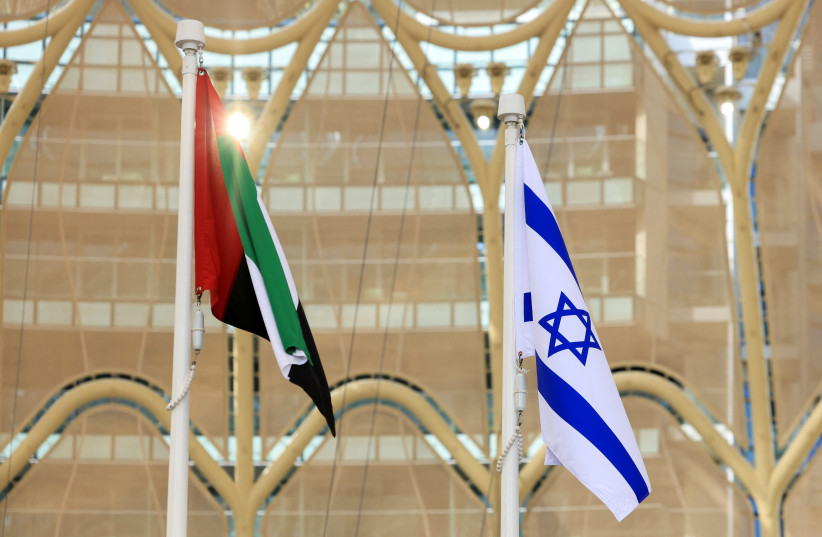
 Flags of United Arab Emirates and Israel flutter during Israel's National Day ceremony at Expo 2020 Dubai, in Dubai (photo credit: REUTERS/CHRISTOPHER PIKE)
US Secretary of State Antony Blinken looks on as protestors hold their hands in the air during a Senate Appropriations Committee hearing to examine the national security supplemental request, on Capitol Hill, Oct. 31, 2023. (Saul Loeb/AFP)

US Secretary of State Antony Blinken said Tuesday that a “revitalized” Palestinian Authority should retake control of Gaza if Israel succeeds in its goal of toppling Hamas, but that regional partners and international agencies could play an interim role.

The comments by Blinken during testimony before the Senate Appropriations Committee marked the first time the Biden administration has publicly declared its desire for the PA to return to the Gaza Strip, after privately raising the idea with regional partners since the outbreak of the Israel-Hamas war.

Hours after the hearing — which included repeated interruptions by several dozen of far-left protesters calling for a ceasefire — an Israeli official confirmed to The Times of Israel that Blinken will arrive in Tel Aviv on Friday for his second visit since the Hamas terror group launched its deadly shock assault over three weeks ago.

“At some point, what would make the most sense would be for an effective and revitalized Palestinian Authority to have governance and ultimately security responsibility for Gaza,” Blinken told the Senate hearing.

Hamas ousted the PA from Gaza in 2007 following bloody fighting, a year after winning a plurality of the vote in Palestinian legislative elections.

“Whether you can get there in one step is a big question that we have to look at. And if you can’t, then there are other temporary arrangements that may involve a number of other countries in the region,” Blinken said. “It may involve international agencies that would help provide for both security and governance.”

The top American diplomat said there cannot be a “reversion of the status quo with Hamas running Gaza.”

“We also can’t have — and the Israelis start with this proposition themselves — Israel running or controlling Gaza,” he said.

Returning the Palestinian Authority to Gaza appears highly difficult to implement, given the historically weak state of the PA. The governing body in the West Bank has been plagued by corruption, has lost face among Palestinians for cooperating with Israel and has seen international support shrink for rejecting peace offers and continuing to pay stipends to Palestinian security prisoners.

Prime Minister Benjamin Netanyahu’s office insists that it is not currently holding formal talks regarding its “day-after” strategy and is solely focused on toppling Hamas. “All talk of decisions to hand over the Gaza Strip to the Palestinian Authority or any other party is a lie,” his office said in a statement on October 20.

Critics of Netanyahu have accused him of strengthening Hamas over the past 15 years in order to divide the Palestinian factions and weaken the more moderate PA, which recognizes Israel and supports a two-state solution.

More recently, the Likud-run Intelligence Ministry drafted a policy paper arguing that the PA’s return to Gaza would amount to a victory for the Palestinian national movement that would pose a danger to Israel.

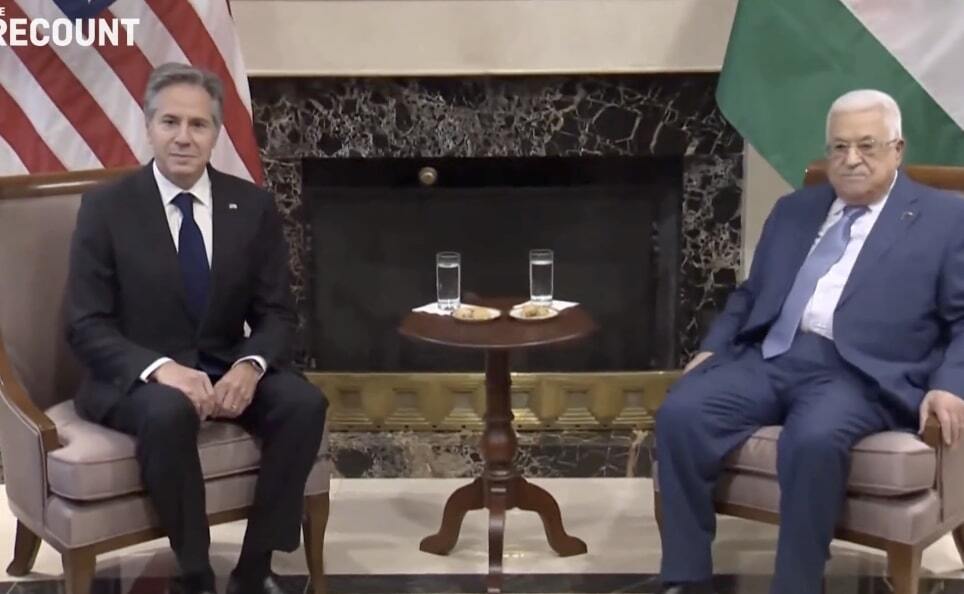
US Secretary of State Antony Blinken meets with Palestinian Authority President Mahmoud Abbas in Jordan on October 17, 2023. (Screen capture/X)

Ramallah, for its part, has asserted it has no interest in returning to Gaza unless as part of a diplomatic initiative that unites the enclave with the West Bank and revamps the peace process with Israel, which would be supported by the Biden administration but have little backing in the current Israeli government.

While working to boost the cash-strapped PA’s international standing, Washington has pushed back against a decision announced Sunday by Finance Minister Bezalel Smotrich to halt the transfer of Palestinian tax revenues to the PA, claiming that Ramallah supported the October 7 massacre.

Due to the PA’s lack of statehood status, Israel is responsible for collecting customs duties and other tax revenues on its behalf. It transfers them to Ramallah on a monthly basis, providing funds that amount to nearly 65 percent of the Palestinian annual budget, which is roughly NIS 18 billion ($5.27 billion).

Commenting on Smotrich’s decision during Tuesday’s hearing, Blinken said the US has asked Israel to release the Palestinian funds.

The message has been passed along privately as well, with Washington demanding an explanation and arguing the move could further destabilize the West Bank, which has been rattled by rising settler violence since the October 7 massacres.

“The Palestinian Authority is doing everything it can to keep security and stability in the West Bank. It is vastly under-sourced. This is another aspect of the problem,” Blinken said. The US leaned hard on the PA in recent weeks for its security forces to continue their efforts to combat terror in the territory.

Finance Minister Bezalel Smotrich attends a press conference at the Finance Ministry, in Jerusalem on October 19, 2023. (Noam Revkin Fenton/Flash90)

In justifying his decision to freeze Ramallah’s funds, Smotrich said the PA did not condemn the October 7 attack. The Palestinian Authority has not denounced Hamas, while expressing opposition to the targeting of all civilians.

Blinken’s scheduled trip to Israel later this week follows his visit on October 12, when he held a nearly eight-hour meeting with Netanyahu’s war cabinet to kick off a regional tour that included stops in five other countries, as he sought to build a coalition against Hamas while coordinating with allies to secure the delivery of humanitarian aid into Gaza and the release of the hostages.

That trip appeared to have had limited success, as Arab countries have not taken well to the continued US support for Israel’s ongoing military campaign in the Strip. US diplomacy was integral, however, in coaxing Israel and Egypt to begin allowing humanitarian aid to enter the enclave 10 days ago.