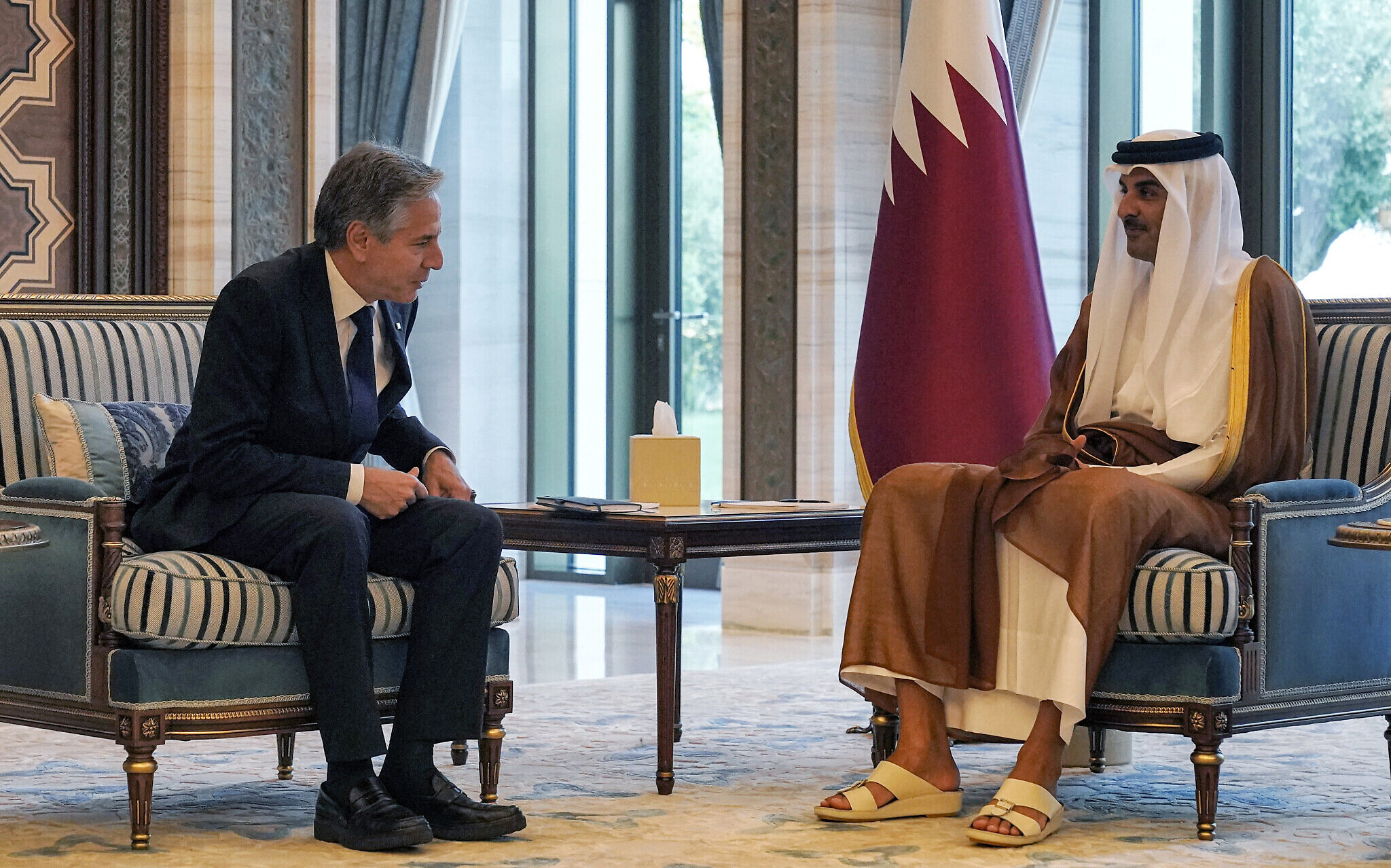
US Secretary of State Antony Blinken (L) meets with Qatar's Emir Sheikh Tamim bin Hamad al-Thani in Lusail on October 13, 2023. (Jacquelyn Martin / POOL / AFP)

US Secretary of State Antony Blinken (L) meets with Qatar’s Emir Sheikh Tamim bin Hamad al-Thani in Lusail on October 13, 2023. (Jacquelyn Martin / POOL / AFP)

Israel has informed Qatari mediators that in exchange for the release of a significant number of hostages from Gaza, it is prepared to give something in exchange, the Kan public broadcaster reports.

The report citing an unnamed political source does not specify what Israel would be willing to offer and Jerusalem has already been said to reject proposals that required it to allow fuel into Gaza due to fears that it’ll be used by Hamas.

Israel has publicly insisted that the hostages must be released unconditionally and it is unclear whether they gave anything in exchange for the release of the first four hostages over the past week.

Kan reports that Israel passed along its red lines for the negotiations to the Qatari mediators.

Hamas is reportedly seeking the entry of fuel into Gaza as well as the release of security prisoners from Israeli jails along with a ceasefire.

The source speaking to Kan speculates that a major development in the talks would soon unfold.


Israel May Tread Carefully With a Two-Front War Threat

Published 10/26/23 07:00 AM ET

Seth J. Frantzman

Israeli army soldiers walk before tracked vehicles deployed at a position in the Upper Galilee region in northern Israel near the border with southern Lebanon on Oct. 24, 2023.JALAA MAREY/AFP via Getty Images

Israel has prepared for the possibility of a multi-front war for a decade. Historically, Israel has faced off against threats from the north and south. In 1967 and 1973, it defeated large conventional armies fielded by Syria and Egypt. Today, as Israel fights Hamas in the wake of a massive attack on Oct. 7 that killed 1,400 Israelis, there is concern that a second terrorist organization — Hezbollah in Lebanon — might enter the war.

Hezbollah already has carried out numerous attacks on Israel since Oct. 8, and it has lost more than two dozen members to Israeli retaliation. Yet, concern about Iran and its proxies further escalating the war in the region has led Israel to exercise some caution in Gaza. Israel doesn’t appear eager to fight the multi-front war for which it prepared.

Why might that be? Defeating conventional enemies, such as masses of Soviet-supplied tanks that the Syrians and Egyptians fielded in 1967 and 1973, is much different from urban warfare that involves hunting down Hamas terrorists who hide in tunnels under Gaza. Israel has compared Hamas to ISIS, the terrorist organization that was difficult to defeat. In Mosul, it took nine months to defeat ISIS; I was there, covering the war, when the Iraqi army began the offensive in October 2016, and when it was still fighting in April of 2017.

Hezbollah is believed to be a stronger organization than Hamas, with thousands of fighters and armed with up to 200,000 rockets. More than two weeks after its attack, Hamas is still firing massive rocket barrages at Tel Aviv. This is different from 1973, when the Egyptians and Syrians did not threaten central Israel.

Israel’s military doctrine since 2020 has envisioned a quick war, one that would harness technology to speed up operations and allow the Israel Defense Forces (IDF) to achieve “decisive victory,” in a plan dubbed “Momentum.” The push for this concept was undertaken by Lt. Gen. Aviv Kochavi, who was chief of staff until January of this year. An article examining Israel’s challenges noted that “the endless cycle of conflicts with Palestinian factions like Hamas and Palestinian Islamic Jihad (PIJ) also shows the increasing inability of the IDF to claim victory on the battlefield.”

The threat posed by these terrorist groups indeed has been a challenge. Prior to Oct. 7, it was not widely recognized just how deadly groups like Hamas might become if they could break through the border. Israel had invested $1 billion in a fence to keep Hamas out. But fences require a lot of soldiers to stand guard, and Hamas was able to break through the fence anyway, and circumvent it in other ways, to carry out its massacre.

Israel has waited to carry out a large offensive in Gaza, using air strikes for two weeks against Hamas, while negotiations continue for the release of more than 220 hostages taken by Hamas. During that time, Israel also has carried out raids in the West Bank against other groups such as PIJ, which is also backed by Iran. Hezbollah and Israel are trading exchanges of fire, but this was not how a conflict with Hezbollah was envisioned. As recently as mid-August, a report suggested that Hezbollah might try to pull off an attack similar to what Hamas did, by trying to conquer some communities in the Galilee region. Israel has evacuated 42 communities along the border, because of this threat.

  • A war with Hezbollah was predicted to involve thousands of rockets fired daily by the group. Although Israel has air defenses to counter rocket fire, this would strain those defenses. And the concern about a wider conflict looms in the region: Iran’s proxies in Iraq and Syria have carried out attacks on U.S. forces and Iran-backed Houthis have fired missiles and drones targeting Israel. A U.S. warship shot down those threats, reportedly with assistance from Saudi Arabia.

This brings us back to the waiting game that Israel is now forced into as it prepares a ground incursion into Gaza. The IDF has trained for a multi-front war, one that was expected to involve Hezbollah as the main adversary and Hamas as the lesser challenge. Now, after a fierce attack, Israel must defeat Hamas, but its Momentum plan calls for decisive victory over various adversaries.

Preventing the two-front war has become the priority, which illustrates a tough lesson for planners. Israel prepared for this scenario, but the actual conflict is proving to be more complex and difficult than the vision of a victory on two fronts.

Seth J. Frantzman, Ph.D., is the author of “Drone Wars: Pioneers, Killing Machines, Artificial Intelligence and the Battle for the Future.” He has more than 15 years of experience covering conflict and security issues in the Middle East as a correspondent and analyst, and is an adjunct fellow at The Foundation for Defense of Democracies (FDD).

UNGA to call for Gaza war ceasefire, won’t condemn Hamas

The resolution objects to plans to relocate Palestinians to territory outside of Gaza.

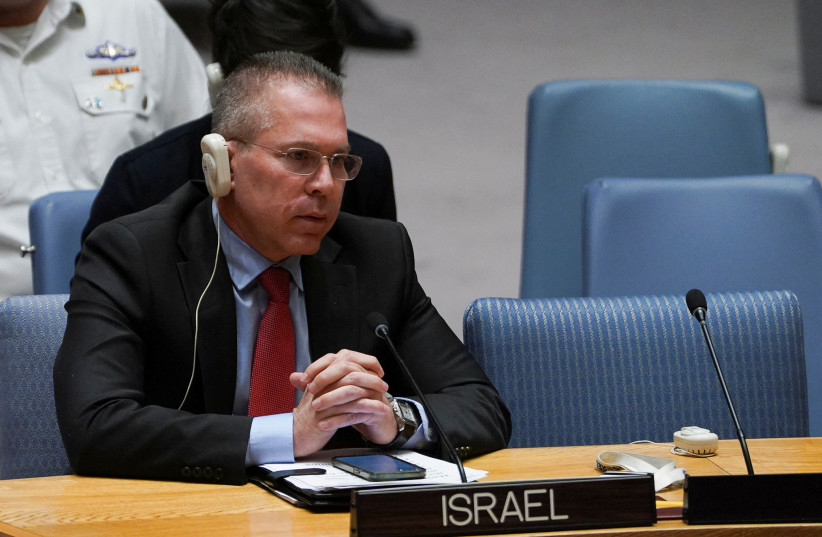
 Israel's Ambassador to the United Nations Gilad Erdan attends a meeting of the Security Council on the conflict between Israel and Hamas, at U.N. headquarters in New York, U.S., October 25, 2023 (photo credit: REUTERS/David Dee Delgado)
Israel’s Ambassador to the United Nations Gilad Erdan attends a meeting of the Security Council on the conflict between Israel and Hamas, at U.N. headquarters in New York, U.S., October 25, 2023
(photo credit: REUTERS/David Dee Delgado)
The United Nations General Assembly is expected to call for a ceasefire to the Gaza war in a resolution slated for adoption on Friday which does not condemn Hamas for its October 7 attack in which over 1,400 people were killed and over 220 taken hostage.

The resolution was submitted by Jordan, an Israeli regional ally since 1994, which also has strong relations with the Palestinian Authority and has been a bitter opponent of IDF aerial bombings of Gaza targeting Hamas.

The UNGA debate preceding the Friday’s vote is slated to begin on Thursday morning in New York at 10 a.m., which will be 5 p.m. Israel time.

The first four speakers will be the Palestinian Authority, Israel, Jordan and Iran. The United States is expected to be the ninth speakers, out of a list of some 106 nations.

Jordanian Foreign Minister Ayman Safadi has been in New York this week seeking to secure International support for a Gaza War cease fire.

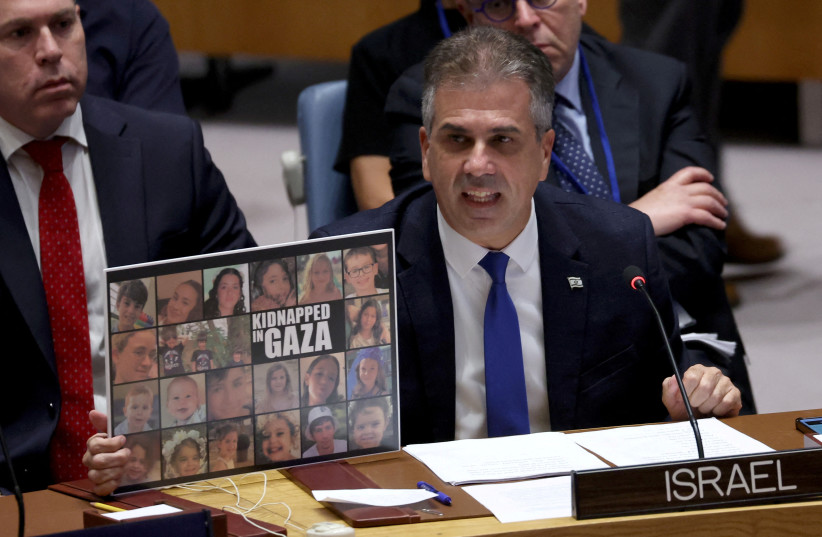
 Israel's Foreign Affairs Minister Eli Cohen speaks during a meeting of the Security Council on the conflict between Israel and the Palestinian Islamist group Hamas at U.N. headquarters in New York, U.S., October 24, 2023 (credit: REUTERS/SHANNON STAPLETON)
Israel’s Foreign Affairs Minister Eli Cohen speaks during a meeting of the Security Council on the conflict between Israel and the Palestinian Islamist group Hamas at U.N. headquarters in New York, U.S., October 24, 2023 (credit: REUTERS/SHANNON STAPLETON)

“We are outraged at what is happening now in Gaza,” Safadi told reporters in New York on Tuesday.

“We need the whole international community to be outraged at the absence of justice. We must be outraged at our failure as the international community to solve a conflict that we all knew was going to get worse,” Safadi said.

ass casualties – but are the numbers accurate?

According to Hamas over 6,500 Palestinians have been killed in Gaza since October 7. Israel has not provided a casualty count, but deaths in Gaza were due to IDF aerial bombing and failed Palestinian rocket launches.

Saudi Foreign Minister Faisel Bin Farhan said that a “cease fire is a humanitarian imperative. We are facing a desperate situation in Gaza… Every hour we speak more civilians are dying.”

The ceasefire resolution also calls on all parties to protect civilians and to obey International law. It also demands that the good be allowed back into Gaza, particularly humanitarian aid.

It also objects to plans to relocate Palestinians to territory outside of Gaza. Palestinians fear such a move would be a permanent expulsion akin to what happened in 1948 during Israel’s War for Independence.

The text does not reference the October 7 Hamas attack specifically nor does it detail its events, in which victims were burned alive, rapped and or dismembered.