Iranian aerial defense sites targeted included an Islamic Revolutionary Guard Corps (IRGC) site where missiles intended for targeting aircraft were stored.
Israeli Air Force fighter jet seen in central Israel amid the ongoing war, March 31, 2026.(photo credit: NATI SHOHAT/FLASH90) ByARIELLA ROITMAN, JERUSALEM POST STAFF Updated:
The IDF completed several strikes against Iranian regime targets, including air defenses and weapons facilities, on Friday, the military announced on Saturday.
The strikes were carried out by the Air Force, guided by IDF intelligence, and targeted military sites used for safeguarding the regime’s weapons research and development facilities, ballistic missile storage, and additional weapons production, research, and development sites.
Iranian aerial defense sites targeted included an Islamic Revolutionary Guard Corps (IRGC) site where missiles intended for targeting aircraft were stored.
The strikes are a part of the IDF inflicting “increasing damage to the Iranian terror regime’s core systems and foundations,” the military stated.
IDF strikes key Iranian regime air defenses and weapons development facilities in Tehran on April 3, 2026. (CREDIT: IDF SPOKESPERSON’S UNIT)
Earlier IDF strikes against Iranian regime capabilities
On Friday night, the military also announced that it had carried out more than 70 strikes in western and central Iran, targeting Iranian regime ballistic missile launch sites and unmanned aerial vehicle (UAV) storage over the past 24 hours.
The strikes targeted additional IRGC weapons storage sites and air defense system facilities.
Iran’s grip on the Strait of Hormuz is pushing Gulf states to advance massive plans for alternative oil and gas export pipelines, the Financial Times reported. Despite costs running into the tens of billions of dollars and major security hurdles, Middle East officials believe this is the best path under current conditions.
Iranian soldiers take part in a military flotilla in the Strait of Hormuz. Photo: AFP
The long-term threat of Iranian control over the Strait of Hormuz, one of the world’s most important trade routes, is forcing Gulf states to rethink their strategy. Senior energy industry officials told the Financial Times that countries in the region are now examining costly and complex plans to build new oil and gas pipelines that would bypass the strait, out of an understanding that this may be the only way to ensure continued exports.
The current conflict has underscored the strategic importance of Saudi Arabia’s 1,200-kilometer east-west oil pipeline. Built in the 1980s out of concern that the strait could be blocked during the Iran-Iraq War, the pipeline is now emerging as a critical lifeline. It carries about 7 million barrels of oil a day to the Red Sea port of Yanbu, completely bypassing Hormuz. “In hindsight, that pipeline looks like a stroke of genius,” a Gulf energy industry executive said.
Amin Nasser, chief executive of Saudi oil giant Aramco, recently confirmed that the pipeline is “the main route we are relying on right now.” Riyadh is now examining how to increase the volume of its exports, currently standing at 10.2 million barrels a day, through pipelines, whether by expanding the existing line or laying new routes. The kingdom is also considering building additional export terminals on the Red Sea, including at the deepwater port under construction as part of the Neom project.
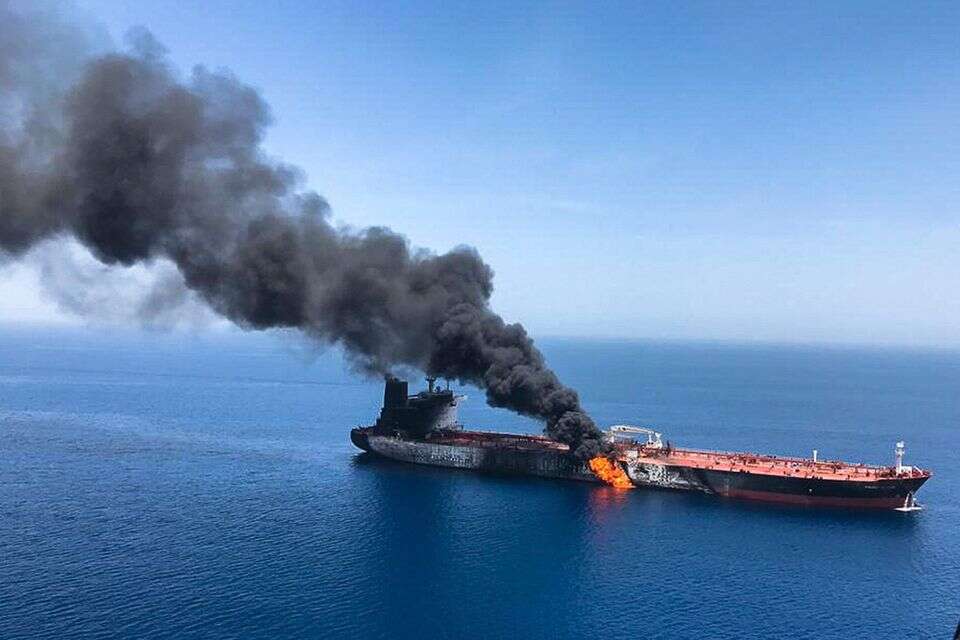
An oil tanker burns after an attack near the Strait of Hormuz. Photo: AP
‘Taking fate into our own hands’
In the long term, the new pipelines are expected to be integrated into broader trade routes. A Gulf official told the Financial Times that one option now being considered is reviving the ambitious US-backed IMEC plan for a corridor stretching from India through the Gulf to Europe. The original plan, as previously outlined, included a complex pipeline that was supposed to reach the port of Haifa.
Yossi Abu, chief executive of NewMed Energy, said he was confident pipelines to the Mediterranean would indeed be built, whether ending at ports in Israel or Egypt. “People need to control their own destiny, together with their friends,” Abu told the Financial Times. “We need oil pipelines and rail connections across the region, over land, without giving others choke points to strangle us.”
An Iranian missile boat in the Strait of Hormuz. Photo: EPA
Minefields and political obstacles
Despite broad agreement on the need for such a move, the obstacles are enormous. Christopher Bush, chief executive of Lebanon’s CAT Group, which helped build the existing Saudi pipeline, estimated that replicating the pipeline today would cost at least $5 billion because of the need to carve through basalt mountains. More ambitious plans crossing several countries, for example from Iraq through Jordan, Syria or Turkey, would cost between $15 billion and $20 billion.
Beyond the cost, there are serious security risks, including unexploded ordnance in Iraq and the continued presence of Islamic State and other terrorist organizations. The southern option of pumping oil to ports in Oman also faces difficulties because of mountainous and desert terrain.
Moreover, Oman’s ports are not immune. Drone attacks in recent days even forced the key port of Salalah to shut down temporarily.
Added to that is the political challenge of managing shared pipelines. “A pipeline system would require Gulf states to abandon their isolationist policies and unite,” Bush said.
While the UK is leading talks among 35 countries in an attempt to form a coalition to reopen the Strait of Hormuz, Mason Kafafy, a senior adviser at the Atlantic Council, said Gulf states understand that reality has changed.
“I sense a shift from hypotheses to operational reality. Everyone is loo king at the same map and reaching the same conclusions,” she said. “I do not expect things to return to what they were before the confrontation.”
According to assessments conducted by multiple US intelligence agencies, the Iranian regime believes it is in a strong enough position to continue the war and not cede to US demands.
People attend a funeral ceremony for the Islamic Revolutionary Guards Corps Navy Commander Alireza Tangsiri, who was killed in strikes, amid the US-Israeli conflict with Iran, in Tehran, Iran, April 1, 2026.(photo credit: MAJID ASGARIPOUR/WANA (WEST ASIA NEWS AGENCY) VIA REUTERS)ByGOLDIE KATZUpdated: American intelligence assessments have indicated that the Iranian regime is unwilling to engage in negotiations to end the war with the US and Israel, The New York Times reported, citing US officials familiar with the information.
According to assessments conducted by multiple US intelligence agencies, the regime believes it is in a strong enough position to continue the war and not cede to US demands.
The report, which was published on Wednesday, also indicated that Iran is willing to keep diplomatic channels open but does not trust the US or believe US President Donald Trump is serious about engaging in negotiations.
Two Iranian officials and one Pakistani official told the NYT that the Islamic Republic might engage in diplomacy under the right conditions. That said, they need to see that the US is willing to seriously discuss ending the war rather than negotiating a temporary ceasefire.
American and Iranian officials both confirmed that the two countries have been exchanging messages through intermediaries, but are not discussing ceasefire terms or ending the war.
Car wrecks and a residential building damaged by a strike amid the US-Israeli conflict with Iran, in Tehran, Iran, March 30, 2026. (credit: MAJID ASGARIPOUR/WANA (WEST ASIA NEWS AGENCY) VIA REUTERS)
A senior Iranian source told Reuters on Wednesday that Iran demands a permanent end to the war and that no mediator-facilitated talks have taken place regarding a temporary truce.
“Iran’s new regime president, much less radicalized and far more intelligent than his predecessors, has just asked the United States of America for a ceasefire!” Trump’s post read, although it is unclear whether he was referring to Iran’s new Supreme Leader, Mojtaba Khamenei, or Iranian President Masoud Pezeshkian, who has been in office since 2024.
US claims of talks ‘false and baseless’
An Iranian Foreign Ministry spokesperson called Trump’s statement “false and baseless” on Iranian state TV, according to a Reuters report.
Iranian officials have repeatedly denied US claims that negotiations have been ongoing or are promising.
This official said that Tehran had deemed the plan “one-sided and unfair,” serving only US and Israeli interests, and lacking “the minimum requirements for success.”