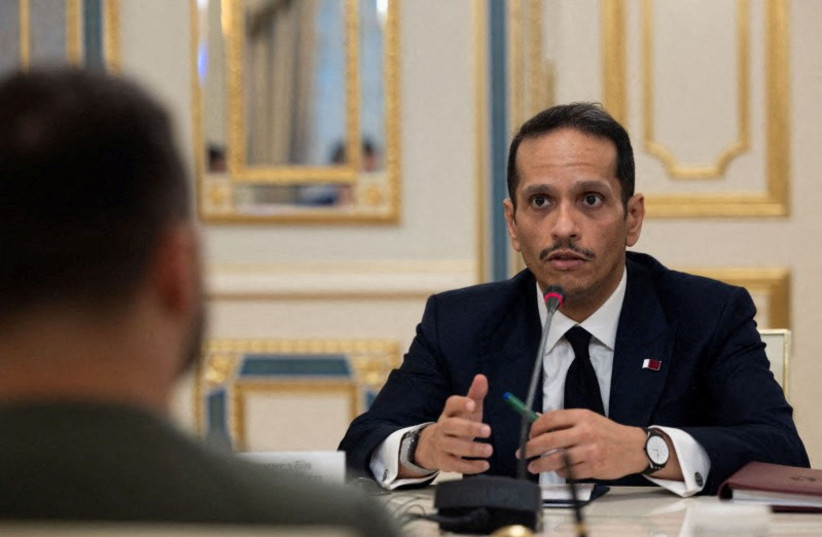
Qatari Prime Minister and Foreign Minister Sheikh Mohammed bin Abdulrahman bin Jassim Al Thani attends a meeting with Ukraine’s President Volodymyr Zelensky, in Kyiv, on July 28, 2023.
(photo credit: Ukrainian Presidential Press Service/Handout via REUTERS)
The stumbling block to Israeli relations with Qatar is the absence of a Palestinian state at the pre-1967 lines, the Qatari Prime Minister Mohammed bin Abdulrahman Al Thani said.
“We don’t have a war with Israel, the Israelis have an occupation over the Palestinians,” Al Thani told the International Institute for Strategic Studies at an event in Singapore on Friday.
He spoke about Qatar’s global role but was pressed about Saudi Arabia and its renewed diplomatic ties with Iran, as well as about the potential for a normalization deal between Riyadh and Jerusalem.
The restoration of Saudi-Iranian relations which was brokered by China, Al Thani said, “was something we encouraged for a long time to stabilize the region.”
With respect to the Saudi-Israel normalization deal and to the integration of Israel in the region in general, he said that in the end, little could happen unless the Israeli-Palestinian conflict is resolved.
Palestinians hold flags as they mark ‘Land Day’, an annual commemoration of six Arab citizens of Israel who were killed by Israeli security forces during demonstrations over land confiscations in 1976, in the east of Gaza Strip, March 30, 2023. (credit: REUTERS/MOHAMMED SALEM)
Qatar: Only peace between Israel and the Palestinians can end the conflict
“Any agreement with the Israelis doesn’t represent peace,” Al Thani said. “Peace can only be represented between [Israel] and the Palestinians,” he added.
The conflict between the region and Israel is over the Palestinian issue. The reference for all Arab states is the Arab Peace Initiative, which was launched by the Kingdom of Saudi Arabia,” Al Thani said.
The 2002 Arab Peace Initiative he referenced offered to normalize ties with Israel in exchange for its withdrawal to the pre-1967 to allow for the creation of a Palestinian state on that territory.
Under the terms of the US-brokered Abraham Accords, four Arab countries agreed to normalize ties with Israel despite the conflict with the Palestinians. The four countries were the United Arab Emirates, Bahrain, Morocco, and Sudan.
Qatar does not have relations with Israel. Al Thani said that Qatar was sticking with the Arab Peace Initiative.
“We believe that this is the best way to make peace,” he said.
Photo Credit: State Department photo by Zinna Senbetta/ Public Domain
Secretary of State Antony J. Blinken meets with with Saudi Crown Prince and Prime Minister Mohammed bin Salman in Jeddah, Saudi Arabia on June 7, 2023.
The Biden administration told the Israeli government last week that it would have to make considerable concessions to the “Palestinians” if a U.S.-brokered deal with Saudi Arabia is to succeed.
U.S. Secretary of State Antony Blinken told Israel’s Strategic Affairs Minister Ron Dermer, who visited Washington on Aug. 17,that Israel’s government is “misreading the situation” if it presumes it won’t need to make concessions, two U.S. officials told Axios.
Saudi Arabia will need to show Muslims the world over that it succeeded in extracting promises from Israel regarding the “Palestinians” in return for a normalization deal, said Blinken.
Saudi Arabia is also requesting American help for a Saudi civilian nuclear program.
The Wall Street Journal reported on Friday that the Saudis are considering a Chinese-made nuclear plant as the U.S. had made its help contingent on the Saudis not enriching their own uranium or mining their own uranium deposits. China has not sought any conditions.
The Saudi move is viewed as a way to pressure the Biden administration to compromise on its conditions for U.S. help in the kingdom’s pursuit of nuclear power, the Journal reported.
On Aug. 9, the White House downplayed claims that Riyadh had agreed to the “broad contours” of a normalization deal with Israel as reported in the the Journal earlier that day.
“There’s no agreed framework to codify the normalization or any of the other security considerations that we and our friends have in the region,” U.S. National Security Council spokesman John Kirby told journalists on a press call.
The Journal reported that U.S. and Saudi officials were “negotiating the details of an agreement they hope to cement within nine-to-12 months.”
Sources cited by the newspaper said it would be “the most momentous Middle East peace deal in a generation.” They cautioned, however, that such a deal still faced long odds.
Efforts accelerated with a visit by U.S. National Security Advisor Jake Sullivan to Saudi Arabia on May 7 where he met with Mohammed bin Salman, the kingdom’s crown prince (known as MBS).
Negotiators were already discussing specifics, including the aforementioned U.S. aid for a Saudi civilian nuclear program, along with security guarantees and the concessions for Palestinians, according to the report.
Washington in return was asking Riyadh to place limits on its burgeoning ties with China, with the U.S. likely to request assurances that the Saudis wouldn’t let China build military bases on their territory.
Limits on Saudi use of Chinese technology and a commitment to use U.S. currency and not the Chinese yuan may also be part of the negotiations.
MBS has sent “conflicting messages” about his readiness to normalize relations with Israel, telling his advisers “that he was in no rush, especially with the current hard-line coalition government in Israel that opposes the creation of an independent Palestinian state,” the Journal reported.
Israeli National Security Adviser Tzachi Hanegbi said negotiators have not broached specifics with Israeli leaders.
Netanyahu said in an interview earlier this month with Bloomberg Television that the concessions to the “Palestinians” that the U.S. and Saudi Arabia expect are not as big a stumbling block as people think.
He expressed confidence that his government could achieve some form of normalization with Saudi Arabia in the coming months.
“I think that we are about to witness a pivot of history,” Netanyahu told Bloomberg’s Francine Lacqua. “First, there is an economic corridor of energy, transport and communications that naturally goes through our geography from Asia through the Arabian Peninsula to Europe.
“We are going to realize that,” vowed the prime minister, adding, “Saudi Arabia is one of the exceptional things that tells you why I’m very optimistic about Israel.
“If there is a political will, there will be a political way to achieve normalization and formal peace between Israel and Saudi Arabia. That has enormous economic consequences for the investors and if they have to bet on it right now, I’d bet on it,” Netanyahu said.
Israeli Foreign Minister Eli Cohen published an op-ed in the Journal on Aug. 8 in which he argued that U.S. defense guarantees under an Israeli-Saudi normalization agreement would render Gulf states’ nuclear ambitions “unnecessary.”
The Americans would be able to provide protection against Iranian aggression in the region, said Cohen, adding, “[A] defense pledge could reassure Middle Eastern nations, primarily Saudi Arabia and the Gulf states. This approach would make individual nuclear ambitions unnecessary, bolster regional stability, and promote the peace and normalization agenda.”
Cohen continued: “A united front, bringing together moderate Sunni nations and Israel, would be an effective check on Iran’s growing ambitions.”
Israel’s top diplomat earlier said that the “Palestinian issue” will not be an obstacle to normalizing relations with Riyadh.
“The current Israeli government will take steps to improve the Palestinian economy,” he stated.
“A visit to Israel by a Saudi foreign minister would be a day of celebration,” Cohen remarked, noting that governments led by Netanyahu had secured diplomatic relations with the United Arab Emirates, Bahrain and Morocco as part of the 2020 Trump administration-brokered Abraham Accords.
The Israeli premier and the Saudi crown prince will make history together, Cohen predicted.
After Washington ditched the nuclear deal in 2018 and reimposed sanctions, Tehran began to violate the nuclear curbs set out in the pact.
By REUTERS
Published: AUGUST 27, 2023 10:51
Updated: AUGUST 27, 2023 11:28
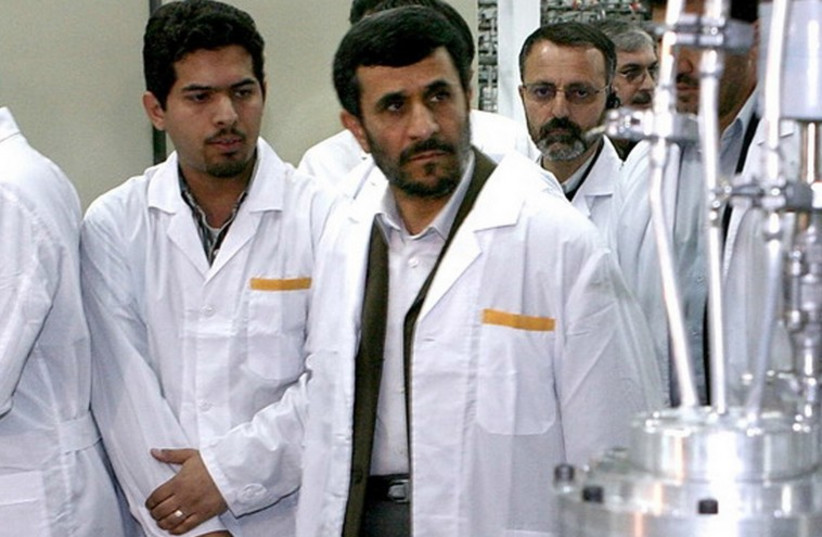
Iranian President Mahmoud Ahmadinejad (C) visits the Natanz nuclear enrichment facility, 350 km (217 miles) south of Tehran, April 8, 2008
(photo credit: REUTERS)
Iran’s enrichment of uranium continues based on a framework established by the country’s parliament, nuclear chief Mohammad Eslami said on Sunday when asked about reports regarding Tehran slowing down its 60% enrichment.
“Our nuclear enrichment continues based on the strategic framework law,” Eslami said, referring to a related legislation.
Earlier this month, the Wall Street Journal reported that Iran had significantly slowed the pace at which it was accumulating near-weapons-grade enriched uranium and diluted some of its stockpile, moves that could help ease tensions with the US and revive broader talks over Iran’s nuclear work.
In 2020, Iran’s hardline parliament passed a law requiring the government to take measures such as stepping up uranium enrichment beyond the limit set under Tehran’s 2015 nuclear deal if other parties did not fully comply with the deal.
After Washington ditched the deal in 2018 and reimposed sanctions, Tehran began to violate the nuclear curbs set out in the pact.
Former Iranian president Mahmoud Ahmadinejad (second left) visits the Natanz nuclear enrichment facility. (credit: REUTERS)
Iran moves closer to the bomb
Iran, which under the nuclear agreement could only enrich uranium to 3.67%, started enriching it to 60% purity in 2021, a move bringing the fissile material closer to levels suitable for developing a bomb. Tehran has repeatedly denied seeking a nuclear bomb.

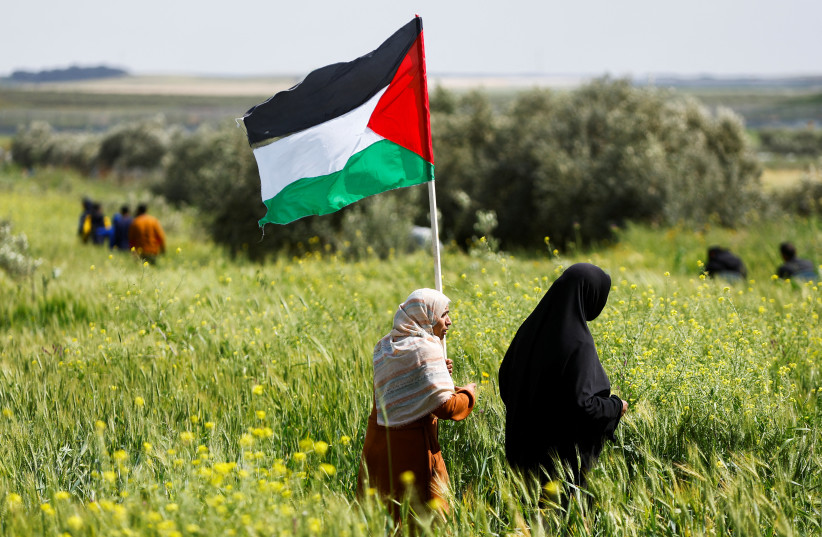
 Palestinians hold flags as they mark ‘Land Day’, an annual commemoration of six Arab citizens of Israel who were killed by Israeli security forces during demonstrations over land confiscations in 1976, in the east of Gaza Strip, March 30, 2023. (credit: REUTERS/MOHAMMED SALEM)