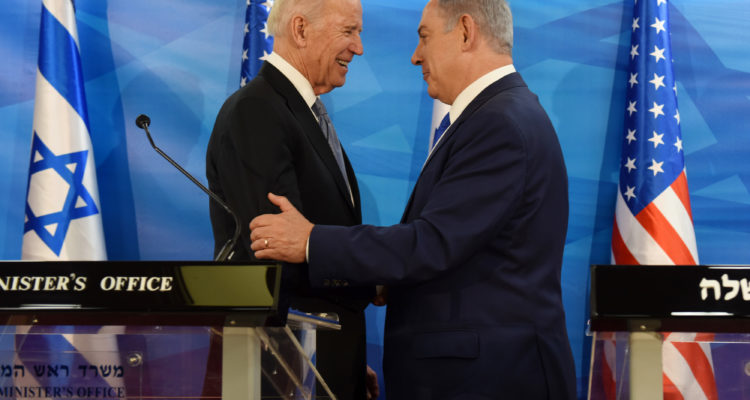
Then-Vice President Joe Biden and Prime Minister Benjamin Netanyahu shake hands while giving joint statements in the prime minister’s office in Jerusalem, Israel, March 9, 2016. (AP/Debbie Hill)
Biden initiated the interview to further ensure that his message of concern over the judicial reform reached the Israeli public as well.
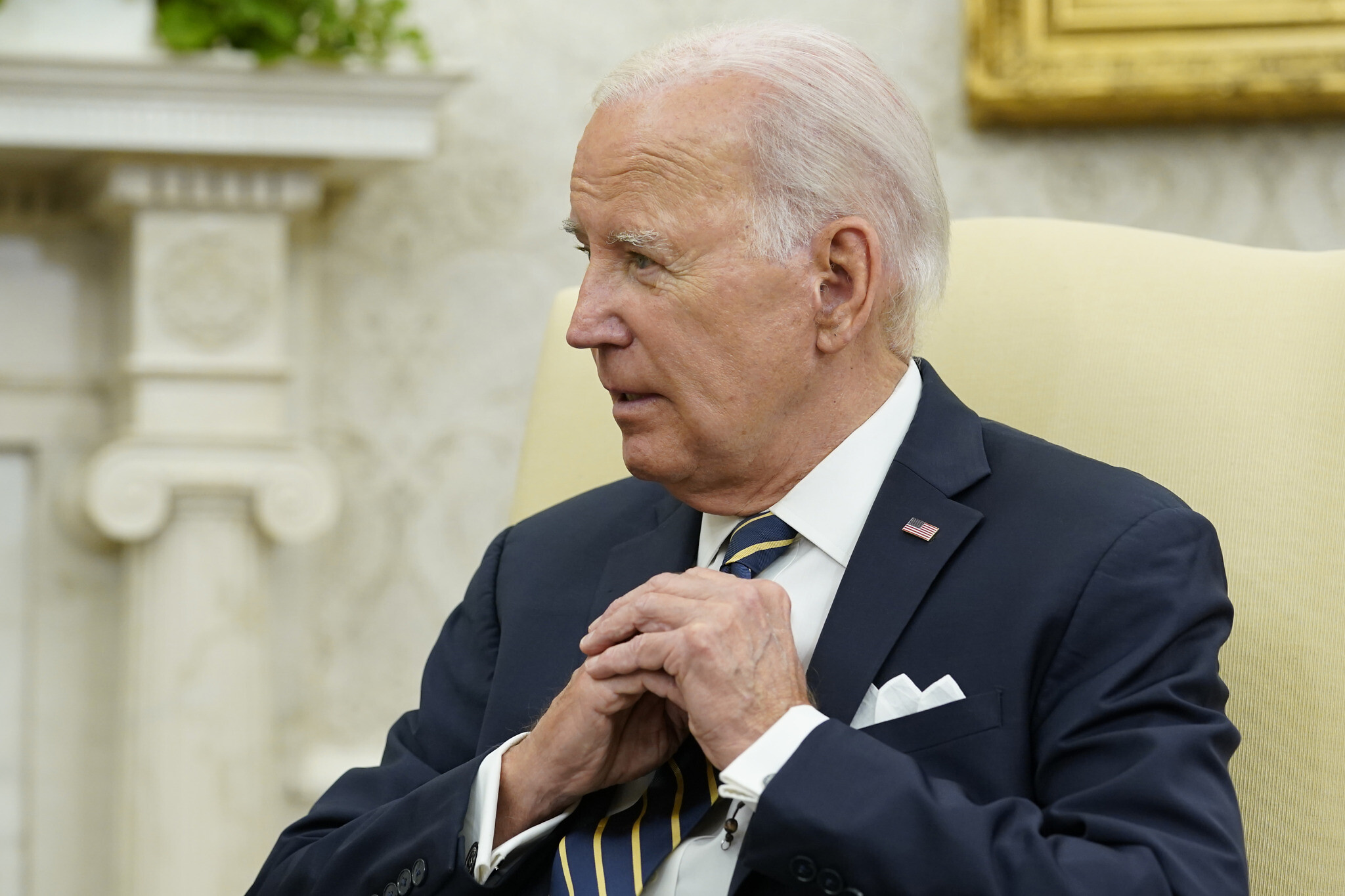
New York Times columnist Thomas Friedman on Thursday said that U.S. President Joe Biden’s recent warning that the potential damage the judicial reform could inflict on the U.S.-Israel “special relationship” was communicated to Prime Minister Benjamin Netanyahu during their phone call on Monday.
Friedman shared his views with Army Radio on Thursday, following an interview with Biden two days prior, during which the U.S. president acknowledged the “enduring protest movement” against the reform that is “demonstrating the vibrancy of Israel’s democracy,” which, he said, “must remain the core of our bilateral relationship.”
The interview with the Times was held a day after Biden’s phone call with Netanyahu and was reportedly initiated by the U.S. president to clarify some aspects of the call with Netanyahu, which he believed had been inaccurately portrayed by the Prime Minister’s Office.
According to Friedman, Biden initiated the interview to further ensure that his message reached the Israeli public as well.
“The president wanted to be sure, having spoken to the prime minister of Israel, and the president of Israel, that he also found a way to speak to the people of Israel, directly, and that was really the motivation for our interview,” Friedman told Army Radio on Thursday in remarks carried by The Times of Israel.
According to Friedman, Biden warned that if the reform went ahead, “you’d be breaking one of the most important bonds between the United States and Israel, our shared values around democratic decision-making and an independent judiciary.”
‘IDF IS ALWAYS SURPRISING’: NETANYAHU PRAISES IDF DRONE STRIKE ON TERROR CELL
During the interview, Friedman conveyed Biden’s “deep worry” that the proposed judicial restrictions might become irreversible. He cited Biden as questioning the logic behind Israel’s desire to modify its system when it currently has a flourishing economy.
Throughout the interview, Friedman underscored that Biden harbors a sincere affection for Israel, but expressed concerns that Biden “could well be the last pro-Israel Democratic president.” He added that the President was discussing a close new military alliance with Saudi Arabia, potentially leading to normalization with Israel, a long-held ambition of Netanyahu. This deal, however, could only materialize if the base of the Democratic Party agrees to it.
The long-discussed visa waiver for Israelis traveling to the US now looks likely to be passed sometime in this year after many months of speculation and negotiation.
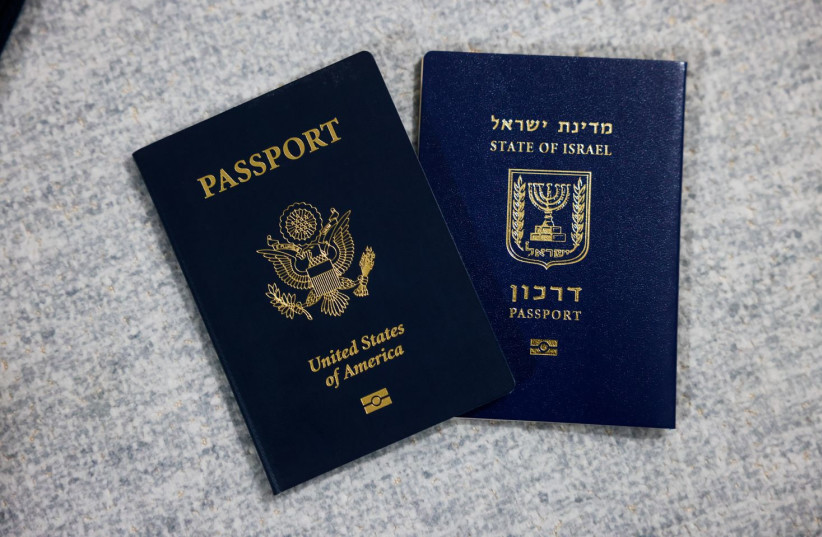
Will Israelis soon be able to travel to the US visa free? (Illustrative image of Israeli and American passports)
(photo credit: MARC ISRAEL SELLEM/THE JERUSALEM POST)
Israel’s ambassador to the United States, Mike Herzog, and the American ambassador to Israel, Tom Nides, signed a Memorandum of Understanding (MOU) on Wednesday regarding a visa exemption for the United States via the visa waiver program.
“I was privileged today to represent the government of Israel in signing a US-Israel memorandum of understanding on the extension of reciprocal privileges in the visa waiver program,” Israeli Ambassador Herzog announced today. “This is a significant milestone towards Israel joining the program.”
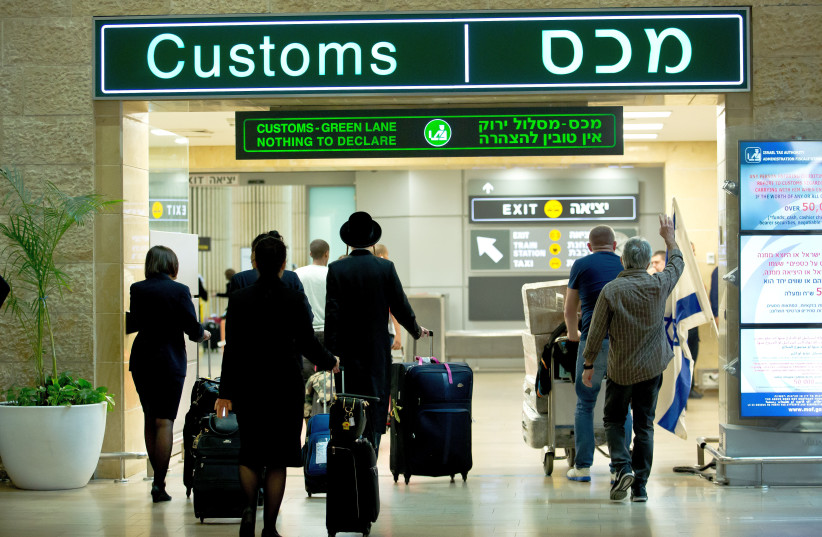
Travelers seen at the arrival hall of Ben Gurion International Airport, near Tel Aviv, on April 11, 2018 (credit: MOSHE SHAI/FLASH90)
“This procedure will allow any American citizen to enter Israel, and subsequently, with the acceptance of Israel as a member of the program, will allow any Israeli to enter the USA without the need for a visa,” said National Security Adviser and Head of the National Assembly Tzachi Hanegbi. “The full application of the procedure will. apply to any American regardless of who he is, including Americans with dual citizenship, Americans living in Judea and Samaria and Americans living in the Gaza Strip,” continued Hanegbi.
“Thank you to everybody on both sides who worked so diligently towards this goal, especially my colleague and dear friend Ambassador Tom Nides and DHS Under Secretary Rob Silvers, for their significant contributions,” declared Herzog.
Israel and the US Visa Waiver Program
The US Visa Waiver Program allows citizens of participating nations to travel to the US for up to 90 days without a visa.
In late March 2023, Prime Minister Benjamin Netanyahu said he expected his country to join the program by September, but the US State Department said Israel had yet to officially meet the requirements.
A big obstacle that Washington has pointed out is that Israel is yet to grant free passage for Palestinian-Americans at its airports and into the West Bank – a requirement that Israel seems to have granted as of Wednesday night.
Palestinian-American passage at all Israeli ports of entry
Later on Wednesday afternoon, the US State Department announced that American citizens – even if of Palestinian origin – can use any and all ports of entry in Israel, including Ben Gurion airport.
“For entry into the Visa Waiver Program, the complete list of requirements must be satisfied. The Department is working closely with the Government of Israel in its efforts to meet those requirements, in furtherance of our shared goal that Israel join the Visa Waiver Program when it meets all program requirements,” the statement read.
State Department spokesperson Matthew Miller confirmed that the rule change was a prerequiste for acceptance into the visa waiver program during a press conference shortly after the announcement. “Over the next few weeks, we will be monitoring very closely – you’ll be able to look at the policies that they announce today,” Miller declared.
US president tells NY Times’s Tom Friedman that ‘vibrancy of Israel’s democracy’ is at heart of ties between the 2 countries, but threatened by unilateral moves to weaken judiciary
US President Joe Biden looks at Israel’s President Isaac Herzog as they meet in the Oval Office of the White House in Washington, July 18, 2023. (Susan Walsh/AP)
US President Joe Biden said that Israel’s leaders need to slow down their divisive overhaul of the judiciary and instead strive to achieve a broad consensus with opposition parties on the issue, reportedly warning that the “special relationship” between the two countries could sustain irreparable damage.
Biden made the comments to New York Times columnist Thomas Friedman, whom he sat down with in the White House Tuesday after meeting earlier in the day with President Isaac Herzog, who is visiting Washington.
Prime Minister Benjamin Netanyahu’s Likud and its allied far-right and ultra-Orthodox parties have been barreling ahead with their overhaul plan, which has been met with months of mass protests from critics who say it will weaken the court’s power to act as a check and balance against the Knesset, and dangerously erode Israel’s democratic foundations.
Amongst the first in the world Sheba & NIH are developing a pan corona vaccine.
Loaded: 42.16%
In addition to protesters blocking roads and disrupting public transportation, pushback against the overhaul has seen groups of military reservists threaten to stop volunteering for special key duties — including piloting fighter jets — if the legislation process continues. Likewise, business leaders and medical staff have called strikes to protest the overhaul.
Speaking to Friedman, Biden expressed public support for the protest movement.
“This is obviously an area about which Israelis have strong views, including in an enduring protest movement that is demonstrating the vibrancy of Israel’s democracy, which must remain the core of our bilateral relationship,” he said.
“Finding consensus on controversial areas of policy means taking the time you need,” said Biden. “For significant changes, that’s essential. So my recommendation to Israeli leaders is not to rush. I believe the best outcome is to continue to seek the broadest possible consensus here.”
Friedman said the administration sees the overhaul issue less as a cross-aisle political debate in the Knesset than as a contest for the essence of Israeli democracy.
The US president, Friedman wrote, is “trying to be respectful of Israel’s right to choose its own path without its American ally intervening in an internal matter,” while at the same time making clear how the developments could affect Israel’s relations with the US.
Prime Minister Benjamin Netanyahu attends a Knesset session on July 10, with Likud ministers Yariv Levin (left) and Israel Katz seated either side of him. (Menahem KAHANA / AFP)
“He is basically pleading with Netanyahu and his supporters to understand: If we are not seen to share that democratic value, it will be difficult to sustain the special relationship that Israel and America have enjoyed for the last 75 years for another 75 years,” Friedman wrote.
“Message to Israelis, right, left and center: Joe Biden may be the last pro-Israel Democratic president. You ignore his sincere concerns at your peril,” he said.
After weighing in several times in recent months to warn Netanyahu’s government not to advance the original version of its overhaul and to adopt judicial reforms only if they have consensus support, Biden notably made no mention of the issue during his comments to the press when he met with Herzog.
The US president kept his remarks overwhelmingly positive, highlighting his commitment to the Jewish state and to the US-Israel relationship before running through a brief list of accomplishments in the Middle East.
Privately, though, Biden told Herzog that it was vital for coalition and opposition leaders to strike a compromise on judicial reform, according to an Israeli official who shared details with reporters after the meeting on condition of anonymity.
Herzog told Biden that he was working to find common ground between the parties and that he believes in negotiations he has championed, but which are currently frozen, the Israeli official said.
The talks fell apart last month and the government has since resumed advancement of the overhaul, readying to pass the first piece of legislation from the controversial package next week and reanimating the protest movement in the process.
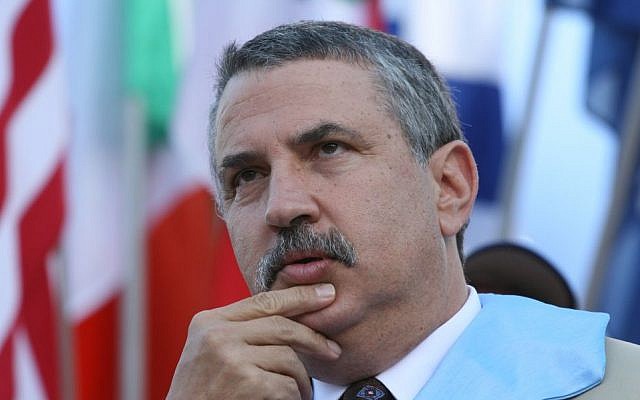
New York Times columnist Thomas L. Friedman. (Rebecca Zeffert/Flash90)
Herzog told reporters outside the White House after the meeting that Biden’s decision to ask about the overhaul wasn’t intended to “annoy” Israel, but was rather a result of his “deep concern” for the country’s democracy. Herzog’s assertion appeared to push back against some of Netanyahu’s allies, who have lashed out or dismissed criticism of the overhaul from the US and other allies as inappropriate interventions in Israel’s internal affairs.
On Monday Biden agreed to meet with Netanyahu later this year after refusing to invite him to the White House since the prime minister was reelected seven months ago and repeatedly speaking out against the government’s overhaul and its “extreme” members who back unrestricted settlement growth in the West Bank.
However, there was no official clarification on when or where the meeting would take place, leading to media speculation that the get-together would not be a state visit to the White House but rather talks on the sidelines of the annual UN General Assembly in New York.
After Biden and Herzog made their public remarks at the White House, the gathered press corps erupted into a barrage of shouted questions at the pair. Channel 13 US correspondent Neria Kraus claimed that a White House transcriber confirmed to her that Biden responded “Yes” to her query if Netanyahu had been invited to the White House.
However, others who were present at the time reported that it was unclear who Biden was addressing with his response.
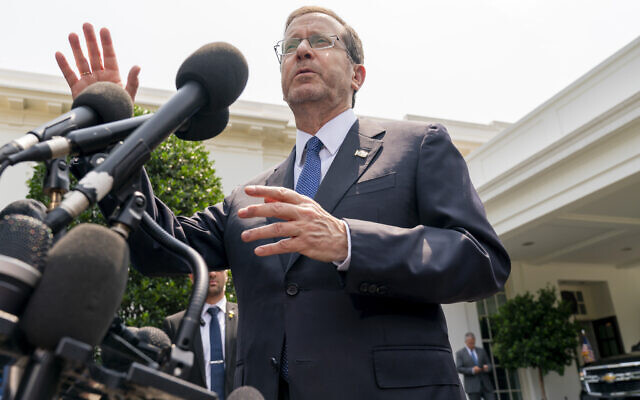
Israel’s President Isaac Herzog speaks to the media outside the West Wing of the White House after meeting with President Joe Biden, Tuesday, July 18, 2023, in Washington. (AP Photo/Jacquelyn Martin)
National Security Adviser Tzachi Hanegbi, seeking to dispel suggestions of a meeting at the UN, told Channel 12 on Tuesday that Biden had invited Netanyahu to the White House, and that the meeting would take place in September.
Hanegbi also offered fresh details on the Monday phone call between Netanyahu and Biden that included the invitation, saying the prime minister assured the US leader that the only part of the judicial overhaul that would be discussed after the Knesset’s summer recess was the makeup of the Judicial Selection Committee. The coalition is seeking to change the representation on the panel that chooses court judges, giving the government a majority say.
According to Hanegbi, Netanyahu told Biden that during the Knesset recess he would make great efforts to reach “broad public consensus” on how judges are selected.
Last week Friedman penned a column warning that the Biden administration was reassessing its ties with Netanyahu’s government, amid growing American alarm over the actions of the hard-right Israeli coalition.
Friedman said Biden believes the government is using its judicial overhaul push as a smokescreen to engage “in unprecedented radical behavior… that is undermining our shared interests with Israel, our shared values and the vitally important shared fiction about the status of the West Bank that has kept peace hopes there just barely alive.”
The op-ed, headlined “The US Reassessment of Netanyahu’s Government Has Begun,” is the latest of several he’s published since Netanyahu’s right-wing bloc’s victory in the November elections.
Netanyahu’s government and overhaul supporters say the legislation is needed to rein in what they see as an over-intrusive and left-leaning court system.