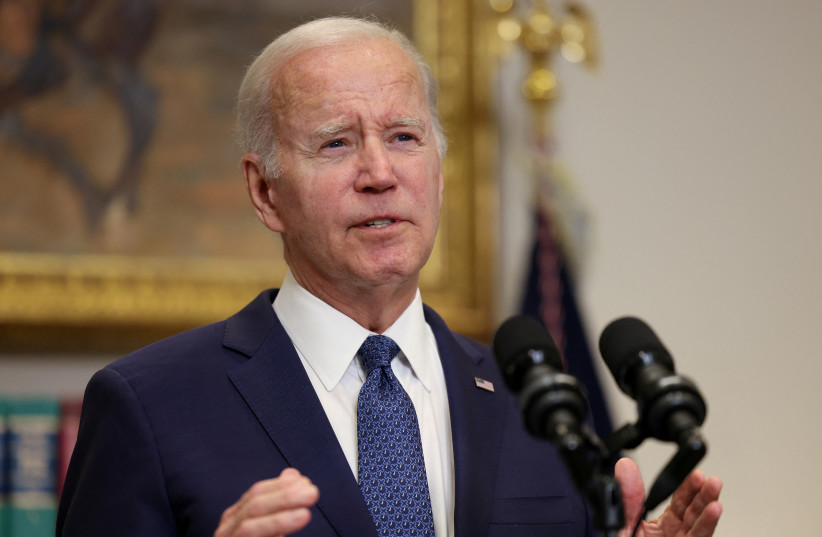
U.S. President Joe Biden speaks on his deal with House Speaker Kevin McCarthy (R-CA) to raise the United States’ debt ceiling at the White House in Washington, U.S., May 28, 2023
(photo credit: REUTERS/Julia Nikhinson)
US President Joe Biden treats the Israeli administration worse than it treats Iranian leadership, the Wall Street Journal editorial board wrote on Thursday.
The editorial piece briefly touched on several issues facing Israel. First, it referenced Biden’s public declination to invite Prime Minister Benjamin Netanyahu to the White House.
Biden made the snub to the Israeli prime minister in an interview with Fareed Zakaria on CNN last week. Deflecting a question about what it would take for Netanyahu to earn an invitation, Biden noted Isaac Herzog’s upcoming trip to the US.
Biden slammed for his responses to Israeli judicial reform
The WSJ editorial also castigated Biden for his responses to Israel’s weighing of judicial reforms. The article condemns the president for treating Israel as a vassal, telling the Jewish state that it “could not continue down this road of reforms” before also critiquing the American ambassador to Israel, Thomas Nides, for his comments.
Nides had remarked that Israel had to be prevented from “going off the rails” and that it should “pump the brakes” on the reforms.
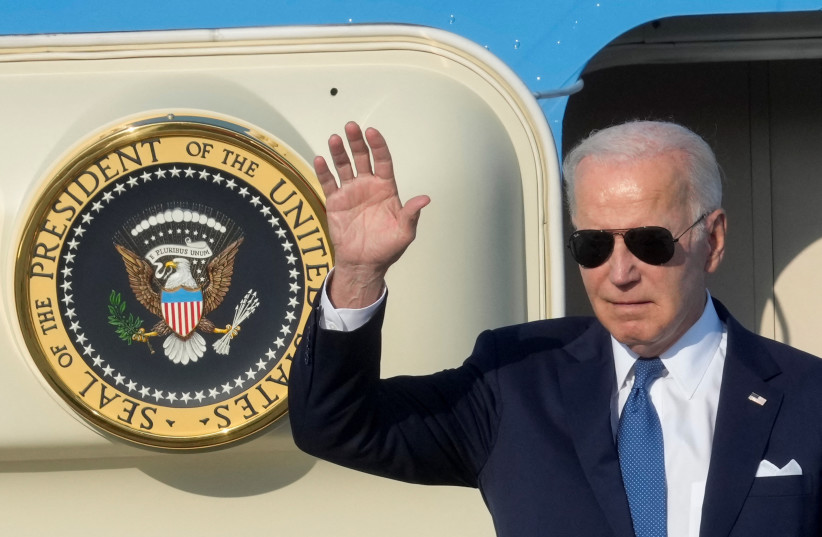
US President Joe Biden waves from the stairs of Air Force One as he arrives at Vilnius airport on the eve of a NATO leaders summit, Lithuania, July 10, 2023. (credit: Ints Kalnins/Reuters)
The WSJ piece also slammed Biden for unnecessary criticism of Netanyahu’s actions on the reforms in March, already after, the editorial states, Netanyahu had agreed to “moderate the reforms.”
Biden criticized for his approach to the West Bank
Additionally, the WSJ lambasted the Biden administration or its approach to anti-Israel efforts and groups, noting that the administration has continued supplying aid to such groups while classifying the West Bank as “occupied territory.”
“How does it advance peace to indulge Palestinians in the belief that Jews are interlopers in Judea and at the Western Wall?” the WSJ asked.
Furthermore, the editorial board noted that Biden has failed to implement a “longer and stronger” deal to prevent Iran from acquiring a nuclear weapon and to expand the Abraham Accords.
While Israel is hoping to add Saudi Arabia to the list of Abraham Accords countries, the editorial piece characterizes Biden’s actions as serving only to alienate the major Gulf country.
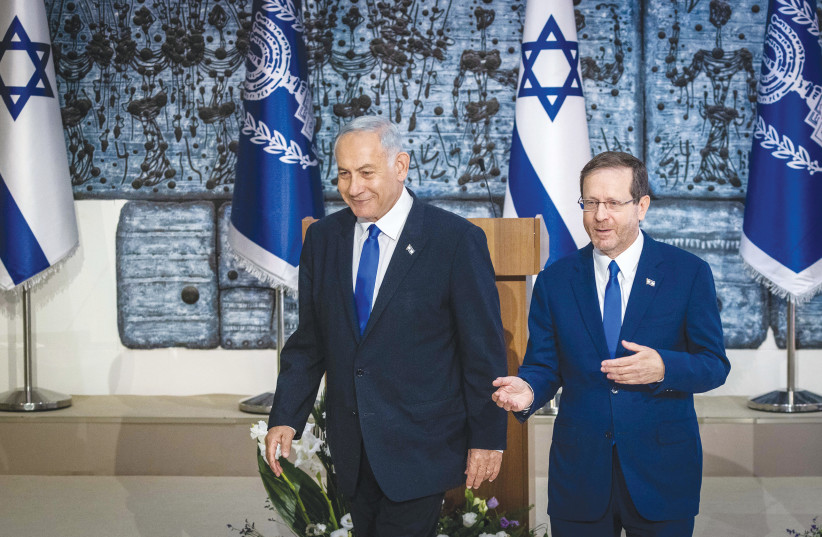
PRESIDENT ISAAC Herzog and Prime Minister Benjamin Netanyahu chat at the President’s Residence in Jerusalem after the president handed Netanyahu a mandate to form a new government, in November.
They discussed the Iranian nuclear threat and Tehran’s destabilizing actions in the region, their offices said.
Netanyahu “emphasized two redlines,” a source close to the prime minister said Thursday.
“Israel will not agree to an American return to the dangerous nuclear deal with Iran and will act with every means it has to stop Iran from attaining a nuclear weapon,” the source said, adding that “Israel will not agree to a ‘no surprises’ policy when it comes to Iran.”
Netanyahu has repeatedly emphasized that he will not share all of Israel’s plans to counter the Iranian threat with the US.
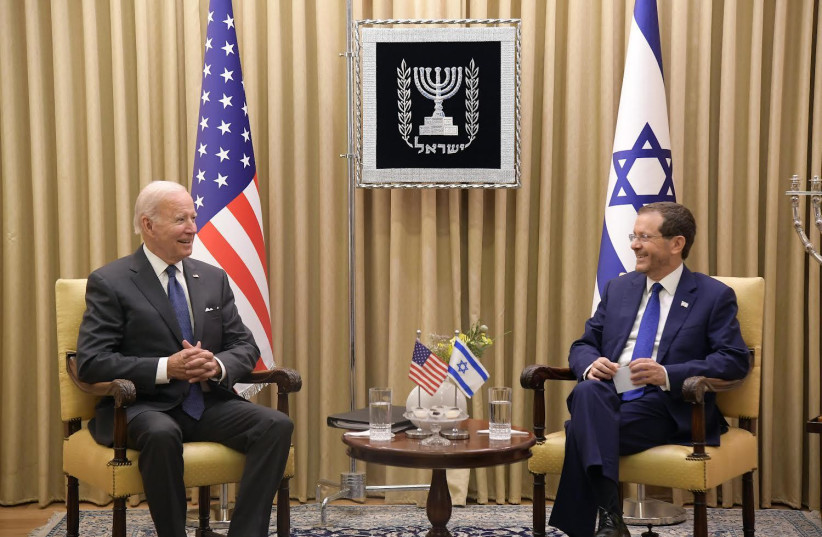
(L-R) US President Joe Biden and Israeli President Issac Herzog meet during the former’s visit to Israel (credit: HAIM ZACH/GPO)
Herzog plans to arrive in Washington on Tuesday for a meeting with US President Joe Biden and an address to both houses of Congress.
Biden “looks forward to welcoming” Herzog to the White House on July 18, a statement said Thursday.
What does Biden plan for the meeting?
“President Biden will reaffirm the ironclad commitment of the United States to Israel’s security,” White House press secretary Karine Jean-Pierre said. “The two leaders will discuss opportunities to deepen Israel’s regional integration and to create a more peaceful and prosperous Middle East.”
Biden will also “stress the importance of our shared democratic values” – a likely reference to judicial reform – “and discuss ways to advance equal measures of freedom, prosperity, and security for Palestinians and Israelis,” she said.
In addition, the leaders plan to discuss the Iranian threat and Russia’s military relationship with the Islamic Republic.
Earlier this week, Biden said the current Israeli cabinet was the “most extreme” he has ever seen, citing its ministers’ support for settlement expansion. He has declined to invite Netanyahu to Washington over the government’s policies.
While the Biden administration is not happy about the coalition’s judicial reform and is even less happy about plans to build thousands of new homes in Israeli towns in the West Bank, their main gripe is about Iran and Netanyahu’s refusal to adopt a “no surprises” policy relating to actions against Tehran, another source close to Netanyahu said earlier this week.
Iran is an “existential issue,” the source said. “The Biden administration is repeating the texts of the Obama era: that we have to be quiet and accept [US policy] in the name of the special relationship. We can’t accept that.”
Whatever the consequences of showing strength to an aggressor, it will be better to do so than for Israel to display weakness to Hezbollah.
(July 12, 2023 / JNS)
Amos Hochstein, the U.S. special presidential coordinator for global infrastructure and energy security, arrived in Israel on Tuesday for meetings with Prime Minister Benjamin Netanyahu and National Security Advisor Tzachi Hanegbi.
Briefing Netanyahu on U.S. efforts to mediate a formal normalization deal between Israel and Saudi Arabia was the official reason for the visit. But it became clear that was not the aim, after President Joe Biden told CNN’s Fareed Zakaria on Sunday that Washington opposes Saudi conditions for such a deal, namely a U.S. guarantee of Saudi security and U.S.-Saudi joint civilian nuclear energy development.
Hochstein’s trip was really about discussing the situation on Israel’s land border with Lebanon, which Iran controls through Hezbollah. Last year, Hochstein was the Biden administration’s point man for forcing Israel’s caretaker government to surrender to all of Hezbollah’s demands about the Israel-Lebanon maritime border on the eve of the Nov. 1, 2022 Knesset elections.
Hezbollah’s financial and military extortion enabled the deal Hochstein forced down Israel’s throat. In July 2022, Hezbollah launched four drones at Israel’s Karish gas platform, which was scheduled to go online two months later.
Hezbollah chief Hassan Nasrallah threatened to destroy the gas platform if Israel began pumping gas out of Karish without first surrendering to Hezbollah demands about the Qana gas platform, partially located in Israeli territorial and economic waters.
The issue of Israel’s and Hezbollah-controlled Lebanon’s maritime border first arose in 2010. After natural gas was discovered in the eastern Mediterranean, states in the region quickly signed maritime agreements delineating exclusive economic zones—a combination of their territorial and economic waters, where they hold exclusive economic rights to the sea’s natural resources.
Israel signed agreements with Egypt, Greece and Cyprus. Cyprus signed a deal with Lebanon. Lebanon and Israel, which are enemy states, did not sign a deal. When Israel submitted its exclusive economic zones to the United Nations, its border with Lebanon was based on the deal that Lebanon signed with Cyprus.
Rather than accept Israel’s boundaries, which were based on Lebanon’s terms, Lebanon demanded more than 325 square miles of Mediterranean waters that belonged to Israel. The demand included complete control over the massive Qana natural gas field.
The Obama administration began mediating an agreement between Israel and Hezbollah-controlled Lebanon. It proposed a compromise, under which 55% of the contested area would go to Lebanon, but Hezbollah rejected the deal. The Trump administration entered the fray in 2019. When it left office, the deal on the table would have given Hezbollah-Lebanon about 60% of the area.
In the meantime, Israel began developing the Karish gas field. After Hezbollah attacked the platform last July, Biden arrived in Israel for a visit. Biden’s key demand during the visit was for Israel to close a deal with Lebanon without delay.
Hochstein arrived on the president’s heels and began strong arming the caretaker Lapid-Gantz government to capitulate to all of Hezbollah’s demands. Less than a month before elections, then caretaker Prime Minister Yair Lapid caved. The agreement was so disastrous that his top negotiator quit the week before the surrender was completed.
By capitulating, Israel was able to start operating Karish, and Hezbollah gained potentially tens of billions of dollars in future gas revenues and a foothold in the eastern Mediterranean. Hochstein presented the deal as a “win-win.” Notably, the Who’s Who in Washington and elite Israeli defense circles echoed this description of Israel’s U.S.-coerced capitulation to Hezbollah extortion.
Israel Defense Force soldiers guard on the border between Lebanon and Israel on March 15, 2023. Photo by David Cohen/Flash90.
Over the past month, Hezbollah and Hochstein have reenacted their two-step along Israel’s land border with Hezbollah-controlled and U.S.-supported Lebanon. This time, Hezbollah forces carry out their aggression along the border with the open involvement of the U.S.-sponsored Lebanese Armed Forces.
On May 31, 2000, Israel pulled out of its security zone in south Lebanon. The United Nations oversaw Israel’s withdrawal and officially stipulated that Israel had withdrawn to the international border between the two countries. But just as it did with the maritime border, Hezbollah has rejected the U.N. determination, claiming that Mount Dov (which Lebanon calls Sheba Farms) is Lebanese, along with 13 other points on the map.
There is no factual basis for the claim. The United Nations certified Israel’s withdrawal. As for Mount Dov, Israel seized the area from Syria in the 1967 Six Day War and applied its law to the area in 1981. Washington recognized Israeli sovereignty over the area in 2019.
On the basis of Hezbollah’s fake claim over the past 23 years, the Iranian proxy force has repeatedly attacked IDF positions on Mount Dov, and insisted that its casus belli against Israel is still valid.
As Israel transferred its territorial and sovereign rights to the contested waters to Hezbollah last September, it also quietly made changes in a border town on Mount Dov called Ghajar.
In 2000, the United Nations delineated Ghajar as located half in Israel and half in Lebanon. All of its residents are Israeli citizens. Last October, with no fanfare, Israel opened the village up on the Israeli side and began fortifying it from Lebanese incursions.
In recent weeks, operating in conjunction with U.S.-trained, funded and armed Lebanese Armed Forces, Hezbollah has conducted repeated infiltrations of Israeli territory in Mount Dov. Hezbollah and Lebanese Armed Forces contingents have crossed into Israel at least six times in the past month.
Two months ago, Hezbollah placed two tents some 65 feet inside sovereign Israeli territory on Mount Dov. To minimize the chance of war, Israel did not blow them up, instead agreeing to U.N. mediation. United Nations Interim Force in Lebanon secured Hezbollah’s agreement to remove one tent. But the other still stands, and Hezbollah personnel remains in place, in Israel.
Last week, Channel 2 reported that the Biden administration has again entered the fray. Hochstein and U.S. Ambassador to Lebanon Dorothy Shea reportedly were offering a deal, in which Israel would remove its fortifications on the Lebanese side of Ghajar in exchange for Hezbollah removing the tent and personnel from Mount Dov.
Ahead of Hochstein’s visit and after meetings of other U.S. officials (including Shea) in Beirut, senior Lebanese officials began discussing a much larger deal. In exchange for removing the tent, Israel would settle all 13 contested points on the border. Shea reportedly supported a larger deal — that is full Israeli capitulation.
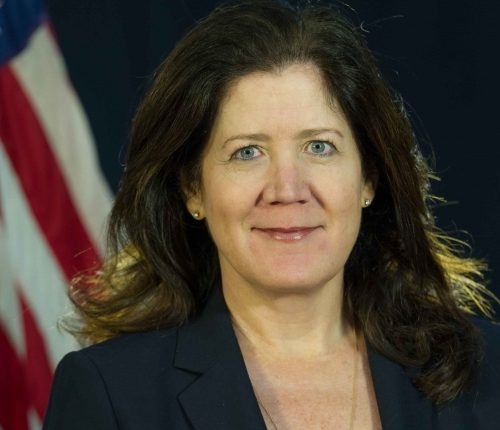
U.S. Ambassador to Lebanon Dorothy C. Shea. Credit: U.S. Department of State.
According to the Lebanese Al Akhbar, Israel told Hochstein it would agree to the limited Ghajar and Hezbollah tent and personnel offer. But the Lebanese already rejected that. Anticipating that Hochstein will arrive in Beirut soon to open border negotiations, the Lebanese rejected Israel’s reported agreement, insisting that they will only remove the tent and personnel if Israel accepts all of Hezbollah’s demands.
Israel rightly views Hezbollah as its most dangerous foe.
Not only does Hezbollah have 150,000 missiles directed against Israel which are capable of reaching every point in the country. Not only does it have precision-guided missiles with the capacity to hit strategic Israeli sites and the capacity to launch 3,000 missiles at Israel daily for more than a month.
Hezbollah personnel are battle-hardened veterans of the wars in Syria and Iraq. They have a war plan that includes invading the Galilee, overrunning border towns and massacring inhabitants. Hezbollah has excavated underground cross border tunnels. Israel exposed some in 2018, but it is not clear what the situation is today.
All the same, as IDF (Res.) Col. Gad Ivgy explained in an article on Wednesday in the Hebrew online journal Mida, both Hezbollah and Israel are averse to fighting a major war at this time. If Jerusalem orders the IDF to blow up the Hezbollah encampment with a combat helicopter, there is no reason to assume Hezbollah will initiate an all-out war.
On the other hand, if Israel allows the Biden administration to coerce it into accepting Hezbollah’s land demands, it will undermine its reputation and standing as a regional power with which to be reckoned. The strategic consequences of such a state of affairs are liable to be catastrophic, whether in relation to future warfare with Hezbollah, to Lebanon’s boss Tehran and its nuclear weapons program or to the Palestinians.
The IDF stood with Lapid when he capitulated to Biden last October. IDF Military Intelligence Directorate head Maj. Gen. Aharon Haliva and other IDF senior commanders parroted the line that capitulating to Hezbollah would advance Israel’s security interests. Then Defense Minister Benny Gantz, of course, agreed completely with his generals and welcomed the deal as a strategic breakthrough that somehow worked against Hezbollah’s interests.
The only major Israeli figure who virulently opposed the deal, calling out its strategic insanity, was then opposition leader Benjamin Netanyahu.
The prospect that voters would return Netanyahu to power in the November 1 elections made the region’s nations pause in rendering final judgment on Israel’s seriousness as a regional actor. Netanyahu’s possible return meant that there was still a chance that Israel hadn’t accepted the humiliating position of U.S. vassal state.
Today, the IDF is reportedly torn over how to respond to Hezbollah’s aggression, particularly in relation to the tent in Israeli territory. But the majority approach apparently is to stand down and hope for a deus ex machina mediation deal.
So far, Netanyahu is going along with that approach. Israel’s failure to date to push back forcefully against Hezbollah’s cross border aggression, and willingness to permit the United Nations, Biden administration and France act as intermediaries, sends the dangerous signal that Netanyahu is little different from Lapid. The fact that Hochstein reportedly left Israel with an offer of any kind reinforces the sense that Israel is weaker than Hezbollah.
Israeli soldiers guard in Metula, on the border between Israel and Lebanon, on May 14, 2021, after Lebanese protesters crossed the Israeli border fence earlier in the day. Photo by Basel Awidat/Flash90.
Wednesday, IDF forces by Metulla fired a stun grenade at Hezbollah operatives attempting to sabotage Israel’s border fortifications. It’s not much to go on. But it may be a sign that even as Israel agreed to Hochstein’s mediation, it may not have settled on an approach for contending with Hezbollah.
The door may still be open to fighting fire with fire. Hopefully, the move is a harbinger of such an approach. Whatever the consequences of showing strength to an aggressor, they will be better than continuing to display weakness.

 US President Joe Biden waves from the stairs of Air Force One as he arrives at Vilnius airport on the eve of a NATO leaders summit, Lithuania, July 10, 2023. (credit: Ints Kalnins/Reuters)