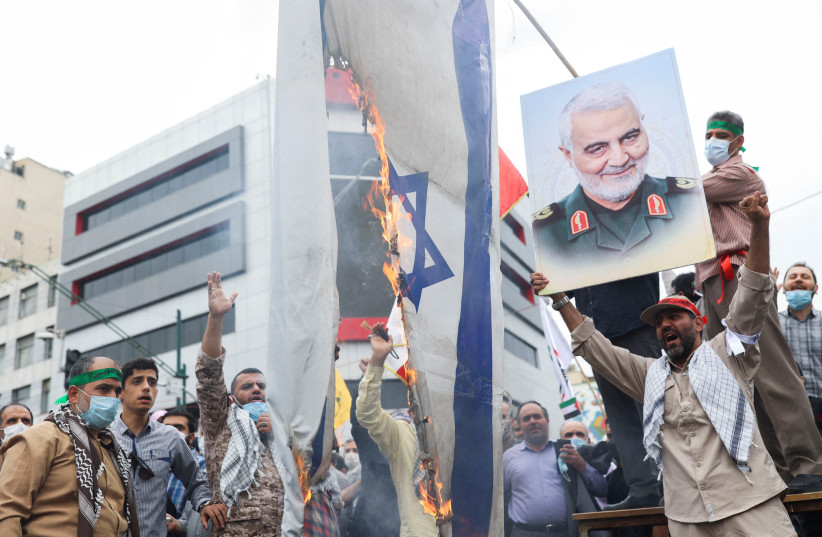
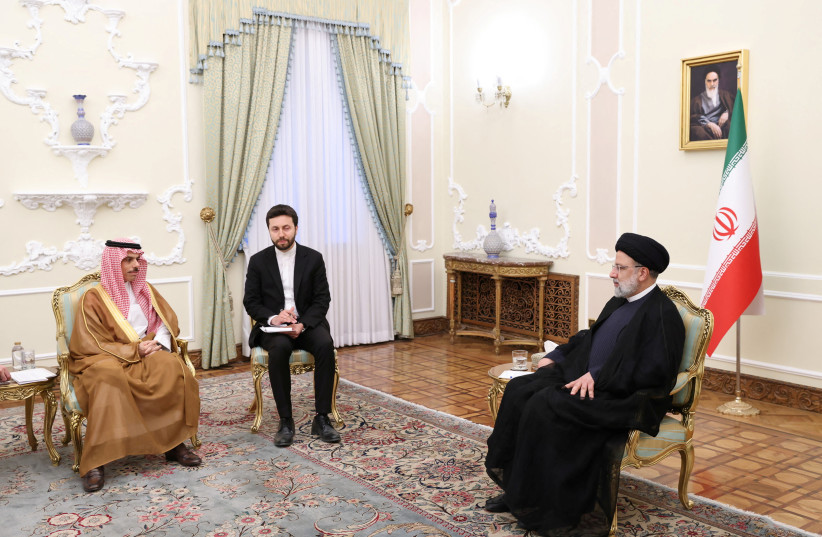
Last November, after 22 months of failed negotiations with the Iranians, President Joe Biden said the Iran nuclear deal was “dead.” In recent weeks, however, he has revived discussions with Tehran in a bid, reportedly, “to reduce tensions.” But that phrase hides more than it reveals. While Biden and his team claim to be working to halt the advance of the Iranian nuclear weapons program, their unstated goal is to constrain Israel, permanently.
Upon assuming office in 2021, Biden returned to the Middle East strategy originally charted by President Barack Obama, whose North Star was an accommodation with Iran. While Obama’s strategy represented an ambitious, regionwide realignment of American policy, he packaged it as a narrow arms control agreement. In truth, the Joint Comprehensive Plan of Action (JCPOA), as the nuclear deal is officially known, did not live up to its billing as a foolproof barrier blocking all of Iran’s pathways to a bomb. But it did succeed in moving the controversy over Iran’s nuclear weapons program off to one side, so that Obama and his team could open direct channels to Tehran, which, they believed, would help stabilize the Middle East.
Obama’s attempt to skirt the nuclear issue rather than solve it was key to the entire nature and structure of the JCPOA. The foundation for that agreement was set in 2013, at the beginning of Obama’s second term, when the U.S. president buckled to Iran’s demand that the United States recognize its self-proclaimed “right” to enrich uranium. At one stroke, Obama’s concession removed the most formidable barrier preventing Iran from developing a nuclear weapon—namely, American political will.
In its public statements, the Obama administration hid the crucial role of its concession in kickstarting the negotiations, presenting its Iran diplomacy instead as the result of the election of Hassan Rouhani, the Iranian president who took office in August 2013. With the help of an “echo chamber,” to borrow the phrase of Ben Rhodes, Obama’s deputy national security adviser for strategic communications, Obama and his team created the impression that a change of heart in Tehran (from an election, no less) had produced a new dawn in relations between the West and Iran. Moreover, by depicting the negotiations as a peace train driven by the twin conductors, Obama and Rouhani, they placed an insurmountable political obstacle before an Israeli attack on Iran. They checkmated, that is, Israeli Prime Minister Benjamin Netanyahu.
Officials in the Obama administration openly gloated over the victory. In 2014, once the negotiations for the JCPOA were well underway and the momentum toward a deal was unstoppable, the officials spun cartwheels in The Atlantic, their mouthpiece. Under cover of anonymity, one official famously called Netanyahu “chickenshit.” Embroidering on the theme, another said, “It’s too late for [Netanyahu] to do anything. Two, three years ago, this was a possibility. But ultimately, he couldn’t bring himself to pull the trigger. It was a combination of our pressure and his own unwillingness to do anything dramatic. Now it’s too late.”
Indeed, we now know that Obama and his team worked in parallel or together with sympathetic Israeli officials to block Netanyahu from launching an Israeli strike in the period 2009-12. Biden, who staffed his Middle East team exclusively with alumni from the Obama administration, is working today directly from Obama’s playbook. As Netanyahu and his advisers mull anew a unilateral strike, the Biden team is restarting the peace train by reviving the “dead” negotiations with Tehran. At the same time, it is applying pressure inside the Israeli political and security structure. A main goal of Biden’s policy toward Israel today is to create a political atmosphere that will encourage Israeli officials and military officers to identify with Washington rather than with the country’s elected leadership and geostrategic interests.
By now, the depth of the Democratic Party’s commitment to Obama’s regional strategy and tactics should be obvious. Almost two years ago, Biden officials defended their supine policy toward Iran by suggesting that it was a temporary posture, that their patience with Tehran was running thin, and that, if results weren’t forthcoming, a tougher policy would result. “We are committed to diplomacy, but this process cannot go on indefinitely,” Secretary of State Antony Blinken said in July of 2021. “Time is running short” for Iran, he said one month later. “If [Iran] doesn’t want to get back into the deal, if it continues to do what it appears to be doing now, which is to drag its feet at the nuclear diplomatic table and accelerate its pace when it comes to its nuclear program, if that’s the path it chooses, we’ll have to respond accordingly,” he said a month after that.
If patience is a virtue, Blinken is a saint. Since those expressions of flagging patience, the Islamic Republic has, to name just a few developments, brutally suppressed the worst protests in its history, advanced its nuclear weapons program considerably, pursued plots to murder former American officials on American soil, and developed a defense industrial cooperation with the Russian military—all while refusing to accept the generous terms for renewing a nuclear deal offered by Washington. None of these developments managed to try the patience of the Biden administration.
Why? Domestic political calculations partly explain Biden’s indulgence of Iran’s malignant behavior. Imagine how the progressives, the most dynamic element in the Democratic Party, would respond if Biden were to stand before them and admit, tacitly or explicitly, that President Donald Trump got it right: There is no purely diplomatic means to convince Iran to give up its nuclear program. “Maximum pressure” is the only rational way to deal with Tehran. The rebellion would be fierce and immediate. Progressives believe, as an article of blind faith, that a diplomatic path to better relations with Tehran exists. They resent Israel, its American supporters, and any policy designed to assist it.
But domestic politics is not the whole story. Among the American national security elite, there exists an entrenched school of thought supporting the Iran realignment, but which does not advertise its existence too loudly, for fear of running afoul of the pro-Israel community. That school of thought rests on five core convictions. First, the Middle East no longer matters as much to the United States as it once did. Second, America’s allies, Israel and Saudi Arabia, have forced the United States, historically, to take a tougher stance on Iran than is strictly necessary on the basis of a cold calculation of the American interest. Third, a major Israeli-Iranian conflict risks sucking the United States into a costly and unnecessary war with Iran. Fourth, offensive countermeasures, in the form of punitive military strikes or aggressive economic sanctions such as those imposed by the Trump administration, are also a slippery slope to war. Fifth, and most importantly, a war to stop Iran from acquiring a nuclear weapon is a worse outcome than simply containing a nuclear-armed Iran, just as North Korea, Pakistan, and other nuclear-armed states have been more or less successfully contained.
These convictions lead inexorably to the conclusion, always unstated, that Israel’s hostility to Iran is a threat to the national security of the United States. They turn managing Israel, suppressing its supposed bellicosity, into a strategic priority of American foreign policy.
Biden officials regard Netanyahu as their bête noire not simply because he openly objects to their approach or because he sides with Republicans, but because he is better positioned than anyone else to expose the egregious flaws of the strategy they favor, which is based on the assumptions that accommodation with Iran is both possible and in the American interest. Netanyahu is that rarest of things: a foreign leader to whom Americans directly listen as if he were one of their own. Israeli military capabilities amplify his voice and embarrass the administration.
Starting with Obama himself, supporters of the Iran realignment have never been open and honest with the American people about their true convictions. To advance their policy, they have always relied on misdirection, obfuscation, and half truths. Netanyahu has a unique gift for exposing this dishonesty.
He rests his case for military action on the time-tested logic of deterrence. If the United States and Israel truly seek to stop Iran from acquiring a bomb, then they must persuade Tehran that they will exact a price that is too painful for it to bear. Persuasion means taking military actions that demonstrate both a political and military capacity not just to punish Iran’s leaders once or twice but to follow them in a dynamic fashion as they proceed up the ladder of military escalation, to absorb whatever counterattacks they unleash and to answer them with even more punishing blows.
This task of persuasion is best done jointly. Ron Dermer, Israel’s minister of strategic affairs and one of Netanyahu’s closest confidants, explained the challenge in a podcast last December, before he joined the government. For the Iranian regime, Dermer explained, the nuclear program is the queen in the chess game; the regime itself is the king. “The only way that you’ll get Iran to give up its program peacefully is if the king is threatened,” he said. “They will only sacrifice the queen to save the king.” Israel, by itself, does not have the power to threaten the regime’s existence. The United States alone can threaten the king. “Without the U.S. credible military threat, no diplomacy will achieve a positive outcome. Nothing you do will achieve a positive outcome,” he added.
According to Dermer, Israel on its own perhaps has enough military capacity to prevent the Iranians from building a bomb, “but it will not get them to dismantle their nuclear capability.” Dermer might have added that, even when acting entirely alone, Israel’s ability to exact concessions from Iran increases exponentially if the United States offers it unqualified diplomatic support. Israel can strike Iran nuclear sites on the first day of the war, but on days two and three, it needs the convincing threat of American intervention to deter Iran from widening the conflict.
Based on this thinking, the Israelis have been proposing to the Biden administration a division of labor: They will carry out the strikes on sensitive targets, but the United States military must be visible in the background to deter Iran lest it be tempted to widen the war. Though it is thoroughly rational, Biden will never accept this proposal. Nor will he reject it outright. Although the roots of the Iran realignment extend deep into progressive soil, the Democratic Party cannot rule without the support of pro-Israel voters. In addition, it must also manage disgruntled allies, Israel above all, who regard the Obama-Biden perspective on Iran as utterly delusional.
Formulating a policy that looks, tastes, and feels like a pro-Israel orientation but that delivers Iran appeasement is no mean feat. To accomplish this illusion, Biden and his team are proceeding along four tracks simultaneously.
First, they express strong rhetorical support for Israel and its security. “There can be no doubt that we are walking the walk and not just talking the talk when we say that our commitment to Israel’s security is ironclad,” said Biden National Security Adviser Jake Sullivan at a recent appearance.
Second, they sponsor joint planning and exercises between the American and Israeli militaries.
Third, now that Israel is a member of U.S. Central Command (CENTCOM), the combatant command responsible for the Middle East, the United States is sponsoring greater coordination between Israel’s military and the militaries of other regional powers, working toward an integrated missile defense.
Fourth, Biden and his team are promoting normalization with Saudi Arabia.
None of these tracks—seen in isolation—is objectionable in any way. On the contrary, they belong, individually and collectively, in the category of “strongly advisable.” To an untrained eye, however, they create the impression, as consciously intended, that the administration is building a regional coalition, centered on Israel, designed to prevent Iran from acquiring a nuclear weapon. In fact, Biden and his team are building a new regional order, centered on accommodating Iran. The purpose of the four policies enumerated above is to mislead and restrain Israel and its supporters. Let’s take them one by one.
When it comes to military deterrence, actions send the most important messages. A recent exchange between Sen. Tom Cotton and Secretary of Defense Lloyd Austin at a Senate hearing was instructive. Since Biden had taken office, the exchange revealed, Iran and Iran-backed militias attacked American forces 83 times. The United States retaliated on only four occasions. “What kind of signal do we think this sends to Iran?” Cotton asked. If the United States refuses to lift a finger to deter attacks on Americans, it will never take military action to protect Israelis.
To the pro-Israel community, the administration presents its full slate of joint military exercises as an expression of deep love and affection. In reality, it is a “bear hug” tactic designed to incapacitate Israel’s military from pursuing independent action, like a strike on Iran’s nuclear facilities. Close cooperation between the two militaries allows the U.S. to monitor its partner more thoroughly and to penetrate and influence the officer corps, which, thanks to the turmoil in Israeli politics, is increasingly polarized, with some officers deeply disaffected from Netanyahu.
Integrated missile defense, also a bear hug tactic, will certainly deliver useful capabilities to Israel and to the Arab states who are also working with CENTCOM, but their value should not be exaggerated. They are purely defensive capabilities. According to General McKenzie, the former commander of CENTCOM, Iran now possesses “overmatch.” This assessment, based on military science that is not up for debate among serious national security professionals, means that Tehran and its proxies can send drones, ballistic missiles, and cruise missiles in configurations that will overwhelm even the most sophisticated missile defense systems in the world. The United States and Israel cannot deter Iranian attacks or prevent a nuclear breakout with purely defensive measures.
As for normalization with Saudi Arabia, it will likely happen one day, possibly relatively soon, but not before November 2024. The Saudis have well-founded concerns about the commitment of the Biden administration to their security—concerns based on the proven reluctance of Washington to prevent Iran from acquiring a nuclear weapon and to contain the ever-growing threat that its conventional military power poses. In return for normalizing relations with Israel, Riyadh has asked Washington for, among other things, security guarantees. Biden officials have demurred, precisely because doing so would require them to abandon their quest for a strategic accommodation with Tehran.
Of all Biden’s stratagems for misleading pro-Israel voters, advocating for normalization of relations between Israel and Saudi Arabia is the most delicious of all. The policy will not bear fruit, at least not in the short term. Washington will never give the Saudis what they are asking for, because, to repeat, doing so would sink the U.S. alignment with Tehran. Nevertheless, Prime Minister Netanyahu eagerly associates himself with Biden’s kabuki peace effort, thus fostering the impression of greater comity between him and the White House than truly exists. After all, no Israeli leader can publicly stand against either the U.S. or peace with Saudi Arabia. So Netanyahu is trapped.
In the end, when the policy fails to deliver tangible results, Biden and his team will enjoy the delightful opportunity of choosing whether to blame the Saudis, the Israelis, or both. “We tried hard,” they will tell us in November 2024, “but Riyadh just wasn’t ready to take the risk.” Progressives will eagerly note that Netanyahu, the leader of an “extremist” government, was unwilling to make the concessions on Palestinian statehood that might have brought the Saudis around. Call it the peace trap.
The “extremist” moniker brings us, lastly, to the intersection between Israeli domestic politics and Biden’s Iran realignment. No sooner did the controversy over Israel’s judicial reform erupt than the Biden administration hoisted the anti-reform banner. “They cannot continue down this road,” Biden said in March about the Netanyahu government’s support for the reform. When asked in response to that statement if he intended to invite Netanyahu to the White House, Biden answered, “No, not in the near term.” In recent days, he has doubled down on the snub by inviting President Isaac Herzog, who holds a purely ceremonial office, to visit the White House instead.
For Biden, the judicial reform controversy is a godsend. In fact, with respect to his priorities of preventing an Israeli strike on Iran and preserving the Iran realignment, it is a trifecta. First, it offers camouflage. Opponents depict the judicial overhaul as an attack on democracy by a corrupt ruler hellbent on instituting an autocracy based on extreme religious and religious nationalist elements. By associating himself with this critique, Biden disguises his fight with Netanyahu over Iran policy to look like a principled dispute over “democratic values,” in which Biden rather than Netanyahu seizes the high ground.
Second, the dispute distracts the Jewish diaspora. The more America’s pro-Israel community debates judicial reform and the ideological character of the Netanyahu government, the less it will concentrate on fighting Biden’s Iran appeasement.
Last week, a senior Biden administration official harshly criticized Amichai Chikli, Israel’s diaspora affairs minister, for calling the Jewish progressive organization, J Street, a “hostile organization” and for calling one of its funders, billionaire and progressive activist George Soros, “one of the greatest haters of Israel in our times.” Chikli, the anonymous Biden official said, “does not understand the American Jewish diaspora.” The official added that Chikli’s “comments have ramifications. The Biden administration is watching.” Clearly, if Biden has his way, many Jews will see him, not Netanyahu, as their community’s true champion.
Third, and most importantly, the judicial reform sows discord between the top ranks of the Israeli military and the political leadership. “[T]he growing rift in society is penetrating the IDF and the defense institutions,” said Minister of Defense Yoav Gallant on March 25. “This is a clear and present danger to the security of the state,” he continued, in a public appeal to halt the reform legislation. Netanyahu responded by sacking Gallant, only to reinstate him two weeks later, in response to public outcry. Even some supporters of the judicial reform balked at Netanyahu’s reaction. They understood Gallant, a career military officer before joining politics, to be sincerely conveying the concerns of military officers to the national leadership.
When Netanyahu debated about whether to reinstate Gallant, he no doubt mulled over the 2009-12 standoff between him and the IDF leadership over a strike on Iran. Top Israeli security officials, reportedly including Ariel Sharon’s close confidant Meir Dagan, played a restraining role, in close communication with the Americans. Whatever Gallant thinks about the judicial reform, he agrees with the prime minister on Iran. If push comes to shove, he won’t side with Biden. Indeed, Netanyahu packed the entire security cabinet with political loyalists and Iran hawks, precisely to avoid a replay of 2009-12.
But every strategy has its point of weakness. Three names in the security cabinet deserve special attention: Justice Minister Yariv Levin, Minister of National Security Itamar Ben-Gvir, and Minister of Finance Bezalel Smotrich. When opponents of the judicial reform depict it as a religious nationalist putsch, they point to these three men, together with Simha Rothman, the chair of the Knesset’s Constitution, Law, and Justice Committee, as the architects of the supposed coup. Regardless of the truth, these accusations fill the air in Israel today. If Netanyahu were to rely on these ministers to order a strike on Iran, the Biden administration would undoubtedly steal a page from Obama’s playbook and amplify the accusations, feeding to the American and Israeli press lines such as, “The most extreme government in Israel’s history is dragging Israel and the United States into a reckless war against Iran.”
This prospect undoubtedly weighs on the minds of Israeli generals today. An attack on Iran large enough to set back the Iranian nuclear program for years could potentially spark a major war between Iran and Israel. Schooled in the thinking of Israel’s founder, David Ben-Gurion, Israeli generals refrain from starting wars without great power support. In 2012, especially, they mounted significant opposition to the planned strike against Iran and thereby denied Netanyahu a needed majority in the security cabinet. Would they behave any differently today?
Attacking Iran would be the challenge of a lifetime for Netanyahu even in the best of circumstances. To launch a strike while his society is bitterly divided over his premiership, while his security cabinet is at odds with the military brass, and while the Americans drip poison in the ears of his own generals would be nearly impossible.
Perhaps for that reason, Netanyahu shows signs of acquiescing in the interim deal that Biden is now cooking up with the Iranians. According to press reports, Iran will refrain from enriching uranium beyond 60%, and in return the U.S. will refrain from imposing stricter sanctions and will release Iranian assets worth billions of dollars. The deal is a victory for Iran, because it blesses a status quo on enrichment that violates previous red lines drawn by both Israel and the United States while also failing to address areas other than enrichment in which Iran’s nuclear weapons program continues to advance.To be sure, the Israeli prime minister is guarding his freedom of action by saying that Israel will not be bound by any agreement between Washington and Tehran. But on June 14, he also reportedly said, “What’s on the agenda at the moment between Washington and Tehran is not a nuclear deal, it’s a mini-deal. We will be able to handle it.”
With that statement, Biden’s bête noire signaled that between now and November 2024, he will take no military action that will disrupt the president’s reelection prospects. Nor will he disrupt the realignment. With each passing day, Iran appeasement becomes the baseline American policy toward the Middle East. Iran’s atomic weapons enterprise grows larger, more sophisticated, and more hardened against attack. The Biden administration says it is protecting Israel and preventing Iran from acquiring a nuclear weapon. It is d




 nnouncing its new Iran deal