PM Benjamin Netanyahu has repeatedly said that any deal between Washington and Tehran will not stop Jerusalem from taking steps against a nuclear Iran.
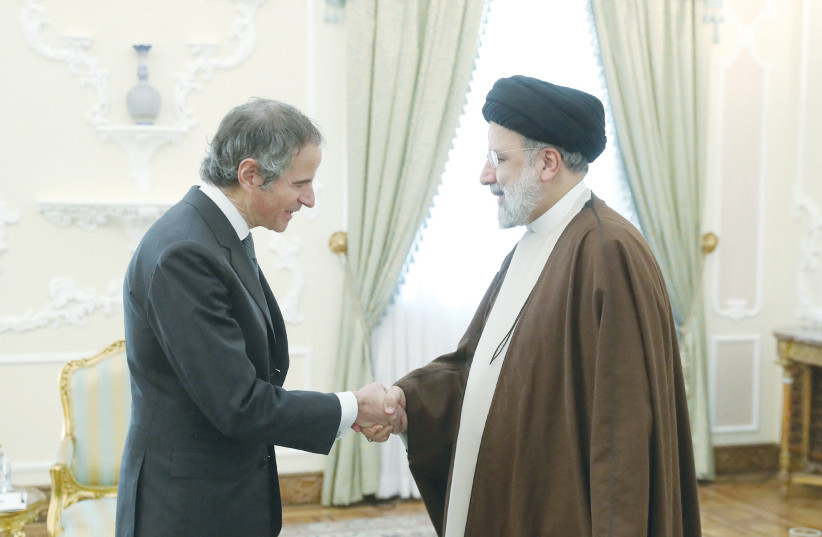
IRANIAN PRESIDENT Ebrahim Raisi meets with IAEA Director-General Rafael Grossi in Tehran in March. The writer says US President Joe Biden may grant Raisi an end to all IAEA investigations
(photo credit: Iran’s Presidential Website/West Asia News Agency/Reuters)
“If [the] Iranians miscalculate, the potential for a strong Israeli response is something that we want to avoid,” the official said.
The Prime Minister’s Office declined to comment.
Prime Minister Benjamin Netanyahu has repeatedly said that any deal between Washington and Tehran will not stop Jerusalem from taking steps against the threat of a nuclear Iran.
“Our stance is clear: No agreement with Iran will oblige Israel,” Netanyahu said in the Knesset last week. “Israel will continue to do everything to defend itself.”
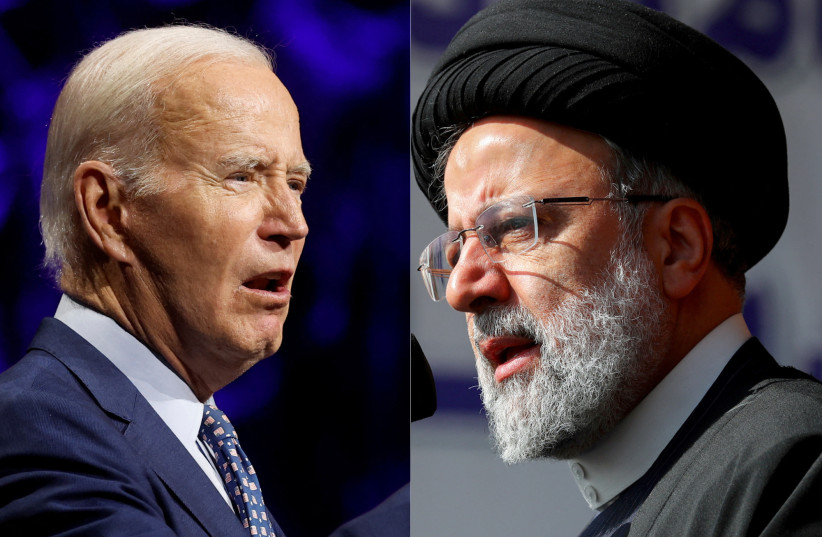
US President Joe Biden and Iranian President Ebrahim Raisi. (credit: Iran’s President Website/WANA (West Asia News Agency)/Handout via REUTERS, REUTERS/JONATHAN ERNST)
Knesset Foreign Affairs and Defense Committee chairman Yuli Edelstein said on Saturday night that “Israel can live with the ‘mini-agreement’ because there is oversight.”
“Iran is a nuclear threshold state and is becoming soundly established as such,” Edelstein said.
He warned that “Iran is gaining abilities [and] Ukraine became an excellent platform for testing them…We need to keep an eye on this.”
What does the expected deal contain?
The US and Iran negotiated the expected deal in recent weeks via Oman, after talks to revive the 2015 nuclear agreement failed last year. The new agreement, which is expected to be a series of unwritten understandings, would have the US provide sanctions relief in exchange for Iran limiting its nuclear program.
It would have Iran halt its uranium enrichment at 60% purity, far beyond the 3.67% permitted in 2015, but below the 90% needed for a nuclear weapon. The US warned in the talks that it would exact a heavy price from Iran if it enriches to 90%.
Iran would also free Americans it is holding in prison, stop selling ballistic missiles to Russia and stop its proxies’ attacks on US contractors in Syria and Iraq, according to The New York Times.
The US would waive nearly $20 billion in sanctions, and not add further sanctions or pursue resolutions against Iran in the UN Security Council or the International Atomic Energy Agency.
The Biden administration has sought to reach informal understandings with Iran, rather than a written agreement, to circumvent the Iran Nuclear Agreement Review Act (INARA), which requires the president to give Congress the text of any deal regarding Iran’s nuclear program and triggering a 30-day review period.
US House of Representatives Foreign Affairs Committee Chairman Michael McCaul, a Republican, wrote to Biden, a Democrat, on Thursday, saying “any arrangement or understanding with Iran, even informal, requires submission to Congress.”
State Department spokesperson Matt Miller denied there was any deal with Iran.
“We continue to use diplomatic engagements to pursue all of these goals.”
State Department spokesman Matt Miller
However, Miller said the United States wants Iran to de-escalate tensions and curb its nuclear program, cease support for regional proxy groups that carry out attacks, halt support for Russia’s invasion of Ukraine and release detained American citizens.
“We continue to use diplomatic engagements to pursue all of these goals,” Miller added, without giving details.
An Iranian official told Reuters, “call it whatever you want, whether a temporary deal, an interim deal or a mutual understanding – both sides want to prevent further escalation.”
Meanwhile, Saudi Foreign Minister Prince Faisal bin Farhan visited Iran on Saturday.
Prince Faisal called for “cooperation among all regional countries to ensure that it is free of weapons of mass destruction.”
Speaking after talks with his Iranian counterpart Hossein Amirabdollahian in Tehran, Prince Faisal also said the Saudi king and crown prince are looking forward to Iranian president Ebrahim Raisi “accepting the invitation to visit the Kingdom soon, God willing.”
Iran and Saudi Arabia agreed in March, in a deal brokered by China, to end a diplomatic rift and reestablish relations following years of hostility that had endangered regional stability including in the Gulf, Yemen, Syria and Lebanon.
Amirabdollahian told a televised joint media event that security was vital for regional countries.
“Iran has never equated security with militarism but sees it as a broad concept including political, cultural, social, economic and trade aspects,” he said.
Google Translate’-like program for Akkadian cuneiform will enable tens of thousands of digitized but unread tablets to be translated to English. Accuracy is debatable
A selection of Akkadian cuneiform translated with AI. (courtesy, Gai Gutherz)
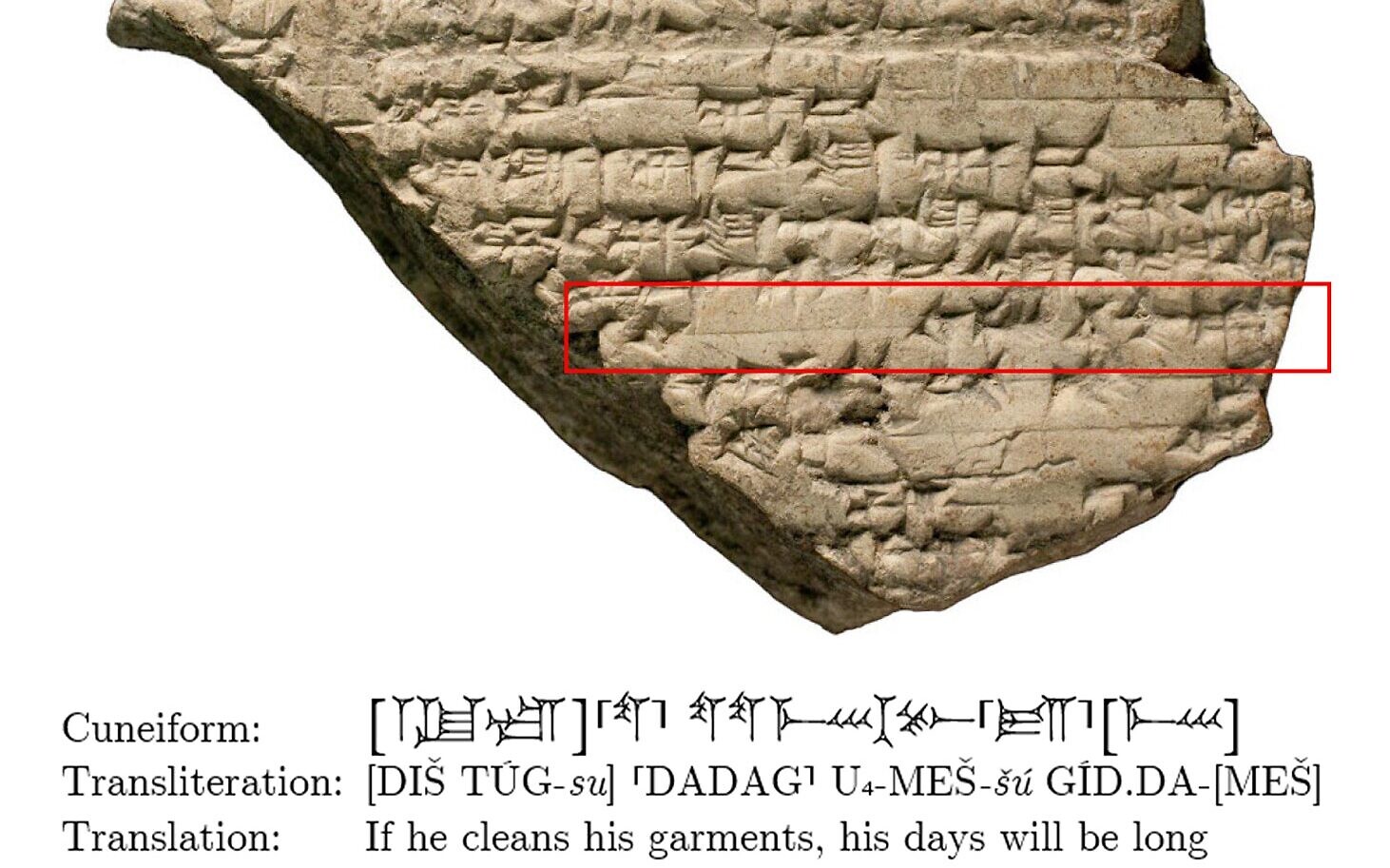
Tablet Inscribed with a Fragment of the Babylonian Flood Story Epic of Atrahasis in Akkadian, Mesopotamia, First Dynasty of Babylon, reign of King Ammi-saduqa (ca. 1646–1626 BCE) (The Morgan Library & Museum)
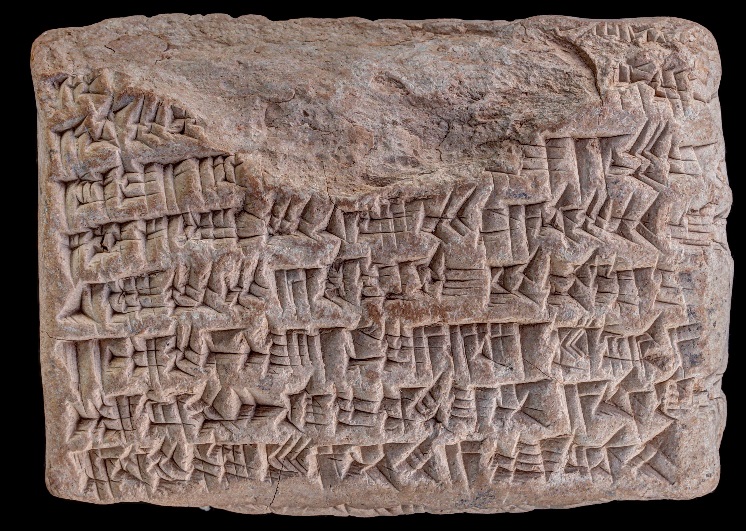
Reverse side of Neo-Babylonian cuneiform tablet YBC 3831 with upper broken section. (Courtesy of the Yale Peabody Museum of Natural History, the Yale Babylonian Collection/Photography: Klaus Wagensonner)
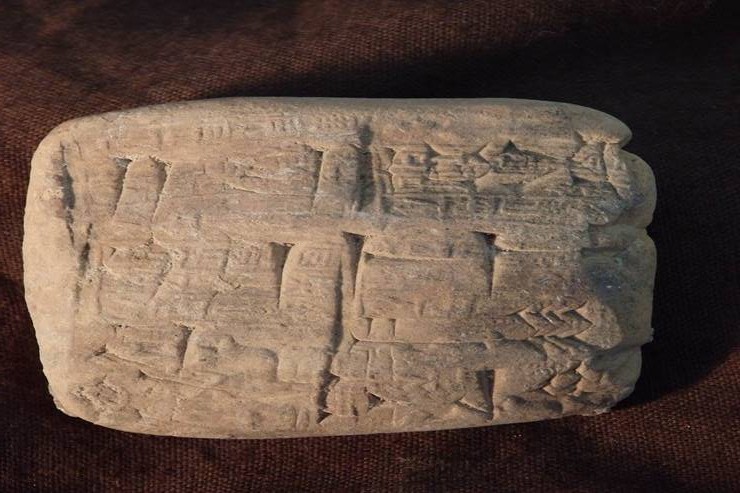
Cuneiform tablets that were falsely labeled as product samples and shipped to Hobby Lobby Stores. (US Attorney’s Office for the Eastern District of New York)
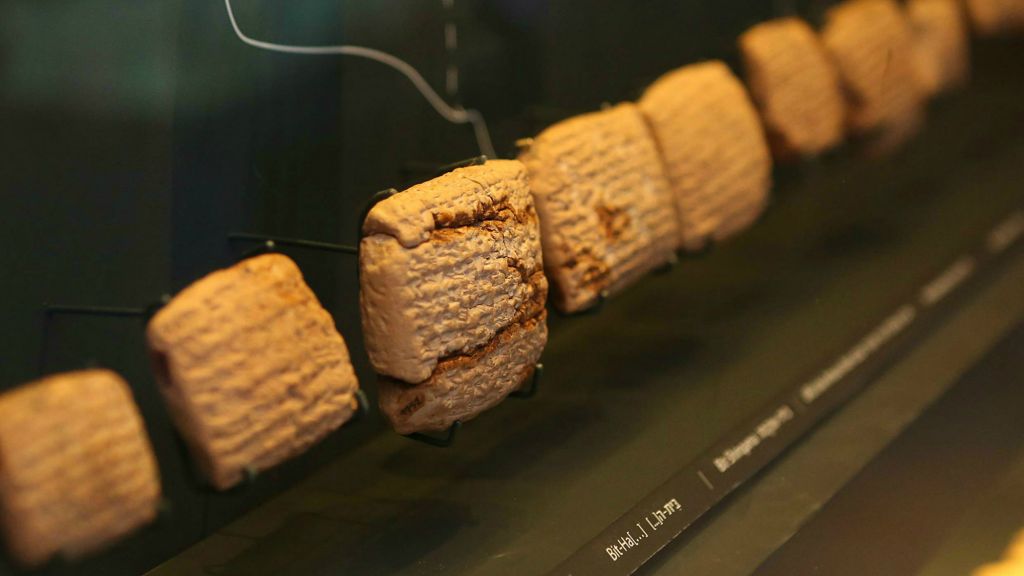
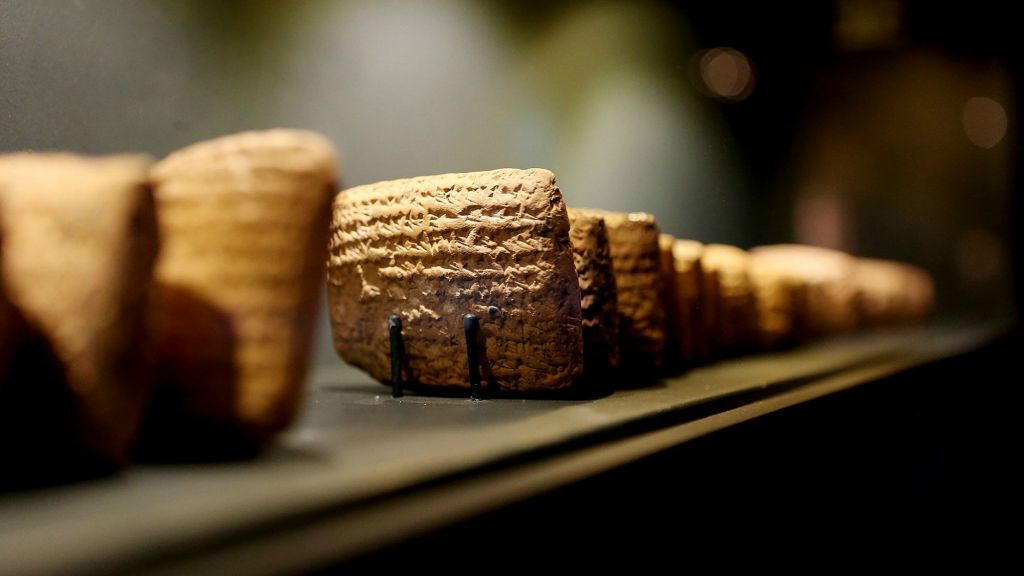
This undated photo provided by the Bible Lands Museum Jerusalem shows tablets containing cuneiform writing, one of the world’s earliest scripts, on display in Jerusalem. (AP Photo/Avi Noam, Bible Lands Museum)
Cuneiform is the oldest known form of writing, but it is so difficult to read that only a few hundred experts around the world can decode the clay tablets filled with wedge-shaped symbols. Now, a team of archaeologists and computer scientists from Israel has created an AI-powered translation program for ancient Akkadian cuneiform, allowing tens of thousands of already digitized tablets to be translated into English instantaneously.
Globally, libraries, museums, and universities have more than half a million clay tablets inscribed with cuneiform. But the sheer number of texts, and the tiny number of Akkadian readers — a language no one has spoken or written for 2,000 years — means just a small fraction of these tablets have been translated.
A new Google Translate-type program may allow armchair archaeologists to try their hand at cuneiform interpretation.
Into the Land: A Tale of Two Cities
Loaded: 21.50%
“What’s so amazing about it is that I don’t need to understand Akkadian at all to translate [a tablet] and get what’s behind the cuneiform,” said Gai Gutherz, a computer scientist who was part of the team that developed the program. “I can just use the algorithm to understand and discover what the past has to say.”
The project began as a thesis project for Gutherz’s masters degree at Tel Aviv University. In May, the team published a research paper in the peer-reviewed PNAS Nexus, from the Oxford University Press, describing its neural machine translation from Akkadian to English.
Get The Times of Israel’s Daily Editionby email and never miss our top stories
Neural machine translation, also used by Google Translate, Baidu translate, and other translation engines, works by converting words into a string of numbers, and uses a complex mathematical formula, called a neural network, to output a sentence in another language in a more accurate and natural sentence construction than translating word-for-word.
This undated photo provided by the Bible Lands Museum shows tablets with cuneiform writing, one of the world’s earliest scripts, on display in Jerusalem. (AP Photo/Avi Noam, Bible Lands Museum)
Akkadian was written and spoken in Mesopotamia and the Middle East from around 3,000 BCE to 100 CE. It was the lingua franca of the time, allowing people from different regions to communicate. The language split into Assyrian Akkadian, and Babylonian Akkadian around the year 2000 BCE. Starting around 600 BCE, Aramaic slowly began to replace Akkadian, until it became much more widely spoken.
Akkadian and its predecessor, Sumerian, were written using cuneiform, in which a sharpened reed creates wedge-shaped markings on a wet piece of clay. The Akkadian and Sumerian cuneiform are the earliest written languages ever discovered, though there are vastly more Akkadian than Sumerian texts available.
Translating all the tablets that remain untranslated could expose us to the first days of history
“Translating all the tablets that remain untranslated could expose us to the first days of history, to the civilization of those people, what they believed in, what they were talking about, what they were documenting,” said Gutherz.
Some of the translated tablets have information that is still relevant today. “If he cleans his garments, his days will be long,” according to one Akkadian scribe more than 3,000 years ago.
Tablet Inscribed with a Fragment of the Babylonian Flood Story Epic of Atrahasis in Akkadian, Mesopotamia, First Dynasty of Babylon, reign of King Ammi-saduqa (ca. 1646–1626 BCE). (The Morgan Library & Museum)
The team is also sharing its opensource research online, in the hope that other experts can create translation programs for other ancient or dead languages, Guetherz said.
Lost in translation?
Translation is an art form, so it can be difficult to measure numerically what constitutes a “good” translation, Gutherz said. In order to rate the translations, the researchers used the Best Bilingual Evaluation Understudy 4 (BLEU4), an evaluation tool developed in the early 2000s to automatically measure the accuracy of machine-created translations.
According to the study, the neural machine translation provided a BLEU4 score of 36.52 for cuneiform to English, and a score of 37.47 for transliterated cuneiform to English. BLEU4 scores are from 0 to 100, with 0 being the lowest and 100 being a perfect translation, which even a human translator could not achieve. Around 37 is considered fairly good for an early-stage translation model, explained Gutherz.
Gutherz said that Google Translate, a privately-funded commercial tool that has been in existence for over a decade, would get a BLEU4 score of about 60 translating from Spanish to English.
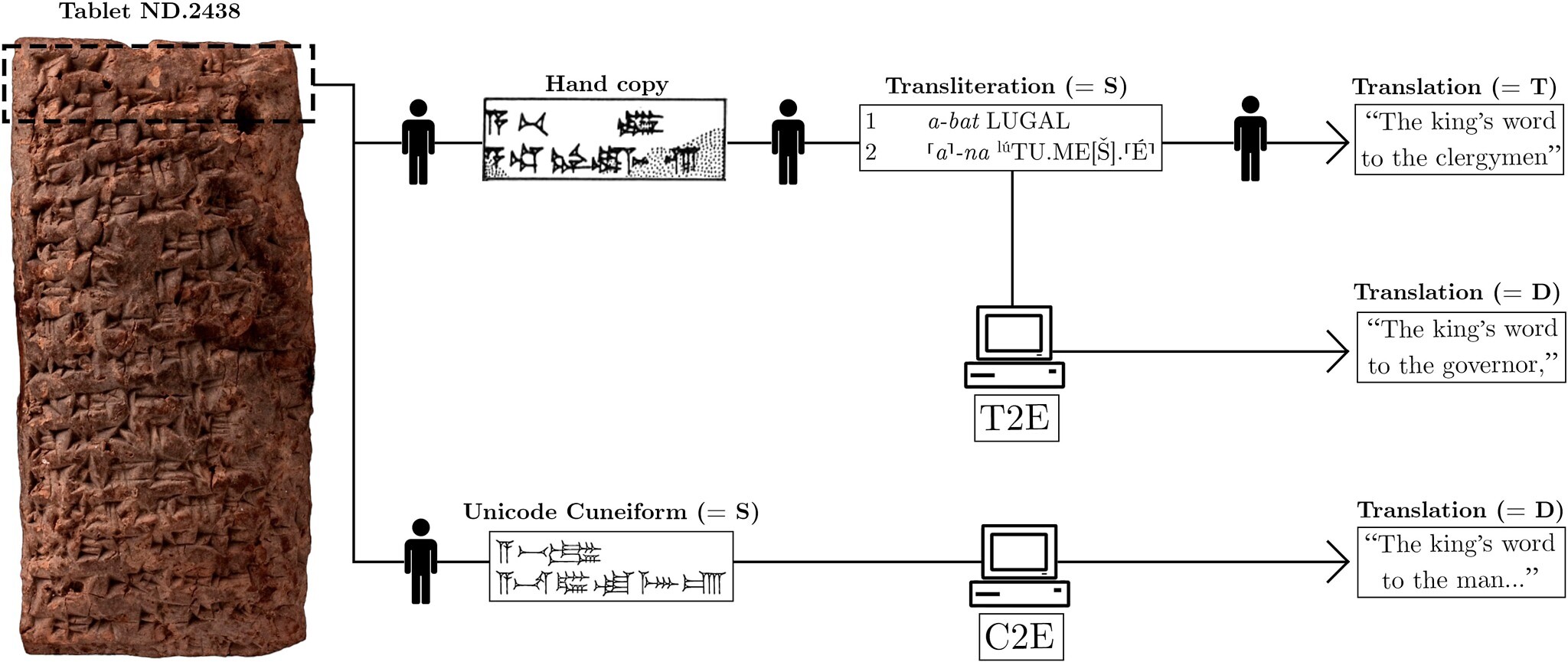
“One of the main achievements in the research is we showed that it’s possible to get a high-quality translation going directly from cuneiform to English,” said Gutherz, who was previously a software engineer for Google and is now starting an AI business involving different technology from this project. The current time-consuming research process usually requires experts to translate the cuneiform first to the Latin transliteration, and then largely to English.
A rendering of how AI translates Akkadian cuneiform into English, using Latin transliteration or going straight to English. (courtesy Gai Gutherz)
In 2020, Gutherz, archaeologist Prof. Shai Gordin of Ariel University, and others published a paper about using AI to translate Akkadian cuneiform to a transliterated Latin script. The transliterated script reads as a nonsensical collection of letters and numbers to the untrained eye, but is a common “language” that allows archaeologists and researchers to study and discuss cuneiform across the world.
In the 2020 paper, the team was able to use AI to achieve 97 percent accuracy from Akkadian cuneiform to transliterated Latin script. This is a much simpler process since it works by translating the cuneiform symbols to a single word, and keeping the words in the same order that they were found.
Translating Akkadian to English or transliterated script to English is a much more complicated process because it requires the computer to string together full phrases or sentences that make sense in English, which is written in a different syntactical order.
Some translations were very good… and some were total ‘hallucinations’
Gutherz said that despite the complexity, the AI translations performed better than expected, though the program is still in the early stages and far from precise. Predictably, the AI had a higher level of accuracy for formulaic texts, such as royal decrees or divinations, which follow a certain pattern. More literary and poetic texts, such as letters from priests or treaties, had a higher incidence of “hallucinations,” an AI term meaning that the machine produced a result that is completely unrelated to the text provided.
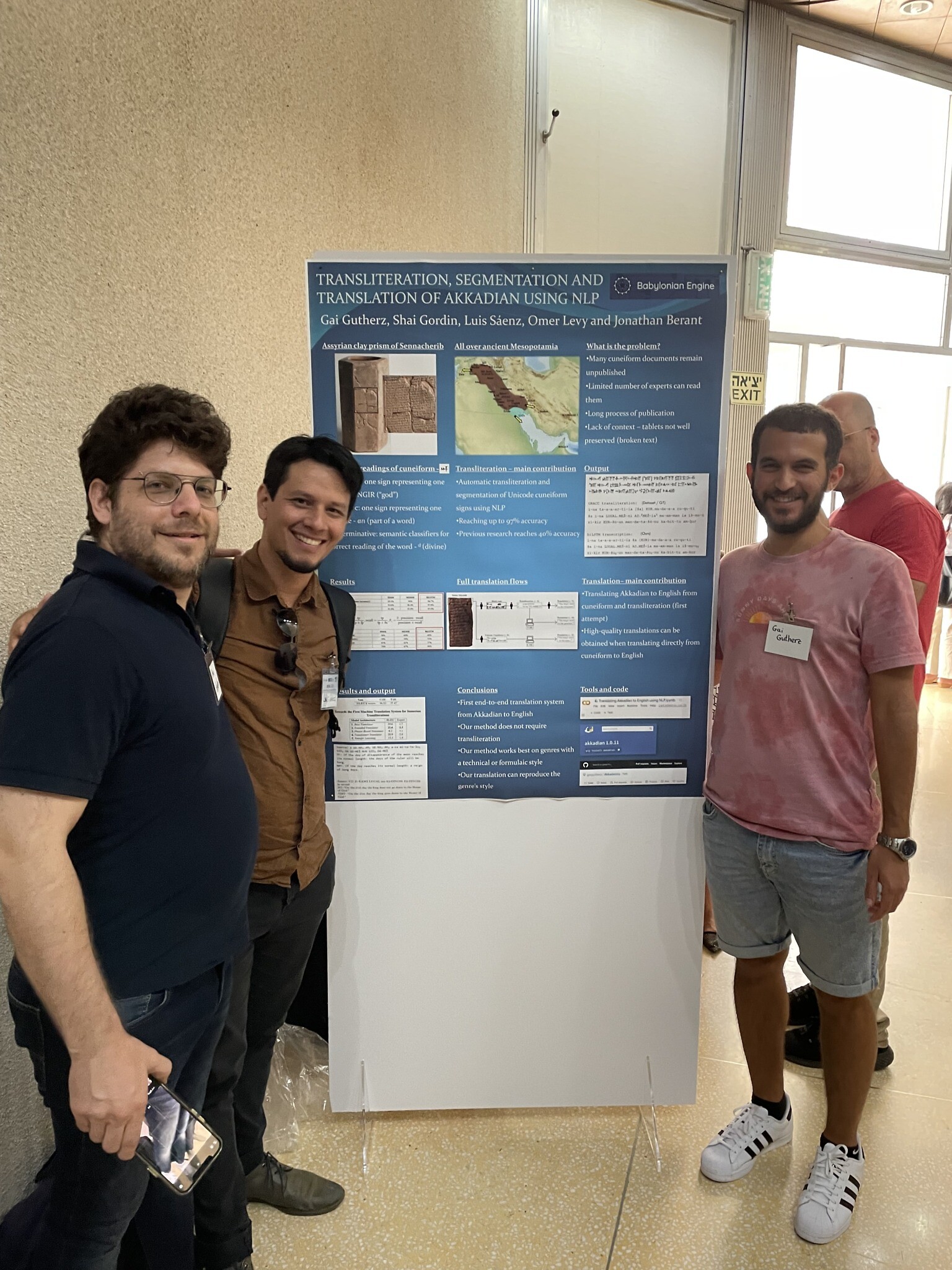
Members of the team that piloted AI to translate Akkadian cuneiform present their work at a conference. (courtesy, Gai Gutherz)
One of the things that most surprised the researchers is that the translations captured the style or rhythm of a certain genre so that they could determine — simply based on the style of the translation — if the text was a formulaic legal document, astrological report, or scholarly letter.
“Some translations were very good, some were near the point, where you could start from it, but you would have to make it more accurate manually, and some were total hallucinations,” said Gutherz. “This is the first step for an automatic translation for Akkadian and ancient languages, and I really hope more research will be done in this area and translations will get better and have higher accuracy.”
Just like Google Translate
The biggest challenge for training the AI model was the limited amount of material — images of tablets and translated tablets — that the team had available to train the AI model. Even the largest online databases of Akkadian tablets have only tens of thousands of entries.
“The amount of data you train on is correlative to how well you can perform, and the more data you have, the better your models will be,” said Gutherz. “ChatGPT works so well because they managed to train it on basically the entire internet. For us, the main task at the beginning was to gather all the possible translations we could get, to generate as many examples as possible.”
Gai Gutherz, part of the team that is piloting AI to translate Akkadian cuneiform. (courtesy)
The team drew their samples from ORACC, the Open Richly Annotated Cuneiform Corpus, an online database from the University of Pennsylvania. For the data they were able to scan, the researchers used 90% of the material for training (50,544 sentences), 5% for validation (2,808 sentences), and 5% for testing (2,808 sentences).
During the 3,000 years that Akkadian was used, there are massive variances. Written Akkadian from 1,000 years apart can have completely different cuneiform symbols, and there were differences in dialects, which add to the complexity.
Gutherz said he decided to take on ancient languages for his final project in natural language processing (NLP), after archaeologist Prof. Shai Gordin, a senior lecturer in Assyriology and Digital Humanities at Ariel University, made a presentation to his NLP class.
Not many researchers are trying to use modern computer science methods to try to work on ancient languages
“I’m interested in history, I think it has a lot to teach us,” said Gutherz. “I realize that not many researchers are trying to use modern computer science methods to try to work on ancient languages. It’s a field that I felt I could contribute to because it’s not in the spotlight… not many people are working on it.”
Not all Akkadian experts are lining up to use the new technology, though.
“I’m an old school philologist who’s sitting at a table, looking at the tablets and reading them as humans used to do for thousands of years,” said Prof. Nathan Wasserman, a professor of Assyriology at the Institute of Archaeology at the Hebrew University of Jerusalem. He looked into the AI translation opportunities in the paper, but is not convinced that they would be useful for him.
“We’re post-ChatGPT and we’re in a different world now, so if I say, ‘It won’t work,’ that makes me look stupid,” Wasserman said. “Of course, it will work, I didn’t land from the moon yesterday. But for deeper and less formulaic texts, this is still very far from being useful.”
Prof. Nathan Wasserman, professor of Assyriology at the Institute of Archaeology at the Hebrew University of Jerusalem. (courtesy)
Wasserman’s area of expertise is the most complicated and poetic Akkadian texts, including hymns, prayers, and myths, often found on tablets that are in the worst condition and exceptionally difficult to read. His work is not just about translating, but about understanding the context within Akkadian culture and literature, he said. And he is interested in watching the way this technology develops, even if he is not rushing to use it now.
“I’m old enough to remember the start of Google Translate, and it was a joke, but now you can do large amounts of texts and get a decent result, plus or minus,” he said. “But what happens if you put Hamlet into Google Translate, will you get a decent translation of Shakespeare’s Hamlet?”
Wasserman said he thinks that AI can be most useful to scan large bodies of digitized tablets and try to find connections. For example, the names of a certain priest or king could pop up on two totally unrelated tablets, maybe even ones that were found in different locations and are housed at different libraries and could lead to new understandings. He is also curious about using the program to track statistics about different word usage, including the chronological or geographic distribution of certain words.
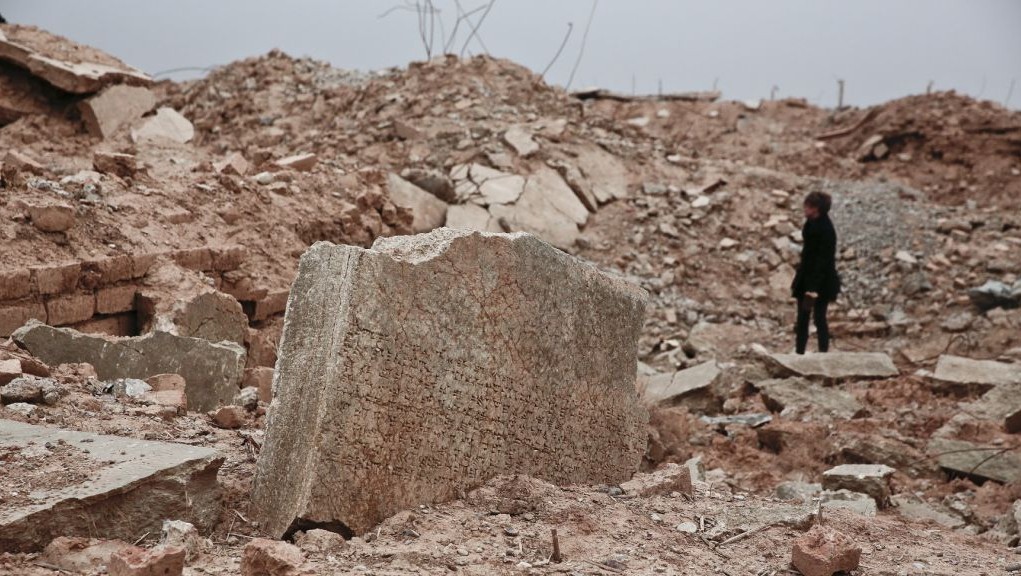
A stone tablet with cuneiform writing is seen in the foreground, as UNESCO’s Iraq representative, Louise Haxthausen, documents the damage wreaked by the Islamic State group at the ancient site of Nimrud, Iraq, on December 14, 2016. (AP Photo/Maya Alleruzzo)
Wasserman counts himself among the “old school” researchers, but he is no enemy to using technology for ancient languages. Wasserman was part of the team that developed SEAL, Sources of Early Akkadian Literature. The online database, hosted by Hebrew University, was one of the pioneering digitization projects of Akkadian cuneiform tablets when it started in 2010. Newly digitized tablets are still uploaded on a regular basis, and the site today remains one of the largest deposits of Akkadian literary works from 3000-1000 BCE.
“I’m not worried [about AI], I’m curious, it’s a brave new world and I’m curious to see what will happen,” he said. “It’s not like I’m working in a bank, and worried I’ll be sent home because a machine will do my work.”
“When you have a text, even when you have the words correct, it doesn’t mean you understand what’s there. For that, you still need the human mind,” he said. “I’m not afraid of [the AI], but also, we should not be totally infatuated with it. It should be evaluated for what it can do for us, and for what it cannot.”
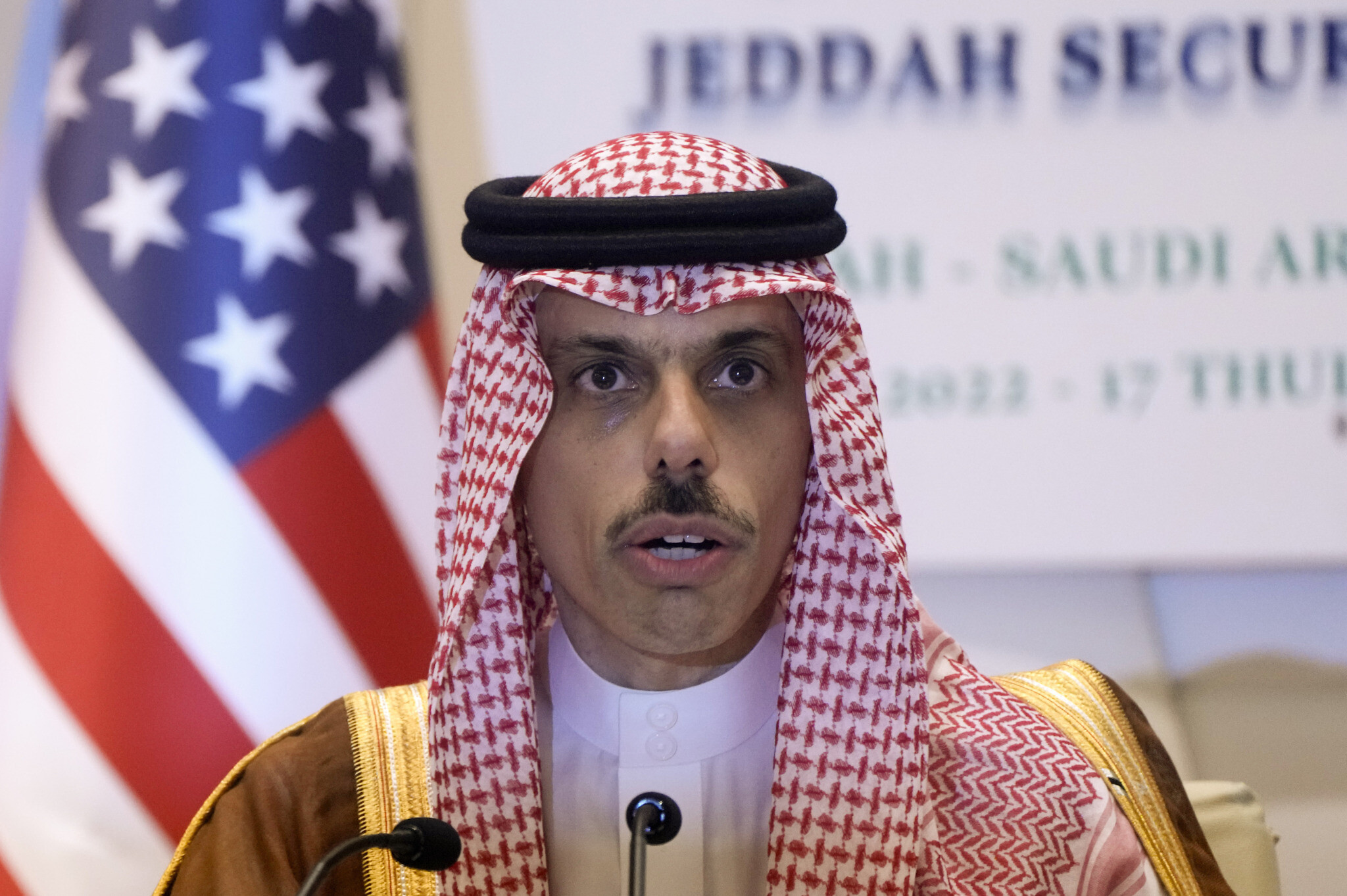
Saudi Foreign Minister Prince Faisal Bin Farhan Al Saud speaks during a press conference after the end of Security and Development Summit in Jeddah, Saudi Arabia, July 16, 2022. (AP Photo/Amr Nabil)
TEHRAN, Iran — Saudi Arabia’s top diplomat is coming to visit Tehran, the latest step in the restoration of diplomatic ties between the two Mideast rivals, according to a statement from Iran on Friday.
The statement said Saudi Foreign Minister Prince Faisal bin Farhan will meet his Iranian counterpart, Hossein Amirabdollahian, on Saturday. Prince Faisal is also expected to officially inaugurate the kingdom’s embassy in Tehran.
Both nations resumed the work of their diplomatic missions in the other country in recent weeks.
Into the Land: A Tale of Two Cities
Loaded: 5.25%
The Iranian foreign minister’s visit comes after a visit to Saudi Arabia by the US Secretary of State Antony Blinken earlier in June.
In March, Iran and Saudi Arabia agreed to reestablish diplomatic relations and reopen embassies after seven years of tensions.
It was a major diplomatic breakthrough negotiated by China, lowering the chance of further conflict between Riyadh and Tehran — both directly and in proxy conflicts around the region.
Iran has been blamed for a series of attacks in recent years following the United States’ unilateral withdrawal from Iran’s nuclear deal with world powers in 2018, including one targeting the heart of Saudi Arabia’s oil industry in 2019, temporarily halving the kingdom’s crude production.
Relations between the predominately Shiite Iran and the majority Sunni Saudi Arabia have long been tense. The kingdom broke ties with Iran in 2016 after protesters invaded Saudi diplomatic posts there. Saudi Arabia had executed a prominent Shiite cleric with 46 others days earlier, triggering the demonstrations.

 US President Joe Biden and Iranian President Ebrahim Raisi. (credit: Iran’s President Website/WANA (West Asia News Agency)/Handout via REUTERS, REUTERS/JONATHAN ERNST)