
Iraq ‘Gradually Turning Into a Source of Threat’ to Israel

(TPS) Last month, almost two years after the United States announced the end of combat missions in Iraq, the White House extended an emergency decree regarding the country due to what it called ongoing obstacles to its orderly reconstruction, peace and security.

The Biden administration said in its decree that “the development of political, administrative, and economic institutions in Iraq continue to pose an unusual and extraordinary threat to the national security and foreign policy of the United States.”

There are growing signs, however, that Iraq is also gradually posing an unusual—and more geographically immediate—threat to Israel.

The Iranian-backed Iraqi Popular Mobilization Forces (PMF), which recently threatened the 2,500 U.S. forces stationed in the country, are a member of the Iranian-backed radical axis, and cooperate with Hezbollah, as well as with Shi’ite militias in Syria.

One PMF group, Golan Liberation Brigade, as its name suggests, was set up to fight Israel. Some of the Iraqi militias are also active in Syria, such as Harakat Hezbollah al-Nujaba, which is activated by the Iranian Quds Force.

In 2019, international media reports said Israeli aircraft or drones struck PMF bases in Iraq—a report that, if true, would suggest that Iran has transferred weapons to Iraq for future use against Israel.

Danny (Dennis) Citrinowicz, a senior research fellow at the Tel Aviv-based Institute for National Security Studies, assessed that the significant threat to Israel stemming from Iraq involves armed unmanned aerial vehicles.

“In the past, there was a claim of an attempted UAV launch from Iraq at Israel during ‘Operation Protective Edge’ [in 2014, against Hamas in Gaza],” said Citrinowicz, who served for 25 years in a variety of command positions in the Israel Defense Forces’ Military Intelligence Directorate.

He added that Shi’ite militias in Iraq have themselves said that they are building up UAV capabilities, noting that they attack American targets in Syria using UAVs on a regular basis.

Professor Eyal Zisser, vice rector of Tel Aviv University and chair in Contemporary History of the Middle East, told the Tazpit Press Service that Iraq is “slowly turning into a source of threat.”

He argued that since Hezbollah wants to maintain a quiet border with Israel, while in Syria the Assad regime, concerned about Israeli reprisals, does not wish to give Iran a free hand, Iraq becomes “a comfortable arena—from which one can fire missiles at Israel without entanglement, and without the finger of blame falling directly on Iran.”

According to Zisser, the missile threat from Iraq is small, and can’t be compared to that posed by Hezbollah’s enormous arsenal. However, he said, any projectile fire out of Iraq “would create a lot of noise— including media [coverage] in Israel.”

Citrinowicz noted that Iraqi militia leaders have stated—including during the recent May escalation between Israel and Palestinian Islamic Jihad, that “they would not hesitate to attack Israel,” adding that it is clear that they are part of the Iran-backed axis, and part of the trend of unifying multiple arenas.

In light of their growing proximity to Hezbollah in recent years—particularly after the death of Quds Force Commander Qassem Soleimani in a January 2020 U.S. drone strike in Baghdad, Citrinowicz said it would be correct to assume that the threat from Iraq is taking shape, in practice, through the actions and declarations of the militia heads.

Zisser noted that in Iraq, the Islamic Revolutionary Guard Corps’ Quds Force is the organizer and funder of the Shi’ite militias, giving the elite extraterritorial Iranian force a significant role there.

At the same time, he added, Iraq has not yet fully fallen “into Iran’s pocket, and there are various streams, including within the Shi’ite sect, some of which are hostile to Iran.”

PMF militias are upset over what they see as Iraqi Prime Minister Mohammed Shia’ al-Sudani’s cooperation with the United States, he said.

“Hence, the Iranian effort is first of all focused on the domestic Iraqi scene,” he explained. “The moment that Iraq is in their pocket—and it’s not certain that this will happen—then it would be easier for the Iranians to focus their efforts on Syria. But that isn’t the current situation.”

Citrinowicz said the Iraqi arena has a deep influence on eastern Syria, where Shi’ite militias have become the main military force active on the Syrian–Iraqi border.

The United States is facing a trap in Iraq, he said, since it “has to preserve its influence and work with Prime Minister Sudani – who is viewed negatively by the militias – and at the same time, the United States has to respond to every action by the militias, mainly in Syria. This is a very delicate balance, and it is expected to become even more delicate in future.”

U.S. influence in Iraq places checks on the Iranians, and also forces them to focus on the U.S. presence there, he said, adding, however, that it is unclear what will happen after U.S. forces leave.

“Iraq is in a transitional phase, and it is worth monitoring developments there, because it can go back to being a threatening arena to Israel,” he cautioned.

by i24 News and Algemeiner Staff

Iran’s Supreme Leader Ayatollah Ali Khamenei delivers a televised speech in Tehran, Iran June 4, 2021. Photo: official handout via Reuters

i24 News – Iran’s Supreme Leader Ali Khamenei on Wednesday called the West Bank a “major battleground for Palestinian factions against Israel.”

Gaza’s Hamas and Iran-backed Palestinian Islamic Jihad (PIJ) terror groups have long tried to increase their foothold in the West Bank, and his statement could indicate growing Iranian support for that.

He continued to tell al-Nakhalah that “the strength and capability of the Palestinian resistance and Islamic Jihad factions are increasing day by day,” stressing the need to “continue on this path.”

Khamenei has in the past praised the terror group for military campaigns against Israel, including one last August and the latest flare-up of violence last month.


Gallant emphasized to Austin how much the Islamic Republic stimulates attacks against Israel using proxies in Syria, Lebanon, Gaza and the West Bank.

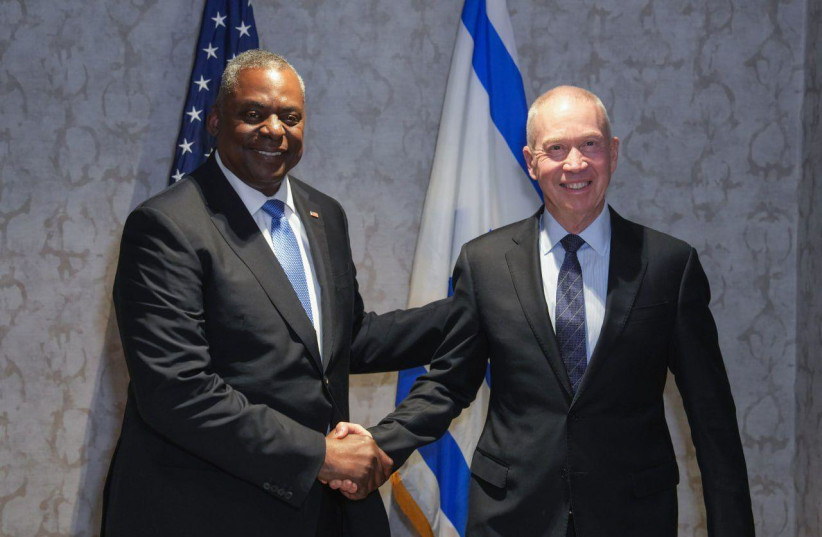
 Defense Minister Yoav Gallant shakes hands with US Secretary of Defense Austin Lloyd on June 15, 2023 (photo credit: DEFENSE MINISTRY)
Defense Minister Yoav Gallant shakes hands with US Secretary of Defense Austin Lloyd on June 15, 2023
(photo credit: DEFENSE MINISTRY)

Defense Minister Yoav Gallant on Thursday night met with US Secretary of Defense Lloyd Austin in Brussels to discuss Iran and other important aspects of the US-Israel relationship.

He emphasized how much Iran stimulates attacks against Israel using proxies in Syria, Lebanon, Gaza and the West Bank, and reiterated Israel’s right to self-defense.

Ahead of the discussion, Gallant said he met with Prime Minister Benjamin Netanyahu “and senior defense officials, and reviewed the measures required to ensure Israel’s qualitative edge in the Middle East region.”

He later thanked Austin for working cooperatively to maintain that qualitative edge.

Meeting comes as ‘small’ Iranian nuclear deal is in the offing

The meeting comes at a critical point where there is increasing speculation of a Western, US-led partial nuclear deal with Tehran; that makes these the last moments for Jerusalem to exact any influence.

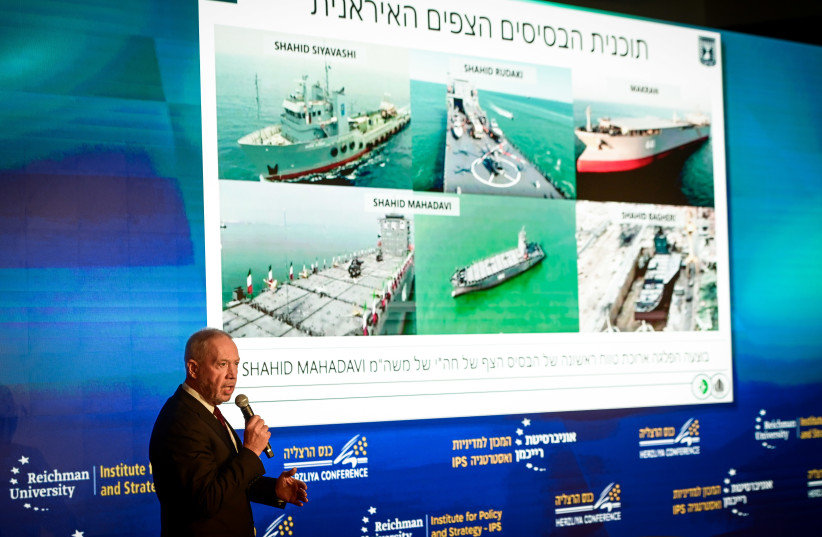
 Defense Minister Yoav Gallant shows photographic evidence of Iranian ''floating terror bases'' in a conference in Herzliya on May 22, 2023 (credit: AVSHALOM SASSONI/FLASH90)Defense Minister Yoav Gallant shows photographic evidence of Iranian ”floating terror bases” in a conference in Herzliya on May 22, 2023 (credit: AVSHALOM SASSONI/FLASH90)

Gallant added on Thursday that they agreed to broaden US-Israeli military exercises. January saw the Juniper Oak exercise, likely the largest cooperative one yet. These are often viewed as a thinly veiled threat to Tehran.

Gallant will also meet European Commissioner for Neighborhood and Enlargement Olivér Várhelyi, and will meet with Belgian Jewish community leaders and Jewish organizations at the Great Synagogue of Brussels.

He will then travel to Paris for the Le Bourget Airshow, where he will meet his counterparts from France, Italy, Hungary and Romania. Gallant is also expected to tour the Israeli national pavilion and deliver remarks during the inauguration ceremony, led by the Defense Ministry’s International Defense Cooperation Directorate (SIBAT).

In March, Austin met with Gallant in Israel. At the time, Austin said that although the Biden administration “continues to believe in diplomacy,” it would “not allow Iran to acquire a nuclear weapon,” adding that America is concerned about the Islamic Republic transferring new battlefield experience of using its drones in Ukraine to its proxies in the Middle East.

Asked by The Jerusalem Post about his position on Iran’s enrichment of uranium to the nearly weaponized 84% level, Austin said the US was “deeply concerned”, but sought to “explore all diplomatic” options to “try to constrain Iran.”

He also addressed both US security cooperation and the Israeli government’s judicial overhaul policy. Although Austin took the trouble to mention the US’s “ironclad commitment” to Israel’s security several times, he was also likely the first US secretary of defense to express public concern about internal Israeli judicial branch politics.

The US defense secretary also addressed both US security cooperation and the Israeli government’s judicial overhaul policy.

Although Austin took the trouble to mention the US’s “ironclad commitment” to Israel’s security several times, he was also likely the first US secretary of defense to express public concern about internal Israeli judicial branch politics.

Austin said he “wanted to be here to make something very clear: America’s commitment to Israel’s security is ironclad, and it’s going to stay that way. As President [Joe] Biden said in his visit to Israel last year, ‘The connection between the Israeli people and the American people is bone deep.’ Israel is a major strategic partner for the US.

“Our bond is rooted in far more than just shared interests. It’s rooted in the shared values of democracy and freedom and the rule of law. And those values remain essential,” he said.

Austin again referred to Biden’s messaging when he noted the democracies of Israel and the US “are both built on strong institutions, on checks and balances, and on an independent judiciary.”
