Commander of IDF Military Intelligence, Major General Aharon Haliva publicly stated recently at the Herzliya Conference held by Reichman University, that Hezbollah and its chief, Hassan Nasrallah, were close to making a dangerous miscalculation. Given Iran’s bolder and increasingly more direct confrontation with Israel, such a miscalculation could be the spark that plunges Israel into open and total war with Iran’s neo-Persian empire in the making. Haliva said as much himself.
The comments by IDF Chief of Staff Lieutenant General Herzi Halevi, as well as by Defense Minister Yoav Gallant, at the same conference have further sharpened the understanding that now any flare-up, incident or provocation between Iran’s proxies/allies and Israel could quickly lead to all-out war. Iran’s unrelenting and escalating attempts to advance and entrench its nuclear program raise the risk even further.
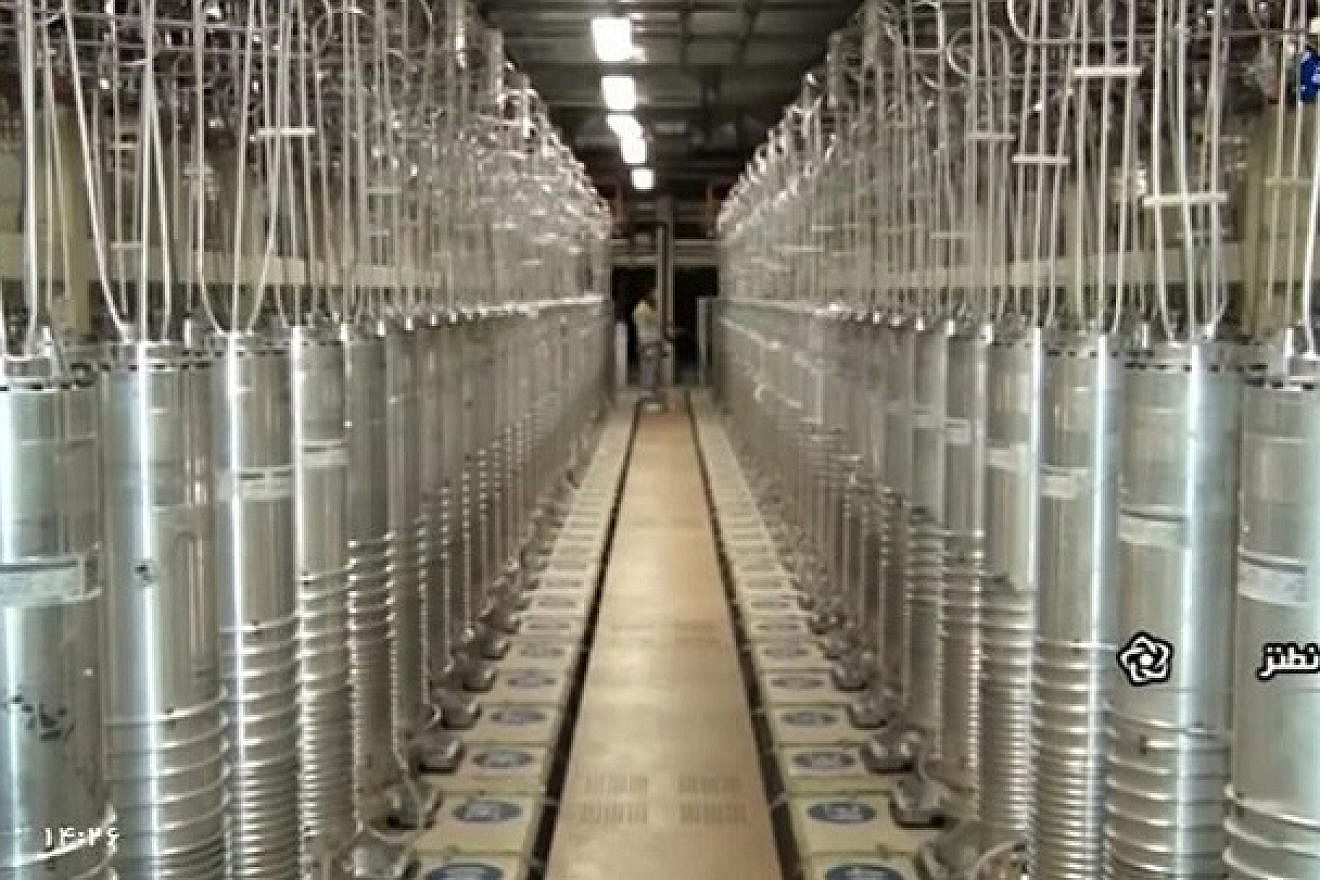
Reports, in the last few days, about a new deeper, seemingly more-fortified subterranean installation being built near the existing Natanz nuclear site came on top of similar reports, last year. This time, various experts and analysts were quoted as stating that such a facility would be virtually immune to attack.
As if to drive home the point that Iran’s nuclear program will soon be so fortified that a conventional aerial assault by any force or combination of forces, whether from aircraft or vessels at sea, would produce insufficient results. The logical conclusion is that anyone seeking to stop Iran’s march to nuclear weapons does not have much time to interdict the program by conventional military means.
An all-out war between Iran and Israel, regardless of the circumstance leading up to it, would therefore see Israel’s goal as not only the defeat of the conventional forces arrayed against it, but the destruction of Iran’s nuclear weapons program first and foremost.
Iran could cultivate new and unconventional threats
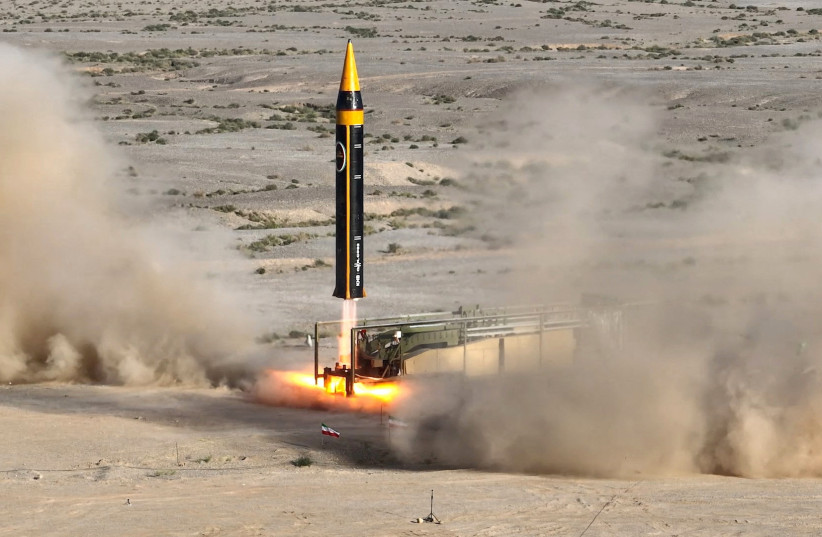
A new surface-to-surface 4th generation Khorramshahr ballistic missile called Khaibar with a range of 2,000 km is launched at an undisclosed location in Iran, in this picture obtained on May 25, 2023. (credit: IRANIAN DEFENSE MINISTRY/WANA/VIA REUTERS)
As for those conventional threats, which Iran continuously attempts to diversify and reinforce, in his comments at the conference, Gallant detailed a sea-borne threat that Iran is cultivating. The Iranians have converted very large commercial ships into makeshift floating terror bases. These large vessels can carry various types of missiles and rockets along with unmanned aerial and perhaps sea vehicles, as well as act as mother ships for smaller craft carrying men and material.
Iran could also theoretically deploy such commercial vessels without any outward modification or identification as military craft, and instead convert only their interiors into floating launch pads for missiles and rockets, including potentially heavy ballistic missiles. Such seaborne assets pre-positioned in the Red Sea, and the Mediterranean in particular, would serve to reinforce and expand the ring of fire Iran has been building around Israel; a geographic circle of steep trajectory ordinance (missiles, rockets) and other heavy firepower operated by Iranian proxies, allies and in some cases, Iranian forces themselves.
Floating platforms for such systems in the Mediterranean would force Israel to deal with a western front that would threaten not only the Israeli home front but shipping lanes, natural gas rigs and even air traffic.
Israel is and has been confronting and neutralizing many of these threats. The hair-trigger situation that now exists between Iran and Israel provides the potential for such preemptive actions to escalate quicker, much quicker, than in the past. Given the scale and scope of Iran’s schemes, the war that would erupt between Iran and Israel would be one that would be fought on multiple fronts and on a grand scale.
The world must be on notice. Israel will once again be fighting for its very survival, and no amount of distorted and manipulative press coverage or corrupt moral relativism and empty platitudes on the part of certain countries and their government officials will affect how Israel defends itself.
That is why the seemingly unrelated words and actions of Rabbi Dee of Efrat, since the slaughter of his wife and two of his daughters by bloodthirsty terrorists in the Jordan Valley over Passover, should be a model of how to handle Israel’s soft power enemies in the international media and diplomatic arena. When serial Israel slanderers Christian Amanpour and her bosses at CNN decided to produce a half-hearted, after-the-fact apology for misrepresenting the circumstances of the murderous attack against the Dee family, Rabbi Dee not only refused to accept the cynical and at first private so-called apology but he also decided to be proactive.
As per Alan Dershowitz, the top-tier US attorney, has offered his services to Rabbi Dee pro bono and they are exploring legal courses of action against Amanpour and CNN.
This must be the precedent for the State of Israel as a whole. No longer can patently false, libelous, and oftentimes borderline or actively antisemitic so-called media reporting, be tolerated or dealt with in a discreet or amicable manner. Given the massive amount of force, Israel will be forced to use in a full-scale war with Iran, this becomes all the more clear.
The resulting destruction to the enemy on multiple fronts will be spun, manipulated, and distorted to delegitimize Israel’s very right to defend itself and even to exist. This would be precisely what the most diabolical forces in the region would want. Another weapon in their arsenal is provided by those seemingly objective and detached from such a conflict.
Full-scale war would devastate Israel and Iran
Israel would have no choice, given the threat to the home front and civilian population, but to plunge its sword deep into the belly of the beast and not remove it until that beast is felled. Reserve forces would have to be activated and massive amounts of firepower deployed.
Whole swaths of southern Lebanon and perhaps further north would have to be taken over at all costs in order to stop the massive bombardment of Israeli civilian population centers and infrastructure. The same would be true for areas of Syria, especially those near the border with Israel that are controlled by Iranian allies and proxy forces. In the Gaza Strip, overwhelming Israeli force will be required against Hamas, as they would be bombarding and attempting to infiltrate Israeli cities, towns, and villages from the south. Given how the battle in the Gaza Strip would develop, and with the Iranian strategy of activating a multi-front and multi-dimensional assault on Israel, Hamas, Islamic Jihad and other terror groups in Judea and Samaria would launch attacks on Israel, as well, and overwhelming force would be required to neutralize them.
Only an ill society would expose its own civilians to the untold dangers and harm of such a total war against it, in order to avoid harm to an enemy’s population (regrettably a large swath of that population many times enthusiastically supports the destruction of Israel or is at best, indifferent to such attempts).
Israel is not an ill society. As such, non-combatants, be they in south Lebanon or in the kasbahs of Judea and Samaria’s Arab population centers, should take heed and physically distance themselves from missile launchers, arms caches, tunnel entrances and exits, terrorists, etc., when war does break out. If they do not, the harm or injury that comes to them is of their own accord, especially given that many voluntarily allow for their civilian assets to be exploited by terror groups and Iran’s other varied forces.
Responsibility for non-combatant deaths and injuries will also ultimately lie of course with Iran itself, as it unflinchingly takes advantage of civilian infrastructure and the local populations throughout the region to exploit Israel’s reluctance or outright refusal to attack such targets. This is the modus operandi it has directed its proxies and allies to practice for decades.
Israel will not have the luxury of that reluctance in striking targets in a large-scale war with Iran. That will hold true for the enemies both on our immediate borders and those Iran has cultivated further afield whom they can call upon in a general war, be they in Iraq or Yemen.
As in 1948, 1967 and 1973, Israel will be forced to fight multiple enemies on multiple fronts. The mobilization of reserve forces, overwhelming force, massive firepower and the total defeat of the enemy to the point, as in 1967 and 1973, of deep penetration into enemy territory would be the requirements for true victory.
In such an Israel-Iran war, an additional element would not only be required but central, as mentioned earlier: the destruction of Iran’s military nuclear program and the removal of the existential threat to Israel, as has been done twice before. Israel will do whatever is necessary whenever it is necessary to ensure its existence.
The writer is an Israeli hi-tech entrepreneur and a member of the Israel Leadership Forum. He is involved with various Israel advocacy causes, including working with Christian Zionist and pro-Israel Noahide groups.