Israel: IAEA let Iran hoodwink it over nuclear site

The Jerusalem Post reported earlier this week that the IAEA was close to closing or at least shelving its probe into the undeclared nuclear site.
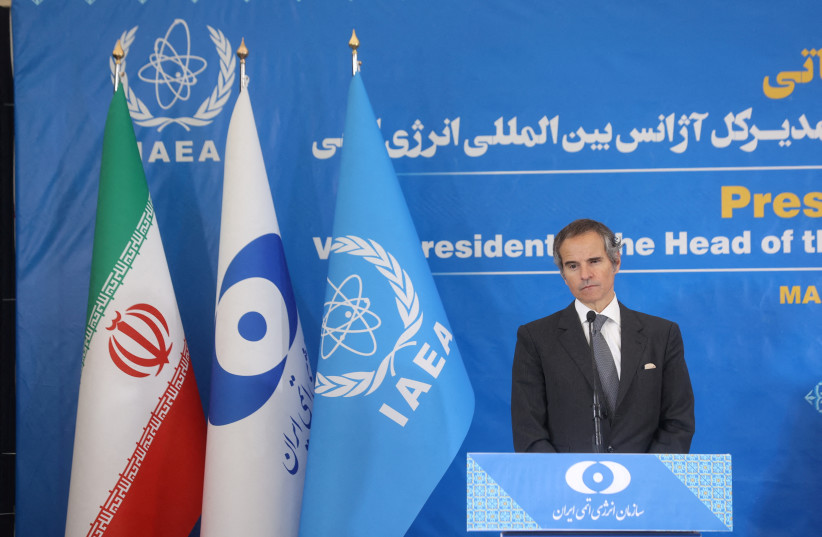
International Atomic Energy Agency (IAEA) Director General Rafael Grossi looks on during a news conference with Head of Iran’s Atomic Energy Organization Mohammad Eslami as they meet in Tehran, Iran, March 4, 2023.
(photo credit: MAJID ASGARIPOUR/WANA/REUTERS)

Israel let loose a barrage of attacks against the IAEA on Thursday following the nuclear inspection agency alluding to taking a weaker line with Iran over certain probes into nuclear violations.

On Tuesday and Wednesday, The Jerusalem Post reported and it was leaked by multiple outlets that the IAEA was close to closing or at least shelving its probe into the undeclared nuclear site at Marivan/Abadeh.

Even if the IAEA inspectors do tell their Board of Governors next week that they are shelving that file, there would still be two other probes left open at other undeclared nuclear sites.

But the closure of the Marivan/Abadeh probe, combined with a possible closure or shelving of a probe into Iran enriching molecules of uranium up to the 84% level, the closest ever to the 90% weaponized level, set off fireworks from Israeli officials as a misplaced messaging of weakness to the Islamic Republic.

“The closure of the Marivan Iranian safeguard case by the International Atomic Energy Agency is a matter of great concern. The explanations provided by Iran for the presence of nuclear material at the site are not reliable or technically possible. Iran continues to lie to the IAEA and deceive the international community,” said the Foreign Ministry.
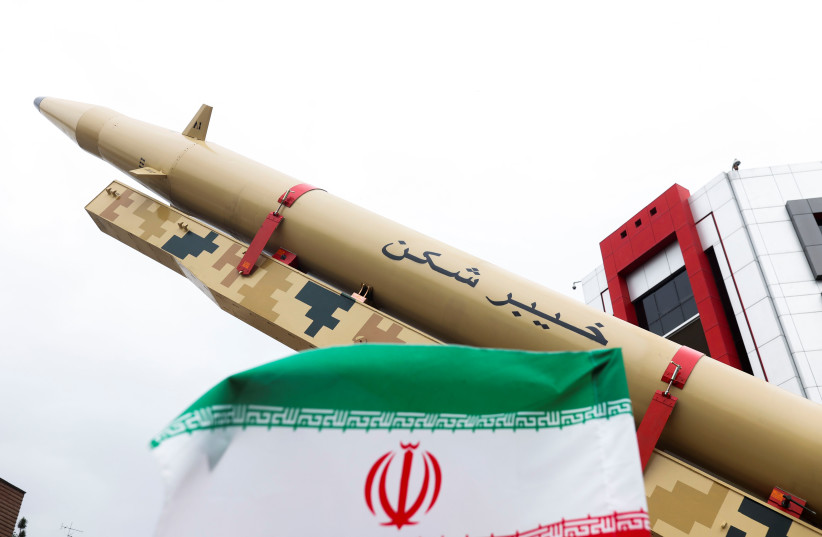
 An Iranian missile is displayed during a rally marking the annual Quds Day, or Jerusalem Day, on the last Friday of the holy month of Ramadan in Tehran, Iran April 29, 2022. (credit: MAJID ASGARIPOUR/WANA (WEST ASIA NEWS AGENCY) VIA REUTERS)An Iranian missile is displayed during a rally marking the annual Quds Day, or Jerusalem Day, on the last Friday of the holy month of Ramadan in Tehran, Iran April 29, 2022. (credit: MAJID ASGARIPOUR/WANA (WEST ASIA NEWS AGENCY) VIA REUTERS)

“The closure of the Marivan Iranian safeguard case by the International Atomic Energy Agency is a matter of great concern”

Israel’s Foreign Ministry

The Foreign Ministry continued, “The yielding of the director-general of the IAEA…to Iranian political pressure is very disappointing, mainly because the information in the file implicitly points to two faces of blatant Iranian violations of the inspection agreements.”

Moreover, the ministry said that “closing the case could have extremely dangerous consequences, and it conveys a message to the Iranians that they are not required to pay a price for their violations and that they can continue to deceive the international community on their way to achieving a full military nuclear program.”

In addition, the ministry said, “closing the case in this manner severely damages the professional credibility of the IAEA.”

Until Thursday’s attack on the IAEA by the Foreign Ministry, Israel had been giving IAEA Director-General Rafael Grossi compliments for holding Tehran to account for its nuclear violations since he took office in December 2019.

More specifically, Israel favored Grossi over his predecessor, Yukiya Amano, who Israelis viewed as too weak on Iran and too invested in maintaining the 2015 Iran nuclear deal, even if that meant ignoring nuclear violations.

The attack on Grossi by the ministry was that much more significant since Israel and the IAEA have been working together more positively during his term.

Netanyahu: Israel will prevent Iran from obtaining nuclear weapons

Defensive Minister Yoav Gallant also addressed the Iran issue in a speech at an IDF ceremony, saying “the dangers to Israel continue to grow more severe and it is becoming more likely that we will need to fulfill our obligations to defend the security of our country and the future of the Jewish nation.”

He added that the threat posed by Iran was complex, but that the IDF would know how to manage the issue and act if necessary.


Prime Minister Benjamin Netanyahu said, “I hear all of the media references regarding Iran, so I have an unequivocal and clear message to Iran and to the international community. Israel will do all that it must to prevent Iran from getting a nuclear weapon.”
International Atomic Energy Agency reportedly no longer has questions about 87.3% enriched uranium found at Fordo facility or traces of man-made uranium found at Marivan

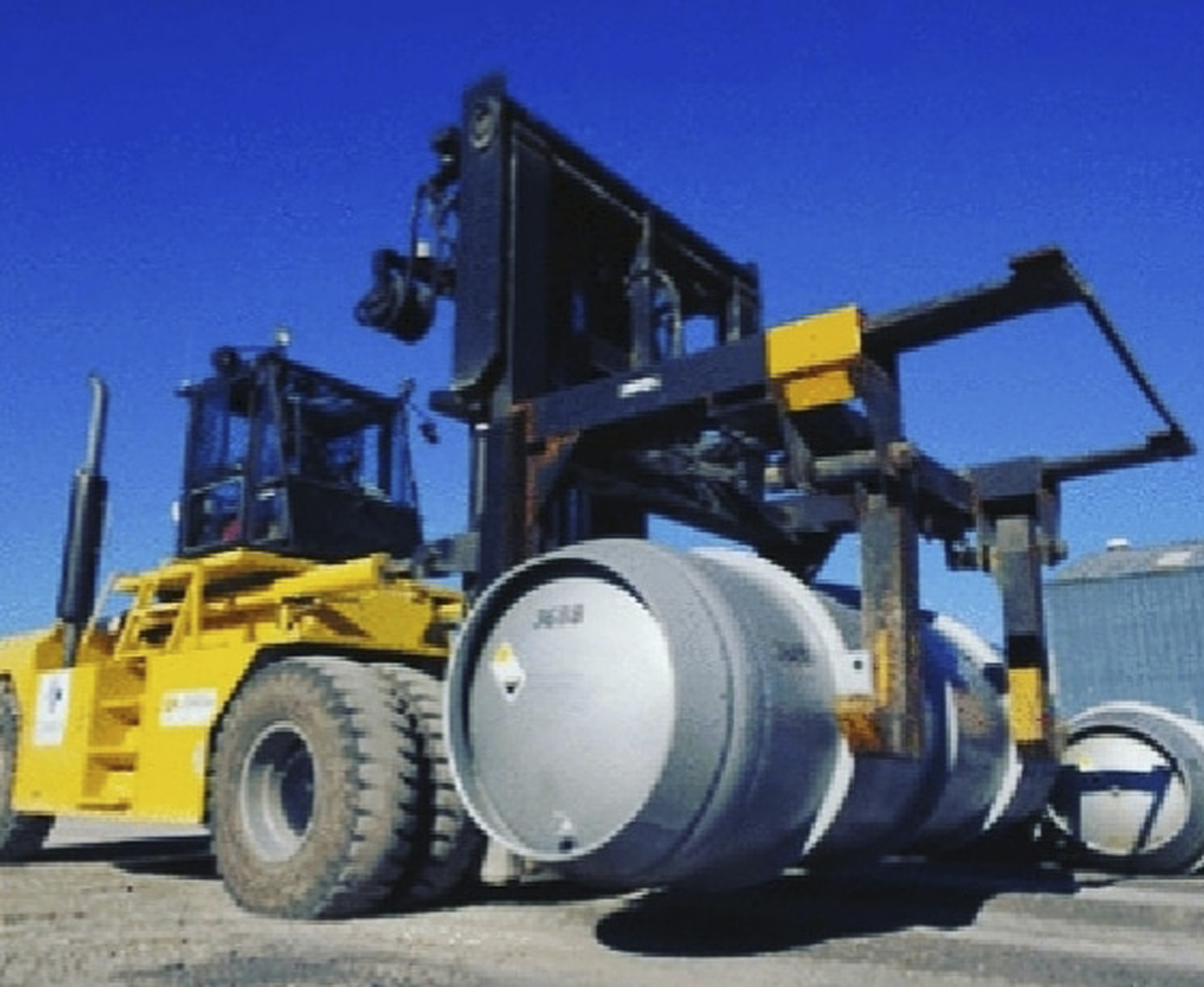
A lift truck carries a cylinder containing uranium hexafluoride gas for the purpose of injecting the gas into centrifuges in Iran's Fordo nuclear facility, November 6, 2019. (Atomic Energy Organization of Iran via AP)

A lift truck carries a cylinder containing uranium hexafluoride gas for the purpose of injecting the gas into centrifuges in Iran’s Fordo nuclear facility, November 6, 2019. (Atomic Energy Organization of Iran via AP)

VIENNA — Iran has resolved two outstanding inquiries from the International Atomic Energy Agency over highly enriched uranium particles and a site where man-made uranium was found, according to confidential reports seen Wednesday by The Associated Press.

The IAEA reports ease pressure slightly on Tehran, which has been escalating its program for years since the US unilaterally withdrew from its nuclear deal with world powers in 2018. However, it continues to amass more uranium nearer than ever to weapons-grade level, worrying nonproliferation experts.

The two confidential quarterly reports by the Vienna-based IAEA, distributed to member states of the organization, said inspectors no longer had questions on uranium particles found to be enriched to 83.7% at its underground Fordo facility. That had sparked tensions over the last several months as uranium enriched to 90% is weapons-grade material.

Sponsored by Sheba: The Stem Cell Revolution at Sheba Medical Center

Loaded: 93.38%

Iran had argued those particles were a byproduct of its current enrichment as particles can reach higher enrichment levels in fluctuations.

“The agency informed Iran that, following its evaluation of the data, the agency had assessed that the information provided was not inconsistent with Iran’s explanation…and that the agency had no further questions on this matter at this stage,” the report said.

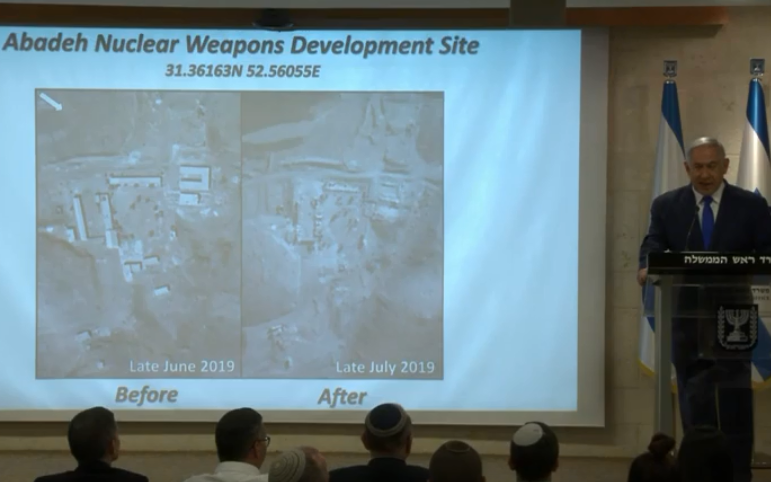
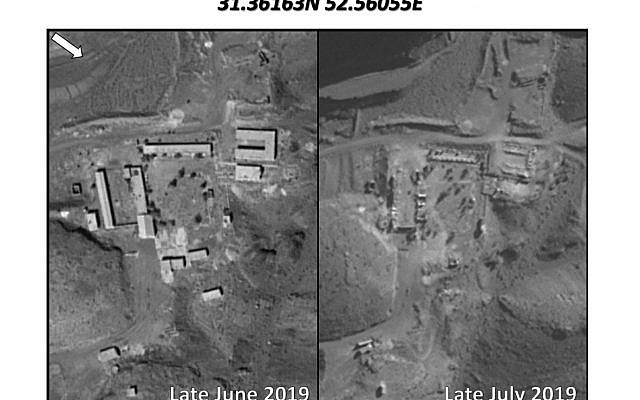
The report said investigators also have closed off their investigation of traces of man-made uranium found at Marivan, near the city of Abadeh, some 525 kilometers (325 miles) southeast of Tehran. Analysts had repeatedly linked Marivan to Iran’s secret military nuclear program and accused Iran of conducting high-explosive tests there in the early 2000s. In 2019, Israel’s Prime Minister Benjamin Netanyahu exposed the site, claiming it was a secret nuclear facility.

Prime Minister Benjamin Netanyahu revealing what he says is a nuclear weapons development site in Abadeh, Iran, at the Prime Ministers Office, on September 9, 2019. (Screenshot: YouTube)

The IAEA report said that “another member state” operated a mine at the area in the 1960s and 1970s under the rule of then-Shah Mohammad Reza Pahlavi. It wasn’t immediately clear which nation was involved in the mining.

Iran had argued the uranium traces could have come from “laboratory instruments and equipment” used by miners at the site. The IAEA called the answer “a possible explanation.”

“The agency at this time has no additional questions on the depleted uranium particles detected at Marivan…and the matter is no longer outstanding at this stage,” it said. The agency also installed enrichment monitoring devices at Fordo and Natanz, Iran’s other main enrichment site, the report said.

A slide made public by Prime Minister Benjamin Netanyahu on September 9, 2019 showing a secret Iranian nuclear facility, before and after it was reportedly destroyed by Iran. (GPO)

The second report also found that Iran has significantly increased its stockpile of enriched uranium in recent months, continuing its nuclear escalation, AFP said.

It said that Iran’s estimated stockpile of enriched uranium had reached more than 23 times the limit set out in the landmark 2015 accord between Tehran and world powers.

Iran’s nuclear deal limited Tehran’s uranium stockpile to 300 kilograms (661 pounds) and enrichment to 3.67% — enough to fuel a nuclear power plant. The US unilateral withdrawal from the accord in 2018 set in motion a series of attacks and escalations by Tehran over its program.

Iran has been producing uranium enriched to 60% purity — a level for which nonproliferation experts already say Tehran has no civilian use.

The IAEA report estimated that as of May 13, Iran’s total enriched uranium stockpile was at 4,744.5 kilograms (10,460 pounds). Of that, 114.1 kilograms (251 pounds) is enriched up to 60% purity, a short, technical step to weapons-grade levels.

Enrichment levels of around 90 percent are required for use in a nuclear weapon.

The last IAEA estimate in February put Iran’s uranium stockpile at some 3,760 kilograms (8,289 pounds). Of that, 87.5 kilograms (192 pounds) was enriched up to 60% purity.

The report came days before the board of governors of the IAEA is due to meet to review progress in addressing the watchdog’s remaining concerns.

There are still open questions about radioactive material found at undeclared sites in Varamin and Turquzabad.

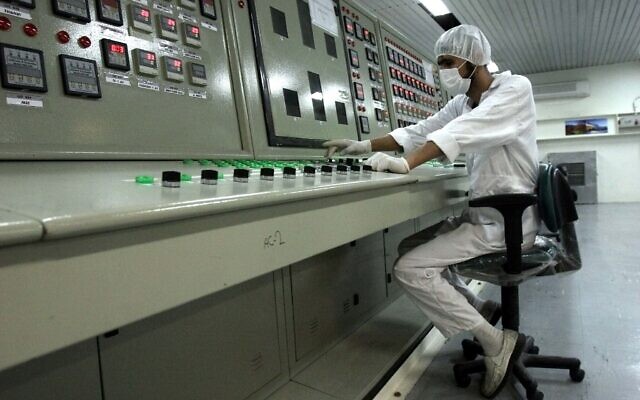
An Iranian technician works at the Uranium Conversion Facility just outside the city of Isfahan, Iran, on February 3, 2007. (AP Photo/Vahid Salemi)

Iran on Tuesday had said international inspectors closed off the two lines of inquiry over its nuclear program.

Separately, the IAEA acknowledged installing new cameras at workshops in the Iranian city of Isfahan where centrifuge rotors and bellows are manufactured. Centrifuges rapidly spin uranium gas, enriching it.

However, Iran has been withholding surveillance footage from the IAEA amid its tensions with the West.

Tensions between Iran and the West have escalated over its nuclear program. Tehran also has faced mass protests recently and anger from the West over it arming Russia with bomb-carrying drones now targeting Ukraine.

While the IAEA’s director-general has warned that Iran now has enough uranium to produce “several” bombs, months more would likely be needed to build a weapon and potentially miniaturize it to put it on a missile. The US intelligence community has maintained its assessment that Iran isn’t pursuing an atomic bomb.

Iran has always denied any ambition to develop a nuclear weapons capability, insisting its activities are entirely peaceful.


Before analyzing how these moves mix together, one must look closely. As is often with the ayatollahs, there is more than meets the eye.

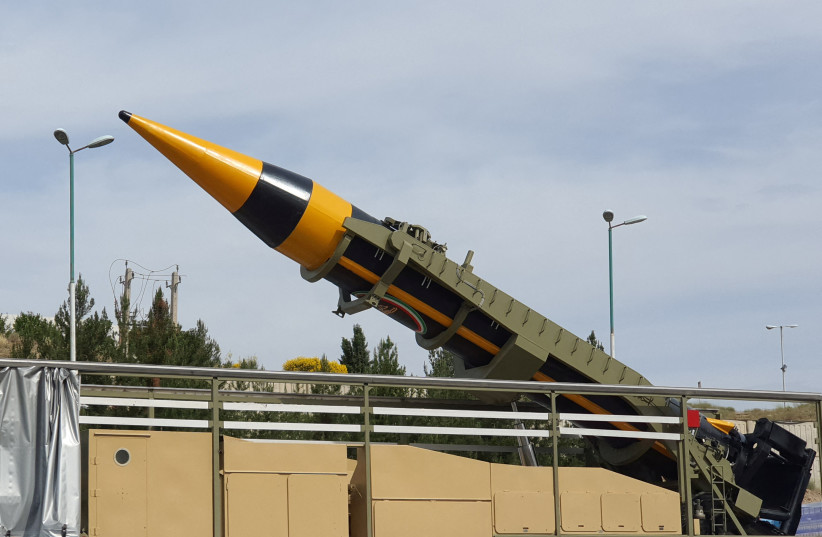
 A new surface-to-surface ballistic missile called Khaibar with a range of 2,000 km, unveiled by Iran, is seen in Tehran, Iran, May 25, 2023 (photo credit: WANA (WEST ASIA NEWS AGENCY) VIA REUTERS)
A new surface-to-surface ballistic missile called Khaibar with a range of 2,000 km, unveiled by Iran, is seen in Tehran, Iran, May 25, 2023
(photo credit: WANA (WEST ASIA NEWS AGENCY) VIA REUTERS)

Iran on Tuesday started to claim that it has closed two IAEA probes into either undeclared sites or unexplained traces of molecules of uranium enriched to the 84% level, leaving only two outstanding probes.

The claims come only days after the Islamic Republic last week said it had tested a ballistic missile with a range of 2,000 kilometers and only days before the IAEA Board of Governors is set to meet next week.

What is Tehran’s game at this time? It is clearly trying to convince the IAEA Board not to refer its nuclear violations to the UN Security Council for a potential global snapback of sanctions? But is this campaign being done by using “carrots” (giving the IAEA more data that it had previously withheld), by “sticks” (new and longer range tests of ballistic missiles) or both?

hatis Iran trying to do?

Before analyzing how all of these moves mix together, it is important to look more closely at the major events, as often with the ayatollahs there is more than meets the eye.

Regarding the IAEA probes, it is unclear if anything at all happened Tuesday.

 International Atomic Energy Agency (IAEA) Director General Rafael Grossi looks on during a news conference with Head of Iran's Atomic Energy Organization Mohammad Eslami as they meet in Tehran, Iran, March 4, 2023. (credit: MAJID ASGARIPOUR/WANA/REUTERS)International Atomic Energy Agency (IAEA) Director General Rafael Grossi looks on during a news conference with Head of Iran’s Atomic Energy Organization Mohammad Eslami as they meet in Tehran, Iran, March 4, 2023. (credit: MAJID ASGARIPOUR/WANA/REUTERS)

The IAEA issued no public statement, only Iran issued one.

Further, The Jerusalem Post requested clarification from the IAEA, and at press time the international inspectors had issued no response which would back up Iran’s claims.

In the past, when only the Islamic Republic claimed some positive movement with the IAEA or the West, it was wishful thinking and an attempt to pressure other parties into accepting Iranian terms which were under negotiation, but which remained in dispute.

So Tehran could be flat-out lying.

Alternatively, there could be some truth to Iran’s claims or a partial deal on the way, but even this would not necessarily be a game-changer.

To date, the IAEA has a number of accusations against Iran that need clearing up.

IAEA Director-General Rafael Grossi has said repeatedly from 2020-2022 that, “Iran has not provided explanations that are technically credible in relation to the agency’s findings at three undeclared locations in Iran.”

“Nor has Iran informed the agency of the current location, or locations, of the nuclear material and/or of the equipment contaminated with nuclear material, that was moved from Turquzabad in 2018,” said Grossi.

Further, he has said, “Unless and until Iran provides technically credible explanations for the presence of uranium particles of anthropogenic origin at Turquzabad, Varamin and ‘Marivan’ and informs the agency of all current locations of the nuclear material and/or of the contaminated equipment, the agency cannot confirm the correctness and completeness of Iran’s declarations under its Comprehensive Safeguards Agreement.”

Then in February of this year, the Islamic Republic was also caught with a small number of molecules of uranium enriched to the 84% level at the Fordow facility.

All Iran is claiming has been resolved is the latest 84% incident and one of the three undeclared sites known alternately as Marivan/Abadeh.

The Turquzabad and Varamin sites and issues would still be open, including illicit traces of uranium found at Turquzabad and a variety of questions about missing nuclear weapons testing equipment from Iran’s nuclear archives which the Mossad seized in 2018.

Moreover, this would not be the first probe closed against Iran, and the last time a probe was closed in March 2022 relating to an illicit metal disc of nuclear material, there was no less pressure by the IAEA on Tehran regarding the remaining open probes.

So the carrot here may be weak.

The stick may not be any less weak.

Iran’s claims last week of launching a ballistic missile with a 2,000-kilometer range led to loud condemnations from the US and others.

But did it really give Iran anything it did not already have and did it cross any of the ballistic missile boundaries that could be game-changers? It looks like it clearly did not.

The British think tank the International Institute for Strategic Studies has campaigned in recent years to promote a Western European talking point of letting Iran keep its existing ballistic missile stock, as long as it does not increase their range.

The main reason?

The think tank and Western European countries want a limit of 2,000 km. because that would stave off the development of missiles that could directly threaten Western Europe, let alone eventually the US.

Even a few years before this last ballistic missile test, Iran’s existing Shahab-3, Emad-1 and Sejjil were estimated to be able to strike up to 2,000 kilometers away, meaning they can already easily strike Israel, the Saudis and much of Eastern Europe.

In contrast, to reliably reach Western Europe, Iran’s ballistic missiles would need to have a range of 3,000 kilometers.

A report by the think tank tip-toes around the issue that the Khorramshahr missile has a maximum range of 2,000 km, but with independent experts’ assessments suggest it could reach greater distances of up to 3,000 kilometers, if armed with a lighter warhead.

But basically, the working assumption is that Iran is still 1,000 kilometers off from being able to threaten Western Europe. The latest ballistic missile test does not change this critical calculus.

However, it does remind Western Europe that if the West’s sanctions continue, the Islamic Republic could increase its ballistic missile’s range to a point where it could threaten Western Europe, even if Tehran does not cross the nuclear threshold.

Threatening the US is a whole different game. The ayatollahs would need to get into the 10,000 kilometers range.

Theoretically, top arms control expert Jeffrey Lewis wrote in December 2021, that a modified Sarir satellite launching rocket might be able to carry 1,000 kilograms for 7,000-9,000 kilometers. That is closer to striking distance. So the latest test is also maybe a vague threat to the US.

It does seem that Iran wants to bribe and threaten the US and the EU to avoid a confrontation at the UN Security Council.

The question is what impact these relatively weak moves will have on IAEA Board decision-makers from those countries.