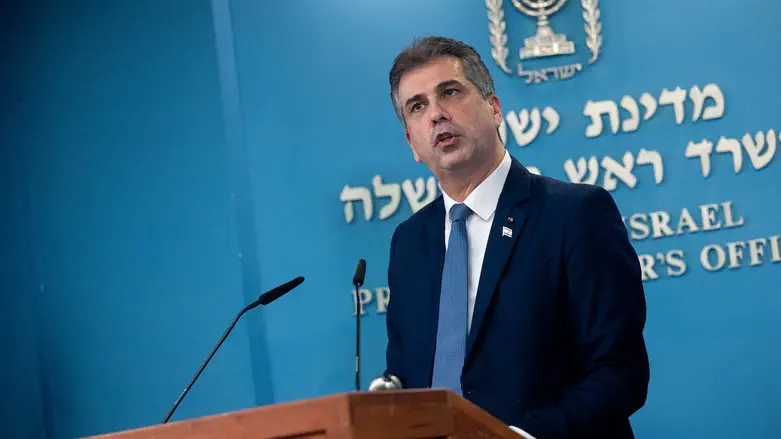
Foreign Minister Eli Cohen on Wednesday hosted ambassadors from the four countries that moved their embassies to Jerusalem, in a special ceremony celebrating Jerusalem Day and 75 years of independence. Representatives from the United States, Guatemala, Honduras and Kosovo were at the event.
Speaking to i24NEWS at that event, Cohen said that he is “optimistic” that three more moves are on the way.
Several countries have mulled the idea of following in the steps of the US and moving their diplomatic missions, but few followed through.
Last year, Suriname’s Foreign Minister, Albert Ramchand Ramdin, announced that the South American country would open an embassy in Israel’s capital city. However, the move was later reversed due to budgetary reasons.
In February, Papua New Guinea’s Foreign Minister Justin Tkachenko informed Cohen of his country’s intention to open an embassy in Jerusalem.
In March it was reported that Hungary would relocate its embassy to Jerusalem. Hungarian President Katalin Novak later said that no decision had yet been made on the issue.
Sweden’s Deputy Prime Minister Ebba Busch hinted at her intention to move the country’s embassy to Jerusalem this week, in a post in which she wrote “next year in Jerusalem.” She even commented on Swedish politics having been “characterized by an unbalanced and almost hostile attitude towards Israel,” and said, “I say it loud and clear – those days are over.”
56 years since the reunification of the capital: Jerusalem Day celebrations will take place today (Thursday) in the capital under heavy security of approximately 3,200 police officers, Border Police personnel, volunteers, and special forces spread out across the city.
The day’s climax will take place in the afternoon when tens of thousands from across the country will march with Israeli flags from the center of the new city, through the gates of the old city, to the Western Wall.
The police made clear that “the Flag March will march along the route that has been used for many years, from central Jerusalem, through the old city gates, to the Western Wall. As in past years, additional Jerusalem Day events, ceremonies, and marches will take place in the city as well.”
Police Commissioner Kobi Shabtai added: “Thousands of police and Border Police officers will be spread out for public security and safety in Jerusalem on the city’s holiday. Just as we prepared for the month of Ramadan for the Muslims and the Holy Fire ceremony for the Christians, we are preparing for the public who will take part in Jerusalem Day.”
Police Jerusalem District Chief, Deputy Commissioner Doron Turjiman, stated: “Jerusalem Day is the holiday of the city of Jerusalem, and we will work to keep it that way, to secure and protect all those who will participate in the various events, while ensuring security, order, and law and minimizing harm to everyone’s daily routine as best as possible. We worked the same during Ramadan, Easter, and Passover, and that’s what we’ll do during Jerusalem Day.”
At the Western Wall, a prayer and thanksgiving gathering will be held at 7:00 PM on Thursday following the Flag March to celebrate 56 years of a united Jerusalem.
In addition, throughout the day, beginning at 11:00 AM, a special broadcast for elementary school students will be held and will include an online competition with tens of thousands of students, a virtual tour of the Western Wall Tunnels, and videos and content for children about Jerusalem and the Western Wall.
Tomorrow morning (Friday) at 7:30, a special morning service will be held at the Western Wall.
The police warned that in recent days false publications and incitement regarding Jerusalem Day and the Flag March have been making their rounds on the internet.
The police say that the entry of visitors to the Temple Mount will take place as usual, along with the Muslim prayers, which will also carry on as usual.
Axios report says Washington officials approached Jerusalem with ‘unprecedented’ offer, but Israeli officials concerned of possible attempt to tie their hands
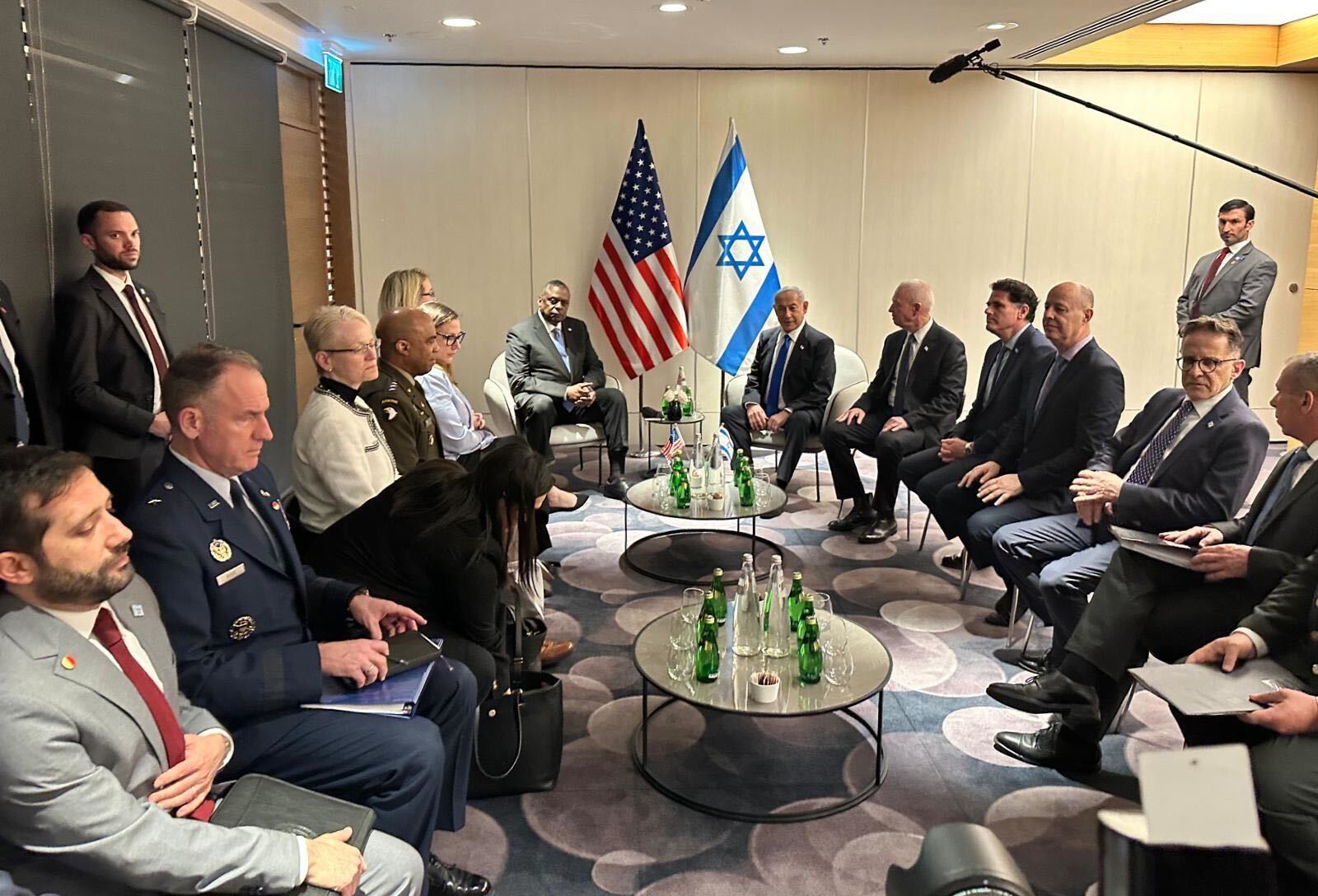
Prime Minister Benjamin Netanyahu sits down with US Defense Secretary Lloyd Austin and other Israeli and American officials at Ben Gurion Airport on March 9, 2023. (Courtesy)
The US recently proposed to Israel that Washington and Jerusalem engage in “joint military planning” vis-a-vis Iran, according to a report Wednesday citing US and Israeli officials.
Axios said the Biden administration had approached Israeli officials in recent weeks with the “unprecedented” proposal that would “significantly upgrade US-Israeli military cooperation.” A US official told the publication that the offer was “not about planning any kind of joint US-Israeli strike against Iran’s nuclear program” and that the planning would mostly center around sharing “different contingencies” and discussing ways to address Iran’s regional activities.
The proposal came up during recent trips to Israel by the Chairman of the Joint Chiefs of Staff Gen. Mark Milley, Secretary of Defense Lloyd Austin, and CENTCOM commander Gen. Erik Kurilla, according to the report.
Sponsored by Sheba: The Stem Cell Revolution at Sheba Medical Center
Loaded: 46.67%
But it said Israel responded to the offer cautiously and asked for more details. According to Axios, Israeli officials are concerned the US offer was an attempt to “tie Israel’s hands” and possibly complicate any plans by Jerusalem to take action against Iran, specifically against its nuclear activities — as it has repeatedly threatened to do — if the US were to raise any objections.
An Israeli official told Axios that Israel asked for clarification on whether the proposal would stay “in the realm of intelligence and scenarios” or extend “into the realm of joint operations.”
Milley’s March trip to Israel followed revelations that Iran has enriched uranium to near weapons-grade level, as well as several airstrikes attributed to Israel that hit Iranian targets in Syria.
That same month, in a meeting with Austin, Prime Minister Benjamin Netanyahu said the US and Israel “have a shared agenda — to prevent Iran from attaining a nuclear weapon, to stop Iranian aggression, to protect regional security and prosperity, and to expand the circle of peace.”
This handout photo from March 3, 2023, shows IDF Chief of Staff Herzi Halevi, left, and Defense Minister Yoav Gallant (right) meeting with visiting Gen. Mark Milley, the chairman of the US Joint Chiefs of Staff. (Sivan Shachor/GPO)
Pentagon spokesperson Lt. Col. Phillip Ventura told Axios that senior Defense Department leaders “have made repeated public statements regarding our interest in expanding military cooperation with the Israeli Defense Forces, to include by increasing joint participation in military training exercises in order to improve interoperability and promote a common understanding of regional security challenges.”
“The relationship between the US and Israeli militaries is extremely close, and our commitment to Israel’s security remains ironclad,” Ventura added.
The Axios report also cited a comment by White House national security adviser Jake Sullivan earlier this month in which he said that the US has made clear to Iran that it can never be permitted to obtain a nuclear weapon.
“As President Biden has repeatedly reaffirmed, he will take the actions that are necessary to stand by this statement, including by recognizing Israel’s freedom of action,” Sullivan said in a speech at the Washington Institute for Near East Policy on May 4.
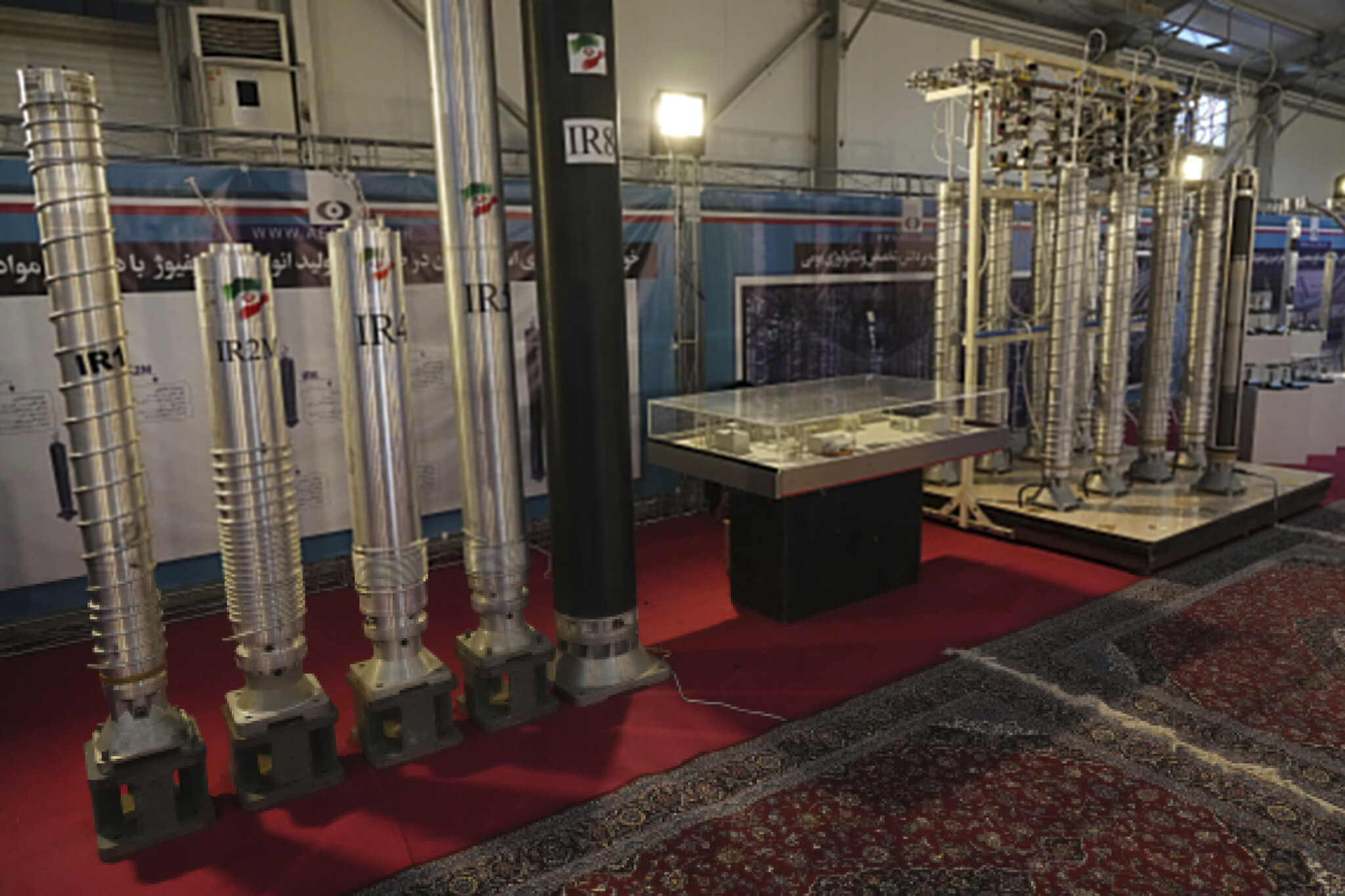
Iran’s domestically-built centrifuges are displayed in an exhibition of the country’s nuclear achievements, in Tehran, Iran, February 8, 2023. (AP Photo/Vahid Salemi)
That same day, Defense Minister Yoav Gallant said Iran had amassed enough fissile material for five nuclear bombs, and warned the Islamic Republic against further enriching uranium toward weapons-grade levels. He was speaking during a visit to Athens to meet with his Greek counterpart Nikolaos Panagiotopoulos, weeks after Israel helped Greece foil an alleged Iranian attack plot on a Chabad house in the Greek capital.
Gallant warned then that “Iranian progress, and enrichment to 90 percent, would be a grave mistake on Iran’s part, and could ignite the region.”
Iran is not believed to have yet enriched uranium to 90%, the purity needed for nuclear weapons, but can quickly do so from current enrichment levels if it chooses.
It holds stockpiles of uranium enriched to 20% and 60% in violation of the 2015 accord limiting its nuclear program, which it has increasingly breached since then-United States president Donald Trump withdrew the US from the deal in 2018 and reimposed sanctions.
Western powers warn there can be no civilian use for uranium enriched to such levels.
Talks to reinstate the nuclear agreement between Iran and world powers restarted in April 2021, but have been stalled since last year as Iran forges ahead with its nuclear ambitions.
Top US officials recently estimated that Iran could produce sufficient fissile material for a nuclear weapon in two weeks if it desires, but would need additional months to ready a bomb for use. The US also believes Iran does not yet have all of the technology required to build a bomb and has not made a final decision to build a weapon, which Iranian leaders have repeatedly claimed they have no intention of doing.
In his remarks, Gallant vowed that Israel will not allow Iran to continue its efforts to establish a military foothold in Syria, where the Israeli Air Force has reportedly carried out a number of strikes in recent months.
Netanyahu has separately warned that Iran could threaten the entire United States if it gets a nuclear weapon.