Iran’s regime media claims that Israel’s use of David’s Sling represents a failure of the Iron Dome, a claim that is not backed up by any evidence from Tehran.
During Operation Shield and Arrow, Israel’s air defenses faced “challenges” from Islamic Jihad rockets, according to an article published by Iranian pro-regime media on Monday. Israel’s performance represented “helplessness,” Iron Dome “failed,” and that is why Israel turned to David’s Sling, an air-defense system used for medium-range missile threats, the article said.
While there is no evidence to back these claims up, the article presented an interesting insight into Iran’s obsession with overpowering Israel’s air defenses.
This fascination isn’t new; it is actually a few years old, with particular interest placed on Israel’s ability to counter Iranian proxy groups. This is an important development because Iran sought to arm these groups, including Islamic Jihad and Hamas, with longer-range rockets.
Iran’s fascination with Israel’s air defenses
This is a pattern of Iran’s. It did the same thing with the Houthis in Yemen post-2015 and in moving missiles and drones to militias in Iraq and Syria. It also helped Hezbollah build up a massive arsenal.
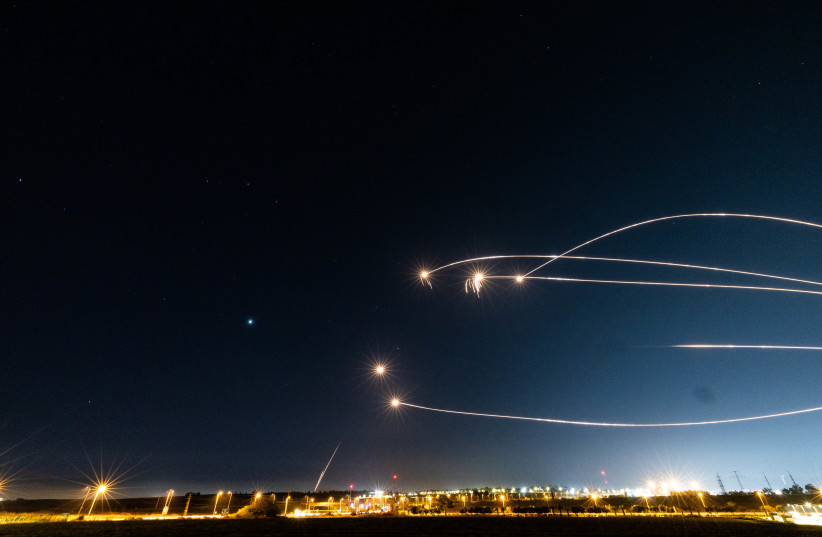
 Iron dome anti-missile system fires interception missiles as rockets are fired from the Gaza Strip to Israel, as it seen from Sderot on May 10, 2023. (credit: YONATAN SINDEL/FLASH90)
Iran is extremely knowledgeable about rockets and missiles – weapons it invested in over the years because it had the know-how and learned from reverse engineering, studying Russian and Chinese designs and working with North Korea.
Tehran also knew it had to invest in these weapons because it saw what happened during the war with Iraq and the so-called “war of the cities” in the 1980s, when Iraqi forces bombarded Iran’s cities.
Back then, Iran understood that it could export missile and rocket technology to groups such as Hezbollah and Hamas to be used against Israel. But it couldn’t export advanced warplanes or tanks for a conventional war, so rockets were the next best option.
Simple rockets like the 107-mm. were common, but so were the 122-mm. Grad rockets. Others came along, and ranges extended from several kilometers to eventually covering most of Israel. Iran also exported drone technology.
Israel’s development of air-defense systems, a necessity in the wake of the Gulf War and Saddam Hussein’s decision to launch Scud missiles at Israel, led to a direct arms race with Iran’s proxies. Iran sought to improve the technology of the rockets and missiles and extend the threat through moving ballistic missiles to Iraq in 2018 and 2019 or helping Hezbollah with precision-guided munitions technology.
Israel’s air defense system: Iron Dome, David’s Sling, Arrow
The Iron Dome and other defense systems, such as David’s Sling, improved at the same time. Iron Dome’s first interception was in 2011, and in the following decade, it has intercepted thousands of munitions. It was also improved to stop drones and other threats, and Israel wants to add lasers to it. The Arrow was first used in 2017, followed by David’s Sling in 2018. According to reports, David’s Sling was used successfully twice in the last week during Operation Shield and Arrow.
Iran backed Islamic Jihad to challenge Israel and monitored the conflict closely, including Israeli decisions on its air defenses. In May 2021, Iran attempted to get Hamas to try to overwhelm the Iron Dome by firing salvos of more than 130 rockets at a time.
DURING PASSOVER, Iran conducted a campaign to “unify” its various fronts against Israel, attempting to spread the conflict outside Israel’s borders. Israel’s multilayered air-defense systems must therefore be simultaneously active on multiple borders. Of the 34 rockets fired from Lebanon during Passover, for instance, several fell in civilian communities in the North, causing damage but no casualties.
While Israel’s air defense is largely a success, with a rare glitch recorded in early May, Iran has a different take on what has happened over the last five years. Iran’s pro-regime Tasnim News Agency, which is considered close to the Islamic Revolutionary Guard Corps, concluded during the recent round of fighting that Israel’s use of David’s Sling represented an achievement for Iran and a weakening of Israel’s air-defense systems.
According to Tasnim, the Iron Dome has had “failures,” which is why Israel chose to use a “new air defense system, the Dawood’s Slingshot [David’s Sling] system for the first time in 2018 to intercept two Toshka short-range missiles that were launched from Syria, although these missiles had fallen before reaching the said system, so the Zionist regime has not been involved in any war so far.”
This means that the system was activated in 2018, but the missiles coming from Syria fell short, and therefore the system was not successful in countering them.
Iran believes Israel has not used David’s Sling since then.
“In the recent conflicts with Gaza, after the defeat of the Iron Dome in dealing with resistance missiles, Israel had to resort to using the said system,” the report said.
Tasnim, quoting an analyst it said was Egyptian, analyzed how Islamic Jihad’s Saraya al-Quds “military wing” used the Badr 3 rocket and Buraq rocket against Israel. It was not clear from the report what the background of the analyst was or why he was mentioned, except to give credence to Iran’s claims. Islamic Jihad first used the Badr 3 rocket in May 2019, the report said.
“At that time, the range of these missiles was 45 km., but their advanced type, used in the recent clashes,” forced Israel to extend alerts to civilian communities up to 80 km. from Gaza, Iran claimed, the report said. It also mentioned the use of the Buraq-85 missile, another addition to its arsenal.
In Iran’s view, the use of David’s Sling was “a very heavy cost for the Zionists and is Israel’s admission of the defeat of Iron Dome.” There is no evidence that this is the case.
Iron Dome performed as expected in the recent round of fighting, intercepting rockets fired from Gaza and protecting civilian areas as it has in the past. The use of David’s Sling was a supplement, and there is no evidence that it was used due to any kind of “defeat” of Iron Dome. Nevertheless, Iran’s media wants to push this spin, likely to give the regime a sense of accomplishment by its support of Islamic Jihad and funding its conflicts against Israel.
The Tasnim report claimed that Israel fears Iran’s missiles, which could mean that Iran is either purposely lying to itself to make the recent round of fighting seem like a success, or it actually believes that this could lead Tehran to take more challenging shots to challenge Israel.