
Iran has also continued to work to increase the terror infrastructure of Hamas and Palestinian Islamic Jihad.
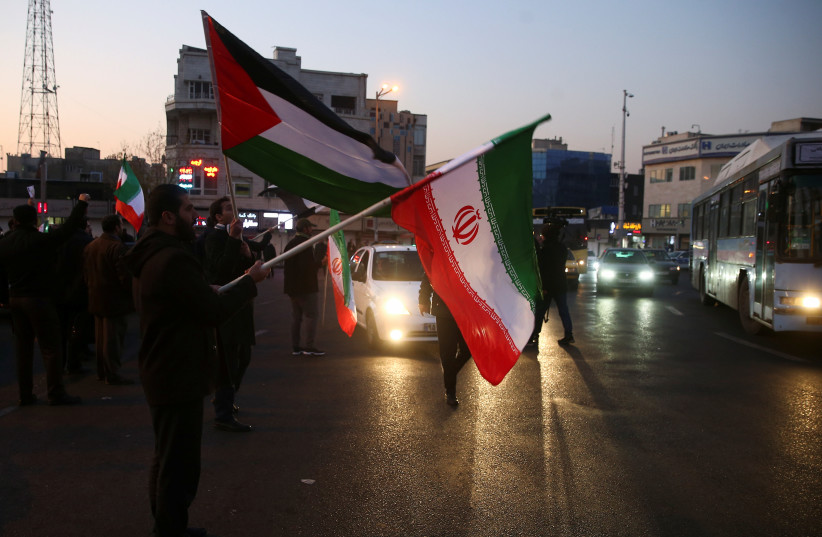
 People hold a Palestinian and Iranian flags as they celebrate in the street after Iran launched missiles at U.S.-led forces in Iraq, in Tehran, Iran January 8, 2020.  (photo credit: NAZANIN TABATABAEE/WANA VIA REUTERS)
People hold a Palestinian and Iranian flags as they celebrate in the street after Iran launched missiles at U.S.-led forces in Iraq, in Tehran, Iran January 8, 2020.
(photo credit: NAZANIN TABATABAEE/WANA VIA REUTERS)

Operation Shield and Arrow may be the first test for Iran’s ‘unity of fronts’ project, which is designed to ring Israel with threats and cause Israel to collapse internally. Iran has been working on this project for years but has recently increased its messaging about how it believes Israel’s internal political squabbles make Israel a ripe target.

Iran’s messaging in this regard includes claims that Iran will continue to work on the “unity” of various proxies and groups it works with.

In Tehran’s view, it has achieved great success in Syria, helping the Syrian regime normalize with the Arab League. Iran sent its president to Syria recently. Iran has also continued to transfer arms to Syria via Aleppo in the wake of the February earthquake. Iran has also continued to operationalize groups and threats in Syria. It flew a drone into Israeli airspace in early April. It also encouraged the small Palestinian group Liwa al-Quds to fire rockets at Israel over Passover.

Iran has also worked to increase the terror infrastructure of Hamas and Palestinian Islamic Jihad. A recent report at the Post noted that Hamas could threaten to stage a coup in the West Bank. Iran believes it can transfer illegal weapons to the West Bank to begin the process of taking advantage of any situation in which the Palestinian Authority Security Forces are weakened.

It has supported the flooding of Jenin and Nablus with weapons, including numerous M-4 and M-16 style rifles now in the hands of gangs, armed groups and terrorists.
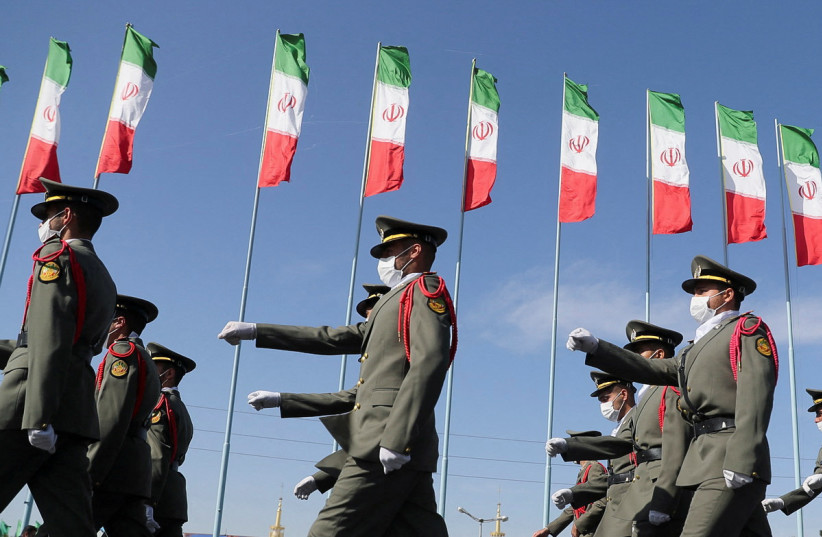
Iran is also in the process of transferring resources from backing the Houthis in Yemen to backing groups in Syria and Iraq. Iran wants the US to leave Syria and Iraq. It thus has a two-front operation in Syria, one against Israel, and one against the US. In Iraq, Iran works through the Hashd al-Shaabi, militant and terror groups linked to the IRGC such as the Nujaba group, Kataib Hezbollah and Asaib Ahl al-Haq.

Iran’s foreign minister also recently traveled to Lebanon where he went to southern Lebanon to view Israel from the border. Iran works in Lebanon with Hezbollah but it has also recently encouraged Hamas to fire rockets at Israel from Lebanon. Over the Passover holiday, Hamas fired 30 rockets at Israel. In addition, Iran has helped Hezbollah acquire precision-guided munitions and drones. It has heralded Hezbollah’s use of drones against offshore gas platforms. Iran also uses Hezbollah to control Lebanon’s presidential elections.

Iran’s overall goal, stated openly, is to unify various fronts against Israel. it brags about this goal. It calls this the “unity of the resistance fronts.” Iran believes Israel is afraid of escalation with Hezbollah. Towards that end Hezbollah enabled an infiltration in March of a man who planted an IED near Megiddo junction. That man was then neutralized by security forces. However, the incident was serious. Iran looks on at these incidents as important and wants to gauge Israel’s reaction.

‘Unity of resistance’

Now Iran is watching closely Operation Shield and Arrow. Iran has many ways to use its unity of “resistance.” It can create tensions in Syria or Lebanon or the West Bank. It can also look further afield such as the Gulf of Oman where Iran uses drones to attack ships. Iran recently waylaid two tankers in areas near the Straits of Hormuz. This was not connected to Israel, but shows Iran’s capabilities.

Iran also wants Syria back in the Arab League so that it can cement its role there. It suspects that once Syria is back in the League then the League members will be more reticent to see airstrikes in Syria. Iran can then entrench at will. However, Iran also knows that there were recent airstrikes ascribed by Jordan that targeted a drug dealer in southern Syria. The Arab states do not want Syria to be a chaos run by Iran. Therefore Tehran must tread carefully as it considers its next steps and how it wants to make moves relating to Israel’s operation.

In the past, Israel has conducted a number of similar operations to Shield and Arrow, such as House of Cards or Black Belt or Breaking Dawn. Israel has also carried out the long-term Break the Wave operation in the West Bank and also Northern Shield which was designed to pre-empt threats along the northern border.

In each case, Israel has tailor-made operations designed to counter Iran’s octopus-like threats. Last year Israel’s former Prime Minister even mentioned an “octopus doctrine” which was designed to confront Iran’s attempt to unify its fronts. In essence, then the deadly game of chess is afoot between Iran and Israel. Iran has to wonder whether it’s worth responding to the cutting off of several tentacles or whether it will wait.

Defense Minister Yoav Gallant has approved the call-up of reserves as needed by the IDF, and the Security Cabinet is set to meet on Tuesday evening.

 Palestinian men inspect the heavily-damaged house of Islamic Jihad leader Jihad Ghannam killed in a pre-dawn Israeli air strike, in Rafah in the southern Gaza Strip, on May 9, 2023.  (photo credit: Said Khatib/AFP via Getty Images)
Palestinian men inspect the heavily-damaged house of Islamic Jihad leader Jihad Ghannam killed in a pre-dawn Israeli air strike, in Rafah in the southern Gaza Strip, on May 9, 2023.
(photo credit: Said Khatib/AFP via Getty Images)

The IDF struck a number of senior terrorists in the Palestinian Islamic Jihad (PIJ) terrorist movement in airstrikes in the Gaza Strip early Tuesday morning, declaring the launch of Operation Shield and Arrow.

The officials targeted include the commander of the al-Quds Brigades in the northern Gaza Strip, an official responsible for terrorist activities in the West Bank and the secretary of the military council in the movement.


At least 12 Palestinians were killed in the strikes and 20 others were wounded, according to Palestinian reports, with a number of sites in Gaza City, Rafah and Khan Yunis targeted, among other locations.

The officials killed in the strikes include Khalil Bahitini, the commander of the al-Quds Brigades in the northern Gaza Strip, Tareq Ezzaldin, a spokesperson for the movement who also manages terrorist activities in the West Bank and Gaza, and Jihad Ghanem, secretary of the movement’s military council.

According to the IDF, Bahitini was the most senior operational commander in the PIJ and was responsible for the rocket fire toward Israel in the past month. Bahitini was planning further rocket fire in the near future, according to the IDF.

Ezzaldin was responsible for the communications between the movement and its branches in the West Bank and for transferring funds and coordinating incitement efforts in Israeli territory.

Ghanem was one of the most senior and veteran operatives in the movement and served at one point as the commander of the al-Quds Brigades in the southern Gaza Strip. In his latest position, Ghanem was responsible for coordinating the transfer of funds and weapons from the PIJ to Hamas.

IDF strikes sites belonging to the Palestinian Islamic Jihad terrorist movement in the Gaza Strip. (Credit: IDF Spokesperson’s Unit)

Alongside the strikes against the terror group members, a number of sites for the production of weapons were targeted as well, including a rocket factory in Khan Yunis and a facility used to produce concrete components for terrorist tunnels.

Additionally, six military compounds and a military position belonging to the PIJ were targeted as well.

The PIJ confirmed that the three senior officials were killed, along with their wives and some of their children, stressing “we affirm that the blood of the martyrs will increase our resolve, and we will not leave our positions, and the resistance will continue.”

The IDF conducted the assassinations in three separate locations simultaneously with 40 fighter jets, helicopters and other aircraft.

“This is about professionalism in planning and precision in execution that led to this operational achievement. This is planning with tweezers in the heart of a civilian population-a targeted assassination in a multi-story building in a dense area, seconds between the impact, a very narrow time window and at 2 a.m. all the buildings are attacked and the three operatives are killed,” said IDF Spokesperson Daniel Hagari.

Among a number of other measures, Defense Minister Yoav Gallant has approved the call-up of reserves as needed by the IDF, and the Security Cabinet is set to meet on Tuesday evening at 7 p.m. in light of the situation.

Hamas warns Israel will ‘pay the price’ for deaths

Ismail Haniyeh, head of the Hamas movement, warned that Israel “made a mistake in its estimates and will pay the price for its crime,” adding that “the aggression targets all of our people, and the resistance is unified in confronting it.”

A senior government official stated on Tuesday morning that the strikes were conducted “in response to the incessant aggression on the part of the Islamic Jihad” and that the terrorists killed in the strikes were working to carry out terrorist operations against Israeli citizens.

The official stressed that “Anyone who initiates terrorist activity against us will not get away. We will protect the citizens of Israel everywhere and with all our strength.”

“We call on the international community to condemn the shooting at Israeli citizens from civilian population concentrations in Gaza, and to express clear and unequivocal support for Israel’s right to defend itself.”

Strikes come less than a week after heavy rocket fire

The strikes come less than a week after over 100 rockets were fired from the Gaza Strip into southern Israel after the death of PIJ official Khader Adnan, who had been on hunger strike for over 80 days while under Israeli custody.

Since the rocket fire last week, the Otzma Yehudit party has demanded a stronger response to the violence from Gaza, boycotting votes and government meetings until such a response was carried out. After the strikes began on Tuesday morning, National Security Minister Itamar Ben-Gvir, the head of the party, published a tweet reading “It’s about time!” Later in the morning, members of the party announced that they would end their boycott.

Last August, the IDF launched Operation Breaking Dawn against the Gaza Strip after the PIJ issued threats against Israel after the arrest of an official in the movement in the West Bank. A number of high-ranking officials in the PIJ were assassinated in the operation and over 1,000 rockets were fired toward Israel.

This is a developing story.


The return of Syria to the Arab League is a symbolic turning point, bookending the Arab Spring and part of a new diplomatic era in the region, with the potential to hand over a win to Iran and Russia

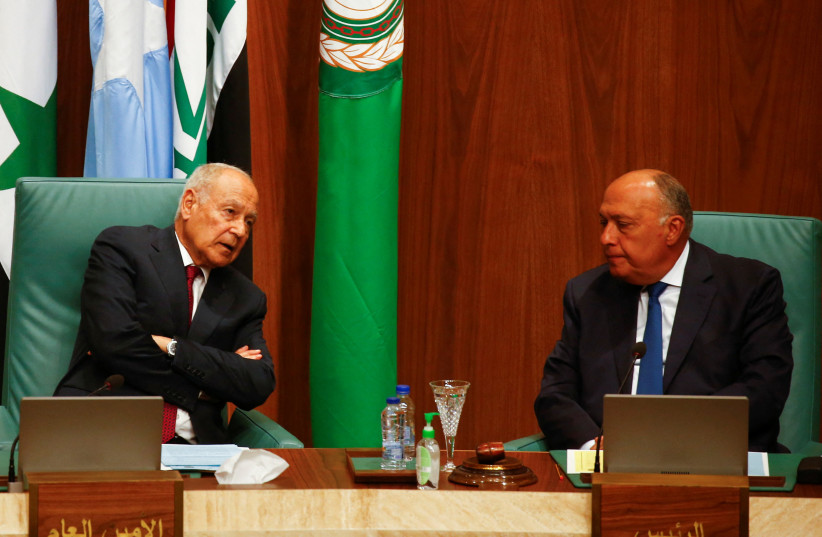
 Secretary General of the Arab League Ahmed Aboul Gheit talks with Egypt's Foreign Minister Sameh Shoukry during the opening session of the meeting of Arab foreign ministers at the Arab League Headquarters, to discuss the Syrian situation and Sudan crisis, in Cairo, Egypt May 7, 2023. (photo credit: Amr Abdallah Dalsh/Reuters)
Secretary General of the Arab League Ahmed Aboul Gheit talks with Egypt’s Foreign Minister Sameh Shoukry during the opening session of the meeting of Arab foreign ministers at the Arab League Headquarters, to discuss the Syrian situation and Sudan crisis, in Cairo, Egypt May 7, 2023.
(photo credit: Amr Abdallah Dalsh/Reuters)

Syria is positioned to return to the Arab League after members of the group voted to allow the country to return on Sunday.

The member states are interested in some movement to resolve the conflict in Syria, which dates back over a decade – to the 2011 “Arab Spring” – and has cost hundreds of thousands of lives and created one of the world’s worst humanitarian crises.

The countries want some kind of movement to help hundreds of thousands of displaced refugees, especially those in Jordan.

Several regional states that have relations with Israel have backed the return of Syria to the league, including the UAE, Jordan and Egypt.

The return of Syria could have ramifications for Israel: Iran threatens Israel from Syria, while also trafficking weapons to Hezbollah. Israel has been conducting its “war between the wars” campaign against Iran’s entrenchment in Syria for years now. With a return to the league and the Arab states seeking an end to the conflict there, the spotlight might shift to Israeli-Iranian tensions in Syria.

 Secretary General of the Arab League Ahmed Aboul Gheit reacts next to Egypt's Foreign Minister Sameh Shoukry during the opening session of the meeting of Arab foreign ministers at the Arab League Headquarters, to discuss the Syrian situation and Sudan crisis, in Cairo, Egypt May 7, 2023.  (credit: Amr Abdallah Dalsh/Reuters)Secretary General of the Arab League Ahmed Aboul Gheit reacts next to Egypt’s Foreign Minister Sameh Shoukry during the opening session of the meeting of Arab foreign ministers at the Arab League Headquarters, to discuss the Syrian situation and Sudan crisis, in Cairo, Egypt May 7, 2023. (credit: Amr Abdallah Dalsh/Reuters)

Iran may seek to shift resources from Yemen or Iraq to Syria, to boost its threats to Israel. It may also try to threaten the forces in Syria of its US ally, the major Western power in the region. Iran may try to use Syria’s return as cover to move more weapons to Syria, attempting to provoke Israel, which could put Jerusalem in a complex position.

Why does the Arab League want to readmit Syria?

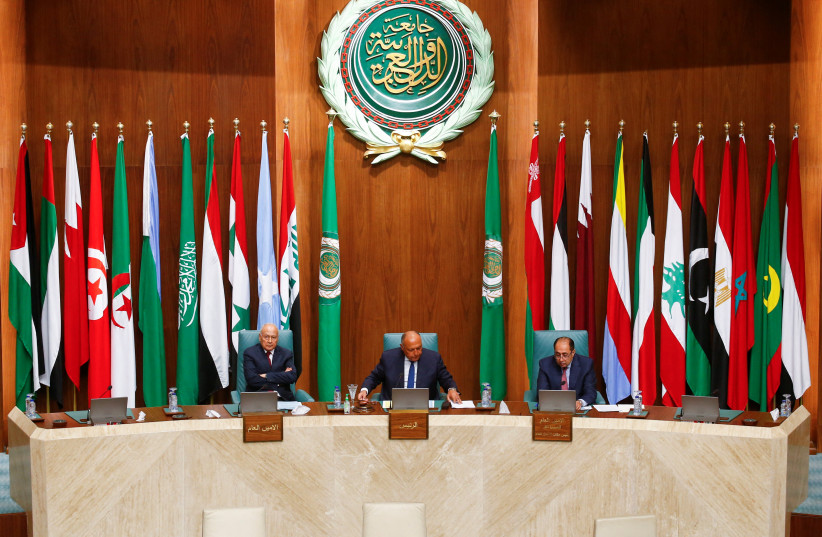
According to reports, a committee made up of Egypt, Jordan, Iraq, Saudi Arabia and Lebanon will be set up to work with the Syrian government to end the conflict. A statement from the closed-door session of the league said the decision is expected to help ease the suffering of the Syrian people and enable them to “realize their legitimate future aspirations. We emphasize the necessity of taking effective and practical steps toward a gradual resolution of the crisis under the principle of ‘one step for one step.’”

Supposedly, the next steps must also be in line with UN Security Council Resolution 2254, from 2015, which called for a ceasefire. Arab League Secretary-General Ahmed Aboul Gheit has said Syrian regime leader Bashar Assad will be able to attend an upcoming league summit.

“When invitations for the Arab summit are sent out to member states by the host nation – Saudi Arabia – then the Syrian President Bashar Assad can attend if he wishes to.”

The decision to bring Syria back to the folds of the Arab League has been in the motion for months. In fact, contact with Egypt goes back many years via Syrian official Ali Mamlouk. Over the last year, it has become clear that the UAE and Saudi Arabia were rapidly shifting on the Damascus issue, after both countries had already done some outreach.

The recent earthquake that hit Turkey and Syria provided a catalyst to do more. The goal of these countries – Egypt, Saudi Arabia, the UAE and Bahrain – which generally work closely together, is to bring stability to the region. They see the era after the Arab Spring as one of chaos that led to the disintegration of Libya and Yemen, enabled extremists to pop up in Syria and Iraq, led to the rise of ISIS and also gave the Muslim Brotherhood the opening to try to take power in Egypt.

The overall perception in Cairo and Riyadh was that the Syrian regime was preferable to the chaos of the Syrian opposition and the civil war. This also led these states to sever ties with Qatar in 2017, viewing Doha as backing extremism.

Critics will view this major shift as symbolic, showing that many regional countries prefer authoritarianism and don’t mind shaking hands with the Syrian regime, despite the blood and suffering. This, then, is a new era in many ways.

China brokered normalization between Saudi Arabia and Iran and Jordan is positioning itself to do much more outreach on Syrian issues. Amman has hosted numerous Arab states in recent months, to pave the way for Syria returning to the league. Jordanian Deputy Prime Minister and Foreign Minister Ayman Safadi also worked the phones in recent weeks to bring about this outcome, while Syrian Foreign Minister Faisal Mekdad has also been lobbying around the region.

However, this doesn’t mean that the Arab states have caved completely. Egyptian Foreign Minister Sameh Shoukry has said he wants to see progress on the demands of the group that the conflict end and reconciliation begin.

“Every stage of the Syrian crisis proved that it cannot be resolved militarily and that there are no winners or losers,” he said. “We are convinced that the only way towards its settlement is a political resolution that has Syrian ownership and without foreign dictates.”

Regional media have paid close attention to the decision, including UAE-based Al-Ain and Al Jazeera in Qatar. The shift in the Arab League’s view won’t change every country’s policies overnight; Kuwait and Qatar have generally opposed this move, while Jordan has been cautious, since it wants Syria’s role in the regional drug trafficking to end.

Iran’s media praised the return as a “resistance reward,” a move that comes right after Iranian President Ebrahim Raisi is fresh from a visit to Damascus. This nearly appears as a seal of approval for Iran’s role in Syria. Russia will also be pleased with the decision. It may also give Turkey an opening to normalize ties with Syria, continuing its ongoing multi-lateral meetings with Damascus.

The return of Syria to the Arab League is a symbolic turning point, bookending the Arab Spring and part of a new diplomatic era in the region, with the potential to hand over a win to Iran and Russia.
