In a briefing to defense reporters in mid-April, Defense Minister Yoav Gallant noted that under his stewardship, Israeli attacks on Iranian infrastructure had significantly increased.
“Since I took office,” Gallant said, “in the first quarter of 2023 we doubled the rate of attacks in Syria.”
Israel’s current actions in Syria take place in the context of a rapidly shifting regional strategic picture, in which the imperative of facing down an emboldened Iran is becoming both increasingly urgent and increasingly complex.
In his briefing, Gallant outlined a clear strategic perception of developments, at the center of which was the Iranian notion of “unification of the arenas.” This phrase, which occurs frequently in statements by Iranian leaders and in pro-Iran regime propaganda, refers to Tehran’s use of the various proxies and franchises that it has assembled around Israel in a single, coordinated effort.
Israel can no longer assume that an escalation against Gaza will remain confined to a dual contest between Israel and the Hamas authority that rules that area. Similarly, action against Iranian proxies in the West Bank may produce a response from pro-Iran elements in Lebanon; friction over the Temple Mount/al-Haram al-Sharif in Jerusalem may lead to a response from Gaza, and so on.
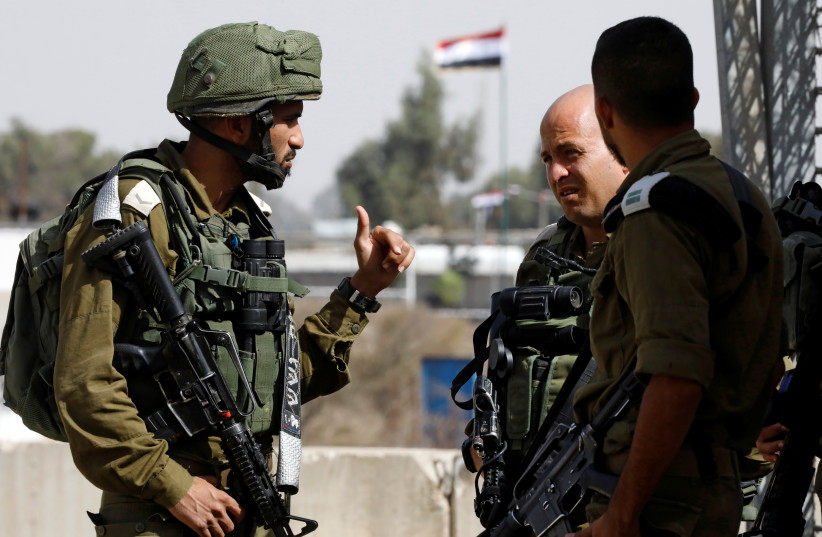
Israeli soldiers chat as they stand near the Quneitra crossing in the Golan Heights on the border line between Israel and Syria, October 15, 2018 (credit: AMIR COHEN/REUTERS)
There are already a number of examples of how this dynamic applies in practice. Operation Guardian of the Walls in 2021 was triggered after Hamas and Islamic Jihad in Gaza launched missiles from the Gaza Strip in response to events related to the Aqsa Mosque in Jerusalem. In that instance, however, the Palestinian front could still be seen as a single, separate arena, taking in Gaza, the West Bank and Jerusalem.
The more ominous incidents, suggesting a more significant widening of the circle, have taken place over the last two months. They were the dispatch by Lebanese Hezbollah of an operative carrying a sophisticated explosive device from Lebanon on March 15, with the intention that the device be detonated in Israel, and the launching with Hezbollah’s and Iran’s permission of a barrage of rockets from south Lebanon by Hamas on April 6.
Israel entering era of multi-front threats
Israel thus confronts, as the defense minister put it, the “end of the era of limited conflicts… We are facing a new security era in which there may be a real threat to all arenas at the same time.”
IN THIS regard, it is worth noting that the circle should not necessarily be widened to include only Lebanon and Syria. Iran’s seeding of missile capacities among its franchise militias in western Iraq over recent years has been widely reported.
The systems in question – Zelzal, Fateh-110 and Zolfaqar missiles – bring Israel within range. The Zolfaqar, for example, has a claimed range of 750 km. The distance from al-Qaim on the Iraq-Syria border to Tel Aviv is 632 km. The current Iraqi government of Mohammed Shia al-Sudani rests on the support of the Iranian franchise militias and turns a blind eye to their activities.
From the point of view of command and control, Tehran today possesses a contiguous structure and area of de facto control stretching all the way from the Iran-Iraq border to Lebanon, the Mediterranean and the Syria-Israel border. Because of the relative stability of Jordan and Israel’s control of the Jordan Valley, this area does not have a contiguous link to the West Bank. But in both Gaza and the West Bank, Iran has franchises available for activation.
This archipelago of militias, backed and armed by a powerful state, is what would be activated against Israel, in the event that the multi-front war discussed by the defense minister were to take place.
Gallant’s claim that Israeli activity on the Syrian front has increased since he took office appears borne out by the facts. According to the Syrian Observatory for Human Rights (SOHR), as quoted in the Saudi Sharq al Awsat newspaper, Israel struck Syria nine times between March 30 and April 29.
The observatory, which maintains an extensive network within Syria, reported that six attacks were conducted from the air and three from the ground. Nine Iran-associated personnel were killed in the strikes, according to SOHR. These included five Islamic Revolutionary Guard Corps (IRGC) operatives, including a senior officer; two members of Lebanese Hezbollah; and two members of the Syrian Resistance Brigades for the Liberation of the Golan (an IRGC franchise militia recruiting from among residents of the Golan area).
SOHR suggested that the strikes resulted in the destruction of about 23 targets, including weapons and ammunition depots, and vehicles. The observatory concluded that this level of breadth and intensity of Israeli strikes is indeed without precedent. Another attack, at the Aleppo airport, took place since the publication of the SOHR report.
It appears that Israel is seeking to maintain deterrence and demonstrate the balance of capacities vis-a-vis Iran by intensifying activities – but on one front only, that of Syria. Whether this will prove sufficient to break the growing confidence on the Iranian side – evidenced by the recent incidents in Megiddo, in northern Israel, and south Lebanon – remains to be seen.
Israel becoming increasingly isolated on diplomatic front
PARALLEL DEVELOPMENTS on the diplomatic front may also play a role. If Israel was once able to see itself as part of an emergent anti-Iranian regional front, such a notion now appears remote. Indeed, Arab diplomacy appears now to be pushing in a direction in which Israel could find itself increasingly isolated in its determined stance against Iran.
In Amman this week, the foreign ministers of Jordan, Egypt, Saudi Arabia, Iraq and, notably, Syria, took part in a joint meeting. This was the first visit of Syria’s foreign minister, Faisal Mekdad, to Jordan since the outbreak of civil war in Syria in 2011. The meeting was the latest sign of the return of the Assad regime to the Arab diplomatic fold and the efforts by a number of Arab states currently underway to re-legitimize the regime.
In a statement following the meeting, the Arab foreign ministers pledged, among other things, to “support Syria and its institutions in any legitimate efforts to expand control over its lands, impose the rule of law, end the presence of armed and terrorist groups on Syrian lands, and stop foreign interference.”
Regarding support for Assad’s endeavors in advancing the rule of law, this author’s capacity for irony concedes defeat, and there is nothing to add. Substantively, however, such statements reflect an effort to revive Arab-centered diplomacy and to meet the Iran-led regional alliance halfway, in a spirit of cooperation.
From this point of view, the Amman meeting is the latest downstream effect of the UAE’s and Saudi Arabia’s rapprochement with Tehran. So even as Israel finds it necessary to escalate in Syria, the main states of the Arab world are moving in precisely the opposite direction.
Arab moves reflect a sober assessment of the regional balance of power. The traditional centers of Arab diplomacy have concluded that their American patron is no longer interested in a substantial regional presence. They are therefore seeking a new equilibrium.
Israel, which the Islamic regime in Tehran has marked for destruction, has no such option. The result is that Jerusalem now faces the prospect of continuing efforts to halt and roll back the Iranian regional advance not as part of a coalition but rather alone.
The extent of Tehran’s ambitions means that efforts by Arab diplomacy to reconcile with it may well be short-lived. In the interim, Israel will need to use its superior physical capacities to continue to disrupt, frustrate and deter Iran’s regional project, despite a distinctly less advantageous diplomatic environment. Achieving such a task and rebuilding deterrence against an emboldened Tehran may well require action beyond the specific confines of Syria.