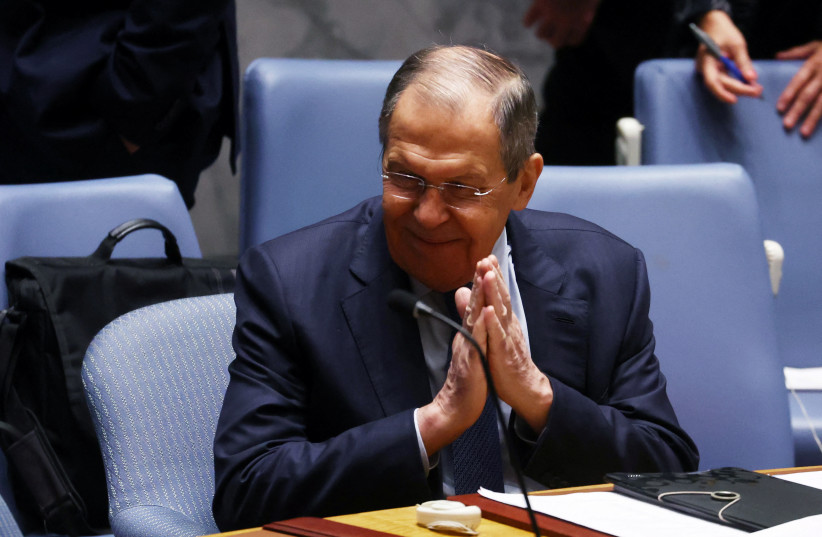
Russian Foreign Minister Sergei Lavrov sharply criticized both the United States and Israel for failing to end the Israel-Palestinian conflict, claiming the Biden administration was not an “honest broker.” He made his comments at a United Nations Security Council meeting he chaired, on the same day as the Jewish state’s Remembrance Day for the Fallen of Israel’s Wars and Victims of Terrorism.
“Washington claims to be the only sponsor of the Middle East peace process, ignoring the fact that it has long ago lost its neutrality and impartiality – qualities that are integral for a fair broker,” Lavrov told the 15-member body in New York on Tuesday.
Russia, which holds the UNSC presidency this month, dismissed requests from Israel to change the date of the monthly meeting, during which countries often attack Israel for its treatment of the Palestinians.
More than 50 speakers took the floor in a session that began in the morning and continued into the afternoon. Moscow’s decision not to change the date of the meeting came as tensions between Moscow and Jerusalem have risen over Israel’s support for Ukraine in its war with Russia.
UNSC gatherings are typically chaired by ambassadors, so Lavrov’s presence at the meeting’s helm gave it added weight. He later told reporters in New York that holding the meeting on Israel’s Memorial Day was not a move against the Jewish state, given that Israel was on the council’s agenda on a monthly basis.
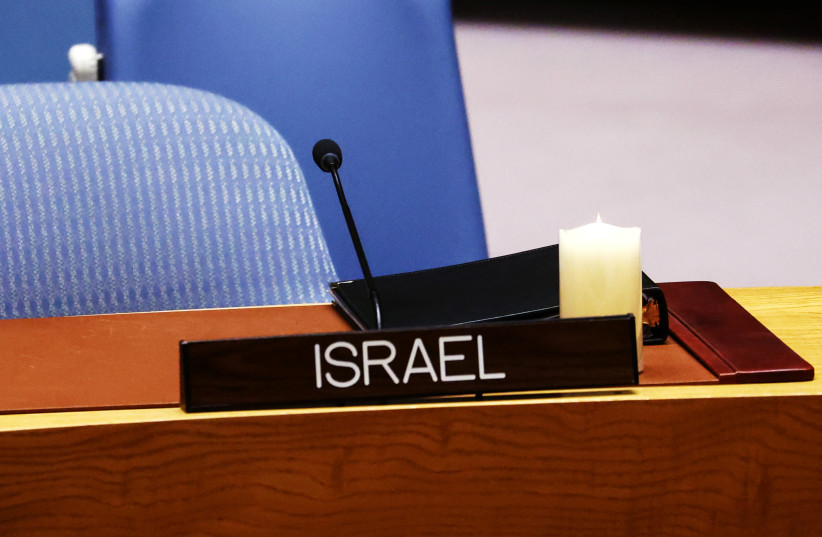
A candle left by Israel’s Ambassador to the United Nations Gilad Erdan to commemorate Israel’s Memorial Day, is seen after Erdan and his delegation left a meeting of the United Nations Security Council on ”The Middle East, including the Palestinian question” at UN headquarters in New York City, (credit: Mike Segar/Reuters)
“This wasn’t an anti-Israel event,” he said, adding that criticism was also voiced at the meeting against Palestinian terror attacks that claimed the lives of Israelis.
Lavrov calls for renewal of Israeli-Palestinian peace process
At the UNSC, Lavrov called for a renewal of the peace process, saying that economic peace cannot be a substitute for ending the conflict.
The United States and European Union have engaged in destructive efforts to substitute economic peace for genuine peace, Lavrov said, adding that the US and EU have bypassed the Palestinians to promote Arab-Israeli normalization.
“It is only the return to direct talks on all issues related to the ultimate status that can break the vicious circle of violence and radicalization and restore mutual trust,” Lavrov said.
The revival of the Middle East Quartet – made up of Russia, the UN, the US and the EU – could help with that effort, said Lavrov. He also called on the UNSC to force Israel to comply with its resolutions.
Erdan ditches UNSC meeting in protest against timing
Israel’s Ambassador to the United Nations Gilad Erdan had already left the council chambers by the time Lavrov spoke.
Erdan did speak at the meeting, however, on Tuesday morning, where he lit a large memorial candle, then read out the 32 names of those killed by Palestinian violence in the last year, including citizens, foreigners, soldiers and police.
“I light this candle to honor them, and may their memory be blessed,” the ambassador told the UNSC.
“I refuse to take part in this absurd farce…. I refuse to spend this sacred day listening to lies and condemnations. This debate disgraces the fallen, and Israel will not take part in it,” he said prior to walking out.
“Today’s debate has crossed all lines. Not only am I both appalled and outraged to the very depths of my soul, but I am sad – very, very, sad.
“Today is one of the most sacred days of the year for Israel, which pauses to commemorate those lost to violence and who paid the ultimate price while defending the Jewish homeland.”
HE DESCRIBED how sirens ring out both at night and in the morning, “bringing all activity – even traffic – to a grinding halt so that every Israeli can observe two minutes of solemn silence.
“All restaurants, cafes and shops shut down, while military cemeteries are filled with hundreds of thousands of visitors paying their respects. Television programming is dedicated solely to films and reels mourning those who fell, while an entire channel runs the names of every single fallen hero,” Erdan explained.
“This day holds more sanctity to Israelis than almost any other day of the year. Yet while Israelis mourn, this council – as usual – will hear more blatant lies condemning the State of Israel and falsely painting it as the root of all the region’s problems. This could not be further from the truth,” he added.
Erdan said the council had chosen to focus on the Israeli-Palestinian conflict rather than focusing on the danger to the region and the globe from Iranian terrorism and its pursuit of a nuclear weapons program.
Iranian Ambassador to the UN Amir Saeid Iravani said that Erdan had made “unfounded claims against his country. [This was not] “surprising or unexpected… deception and lies have long been part of this regime’s toolbox.” The purpose, he claimed, was clear: to divert attention away from “the atrocity crimes committed against the Palestinian people. Therefore, such false and unfounded claims do not merit a response.”
Many of the speakers spoke about their concern over the loss of Palestinian lives. According to the UN, close to 90 Palestinians have been killed this year by Israeli security forces. In many cases, those deaths occurred during violent clashes.
Palestinian Authority Foreign Minister Riyad al-Maliki said that when it came to security, it was the Palestinians whose lives were in danger and for whom international protection was needed.
“Soldiers and settlers wreak havoc in our streets and in our lives. No one is safe, anywhere, anytime, not in our land, not in our streets, not in our mosques, not in our churches, not in our schools and not in our homes,” Maliki said. He called on the UN and the international community to designate Israeli civilians and settlers as a terrorist group, saying they were involved in killing innocent Palestinians.
It was now time, he said, for the UN to upgrade the Palestinian status from non-member state and recognize it as a member state of the United Nations.
“Recognize the State of Palestine…. How can any country that supports the two-state solution and peace, justify not recognizing until now the State of Palestine, without which there is no two-state solution?” he said.
“As long as Israel reaps the benefits of its occupation while we pay the cost, annexation and apartheid are the only reality we are left with. Make the occupation costly and I can assure you it will come to an end.”
He urged Israel’s allies to pressure Israel to withdraw to the pre-1967 lines as a condition of those diplomatic ties.